ON THIS DATE (3RD JULY) 133 YEARS AGO : BIRTH OF THE IRISH 'MRS HITLER'!
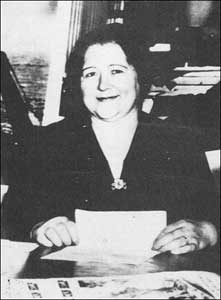
'Bridget Dowling (pictured) was born in Dublin on this date in 1891 ; she is noteworthy in history because she married the brother of Adolf Hitler.
Alois Hitler met Bridget when she was 19 and impressed her by telling her he was a wealthy hotel owner but, in fact, he was working as a waiter in Dublin, but still managed to win Bridget's heart ; her father was against the relationship because Alois "had no prospects..."
In 1910, the young couple ran off to London and got married, and Bridget’s father threatened to charge Alois with kidnapping, but he finally backed down after Bridget pleaded with him to accept her new husband ; the newlyweds settled in Toxteth, Liverpool and had a baby boy, William Patrick Hitler.
In 1914, Alois went to Germany to try and become a businessman, but Bridget refused to travel with him as by now he had become violent towards her and she feared for the safety of their son.
Alois' business plans were immediately disrupted by the outbreak of World War One and he decided to abandon his young family back in England and stay in Germany - he actually married again, was found guilty of bigamy but was let off when Bridget intervened and the two were divorced.
Bridget moved to London and raised her son on her own, and opened her house up to lodgers to make enough money to survive.
By the early 1940s, William Hitler was a grown man in his early thirties and had not seen his father since he was a toddler. However, he saw the potential of cashing in on his surname...
His uncle, Adolf Hitler, was becoming one of the world’s leading figures having become the leading politician in Germany.
William and his mother moved to America, where William worked as a public speaker and lecturer on his famous uncle. However, Hitler’s Nazi Germany then started the Second World War, and millions of men were killed at their hands.
Bridget and William were now ashamed of their family name and changed it to Stuart-Houston and mother and son lived out the rest of their lives in America.
Bridget once claimed that Adolf Hitler had lived with her and her husband in Liverpool for a short time in 1912-13 and she wrote a book, 'My Brother-in-Law Adolf', that described her relationship with her husband and brother-in-law, and claimed she was the one who advised Hitler to trim the edges of his moustache off, giving him the iconic look we are all familiar with.
However, expert historians have rubbished Bridget's claims that Hitler had ever stayed in England ; there is apparent evidence that he was in Vienna at the time Bridget claims he was staying with her and his brother in Liverpool, and they accused Bridget of making the whole story up, in order to sell copies of her book and cash in on her infamous relative.
A local newspaper here in this part of Dublin ('The Echo' newspaper) published an article, by a Mr Donal Bergin, in November, 1999, in relation to Mrs Hitler (!) -
'Adolf Hitler, the monster who tried to wipe out an entire race of people off the face of the earth, had a sister-in-law who was born in Tallaght.
Bridget Elizabeth Dowling...married Hitler’s half-brother Alois (pictured) in London in 1910. He was a waiter and she was a cook in a Dublin hotel where she met him at a staff dance. Though an unfortunate accident of marriage, the convent girl became the sister-in-law of the man who would become Nazi Fuehrer of Germany and later bring the world to its knees.
When she was 17, the young cook eloped to London with Alois who was twice jailed for theft. "Nowadays it is a bit embarrassing to be Mrs Hitler, but the people who know me don’t mind," Bridget Hitler, who was born in Kilnamanagh, once said.
The devout Catholic later said : "It seems funny for an obscure little Irish girl like I was to get mixed up in all these international affairs. I was plain Bridget Dowling of Dublin when I met Alois who was a waiter. I was 17 and had just left a convent, and it was very romantic. When I went to the hotel staff dance I met him," she said, long before she claimed to have met the "handsome stranger" at the Dublin Horse Show.
Adolf and Alois shared the same father but had different mothers. Disliked by Adolf, historians state Alois was a hapless good-for-nothing.
Bridget claimed he was a waiter in the Shelbourne Hotel in Dublin, but it is claimed he worked in the old Royal Hibernian Hotel on Dawson Street.
"He fairly won my heart with his sugary talk and foreign ways. My father – rest his soul – was a real Irishman. He would not hear or tell of a wedding to a foreigner. Alois and I used to meet every afternoon in the museum and plan to elope," she said in a prewar interview with the Daily Express newspaper in London.
Mrs Hitler revealed : "Four months later when Alois had saved enough money, we went to England on the night boat and came to London.
I wrote to my mother and said I would not return until we got permission to marry. She talked my father around and he gave us his consent."
Bridget Elizabeth Dowling married Alois Hitler in Marleybone registry office, London on June 3rd, 1910. She was aged 18 and he was 27.
After the wedding, Bridget recalled, she "..took him straight back to Dublin to meet the family, and then we went to Liverpool". She continued : "He got a job in a restaurant as a waiter and then became an agent for a razor firm. Willie, our only child, was born in March 1911. My husband used to talk about his family. He told me of his younger brother, Adolf, who was a dreamy sort of lad and was studying architecture when we were married."
But Alois left her early in 1914 and returned to the continent. Her parents moved to Liverpool around that time, where her father died - "I was in a very poor way when he went to the war (and left me) with three-year-old Willie on my hands. My mother and I did the best we could," she recalled.
In the 1930s, her son, William Patrick (pictured), became a car salesman in Nazi Germany after mother and son allegedly tried to blackmail Adolf over his brother's bigamy.
After Alois deserted Bridget and their three-year-old son, he bigamously remarried. He escaped jail because Bridget agreed to separation. William Patrick later said his mother felt "very bitter" about many things. He was "sent" to Liverpool to live with his Irish grandparents after Alois left.
While she was born, and lived, in Tallaght, it is believed Mrs Bridget Hitler-To-Be also lived in Clondalkin where her mother's family lived.
William Dowling, a farm labourer from Kilnamanagh, was her father, and her mother was Bridget Reynolds Jnr from Ballymount and, earlier, Kilnamanagh.
Mrs Hitler's parents were conservative Catholics, she has written, while her brother, Thomas J Dowling served in the RAF from 1923 to 1926.
Bridget’s marriage to Hitler’s brother was unspoken of in the area : "That was hidden. The next generation weren’t told much about it," said a source. 'The Echo' has also found that her family probably lived for a few years in a cottage in Cookstown townland, the ruins of which still stand today. The cottage was leased to a man that this reporter believes to have been her father, by Andrew Cullen Tynan, the father of the famous poet Katharine Tynan.
Interestingly, the only Irish person who is named in Bridget Hitler’s distrusted memoirs is a 'Mr Tyna', who was described as a neighbour.
Bridget claimed in 1941 that hanging would have been too good for her brother-in-law, Adolf, but the French had claimed she was in the payroll of the Nazi's.
According to a 1938 article unearthed by Patrick Maguire, a Dublin historian, a Paris paper claimed the 'cook' received 300 marks a month from the Nazi's ; it claimed nobody wanted a cook who was Hitler's sister-in-law. She had come a long way since being swept off her feet by the handsome foreigner.
Obviously short of cash, Mrs Hitler made news after she appeared before a London Police court in January 1939 for failing to pay over £9 in rates ;
the court accepted her offer to pay within six weeks, as she said she was expecting money from Germany, but did not say from whom. The money never appeared -
"So there was nothing for it but to take the devil by his tail up the hill and go to court," Mrs Hitler said.
A resident since the early 30's of Priory Gardens, Highgate, London, she then said she took in boarders while her son worked in a Berlin brewery. Six months prior to the outbreak of the Second World War in Europe, Mrs Hitler and her son went to America where the authorities quizzed them. She went to work for the British War Relief Society opposite Tiffany’s jewellers on Fifth Avenue in New York in 1941 where she "proudly" wore an 'Aid Britain' brooch.
Bridget's memoirs were discovered, unfinished and halfway through a sentence, in the manuscript division of the New York Public Library in the 1970's : they include a claim that Adolf Hitler stayed in Liverpool in 1912 and 1913, but last year, her daughter-in-law said the memoir "was all made up".
Mrs Hitler's mother could not write when Bridget Elizabeth Dowling was born and she also called herself Eliza and marked her 'X' on the birth cert.
Why she called herself Eliza is a mystery, but there were many other Bridget Dowling namesakes in the nearby districts when she gave birth. Mrs Hitler was the only Bridget Dowling registered born in 1891 whose father's name was William, and her birth cert date matches her gravestone date.
Thirty years after her death, Professor of History at the University of South Carolina, Arthur Mitchell, is anxious to hear from any surviving relatives. He said he is co-writing a book on Hitler, and believes relatives may have old personal letters from Mrs Hitler which may be of historical value - "I have no mention of embarrassing the Dowling's ; I imagine some relatives might tell you to go to hell with that," Professor Mitchell said.
And he added: "If she did have any relatives it wouldn't be unusual if she wrote letters saying 'I was in Germany and met Adolf Hitler’.
Bridget Elizabeth Dowling - Mrs Hitler - was born on this date , 3rd July, 133 years ago (1891).
She died on the 18th November, 1969, aged 78, in Long Island, New York.
Incidentally, her son, William Patrick, died suddenly in 1987, at 76 years of age, and is buried alongside his mother, but their graves give no clue to their close connection to one Mr Adolf Hitler...
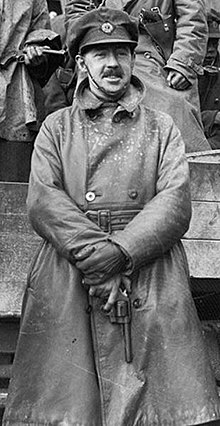
On the 3rd July, 1920, a Unit of nine IRA Volunteers, with the Vice-Commander of the Bandon Battalion IRA, Charlie Hurley (pictured), in charge, stopped, subdued and disarmed a group of four RIC members at Downdaniel Railway Bridge on the Bandon-Innishannon Road, in County Cork, in the course of which one RIC man was wounded.
On the 19th March, 1921, Volunteer Hurley, who was by then the Officer in Command of the Third Cork Brigade IRA was shot dead in a gunfight with British soldiers from the Essex Regiment, in the townland of Ballymurphy (located a few kilometres from Crossbarry).
RIP Commander Charlie Hurley.
==========================
'Forcibly cutting women's hair, a widespread practice in Ireland and in many other wars including the later Spanish and Greek civil wars, was a form of serious violence that singled out and marked women as enemies, sexual transgressors and traitors...'
"...two lady assistants in a draper firm in the town have had their hair cut owing to their keeping company with soldiers.
It appeared that the young ladies received more than one warning. They were held up between Carlow and Baltinglass, and though both strongly resisted, they were overpowered.
It is stated that one of the girls asked her attackers to take her life first.
Previous to this outrage three young ladies in town had been similarly attacked and had their hair shorn. It is understood that several other girls have been warned about keeping the company of soldiers..."
On the 3rd July, 1920, a number of IRA Volunteers entered a house in Clonakilty, in County Cork, apparently looking for four people - the man of the house, two of his sons - who were all members of the British Army - and one of the man's daughters, who was present in the house.
None of the three men were there, so the daughter (19) was held in place by two or three of the Volunteers as others cut her hair from her head as a warning to her family to stop their anti-Irish activity.
Had any of the men being there, it's doubtful that they would have got away so lightly...
==========================
In a letter he wrote to a family member on the 3rd July, 1920, IRA leader Liam Lynch stated that "John Bull should give in soon".
It wasn't to be, unfortunately, and today, over 101 years later, it still hasn't happened.
IRA Chief of Staff Liam Lynch was shot dead in a gunfight with the Free Staters in County Tipperary on the 10th April, 1923.
RIP Volunteer Liam Lynch.
==========================
'THE STORMONT CORONERS AMENDMENT BILL.'
From 'The United Irishman' newspaper, April 1955.
It is surely questionable whether such a Bill is at all moral under present-day circumstances, but at least we have the consolation that it is yet another stage of aiding their own destruction by their own deeds.
It is significant, however, that on the same page of the newspaper which published the article, a Mr Diamond is reported in Stormont Parliament to have stated that RUC barracks were being turned into fortresses, and in one barracks a six-foot wall had been raised to twenty feet!
Somehow we cannot help but feel that this Coroners Bill and the fortification of RUC barracks go hand in hand...
(END of 'The Stormont Coroners Amendment Bill' ; NEXT - 'Sinn Féin Statement', from the same source.)
The IRA regularly raided post offices and postboxes throughout the State in the 1920's, to examine mail for British military intelligence and to discover if civilians were in contact with the Crown Forces etc, and in some cases would apply a 'Censored By The IRA'-stamp (pictured) to certain envelopes before forwarding them on to the addressee, for psychological and propaganda purposes.
One such raid was carried out on the 3rd July, 1921, on the Post Office in the Curragh Camp and bags of mail were liberated from enemy hands!
On that same date, an IRA Battalion Council Meeting for the Athgarvan IRA Column (Kildare) took place and it was decided to form a second 'IRA Active Service Unit' for the Kildare area.
As IRA Captain Michael Smyth was making his way to the first meeting of that ASU, he was jumped-on by a gang of Black and Tans at Twomilehouse, Kildare, as was Volunteer William Jones, the local Lieutenant of Engineering : both men were badly beaten up by the Tans before been 'arrested'.
Both Volunteers were taken to the British barracks in Newbridge and held there until the 13th July, when they were moved to Harepark Camp in the Curragh and, on the 8th October, were put in Mountjoy Jail in Dublin, to be Courtmartialed by the British.
They were still in Mountjoy when, on the 12th January, 1922, the British administration in Dublin Castle issued a statement on behalf of their 'King', George V, granting 'a general amnesty in respect of all offences committed in Ireland from political motives prior to the operation of the Truce on July 11 last...' and, that same afternoon, 370 IRA prisoners – some of whom were serving life or death sentences – were released from Mountjoy, Cork, Limerick, Waterford and Galway jails, including Volunteers Michael Smyth and William Jones.
==========================
On the 3rd July, 1921, two 'off-duty' RIC members were relaxing on the banks of the Murrough River, County Wicklow, chatting to a few girls.
Five men on bicycles were heading in their direction and, when they got close enough, fired about eight shots at the two RIC men ; the girls ran away screaming and one of the RIC men made a run for it and escaped.
The other RIC man was shot dead.
His name is John Fitzgerald (pictured, 'Service Number 76431') , from Millstreet, in County Galway, and he would have been 19 years of age on the 31st of that month.
==========================
John Cameron was born in Edinburgh, Scotland, on the 25th November, 1879 and, at 16 years young, joined the British 'Royal Navy' ('Royal Marines').
Mr Cameron progressed through the ranks and, as a Lieutenant in the '8th Royal Marine Battalion, Royal Marine Artillery', he was placed as the Commanding Officer of the Ballydavid Coastguard Station in County Kerry.
On the 3rd July, 1921, he was shot dead at Muiríoch (Murreagh), about a half a mile from his base, by IRA Volunteers from the Ballydavid Company, Kerry Number 1 Brigade.
He was 41 years of age, and is buried in Ann's Hill Cemetery in Gosport Borough, Hampshire, in England.
==========================
On the 3rd of July, 1921, the body of a man - believed to be a Mr Samuel Lee - was discovered at Killavally, Tyrellpass, in County Westmeath.
Mr Lee had been shot dead (on the 11th June...?) by IRA Volunteers attached to the 1st Offaly Brigade ; a label was pinned to his clothes which read - 'Spies Beware. IRA'.
==========================
On the 3rd July, 1921, a Mr Maurice Cusack, from Ballycotton, in County Cork, and a Mr Michael 'Seamus' Whelan were in the town of Ballycotton, in County Cork, when armed marauders from the 'Queens Own Cameron Highlanders' (pictured) drove furiously into the town and started shooting indiscriminately at various targets.
Mr Cusack, a British Navy pensioner, was shot dead and Mr Whelan was seriously wounded.
==========================
On the 3rd July, 1921, seventeen-years-young Kathleen Kelleher, from Dublin, who worked as an embroiderer, was sitting under a tree in the Phoenix Park in Dublin (pictured) with her boyfriend-for-a-week, a young Black and Tan, John McCansh.
Mr McCansh was later to say that, as he was removing his pistol from his hip pocket, the gun fired and the bullet hit Miss Kelleher in the head. She died later in Doctor Steeven's Hospital in Dublin, from the head wound.
Rumours circulated that Miss Kelleher was ending the short relationship with Mr McCansh and the British felt that they had to be seen to be addressing those rumours, so Mr McCansh was charged with 'manslaughter' in a civil court.
A British Army Major General, Gerald 'Gerry' Farrell Boyd CB, CMG, DSO, DCM GOC etc (pictured), who was in command of the Dublin military district for Westminster, stated his opinion that...
"...in view of the abnormal conditions in this country, and the necessity for carrying a loaded revolver, and also in view of the opinion of the court of inquiry, I suggest that the constable should not be tried.."
But Mr Boyd's boss in the military, General The Right Honourable (!) 'Sir' Nevil Macready BT GCMG KCB etc, perhaps recognising the outrage that the shooting and Mr Boyd's comments were causing, intervened, and directed that Mr McCansh, the shooter, should be charged with murder.
And he was - but that charge was later, again, reduced to one of 'manslaughter' and, when the case went to court, Mr McCansh was quickly acquitted.
Who was it said what about "the abnormal conditions in this country.."?
==========================
On the 3rd July, 1921, after they were attacked by the IRA, the RIC and their colleagues in the 'Ulster Special Constabulary' raided the village of Dunamore in County Tyrone, where they shot one man and burned the parochial hall and several houses.
On the 3rd July, 1921, an RIC patrol in Moneyrea, Ballymoney, County Antrim, claim that they had called on a civilian, Mr Joseph Murray, to stop and, when he didn't, they shot him dead.
A Dublin man, Danny Duffy, who worked as a fitter in the Guinness Brewery, was on his way home after his work shift on the 3rd July, 1921, when he found his path was blocked by British soldiers at a checkpoint on Upper Clanbrassil Street, between Harold's Cross Bridge and the South Circular Road in Dublin.
The British soldiers claimed that, as it was "during curfew hours", they had called on him to stop and, when he didn't, they shot him dead.
==========================
SO, FAREWELL THEN, CELTIC TIGER....
It had to happen, sooner or later.
Most of the pundits and economists were too busy singing the Celtic Tiger's praises to notice, but a few critical observers worried all along about the weaknesses of a boom economy that depended so much on a few companies from one place - the United States.
By Denis O'Hearn.
From 'Magill' Annual 2002.
These trends created a dynamic of class inequality that was unknown in Ireland before the 1990's.
Before 1987, non-agricultural incomes were shared out in relatively stable proportions ; wages accounted for 70 per cent of incomes and profits and professional fees 30 per cent.
But in the 1990's incomes began to shift rapidly towards profits.
By 2000, for the first time in the history of the Irish State, the profit share was virtually equal to the wage share, and personal income inequality rose as well.
While the 'Celtic Tiger' created a lot of jobs, only a few of them are the high-paying engineering jobs that we hear so much about, as foreign companies created a lot of economic growth but very few jobs...
(MORE LATER.)
On the 3rd July, 1922, Leinster House politicians issued the necessary permissions to the leadership of the Free State Army (Michael Collins and Richard Mulcahy) to recruit an extra 20,000 members for at least a six-month period, and criminals, fugitives and other renegades from the six disbanded regiments of the British Army found a new entity with which to continue their savagery soldiery.
On the 13th June, 1922, the 'Royal Irish Regiment, the Connaught Rangers, the Prince of Wales’s Leinster Regiment (Royal Canadians), the Royal Munster Fusiliers, the Royal Dublin Fusiliers and the South Irish Horse Regiment' were disbanded by Westminster and the Staters stepped-in to employ the unemployed (and unemployable) ex-British soldiers against their own countrymen, women and children.
Then, on the 6th July, Leinster House issued a 'Call To Arms' order (ie 'a summons to engage in active hostilities') to its army ie carte blanche to destroy the IRA.
But the spirit and the moral right of Irish Republicanism still lives on to this day.
==========================
On the 3rd July, 1922, Mr Florence O'Donoghue (pictured), the ex-Head of Intelligence for the Cork Number 1 Brigade of the IRA and Adjutant and Intelligence Officer of the 1st Southern Division IRA, wrote to Liam Lynch, stating...
"...my sympathies are entirely with you but, out of civil war, will come not the republic or unity or freedom or peace, but a prolonged struggle in which the best elements in the country will be annihilated or overborne..."
As it turned out, Mr O'Donoghue was right - the best of Irish republicanism was imprisoned, murdered, executed and killed by the Staters during that period in our history.
Mr O'Donoghue was by then assisting Seán O'Hegarty in setting-up the groundwork for the formation of the 'Neutral IRA Association'.
==========================
On the 3rd July, 1922, a 63-year-old Lady, a M/s Sarah Richardson, was on Mark Street, in Dublin (between Pearse Street and Townsend Street) when she was hit by a bullet 'which had gone astray'. She died on the spot.
Some sources list the date as June 30th ; there is no more information on this shooting.
==========================
BEIR BUA...
The Thread of the Irish Republican Movement from The United Irishmen through to today.
Republicanism in history and today.
Published by the James Connolly/Tommy O'Neill Cumann, Republican Sinn Féin, The Liberties, Dublin.
August 1998.
('1169' comment - 'Beir Bua' translates as 'Grasp Victory' in the English language.)
REPUBLICANS AND THE STATE :
A truce was called in 1921 and a period of negotiations began ; these culminated on December 6th, 1921, when 'the Treaty' was signed by the Irish delegation in London.
The 'Treaty' set out that an 'Irish Free State' would exist over 26 Counties.
That 'Treaty' was an acceptance of the British-imposed partition of Ireland into separate States in the '1920 Government Of Ireland Act' and a betrayal of the All-Ireland Republic endorsed by the Irish people in two general elections, in 1918 and 1921.
In 'Dílseacht : The Story Of General Tom Maguire And The Second (All-Ireland) Dáil', Ruairi Ó Brádaigh says -
"Griffith was elected President of Dáil Éireann (the Government of the Irish Republic) on January 10, 1922.
Two days later, in his capacity as Chairman of the Delegation to London, which signed the Treaty, he summoned a meeting of 'the Parliament of Southern Ireland' for January 14.
This was a partitionist body for 26 Counties only, created by the 'British Government of Ireland Act of 1920' and rejected by the people in May 1921 when they elected their Deputies to the All-Ireland Dáil..."
(MORE LATER.)
On the 3rd July, 1923, IRA Captain Noel Lemass (pictured) had lunch with a friend of his in the Wicklow Hotel, in Dublin and, afterwards, on his way home, as he was walking past MacNeill's Hardware shop at the corner of Exchequer Street and Drury Street, a car pulled-in abruptly beside him.
He was set upon by a group of plain-clothed Free State Army intelligence officers and thrown into the back of their car, which then sped away.
His badly decomposed and mutilated body was found on the 12th/13th October that year in the Featherbed mountain range, Oldboleys, in County Wicklow, about 20 yards from the Glencree Road, in an area locally known as 'The Shoots'.
'The Leitrim Observer' newspaper (20th October 1923) described how...
'...Civic Guards found his body, clothed in a dark tweed suit, light shirt, silk socks, spats and a knitted tie.
The pockets contained Rosary beads, a watch-glass, a rimless glass, a tobacco pouch and an empty cigarette case.
The trousers' pockets were turned inside out, as if they had been rifled. There was what appeared to be an entrance bullet wound on the left temple, and the top of the skull was broken, suggesting an exit wound.
There were obvious signs of torture. Noel was shot at least three times in the head and his left arm was fractured. His right foot was never found...'
Captain Lemass had been subjected to extreme torture ; the jury at his inquest (despite intimidation by State forces) concluded that he had been "brutally and wilfully murdered" and that "the armed forces of the State have been implicated" - he had been badly beaten, his arm and jaw were broken, and some of his fingers had been removed.
'Take it down from the Mast, Irish traitors,
the flag we republicans claim,
It can never belong to Free Staters,
You've brought on it nothing but shame...'
==========================
Thanks for the visit, and for reading!
Sharon and the team.
There is a lot of talk recently about the State Army and the possibility/probability that it has thugs within its ranks ("...68 members of the (State) Defence Forces have been convicted or are before the courts for a range of offences. The figure was provided to Micheál Martin in a report from (State Army) Chief of Staff Lieutenant General Seán Clancy...").
Yet, in the 1920's, when Leinster House politicians and their State Army chiefs practically timed their recruitment campaign to specifically target miscreants, those guilty of "a range of offences", there was, if anything, encouragement for such a move, rather than objections.
More about that on the 3rd, and we'll be naming names...
We'll also have a few paragraphs about a military/political figure who is known the world over as 'an evil genius, a madman, a lunatic..', but yet his close family connections to Ireland are not half as well known, if even that.
Indeed, in the course of our research, we came across a connection between that person and the area we ourselves live in, in Dublin...!
And we'll be mentioning a not uncommon occurrence in this country (pre-partition) that still affects us girls to this day : we know what it's like, more so than men would, when we get put in contact with a good, professional mobile hairdresser- bear with me now... - as we don't always have the time to make an appointment with the salon, then with a childminder (who will also keep an eye on the dog..!) and then organise transport to and from the shop...phew!
The more convenient option is to have herself call to you, to do the job.
In the 1920's, IRA Volunteers undertook such 'house calls', but in reverse...!
On Wednesday, 3rd July 2024, we'll be posting the finishing touches (groan!) to the above-mentioned three pieces, plus 15 other ones, in an 18-part blog post.
So, if we've piqued your curiosity (Ya wha', Shar...?!), or you're just a nosey fecker, then give us a shout on the 3rd!
Thanks for the visit, and for reading!
Sharon and the team.
ON THIS DATE (26TH JUNE) 102 YEARS AGO : FREE STATE GENERAL KIDNAPPED ON THE EVE OF CIVIL WAR.
On the 26th June, 1922, Leo Henderson and a group of 'Irregulars/Dissidents' left the then republican-occupied Four Courts (which had been taken over on the 14th of April by anti-treaty forces) and arrived at Ferguson's garage on Dublin's Baggot Street, accusing them of doing business with Belfast ; this was, they said, in violation of the boycott the IRA had placed on the city due to violence against nationalists/republicans there.
Leo Henderson seized a number of cars at gunpoint, and was on the point of driving back to the IRA stronghold of the Four Courts when he was 'arrested' by Free State troops.
Volunteer Henderson's comrades in the Four Courts in response arrested a Free State Army General, Jeremiah Joseph ('JJ') 'Ginger' O'Connell (pictured) and, within 24 hours, Free State artillery ('borrowed' from Westminster) was battering at the walls of the Four Courts in central Dublin.
The first shots of the Irish Civil War were caused by a row over selling cars to Belfast...
..not altogether the full story, although the 'bones' of what actually happened are there.
Harry Ferguson's garage was a well-known Belfast automobile company, with a branch on Baggot Street, in Dublin. It was known to be unsympathetic to the 'Irregulars' and had blatantly ignored an overall directive from the IRA that for-profit business dealings with Belfast should cease until business bosses in that city took steps to ensure the safety of their nationalist workforce.
Leo Henderson and his men commandeered about 15 cars which had been sent, for sale, to Dublin from Belfast - the IRA's intention, as well as to be seen enforcing the 'Belfast Trade Boycott', was to use the vehicles, as part of the war effort, against the continuing British political and military presence in the Six Occupied Counties and in their campaign to overthrow the then-fledging Free State political administration.
Leo Henderson was captured by the Staters, with ex-IRA man Frank Thornton in command of them and, when the IRA leadership heard that Henderson had been 'arrested', they discussed abducting Collins himself or Richard Mulcahy in retaliation, but decided instead to seize Free State General Jeremiah Joseph (JJ) 'Ginger' O'Connell, who was Richard Mulcahy's Deputy Chief-of-Staff.
At 11.15pm on the night of Tuesday, 27th June, 1922, 'Ginger' was arrested in Dublin by the IRA after an evening out with his girlfriend - the couple had gone to the theatre and, after the girlfriend was dropped home, 'Ginger' went to McGilligan's Pub in Leeson Street for a few pints.
As he left the pub, the IRA seized him and held him in the republican-occupied Four Courts ; Ernie O'Malley actually telephoned Free State General Eoin O'Duffy, who was in Portobello Barracks, and told him that 'Ginger' will be returned to the Staters in exchange for Leo Henderson.
The republicans knew that 'Ginger' was valued by Collins and his renegades - he was one of the few that eagerly conveyed the 'cancel-the-Rising'-order
from Eoin MacNeill in 1916 and both Collins and Mulcahy regarded him as a safe pair of hands.
Collins's political and military bosses in London were notified about 'JJ Ginger' being held in republican custody and made it clear to Collins that if he and his Free State colleagues didn't take steps to remove the republicans from the Four Courts, they would - the Staters had already decided to attack their former comrades in the Four Courts and had already accepted the offer from Westminster of equipment with which to carry-out the task ; British artillery, aircraft, armoured cars, machine guns, small arms and ammunition were by then in the possession of Collins and his team, who then used the 'JJ kidnap'-incident to press ahead with the assault.
At 3.40am, on Wednesday, 28th June 1922, the republican forces inside the Four Courts were given an ultimatum by Collins - 'surrender before 4am and leave the building'.
The republicans ignored the threat and held their ground and, less than half-an-hour later - at about 4.30am - the Staters opened fire on the republicans with British-supplied 18-pounder guns and practically destroyed the building (pictured), an act which was recently described as "..a major national calamity..an assault on the collective memory of the nation..such actions are considered as war crimes..a cultural atrocity.."
The IRA held out for two days before leaving the building, but fought-on elsewhere in Dublin until early July, 1922, with Oscar Traynor (who later joined the Fianna Fáil party) in command.
'JJ Ginger' was rescued by his Stater colleagues on Friday, 30th June 1922 when they finally managed to enter the then shell of a building where the Four Courts once stood and, within months, was demoted from a Lieutenant-General to a Major-General and then to a Colonel, a position he was to remain in.
He got married in 1922 and, between 1924 and 1944 (he died in the Richmond Hospital in Dublin from a heart attack on the 19th February of that year), he was shifted around like a pawn on a chess board : chief lecturer in the FS Army school of instruction, director of Number 2 (Intelligence) Bureau, OC equitation school, quartermaster-general and director of the military archives.
We wonder did he consider himself to be the man who started a Civil War...?
On the 26th June, 1919, two British military gentlemen, a Brigadier General Francis Waldron CB and a Major Thackeray RM presided over a meeting in the Courthouse, in Kildare, to discuss their intentions to establish a branch of the 'Comrades of the War Association' in Kildare, to service like-minded individuals in that and surrounding districts.
The grouping had as its objective "..to represent the rights of ex (British)-servicemen who had served during 'The Great War 1914-1918' (and to) provide financial, social and emotional care and support to all members of the British Armed Forces - past and present, and their families..."
The 'Comrades of the War Association' grouping later merged with other ex (British)-servicemen's organisations to form the 'British Legion'.
I believe my membership card is in the post...
==========================
On the 26th June, 1919, the subject of the farm workers strike in Celbridge, County Kildare, was raised at a meeting of the 'County Kildare Farmer's Union' in Athy, in that county.
The Athy farmers put it to a vote whether or not they should join their colleagues in the Celbridge district and sack their farm employees who were members of the then ITGWU trade union, but the proposal to do so was defeated by about 40 votes.
The next day (27th June), the ITGWU was notified by the 'County Kildare Farmer's Union' that, unless the striking workers in the Celbridge area were back at work by the 2nd of July (1919) the County Executive of the 'County Kildare Farmer's Union' would impose an enforced 'lockout' of all members of the ITGWU.
You can read more about that employee bullying here...
==========================
On Monday, 23rd June 1919, as an RIC 'District Inspector', a Mr Michael Hunt (50), was making his way across the Market Square in Thurles, County Tipperary, three shots were fired at him by three IRA Volunteers, 'Big Jim' Stapleton, Tommy Stapleton and Jim Murphy.
Two of the bullets hit him - one went through his right shoulder and the second entered his body just under the left lung. He died within 10 minutes.
The third bullet hit a 12 year old boy, Danny Maher, in the left kneecap.
The young lad was taken to see a local doctor, who couldn't retrieve the bullet and, as there was no point in him staying there, he thought (!), Master Maher walked the eight miles back home (...the next day he got the train to the Mater hospital in Dublin to get x-rayed and proper medical attention. Danny Maher lived well into his 80's!).
Mr Hunt's involvement with the RIC wasn't just a job for him - it was a passion, and he had stepped on many republican toes throughout his 'career', to the extent that he went out of his way to tear Tricolour flags down from lamp posts etc, without a care in the world. He was from County Sligo, and was married with three children, and 'served' the Crown in various parts of the country, including as 'Head Constable' in Carrick-on-Suir, County Tipperary.
On Thursday, 26th June 1919, his execution was raised in the Westminster Parliament, in London : 'Lord' John French, the '1st Earl of Ypres' and the British-appointed 'Lord Lieutenant of Ireland', called for the Sinn Féin organisation to be proclaimed an illegal group, but some of his own parliamentarians argued against him, stating that they couldn't do that as Sinn Féin.. "...was a very composite movement (which) included many members holding ordinary Nationalist views.." and put it to Mr French that.. "...he made no distinction between different elements of the separatist movement.."
It was sometime after that exchange that they started calling us 'terrorists' instead...!
==========================
'THE STORMONT CORONERS AMENDMENT BILL.'
From 'The United Irishman' newspaper, April 1955.
On the 15th March 1955, we notice that the Stormont Coroners Amendment Bill has been published.
The aim of the new Bill is to enable coroners in certain circumstances to hold an inquest without a jury.
If this is one of the signs of coming events, then it is easy to predict that in any future shootings by B Specials or their colleagues, they will be caused no undue anxiety as to the type of verdict which may be brought in.
It is surely questionable whether such a Bill is at all moral under present-day circumstances...
(MORE LATER.)
On the 26th June, 1920, an IRA Unit from the North Cork Number 2 Brigade, led by Liam Lynch, George Power, Sean Moylan (Officer Commanding Newmarket Battalion) and Patrick Clancy (Officer Commanding Kanturk Battalion) captured British Army Brigadier General Cuthbert Lucas (pictured), the Commander of the 16th Brigade of the British Army in Ireland.
Two other British Army officers, a Colonel Danford and a Colonel Tyrell, were also captured.
The three British Army Officers had taken a break from marauding on that day, and were resting in a cottage in Kilbarry, County Waterford, preparing to go salmon fishing on the banks of the Blackwater River, just as the IRA Intelligence Department had told the IRA North Cork Number 2 Brigade they would be!
As they were outnumbered and outgunned, the three British operatives offered no resistance as they were put into the touring car belonging to Mr Lucas but, as they were leaving the site, Mr Danford and Mr Tyrell began talking to each other in Arabic and then suddenly tried to overpower Volunteers Lynch and Clancy in an escape attempt.
The IRA men got the better of them and, in the struggle, Mr Danford was seriously wounded ; himself and Mr Tyrell were removed from the car and made as comfortable as possible on the side of the road, and were told to stay where they were as a doctor would be sent from the next village to tend to them.
The Volunteers travelled to East Clare with their prisoner, Mr Lucas, from where they contacted the British Army leadership with the intention of exchanging their prisoner for IRA captives (Mick Fitzgerald and other Volunteers) held by them but, over the next few days, it became obvious to them that the British had no interest in, or intention of, taking part in such an exchange.
The IRA never intended to shoot Mr Lucas in cold blood, but he was now of no use or value to them ; on the 30th of July (1920) he 'escaped', according to himself, and was safely collected by his own people.
However, while being taken out of the area in a small convoy of British Army vehicles, travelling through Oola in East Limerick (on the border with Tipperary) they were attacked by a Unit from the IRA 3rd Tipperary Brigade (with Dan Breen and Seán Treacy in command) and Mr Lucas was grazed in the head by a bullet - he was lucky, but five of his 'rescuers' weren't ; two of them were killed and three were wounded, before the IRA withdrew, as British Army reinforcements were moving towards their position.
Later that day, Mr Lucas and his remaining convoy arrived in Fermoy, County Cork, with n'er a salmon between them...
==========================
On the 26th June, 1920, under the command of Brigade Officer Commander Frank McGrath, the Number 1 North Tipperary Brigade IRA attacked the RIC in their barracks in the town of Borrisokane, in County Tipperary.
During the operation, two IRA Volunteers were wounded (by their own side) and one of them, Michael Kennedy, died from his wounds in early July.
It is recorded that, despite the self-inflicted injuries, victory was almost imminent, but Brigade O/C McGrath ordered the withdrawal of the Volunteers, despite protestations from his Adjutant, Seán Gaynor.
Adjutant Gaynor, who had joined the Volunteers in 1917 and had served terms of imprisonment in Limerick and Belfast, was immersed in the IRA military campaign and subsequently replaced Volunteer McGrath as the Officer Commanding of the Brigade.
==========================
In February, 1920, the Officer Commanding of the Sligo Brigade IRA, Frank Carty (pictured, a republican-gamekeeper-turned-Free State-poacher) , who joined the 'Irish Volunteers' in 1914 and then joined the 'Irish Republican Brotherhood' the following year, was 'arrested' by the British and incarcerated in Sligo Jail.
In June (1920), IRA Volunteers Liam Pilkington and Seamus Devins were put in charge of an escape committee to rescue their comrade from the jail and, on the 26th of that month, they put the plan into action.
Dozens of Sligo Volunteers were involved in the operation, before which they placed an armed defensive cordon on all roads leading to and from the jail (including a blockade of sorts - a pair of old, heavy iron gates were placed across one of the access roads).
Thirteen Volunteers used a ladder to scale the jail wall, in near full darkness, and lowered themselves to the ground inside with a rope ladder, overpowered the guard on security duty and successfully gained entrance to the Governor's house.
They tied the Governor up and got his set of keys, which were used to open Frank Carty's cell door and, when he was out, the group made their way to the rope ladder but it was decided that that would be too slow of a method for so many people.
'Plan B' was put into action ; several men with sledgehammers and pickaxes splintered the wicket gate (a small entrance/exit gate in the main gates), which took only a few minutes, and all involved got out and away into the hills and freedom.
It is said that there was a reluctance on the part of the Sligo town RIC and British Army to be first on the scene of all the commotion, a reluctance which helped to ensure the success of the operation.
The only injuries reported that night, on both sides, was caused by the heavy iron gates on the road when a British Army truck, in the darkness, drove into them and a few of its passengers got thrown around a bit!
==========================
ON THIS DATE (26TH JUNE) 33 YEARS AGO : 'MAGUIRE SEVEN' CONVICTIONS QUASHED.
'Two brothers who were falsely imprisoned as teenagers for the Guildford pub bombings have spoken of the experience 40 years on. Patrick and Vincent Maguire were part of the 'Maguire Seven' group who were - together with the Guildford Four - wrongly convicted for the 1974 bombings ; "I remember the day I came home from school. It was a Thursday.. youth club night... a normal day," Patrick - who was 13 at the time of his arrest - told RTE Radio 1's Sunday with Miriam this morning.
"We [himself and his brother John] were eager to get and go there... [Afterwards] we saw a lot of police and unmarked car outside our home. I ran up to the house, knocked on the door. The door opened... I said 'I live here' and I was dragged inside. They said, 'here's another one'. That was the day my childhood ended," he said.
The 'Maguire Seven', who were convicted of handling explosives allegedly passed to the IRA to make bombs, were made up of Anne and Patrick Maguire, Anne's brother Sean, Anne's brother-in-law Patrick Conlon, family friend Patrick O'Neill, and Anne's two sons Patrick and Vincent...' (from here.)
'On the day after the 'Guildford Four' had walked out of the Old Bailey, the British Government had appointed Sir John May to lead a public inquiry into the convictions of the eleven people charged with the Guildford and Woolwich pub bombings.
Sir John bared his teeth in July 1990 when he forwarded to the government his 'Interim Report on the Maguire Case' ; in this report
he criticised the trial judge Sir John Donaldson's handling of the 'Maguire Seven' case and questioned the credibility of the forensic evidence that had been presented to the court. What is more, he recommended that the 'Maguire Seven' case should go back to the court of appeal. When this occurred, the court of appeal quashed the convictions of the 'Maguire Seven', on the 26th June, 1991...' (from here.)
Could never happen again, could it - innocent people imprisoned to satisfy the requirements of an unjust political regime...?
On the 26th June, 1921, Westminster's 'Sir' Joseph Austen Chamberlain, the then Conservative (Tory) Party leader (the older half-brother of British Prime Minister Neville Chamberlain)wrote a letter to his sister, Hilda, in which he mentioned 'work'...!
Mr Chamberlain's job (!) at that particular time was in connection with mostly 'behind-the-scenes' wheelin' and dealin' with Michael Collins and others about a truce and treaty between the warring sides ie Westminster and Dáil Éireann/the British Armed forces and the IRA.
In his letter, Mr Chamberlain opined that his government's change of policy towards those damned Irish rebels/terrorists/dissidents (!) was "...a last attempt at peace before we go the full length of martial law.."
The wheelin' and dealin' started, officially, in London, on the 11th October, 1921, and culminated in the signature, by British and Irish negotiators of 'Articles of Agreement' ('the Treaty of Surrender', as Irish republicans call it) in the early morning of the 6th December, 1921, leading directly to the creation of the Irish Free State on the 6th December, 1922, consisting of 26 of our 32 counties.
And, today - 2024 - we remain six counties short of our objective.
==========================
In August, 1920, the British Army leadership in Ireland issued an order to all its gunmen-in-uniform stating that, for fear of retaliation in kind, they should send their wives and children back home to England, for their own safety.
Ten months later, some of those who 'bravely' ignored that order were to pay the price for their own savagery :
In June, 1921, British operatives Mr William Frederick Hunt (a 'District Inspector' with 'R Company', RIC 72296/ADRIC 104) , who had a reputation for being an agressive person, and Mr Enfield White, who had obtained lodgings in the Mayfair Hotel on 30 Lower Baggot Street, in Dublin, were in the private dining room of that establishment, enjoying an early evening tea.
Mr Hunt was accompanied by his wife, Alice, and their ten-year-old daughter, Doris, and Mr White was accompanied by his wife, Annie.
The group were relaxed in their private room, supping tea, when a knock came to the door, which was then opened by Mr Hunt.
Four IRA Volunteers entered the room and shot Mr Hunt three times, and he fell to the floor, dead. Mr White survived the wounds inflicted on him.
The hotel was owned at the time by a British Army Captain, Walter Aloysius Doyle-Kelly, who 'served the Empire' in '6th Jats' in France in 1915, and was wounded in Mesopotamia on the 7th January, 1916.
The IRA Unit which carried out the operation consisted of Volunteers from 'Number 4 Section ASU' of the Dublin Brigade, IRA, which was led by Pádraig Ó Conchubhair (Paddy O'Connor) and included Volunteers Michael Stack, Peter Larkin, Jim Stapleon, James Murphy, Jack Hanlon, Jim O'Neill, James Tully and Alec O'Toole.
==========================
On the 1st April, 1921, an ex-British Army soldier living in Cork, Thomas Goulding, had to jump into the River Lee (pictured) to escape an IRA ASU who were closing-in on him. He swam to the other side of the river and escaped certain death.
On the 26th June that year, another attempt was made to shoot him, but he survived that, too.
We presume Mr Goulding got the message, and moved to a different location...
==========================
In around December, 1920, a 25-years-young Scottish man, Alex McDonald, from the town of Caithness, no doubt looking for 'adventure', decided to move to Ireland and join the RIC ('Service Number 59921'). On the 26th June, 1921, he 'went missing' and has never been heard of since.
Thomas Shanley, a then 20-years-young farmer, in 1911, in the area where he was born, County Leitrim, no doubt looking for 'adventure', too, decided to join the RIC ('Service Number 65937/LDS 2092/094') and, for five years, was moved around to different parts of Ireland 'to keep the peace'.
In 1916, at 25 years of age, he was permanently stationed in Kildorrery, in County Cork, and was said to have been in close proximity when Lord Mayor Tomás MacCurtain was assassinated in his house by the RIC in March, 1920.
On the 26th June, 1921, as he was leaving Mass in Kildorrery Church, the IRA shot him four times, killing him instantly.
==========================
A group of British Army soldiers from the 'Rifle Regiment' were on patrol in the Donegal area on the 26th June, 1921, when they came upon a civilian, a local man, a Mr Manus O'Donnell.
The British claimed they called on him to halt and, when he didn't, they shot him. Mr O'Donnell died two days later in the Infirmary in Lifford, County Donegal.
==========================
On Friday, 24th June, 1921, IRA Volunteer John (Seán) Twomey (23), from North Main Street in the city, the Officer Commanding of the Cork City ASU, was out and about his business on the Grand Parade in Cork when he was jumped-on by British soldiers from the 'Manchester Regiment' and 'arrested' by them.
On Sunday, 26th June, at about 8pm, he was being moved from one holding centre to another and, as the British Army armoured car pulled up, Volunteer Twomey made a break for freedom.
He ran towards Kyle Street and was called-on by his ex-captors to stop, but he kept running ; one of the British soldiers later said - "(One of us) fired with his revolver...(he) fired six shots...(our) driver fired two shots, and one of the RIC also fired, but I don't know how many shots..."
Volunteer Twomey ran into Mrs Bradley's Public House on Kyle Street as the shots rang out and, as he was running in, a woman in the doorway collapsed.
When the British soldiers got to the pub, they found a woman, Mrs Mary Parnell (32), a widow with two children, who lived in Number 11 Kyrl's Quay, Cork City, dead in the doorway with "...most of her face and the top of her head having been shot away.."
The 'inquest jury' determined that 'Mary Parnell had been killed by crown forces in the execution of their duty..'
Volunteer Twomey had been wounded in the escape attempt and was unfortunately recaptured that same night.
==========================
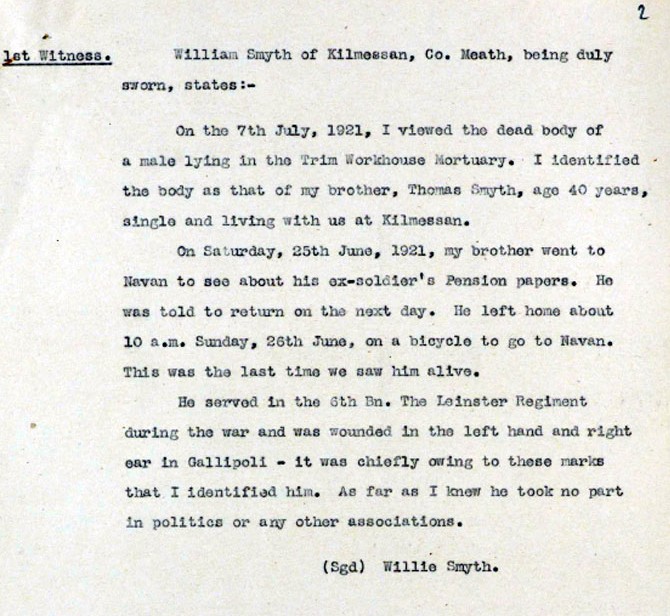
On Saturday, 25th June 1921, ex-British soldier Thomas Smith (38) left his home in Kilmessan, in County Meath, to travel on his bicycle the 13km to the town of Navan, to inquire about his military pension - Mr Smith had 'served the Crown' in Gallipoli in the 6th Brigade of the 'Leinster Regiment' and was wounded in the left hand and right ear, and was due a few bob.
In Navan, the BA pensions people took his details and asked him to call in to them the next day.
On Sunday, 26th June (1921), Mr Smith left his house at about 10am and disappeared.
In early July, a body was discovered in the River Boyne, with its hands, arms and feet tied, and iron weights fixed to it. On the 7th July, a Mr William Smith identified the body as that of his brother, Thomas.
There was no claim of responsibility, nor was there any witnesses to what had happened.
==========================
SO, FAREWELL THEN, CELTIC TIGER....
It had to happen, sooner or later.
Most of the pundits and economists were too busy singing the Celtic Tiger's praises to notice, but a few critical observers worried all along about the weaknesses of a boom economy that depended so much on a few companies from one place - the United States.
By Denis O'Hearn.
From 'Magill' Annual 2002.
Inequality has increased and governments have been unable or unwilling to use their tremendous resources to the benefit of the Irish people*.
One reason inequality increased is because growth is so heavily concentrated in profits ; US companies came to Ireland to make lots of profits and to avoid taxation.
They succeeded very well.
In the 1980's, US companies' profit rates in Ireland were two-and-a-half-times higher than elsewhere in the world ; now they are five times higher, a fact that makes US tax authorities very suspicious of their accounting procedures.
Apart from foreign companies, the 'Celtic Tiger' also created a large rise in unearned incomes and professional fees for the richest segments of Irish society... ( *...the more things change..)
(MORE LATER.)
On the 26th June, 1922, British Army Colonel John Gretton, of the 6th Battalion of the Staffordshire Regiment, wrote to his boss, Winston Churchill, with some alarming information...!
Mr Gretton told Mr Churchill that a concerted IRA attack was imminent on the good loyalist people of the Six Counties any hour now if, indeed, it wasn't actually taking place as he wrote!
He told Mr Churchill that he knew this because the Roman Catholic Franciscan Order was holding a religious pilgrimage in Multyfarnham Abbey in County Meath and the last time they met there it was to "plan a Protestant massacre".
We don't know how Mr Churchill reacted when he discovered that the last time the Franciscans met there was in 1641...
==========================
On the 26th June, 1922, a 'Special Constable', a Mr William Leggett, was a passenger in a Crown Force Crossley Tender (pictured) when the vehicle suffered a burst tyre, overturning as a result, and Mr Leggett died in the crash.
==========================
On the 22nd June, 1922, British Army Field Marshal Sir Henry Wilson, MP (pictured), and the chief military advisor to the Stormont political and military administration in Ireland, was assassinated in London, outside his house at 36 Eaton Place, by the IRA.
There was, as would be expected, much disgust in Westminster over his execution and, on the 26th June, within hours of Mr Wilson's State funeral in Saint Paul's Cathedral in London, Mr Lloyd George and Mr Winston Churchill came under verbal attack from Mr Bonar Law and others about his death.
Mr Lloyd declared that he regretted that the Free Staters in Ireland had not done more to protect life and property, overall, questioning whether they were capable at all of doing that, while Mr Churchill went further.
He made a speech in which he linked Mr Wilson's assassination with the anti-Treaty IRA men occupying the Four Courts in Dublin and demanded that the Free Staters clear out this "nest of anarchy and treason", stating that if they didn't do so, the British would do it for them -
"This sort of thing must come to an end (or) His Majesty's Government shall deem the Treaty to be formally violated and resume full liberty of action in any direction that may seem proper..."
But of course "the proper sort of thing" was not done - that of a complete British military and political withdrawal from Ireland.
==========================
Between 31st January and 26th June 1922, the British Government supplied Michael Collins and his Free State military with 11,900 rifles, 79 Lewis Machine Guns, 4,200 revolvers, 3,504 grenades, 1.7 million rounds of ammunition, six armoured cars and a large number of trucks, with which to defeat Irish resistance to British interference in Ireland.
Free State forces amounted to approximately 8,000 armed men while a Leinster House source estimated that the IRA had 12,900 men and 6,780 rifles.
So, while the IRA actually outnumbered the Staters (and had more experienced fighters), the Staters were much better equipped.
The Brits did, sometimes, look after their own...
==========================
BEIR BUA...
The Thread of the Irish Republican Movement from The United Irishmen through to today.
Republicanism in history and today.
Published by the James Connolly/Tommy O'Neill Cumann, Republican Sinn Féin, The Liberties, Dublin.
August 1998.
('1169' comment - 'Beir Bua' translates as 'Grasp Victory' in the English language.)
REPUBLICANS AND THE STATE :
The First Dáil Éireann was 'illegal', but whose 'law' was being quoted?
The Irish people had overwhelmingly backed Sinn Féin who had openly announced their intentions before the elections.
Throughout this time the Dáil operated unevenly ; it enjoyed success in the Republican Courts which, in areas, were able to gain the confidence of the people and drew support away from the judicial pillar of the British State.
It was also successful in establishing a Republican Police Force and establishing a local government structure.
Of course it was difficult to operate at this time as the two parallel States - Republican and British - competed for support and the armies of the two States were at war...
(MORE LATER.)
On the 26th June, 1924, a Mr Richard Mulcahy (pictured, a republican-gamekeeper-turned-Free State poacher) introduced a 'Censure Motion/Motion Of Censure' in the Leinster House assembly stating that "it was contrary to the best interests of the State, and ill-considered of the Executive, to have removed the (IRA) Army Council..."
Mr Mulcahy no doubt wanted to keep his friends close and his enemies closer, but the 'Labour Party' (becoming accustomed to 'perks and pensions') abstained from the vote and the motion was defeated.
The Staters hadn't learned then, and still haven't learned to this day, that they have no business in republican business.
==========================
Thanks for the visit, and for reading!
Sharon and the team.
Ah sure, look it...
...we're not anymore bigheaded now than we were before we clocked-up over 1,500,000 hits.
YA WHA'???
You hadn't noticed, you say... "so what?", ya declare, with a shrug of your shoulders...
"Big deal...", you retort, throwing your eyes up to Heaven...
Well feck off then, and don't check back with us on Wednesday, 26th June 2024, when we'll be posting a blog with 1,500,000...eh...23...parts in it, covering the following four stories and nineteen others -
Between January and June in this particular year in the 1920's, the IRA had time-and-a-half the number of 'men and women in uniform' that the Staters had, but the latter had one advantage that the former didn't have - Westminster...
1920's, Ireland - Michael Collins told directly by Westminster to 'sort out' an on-going incident between his people and the IRA or else they would do what they deemed necessary to bring the incident to a close in their favour...
1919, Ireland - 'Legion'-aires (!) disease outbreak (a rose by any other name..!) in a county near Dublin soon morphed into its true colours...
1919, Ireland ; for this RIC man, his 'job' wasn't - it was a passion, his 'mission in life'. His forced absence (!) was even noted in Westminster, who praised him and called for political ramifications to be enacted in Ireland...
So...do US a favour : add another score to our hit counter, won't ya not, as we're trying to get to two million.
Not greedy or anything...!
Thanks for the visit, and for reading : see yis on Wednesday, 26th June 2024!
Sharon and the team.
Go Raibh Maith Agat/Thank You!
A couple of days ago, we 'aged' - to over 1,500,000 hits on this blog - and counting...!
We espouse, support and believe in traditional Irish Republicanism on this weblog and, while we have always been aware that there is support 'out there' for our political, societal and historical values, the three of us continue to be grateful to all our readers, and surprised by where they come from.
We have been repeatedly 'hit on' by regular customers (!) from America (big 'Hi!' to our readers in the White House, all our colleagues in New York, Florida, Boston etc), Canada, Russia, England (...including our viewers in the 'House of Lords' and elsewhere in Westminster - yes, we see you...!) and our tens of thousands of readers in France, Germany, Switzerland and about 170 other countries!
The three of us try our best to remember lesser-known figures and occurrences from Irish history and politics, and keep them 'alive' for those with a similar interest, as well as the better-known occurrences.
It's a formula which works for us, and one that we love and enjoy, and our intention is to keep doing it until we have exhausted all our many resources.
Mór againn do chuidiú.
Is mise le meas, agus le gach dea-ghuí!
Thanks for the visit, and for reading!
Sharon and the team.