ON THIS DATE (21ST JUNE) 50 YEARS AGO : "FASCIST MURDER SQUAD" STRIKE AGAIN.
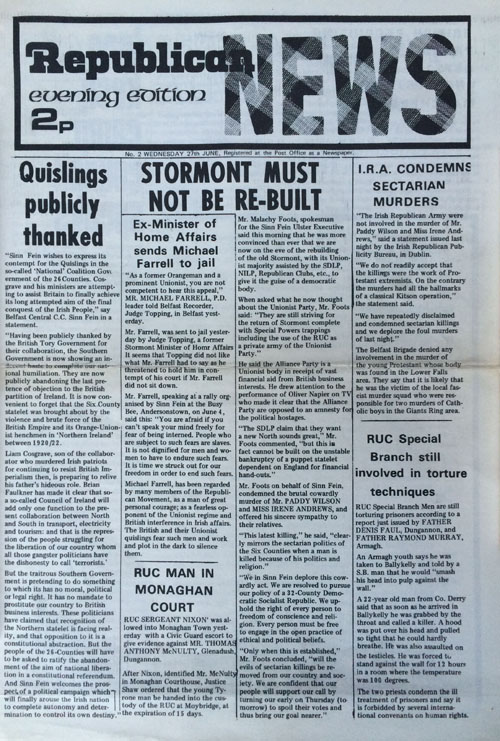
"The Belfast Brigade denied any involvement in the murder of the young protestant whose body was found in the Lower Falls area. They say that it is likely that he was the victim of the local fascist murder squad who were responsible for two murders of catholic boys in the Giants Ring area" - from the 'Republican News' newspaper, June 1973.
Of all the bombings, atrocities, tortures and killings that have unfortunately being visited and imposed on this country by Westminster due to their unwanted military and political presence here, the shooting dead of David Walker is one of the worst : this special needs sixteen-year-old boy was lifted off the street by the 'Official IRA', apparently as a 'dare', at about 8.30am on Thursday, 21st June 1973 - 50 years ago on this date - as he was working in his job.
He was found about three hours later on the Falls Road with gunshot wounds to his head and chest. He died a few minutes after he had been found.
'David Walker, 16-year-old Protestant civilian was found at O'Neill Street in the lower Falls area where he was shot and left by the Official IRA..(he) was described as being educationally subnormal and had a job in the Belvoir area of south Belfast near his home at Castlecoole Park...as (he) was working, the Official IRA abducted him and took him to the west of the city where they shot him. Joseph Cunningham, Senator Paddy Wilson, and Irene Andrews were later killed by the UDA/UFF in retaliation for young David's death.
The man jailed for David Walker's killing said in a statement that he thought David was a member of the UFF. He said he had been approached by a man in Leeson Street who asked him if he was "man enough to shoot a member of the UFF murder gang". The man said : "I said I would do it if there was proof that he was killing innocent Catholics. I asked for proof and he said Walker was involved in the murder of Danny Rouse".The judge said that David Walker's murder was "a horrible and unjustified murder.." ' (from here.)
It may well be fifty years since that barbarous act, but the political conditions for deeds like it are still in place - and it would still suit those in power in Westminster to have 'the wild Irish' killing themselves, allowing the British - the 'man in Leeson Street' - to continue to present themselves as being in Ireland 'to keep the warring factions apart'.
The only workable solution is that of a British political and military withdrawal from Ireland.
'RESURGENT ULSTER : NORTHERN SPEAKERS ADDRESS DUBLIN MEETING...'
From 'The United Irishman' newspaper, April 1955.
A large and enthusiastic audience accorded a warm welcome to a group of Ulster republicans who came to speak at a public meeting on Saturday, 19th of March (1955), in O'Connell Street in Dublin.
Joe Cahill, Belfast, speaking briefly, stated that he would sooner face the might of the Empire with a gun in his hand than address a public meeting.
He pointed to the futility of talk while an army of occupation was on our soil, and stated that moral force was not the answer to physical aggression. He said that the British Empire must be met on her own terms with a superior discipline and resolute determination. That way only lay victory.
Sean McKearney, Belfast, and James Rowantree, Newry, also spoke at the meeting.
Concluding, the Chairman (sic),Seoirse Dearle, traced the part played by Irish Protestants in the struggle for freedom from Tone, Emmet and Mitchel, down to the present day. It was Catholic England who first oppressed Ireland ; Ireland is the property of all Irishmen (sic) and freedom is our God-given right, but that freedom must be won.
Tone and Emmet had shown the way. Are the people of Ireland prepared to follow?
(END of 'Resurgent Ulster : Northern Speakers Address Dublin Meeting' ; NEXT - ' 'Northern Ireland' Flag Act', from the same source.)
'THOUGH THE HEAVENS MAY FALL...'
From 'Magill' Annual, 2002.
Dr Moira Woods (pictured).
Since it is clear that the families in question, including their now adult children, are anxious for the report to be published, and since the Medical Council has itself previously declared that it wishes all these matters to be as fully ventilated as possible, it is difficult to understand what possible basis there could be for declining now to publish the results of this investigation.
It would be a pity if the families were forced to return to the High Court to explore the potential of Mr Justice Barr's injunction concerning the paramountcy of doing justice.
(END of 'Though The Heavens May Fall' ; NEXT - 'Law And Society : Is It Time To Ask Questions Of The Legal Profession?', from the same source.)
ON THIS DATE (21ST JUNE) 146 YEARS AGO : 'THE DAY OF THE ROPE'.
'On 21st June 1877, in the anthracite-mining county of Schuylkill, Pennsylvania, ten Irish immigrant men alleged to have been members of an oath-bound secret sect of vigilantes called the 'Molly Maguires' were hanged in what came to be known as 'The Day of the Rope'. Twenty members of the group in all would be executed, following a kangaroo court that American historian John Elliot called "one of the most disgraceful episodes in the history of the bench and bar in the United States." Oppression, exploitation, racial and ethnic bigotry, strikes and union-busting are common enough themes in the American labour movement, but the story of the 'Molly Maguires' and the ruling class's attempts to destroy these Irish workers is so especially contemptible it has achieved legendary status....' (from here.)
On what became known as 'Black Thursday' (21st June, 1877), ten coal miners were hanged until dead in eastern Pennsylvania ; all ten had been born in Ireland but were forced to leave because of the attempted genocide ('An Gorta Mór') orchestrated by Westminster.
It was claimed that they, and others, were involved in 'organised retributions' against corrupt and unfair employers and other members of the establishment, and operated as such under the name 'Molly Maguires' (Molly Maguire had become famous in Ireland - or 'infamous', as the 'landlord' class described her - for refusing to bow down or bend the knee to them).
The workers had been arrested for their alleged part in several killings and, despite much doubt cast over the 'evidence' used against them, they were convicted and sentenced to death.
The court case was widely seen as employers drawing 'a line in the sand' in regards to what they considered to be 'uppity' workers looking for better wages and conditions, and an excuse for the establishment to vent its anti-labour and anti-Irish prejudice -
'The first trials began in January 1876. They involved 10 men accused of murder and were held in Mauch Chunk (an Indian name meaning 'Bear Mountain') and Pottsville. A vast army of media descended on the small towns where they wrote dispatches that were uniformly pro-prosecution.
The key witness for the prosecution was yet another Irishman, James McParlan. Back in the early 1870's, when Gowen had hired the Pinkerton Detective Agency to spy on his workers, McParlan had gone undercover to infiltrate 'the Mollies' and gather evidence. And gather he did — or at least he claimed he did, during the trials. On the stand he painted a vivid picture of 'Molly Maguire' secrecy, conspiracy and murder. With Irish catholics and miners excluded from the juries, the verdicts were a foregone conclusion.
The scene in Pottsville, Pennsylvania, on Thursday, 21st June 1877 - 146 years ago, on this date - as alleged members of the 'Molly Maguires' were taken to the scaffold.
All 10 were convicted and sentenced to hang.
No doubt seeking to send the most powerful message to the region's mining communities, authorities arranged to stage the executions on the same day — June 21st, 1877 – in two locations. Alexander Campbell, Michael Doyle, Edward Kelly, and John Donahue were hanged in Mauch Chuck (where the four men "all swung together"), while James Boyle, Hugh McGehan, James Carroll, James Roarity, Thomas Duffy, and Thomas Munley met a similar fate in Pottsville (where all six "swung two-by-two").
Although the hangings took place behind prison walls, they were nonetheless major spectacles that drew huge crowds and generated international news coverage..' (from here).
It was reported that there was "..screams and sobbing as husbands and fathers were bid goodbye.." and that "..James Boyle carried a blood-red rose and Hugh McGehan wore two roses in his lapel (as) James Carroll and James Roarity declared their innocence from the scaffold.."
Over the following two years, ten more alleged members of the 'Molly Maguires' were hanged, including Thomas P. Fisher (on the 28th March 1878) and James McDonnell and Charlie Sharp (on the 14th January 1879).
In 1979, the state of Pennsylvania pardoned one of the men, John 'Black Jack' Kehoe, after an investigation by its 'Board of Pardons' at the behest of one of his descendants (incidentally, Seán Connery played the part of John Kehoe in the film 'The Molly Maguires') and, on the 5th December 2005, the Pennsylvania State House of Representatives passed a resolution recognising the lack of due process for several of the men.
Make way for the Molly Maguires
They're drinkers, they're liars but they're men
Make way for the Molly Maguires
You'll never see the likes of them again.
Down the mines no sunlight shines
Those pits they're black as hell
In modest style they do their time
It's Paddy's prison cell
And they curse the day they've travelled far
Then drown their tears with a jar.
So make way for the Molly Maguires
They're drinkers, they're liars but they're men
Make way for the Molly Maguires
You'll never see the likes of them again.
Backs will break and muscles ache
Down there there's no time to dream
Of fields and farms, of womans arms
Just dig that bloody seam
Though they drain their bodies underground
Who'll dare to push them around.
So make way for the Molly Maguires
They're drinkers, they're liars but they're men
Make way for the Molly Maguires
You'll never see the likes of them again.
So make way for the Molly Maguires
They're drinkers, they're liars but they're men
Make way for the Molly Maguires
You'll never see the likes of them again.
'WAITING TO FALL...'
If this year sees the end of the 'Age of Tribunals', it won't be a moment too soon.
By John Drennan.
From 'Magill' magazine, January 2003.
The hopes and dreams of our tribunalistas that the Flood and Moriarty Tribunals would be the Trojan Horses which would facilitate the sack of Fianna Fail have been dashed.
Instead, if the present rate of 'progress' in the Flood Tribunal continues, they have provided Fianna Fail with the prospect of a cordon sanitaire that could last for 15 years.
The new popularity of tribunals was epitomised by the Morris Tribunal ; its creation - together with the cleverly designed terms of reference which have omitted PR Pat the Garda Commissioner, Michael McDowell and John O'Donoghue - has neutralised the political impact of the most serious Garda scandal in the history of the State.
From now on, any politician who attempts to raise the McBrearty affair will be greeted by the sight of Bertie Ahern highlighting the separation of powers and sighing - "I cannot comment on dat issue as it is a matter for de Tribunal".
Sweet...
(MORE LATER.)
Thanks for the visit, and for reading,
Sharon and the team.
ON THIS DATE (7TH JUNE) 102 YEARS AGO : TWO IRA MEN EXECUTED BY WESTMINSTER.
Patrick Maher (left), executed by the British on the 7th of June 1921 - 102 years ago on this date.
Ned Foley, executed by the British on the 7th of June 1921.
"Fight on, struggle on, for the honour, glory and freedom of dear old Ireland. Our hearts go out to all our dear old friends. Our souls go to God at 7 o'clock in the morning and our bodies, when Ireland is free, shall go to Galbally. Our blood shall not be shed in vain for Ireland, and we have a strong presentiment, going to our God, that Ireland will soon be free and we gladly give our lives that a smile may brighten the face of 'Dear Dark Rosaleen'. Farewell! Farewell! Farewell!" - the last words of Limerick (Ballylanders) IRA man Patrick Maher, 32 years of age, to his comrades.
Patrick Maher and his comrade Ned Foley were hanged in Mountjoy Jail in Dublin by Westminster on Tuesday 7th June 1921 - 102 years ago on this date - for their 'involvement' in the rescue of Tipperary IRA man Seán Hogan.
Patrick Maher, who worked as a clerk at Knocklong railway station and was about three miles from the scene of the rescue when it happened, was not involved in that operation. The two men were charged with the 'murder' of two RIC men (Peter Wallace and Michael Enright): - Patrick Maher strongly protested his innocence but, even though two juries failed to reach a verdict, he was convicted (by a military court martial) and sentenced to death.
He was one of 'The Forgotten Ten' IRA Volunteers (Kevin Barry, Patrick Moran, Frank Flood, Thomas Whelan, Thomas Traynor, Patrick Doyle, Thomas Bryan, Bernard Ryan, Edmond (Ned) Foley, and Patrick Maher) - Kevin Barry was executed in 1920 by the British and the other nine men were put to death in 1921.
All ten were buried in the grounds of Mountjoy Jail in Dublin, where six of them were placed in the same grave.
John Ellis, the British hangman hired to execute Maher and Foley, had 'proved his worth' to Westminster by previously carrying out other 'jobs' in Ireland for that institution - he and his assistant, Bill Willis, had listed in their bloody CV the names of Roger Casement and Kevin Barry (Ellis later killed himself in 1932, on his second attempt, but Willis lived for a further seven years).
The most poignant appeal for clemency was made by Edward Wallace, the father of RIC Sergeant Peter Wallace, who wrote to the Commander in Chief of British forces in Ireland, Sir Nevil Macready -
"The tragedy will pass heavily on me during the remaining years of my life, if any lives are sacrificed on account of my son's death. My son and daughter join with me in imploring you to be clement and merciful to those who have been tried in connection with the tragedy. May God forgive those who were really guilty. I do."
Thousands of people had gathered outside Mountjoy Jail in Dublin in protest against the executions, but to no avail (it should be noted that at the time, Munster and a small part of Leinster were under British 'martial law' and those executed there were shot as soldiers, but Dublin was under civilian law and that is why those executed in Mountjoy were hanged).
On Sunday, 14th October 2001, nine of those men were reinterred in Glasnevin Cemetery in Dublin by representatives of a 26-county state in an 'official' ceremony and, on Friday 19th October 2001 this state made the final arrangements to do the same for the tenth man, Patrick Maher, who was reburied in his home parish of Glenbrohane in Limerick (at the request of his family) on Saturday, 20th October 2001.
Both reinterments were carried out by a state which none of the ten men were fighting for - a 26-county free state - as the objective of the republican campaign - then (1920/1921) and now (2023)- was and is for a free Ireland, not a partially-free Ireland.
And, to add insult to injury, the then Free State 'minister for justice', John O'Donoghue, was the 'official figurehead' present, on both occasions, during which he delivered the graveside orations.
Irish republicans are looking forward to the day when those moral and political misappropriations can be corrected.
'RESURGENT ULSTER : NORTHERN SPEAKERS ADDRESS DUBLIN MEETING...'
From 'The United Irishman' newspaper, April 1955.
A large and enthusiastic audience accorded a warm welcome to a group of Ulster republicans who came to speak at a public meeting on Saturday, 19th of March (1955), in O'Connell Street in Dublin.
Frank McGlade deplored the insincerity of the party politicians in the 26 Counties who had made the long-suffering people of the North the scapegoat and pawn in their political game each time they sough election.
Referring to the activities of the 'B Specials', P McParland, from Bessbrook, in County Armagh, stated that apparently the death of Arthur Leonard was necessary, before many people of the 26 Counties were aware of their existence.
But the people of Ulster had been the subject of attack from this private army which was at the disposal of the Unionist clique for 30 years, and he deplored the deliberate attempts being made to relegate the struggle for freedom to a sectarian level.
Ireland had only one enemy - England, and the IRA had made this clear in the recent raids on British Army barracks and on British soldiers...
(MORE LATER.)
ON THIS DATE (7TH JUNE) TEN YEARS AGO : A PERSONAL REFLECTION.

 Ruairí Ó Brádaigh (far left, and his funeral service, above), pictured in 1954 : from this blog, June 2013 - 'Funeral arrangements : Reposing at Smyth's Funeral Home, Roscommon, on Friday 7th June 2013, from 5.30pm to 8.00pm, followed by Removal to the Sacred Heart Church. Requiem Mass on Saturday at 11.30am with Burial afterwards in St. Coman's Cemetery. Family Flowers only. House private Saturday morning. Donations, if desired, to CABHAIR (Irish Republican Prisoners’ Dependants Fund), 223 Parnell St, Dublin 1 and to the Roscommon-Mayo Hospice.'
'Born in Longford in 1932 to a republican family, Ruairí Ó Brádaigh studied at UCD where he gained a degree in commerce. During his time at UCD he became involved with Sinn Féin and joined the IRA, of which his father had also been a member. Although by profession a teacher, Ruairí spent most Of his time as a training Officer for the IRA and in 1954 was appointed to the Military Council Of the IRA, eventually being IRA Chief Of Staff until 1962.
He was elected as Sinn Féin TD in the Longford – Westmeath constituency in 1957. In 1970 Ruairí Ó Brádaigh led the walkout from the Sinn Féin Ard Fheis after the majority voted in favour of the abolition Of Sinn Féin's policy of abstention. He became President of Provisional Sinn Féin which he held until his resignation in 1983. In 1986, Ruairí Ó Brádaigh again led a walk out, this time from the Provisional Sinn Féin Ard Fheis, when they voted to drop the abstention policy. He and several supporters established Republican Sinn Féin..' (from here.)
"In the coming year we must present to the whole Irish people our framework of a federation of the four provinces of Ireland - in a post British withdrawal situation - with maximum devolution of power and decision-making to local level, with the complete separation of church and state and the building of a pluralist society and with neutrality and non-alignment in foreign affairs as the best hope for all the people of this island...this requires massive political and structural change on both sides of the border in order that all of us may escape from the political strait-jacket North and South designed for us in the Westminster parliament and imposed on us by the English ruling class to our detriment.
Such a solution remains our only hope of growing and developing naturally as a people and enjoying our cultural heritage. God speed the day...!" - Aitheasc an Uachtaráin Ruairí Ó Brádaigh don 85ú Ard-Fheis de Shinn Féin in Óstlann an Spa, Leamhcán, Co. Atha Cliath, 21ú agus 22ú Deireadh Fómhair, 1989 (Presidential Address of Ruairí Ó Brádaigh to the 85th Ard Fheis of Sinn Féin in the Spa Hotel, Lucan, County Dublin, 21st and 22nd October 1989).
And I still go looking for him at the Ard Fheis ; I miss him. But, thankfully, that which he stood for and represented is still here.
'THOUGH THE HEAVENS MAY FALL...'
From 'Magill' Annual, 2002.
Dr Moira Woods (pictured).
The parents are understandably concerned about these delays and might be forgiven for fearing the worst.
Mr Justice Barr, in his ruling of the 3rd April 1998, stated that no absolute mandatory prohibition exists on the publication of information concerning family proceedings on the basis of the in camera legislation.
He pointed out that established practice was that the court concerned had discretion to permit the dissemination of information where the judge "...believes that it is in the interests of justice so to do, due and proper consideration having been given to the interest of the person or persons intended to be protected by the conduct of the proceedings in camera."
The court, he said, was bound by the concept that "...the paramount consideration is to do justice.."
(MORE LATER.)
'WAITING TO FALL...'
If this year sees the end of the 'Age of Tribunals', it won't be a moment too soon.
By John Drennan.
From 'Magill' magazine, January 2003.
But when it comes to time we do have serious concerns - the length of tribunals means politics is set fair to remain in the dock for another decade.
Before our tribunalistas throw their caps into the air and indulge in another bout of huzzas, they would do well to stop and wonder if that's asking too much ; if the consequences will be corrosive rather than correctional.
After all, it can hardly be a matter of pride for the legal profession that tribunals have acted as the foster parents for the rise of Sinn Féin/IRA, whose representatives are being feather-bedded into seats by the belief that 'they're all at it' which is being fostered by our inquiries.
The very length of tribunals has diluted their impact in another critical way ; who can blame Bertie Ahern for his newborn enthusiasm for the things? The Lilliputians over in the Flood Tribunal took five years - and one election - to report on Rambo Burke's disgrace, whilst after five years - and one election - the Gullivers over in the Moriarty Tribunal still haven't reported on the frolics of some historical figure from the last century who went by the name of Charles J Haughey...
(MORE LATER.)
ON THIS DAY NEXT WEEK (WEDNESDAY 14TH JUNE 2023)...
..we'll be recovering from...
BODENSTOWN SUNDAY, JUNE 11th, 2023...ANNUAL WOLFE TONE COMMEMORATION : Sunday, June 11th, 2023, Sallins, County Kildare.
For information on the death of Wolfe Tone , scroll through this piece (article starts on March 9th on that page, just scroll down) which was published on this blog in 2005.
"From my earliest youth I have regarded the connection between Great Britain and Ireland as the curse of the Irish nation, and felt convinced that, while it lasted, this country could never be free nor happy.
My mind has been confirmed in this opinion by the experience of every succeeding year, and the conclusions which I have drawn from every fact before my eyes. In consequence, I was determined to employ all the powers which my individual efforts could move, in order to separate the two countries.
That Ireland was not able of herself to throw off the yoke, I knew ; I therefore sought for aid wherever it was to be found. In honourable poverty I rejected offers which, to a man in my circumstances, might be considered highly advantageous. I remained faithful to what I thought the cause of my country , and sought in the French Republic an ally to rescue three millions of my countrymen." -Theobald Wolfe Tone.
We won't be posting our usual (or any!) contribution on Wednesday 14th June, 2023, as we'll be putting out house back in order after the Bodenstown Commemoration, but we'll be back 'on air' here on the following Wednesday, 21st June 2023.
But if yer that bleedin' desperate for something to read, you can catch me between this and then on Twitter and Facebook as well!
Thanks for the visit, and for reading,
Sharon and the team.
Ruairí Ó Brádaigh (far left, and his funeral service, above), pictured in 1954 : from this blog, June 2013 - 'Funeral arrangements : Reposing at Smyth's Funeral Home, Roscommon, on Friday 7th June 2013, from 5.30pm to 8.00pm, followed by Removal to the Sacred Heart Church. Requiem Mass on Saturday at 11.30am with Burial afterwards in St. Coman's Cemetery. Family Flowers only. House private Saturday morning. Donations, if desired, to CABHAIR (Irish Republican Prisoners’ Dependants Fund), 223 Parnell St, Dublin 1 and to the Roscommon-Mayo Hospice.'
'Born in Longford in 1932 to a republican family, Ruairí Ó Brádaigh studied at UCD where he gained a degree in commerce. During his time at UCD he became involved with Sinn Féin and joined the IRA, of which his father had also been a member. Although by profession a teacher, Ruairí spent most Of his time as a training Officer for the IRA and in 1954 was appointed to the Military Council Of the IRA, eventually being IRA Chief Of Staff until 1962.
He was elected as Sinn Féin TD in the Longford – Westmeath constituency in 1957. In 1970 Ruairí Ó Brádaigh led the walkout from the Sinn Féin Ard Fheis after the majority voted in favour of the abolition Of Sinn Féin's policy of abstention. He became President of Provisional Sinn Féin which he held until his resignation in 1983. In 1986, Ruairí Ó Brádaigh again led a walk out, this time from the Provisional Sinn Féin Ard Fheis, when they voted to drop the abstention policy. He and several supporters established Republican Sinn Féin..' (from here.)
"In the coming year we must present to the whole Irish people our framework of a federation of the four provinces of Ireland - in a post British withdrawal situation - with maximum devolution of power and decision-making to local level, with the complete separation of church and state and the building of a pluralist society and with neutrality and non-alignment in foreign affairs as the best hope for all the people of this island...this requires massive political and structural change on both sides of the border in order that all of us may escape from the political strait-jacket North and South designed for us in the Westminster parliament and imposed on us by the English ruling class to our detriment.
Such a solution remains our only hope of growing and developing naturally as a people and enjoying our cultural heritage. God speed the day...!" - Aitheasc an Uachtaráin Ruairí Ó Brádaigh don 85ú Ard-Fheis de Shinn Féin in Óstlann an Spa, Leamhcán, Co. Atha Cliath, 21ú agus 22ú Deireadh Fómhair, 1989 (Presidential Address of Ruairí Ó Brádaigh to the 85th Ard Fheis of Sinn Féin in the Spa Hotel, Lucan, County Dublin, 21st and 22nd October 1989).
And I still go looking for him at the Ard Fheis ; I miss him. But, thankfully, that which he stood for and represented is still here.
'THOUGH THE HEAVENS MAY FALL...'
From 'Magill' Annual, 2002.
Dr Moira Woods (pictured).
The parents are understandably concerned about these delays and might be forgiven for fearing the worst.
Mr Justice Barr, in his ruling of the 3rd April 1998, stated that no absolute mandatory prohibition exists on the publication of information concerning family proceedings on the basis of the in camera legislation.
He pointed out that established practice was that the court concerned had discretion to permit the dissemination of information where the judge "...believes that it is in the interests of justice so to do, due and proper consideration having been given to the interest of the person or persons intended to be protected by the conduct of the proceedings in camera."
The court, he said, was bound by the concept that "...the paramount consideration is to do justice.."
(MORE LATER.)
'WAITING TO FALL...'
If this year sees the end of the 'Age of Tribunals', it won't be a moment too soon.
By John Drennan.
From 'Magill' magazine, January 2003.
But when it comes to time we do have serious concerns - the length of tribunals means politics is set fair to remain in the dock for another decade.
Before our tribunalistas throw their caps into the air and indulge in another bout of huzzas, they would do well to stop and wonder if that's asking too much ; if the consequences will be corrosive rather than correctional.
After all, it can hardly be a matter of pride for the legal profession that tribunals have acted as the foster parents for the rise of Sinn Féin/IRA, whose representatives are being feather-bedded into seats by the belief that 'they're all at it' which is being fostered by our inquiries.
The very length of tribunals has diluted their impact in another critical way ; who can blame Bertie Ahern for his newborn enthusiasm for the things? The Lilliputians over in the Flood Tribunal took five years - and one election - to report on Rambo Burke's disgrace, whilst after five years - and one election - the Gullivers over in the Moriarty Tribunal still haven't reported on the frolics of some historical figure from the last century who went by the name of Charles J Haughey...
(MORE LATER.)
ON THIS DAY NEXT WEEK (WEDNESDAY 14TH JUNE 2023)...
..we'll be recovering from...
BODENSTOWN SUNDAY, JUNE 11th, 2023...ANNUAL WOLFE TONE COMMEMORATION : Sunday, June 11th, 2023, Sallins, County Kildare.
For information on the death of Wolfe Tone , scroll through this piece (article starts on March 9th on that page, just scroll down) which was published on this blog in 2005.
"From my earliest youth I have regarded the connection between Great Britain and Ireland as the curse of the Irish nation, and felt convinced that, while it lasted, this country could never be free nor happy.
My mind has been confirmed in this opinion by the experience of every succeeding year, and the conclusions which I have drawn from every fact before my eyes. In consequence, I was determined to employ all the powers which my individual efforts could move, in order to separate the two countries.
That Ireland was not able of herself to throw off the yoke, I knew ; I therefore sought for aid wherever it was to be found. In honourable poverty I rejected offers which, to a man in my circumstances, might be considered highly advantageous. I remained faithful to what I thought the cause of my country , and sought in the French Republic an ally to rescue three millions of my countrymen." -Theobald Wolfe Tone.
We won't be posting our usual (or any!) contribution on Wednesday 14th June, 2023, as we'll be putting out house back in order after the Bodenstown Commemoration, but we'll be back 'on air' here on the following Wednesday, 21st June 2023.
But if yer that bleedin' desperate for something to read, you can catch me between this and then on Twitter and Facebook as well!
Thanks for the visit, and for reading,
Sharon and the team.
This British executioner and his 'assistant', hired by Westminster and placed in Ireland, had a 'Who's Who' of Irish republicans in his notebook but later became an alcoholic (due to a heavy conscience, hopefully) and failed to 'execute' himself, despite having shot himself in the head. In the early 1930's, drunk again, he used a blade on himself. Successfully.
Due to British interference in Irish affairs, the nationalists in the Occupied Six Counties were the subject of attack by what was in effect a private army which was at the disposal of Westminster, which 'gifted' that army to 'loyal' people in Ireland...
Born in the early 1930's into a republican family, this man studied in Dublin and gained a degree in his chosen field, but a different 'field' soon entered his life and he became dedicated. And sought after...
...and two or three more pieces, which we're working on at the moment!
Thanks for the visit, and for reading - see ye on Wednesday the 7th of June, 2023!
Sharon and the team.
ON THIS DATE (31ST MAY) 11 YEARS AGO : A MISSED OPPORTUNITY FOR PAYBACK!
On (Thursday) the 31st May 2012 - 11 years ago on this date - a vote was held in this State to decide whether to support or not to support a European treaty in relation to fiscal rules which would limit State spending by the Leinster House administration, placing those limitations into State law.
At the time, the Euro currency was in trouble ("the most serious financial crisis at least since the 1930's, if not ever..") and the quickest way for the political and financial 'bosses' to stabilise it (and, by extension, their own profits) was to take more of it from the 'ordinary joe' throughout the EU, by instructing local politicians to cut back on their share of the 'cake'.
But, as expected, when those 'captains of industry' were raking it in during the cyclical 'boom times', they were quite happy to leave us little people to our own devices, sink or swim.
At the time, we stated - 'This Treaty is about trying to shore-up a failed currency - the Euro. In this State, that failure is compounded by the activities of the gangster politicians, property speculators and bankers who, although already wealthy and financially comfortable, wanted more and, because they move in the same 'circles', closed ranks to protect each other's backs as their joint efforts bankrupted the State. Those who still have jobs, and those who have lost them, are now being penalised for the mistakes and the outright greed of that 'elite'... (from here.)
Unfortunately, more of those that voted went with the establishment and the good guys lost, prompting the following from us -
'I don't write this post as a sore loser, or a begrudger or because I'm in a vindictive mood (well..no more than usual, anyway!) but rather as someone who has seen the same mistake being made over and over again and, despite repeated warnings to the victim, as someone who has recently witnessed the same again : scare tactics and a pro-administration and business-friendly media manipulated enough victims into the path of the cushion-covered snare it had hidden in the undergrowth and obtained the result that their employers in the IMF and the EU ordered : a 'YES' vote for more austerity for the unemployed and the low paid, to secure the continued comforts of the 'protected class' ie the politicians themselves and their 'friends’' ('interests', rather..) in the banking and property-speculating industries.
Although over three million people (3,144,828) in this State were entitled to vote on the 'Austerity Treaty', only slightly more than one-and-a-half million (1,584,179) of those actually did so and, of that latter figure, 955,091 voted for more 'austerity' (after being told by the 'Establishment', among other frightening lies, that the ATM's would soon be cashless!) whilst 629,088 voted 'NO'..'
The 'Yes' vote was signed into FS law by the Free State President, Michael D. Higgins, on 27th June 2012 but, 11 years after the fact, the Euro currency is still in trouble, the 'cops' (who are as 'careless' now as they have been in the past..), like the State that employs them and gives them succor, are bent but are still sometimes the only point of rescue for those that the State would rather forget, while those that the decent among us would rather forget are allowed free reign.
And neither Brussels or Leinster House will do anything - except probosculate about it, occasionally - because the careerists in those institutions would be making headlines like that themselves were it not for the fact that they are placed in positions where they can cover for each other.
'RESURGENT ULSTER : NORTHERN SPEAKERS ADDRESS DUBLIN MEETING'.
From 'The United Irishman' newspaper, April 1955.
A large and enthusiastic audience accorded a warm welcome to a group of Ulster republicans who came to speak at a public meeting on Saturday, 19th of March (1955), in O'Connell Street in Dublin.
Prior to the meeting, which was billed for 8pm, the public - many of whom were there from 7pm - were entertained to a programme of national airs on records.
Seoirse Dearle, Ath Cliath, who presided, welcomed the speakers from occupied Ireland to Dublin, and stated that the meeting was for the purpose of affording the republicans of Ulster an opportunity of stating their case to the people of Dublin and Ireland in general and also to refute the allegation that a group of people from Dublin and Belfast were striving to stir up trouble in Ulster at the expense of the people of 'Northern Ireland'.
Speaking on this allegation, Frank McGlade, Belfast, said that the people of Ulster did not care from which county in Ireland eager young men came to their assistance, as the freedom of Ireland was and is the concern of all Irishmen (sic) irrespective of class or creed...
(MORE LATER.)
'THOUGH THE HEAVENS MAY FALL...'
From 'Magill' Annual, 2002.
Dr Moira Woods (pictured).
This is most disturbing.
The five families implicated in this case have spent more than a decade living under the shadow of some of the most dreadful accusations that can be levelled at parents in the matter of the care of their children.
In that time, they have had to persevere in their attempts to obtain a fair hearing of their complaints through the lifetimes of no less than three different configurations of the Medical Council!
The first Medical Council to be made aware of these matters was elected in 1990 and sat for five years ; the second, which initiated the inquiry process, sat from 1995 to 1999 and the third was elected in 1999 and is still sitting.
The public requires to be reassured that there is no reluctance on the part of the present Medical Council to publish the outcome of a process initiated by a previous council - in other words, that there is no political dimension to the delays and reported reluctance comcerning these matters...
(MORE LATER.)
ON THIS DATE (31ST MAY) 225 YEARS AGO : 'UNITED IRISHMEN' LEADER ELECTED.
Farewell my brave United men,
who dearly with me fought,
though tyrant might has conquered right,
full dearly was it bought.
And when the sun of freedom
shall again upon you shine,
oh, then let Bagenal Harvey’s name array your battle line...'
Beauchamp Bagenal Harvey was born in Wexford in 1762, into a fairly well-off (Protestant) family, and was educated at Trinity College in Dublin (his father was a senior civil servant). Beauchamp, by now a barrister, was an outspoken supporter of Catholic emancipation and, at 30 years of age, joined the 'Dublin Society of United Irishmen'. In that same year (1792) his father died, leaving him property in Wexford and Waterford, which yielded an annual rental of £3,000.
Harvey was arrested by the British in late May 1798 and was imprisoned in Wexford Jail but the prison was forcibly taken over a few days later by the United Irishmen and he was set free.
On the 31st of that month - 225 years ago on this date - he was appointed by the approximate four-thousand strong rebel army in that area as their Commander-in-Chief. He gathered his forces and headed for the walled-town of New Ross, intending to set up camp there - they set up a temporary base at Three Rock, just outside Wexford Town, and spent about three days there, drilling and learning basic military manoeuvres.
From New Ross they intended to march on Kilkenny, where they could recruit more fighters. On the 5th June 1798, Harvey sent a despatch rider into New Ross with an instruction to the British general in charge (Johnson) demanding the surrender of the town 'to avert rapine and bloodshed' but the messenger was killed by Johnson's yeomanry. The Irish, numbering approximately four-thousand strong, attacked New Ross and won the fight, and the town, only to lose it when the British re-grouped and drove them out.
However, within hours the Irish had themselves re-grouped and were ready for another attack.
The rebel leaders - Beauchamp Bagenal Harvey, Thomas Cloney, Father Philip Roche and John Kelly - led their army into New Ross again and scattered the British but failed to properly secure the town ; the British again re-grouped, attacked and, for the second time, put the Irish to flight. Feeling that a final victory was within their grasp, the United Irishmen assembled for another push - the third such attack.
They divided into three groups, two of which - each consisting of hundreds of rebels - were dispatched towards Wicklow, to confuse the enemy, while the third contingent, consisting of about three-thousand men and women, headed for New Ross again. The two 'Wicklow' groups put up a fierce struggle against professional British Yeomanry, but were eventually forced to scatter, leaving hundreds of fellow rebels dead or dying. By this time, the largest group (under Harvey) had reached Carrickbyrne Hill, about two-hours march from New Ross ; on their journey from Three Rock to Carrickbyrne Hill they had encountered and defeated armed British contingents and Harvey decided they should set-up base at the Hill and teach the rebel army how to use the captured pieces of artillery which they had taken from the British forces they had met along the way.
After a few days in training, the rebel army were judged to be ready to be moved to the next 'camp', Corbett Hill - the last such stop before they would reach the town of New Ross, and from where they could look down on the town. They knew that there was about three or four-thousand enemy soldiers in New Ross, commanded by a General Johnson and a 'Lord' Mountjoy, the latter in charge of an enemy Brigade from Dublin. Beauchamp Bagenal Harvey wanted to take the town without bloodshed, if possible, and sent a number of his men, under a flag of truce, to let the British know that he was willing to accept their surrender and take prisoners. The British shot the truce party dead. A battle that was to last thirteen hours was about to begin.
The rebels gathered a huge herd of cattle and stampeded the animals towards the town, following immediately behind the terrified beasts. The British outposts fell, and the Irish fought their way into the middle of New Ross , meeting strong resistance - the enemy retreated, re-grouped and, once more, succeeded in forcing the United Irishmen out of the town. Some of the rebel army were reluctant to lose the ground they had gained, and had to be practically dragged away by their own comrades ; one such rebel was Mary Doyle, who ran from body to body of dead and dying enemy soldiers, finishing them off or just making sure they were dead before removing their ammunition belts and weapons which she then distributed to her own side! -
'By 1798 the wearing of the colour green was forbidden by order of the English government, but this order was defied by the women, especially in Wexford. The women of Wexford had their petticoats, handkerchiefs, cap ribbons and all parts of their dress that exhibited a shade of green, torn off and were subjected to the most vile and indecent language by the Yeomen.
Any women who encountered the government troops ran a most terrible risk. In a desperate encounter with a Hessian Captain, Anne Ford of Garrysackle, County Wexford, slew him with a mallet. Peg Kavanagh was one of many women who conveyed despatches and food to Michael Dwyer and Joseph Hall in their hiding place in the Wicklow Mountains. Susan O'Toole, the blacksmith's daughter of Annamore, carried ammunition and provisions to the insurgent chiefs for many a long year. Joseph Hall used to call Susan O'Toole his "moving magazine". William Rooney has immortalised the memory of Mary Doyle, a fearless Wexford insurgent :
But a figure rose before us,
Twas a girl's fragile frame
And among the fallen soldiers
There she walked with eyes aflame,
And her voice rang o'er the sea :"Who so dares to die for Ireland
Let him come and follow me!"' (more here.)
It was during that retreat that Mary Doyle was said to have climbed on to a British cannon and vowed to stay with the gun regardless of what happened - her own comrades could only get her to safety by wheeling the weapon out of the town, with Mary Doyle said to be sitting on the barrel of it!
The town of New Ross was now on fire, with buildings crumbling and hundreds of bodies strewn around ; one of the leaders of the United Irishmen, John Kelly (from Killane), assembled the remnants of the rebel army for one last push, which he led. It was in that last attack that Kelly was badly wounded and Mary Doyle was killed by one of the many fires which now consumed the town.
Both sides were by now exhausted. One of the surviving United Irishmen, Thomas Cloney, described the last battle as a free-for-all "with two confused masses of men struggling alternatively to drive the other back by force alone."
For the third time in 13 hours, the Irish rebels were forced out of their own town - they had lost the battle.
The British 'Lord', Mountjoy', who was in command of a British force from Dublin, was killed during the fight. Beauchamp Bagenal Harvey was captured within a few weeks by the British and was 'tried', convicted and hanged on the 28th June 1798 at the bridge of Wexford. His body was then beheaded, the torso thrown into the River Slaney and his head displayed on a spike at the courthouse in Wexford town.
The British no longer 'behead and spike' their enemy anymore (at least not in Ireland) but they continue to make enemies of the calibre of the Harvey's and Mary Doyle's of this world and will continue to do so until they realise that their 'days of empire' are over, and should never have even begun.
We don't want their political or military presence in Ireland.
'WAITING TO FALL...'
If this year sees the end of the 'Age of Tribunals', it won't be a moment too soon.
By John Drennan.
From 'Magill' magazine, January 2003.
The counterattack intensified as Moriarty appeared with a set of allegations which may destroy the party which founded the State.
The colourful antics ('1169' comment - just this - !) of Michael Lowry left political insiders wondering if Fine Gael would ever be fit to be in government again. However, even as our tribunalistas honk and clap at the very ripe fish that 'Saint Frank of Shefran' is throwing, we can still hope that the apparent vitality of our tribunals is that of a distempered animal which gambols most vibrantly in the final hours before its death.
One common canard the tribunalistas of 'The Irish Times' advance is that any criticism of the wonderful tribunal - pick any one of the dozen in operation right now - is merely informed by 'greasy till' ethics of time and cost. In fact, our difficulty with tribunals has very little to do with costs, though it should be noted that the Flood Tribunal's claim that it has created a profit for the State is as accurate as a forecast by the Department of Finance...
(MORE LATER.)
Thanks for the visit, and for reading,
Sharon and the team.
ON THIS DATE (24TH MAY) 82 YEARS AGO : 'DRAFT RIOTS' AS WESTMINSTER PUSHES FOR CONSCRIPTION IN IRELAND.
In Ireland, in 1941, conscription was again being discussed in Westminster ; this time for the partitioned six north-eastern counties of Ireland.
It is recorded that, at a meeting between the then 'American Ambassador to Ireland' (sic - the Free State), a Mr. David Gray (who was said to be friendly with the British Ambassador to America, 'Lord' Halifax and Eamonn de Valera, which took place in January 1941, Gray rounded on de Valera "for capitalising on hatred of Great Britain for political reasons and so must take some responsibility for the existing popular state of mind..", by which he meant the Free State policy of so-called 'neutrality' and the then impending strong possibility of conscription by Westminster in the Six Occupied Counties, which de Valera and his State Administration were opposed to.
Grey stated that de Valera "began to talk about his rights. I told him that the only right that he and myself enjoyed was to believe in our religion, and be burned for it if need be. Every other right depended upon force to maintain it, and he was steering a very dangerous course if he thought otherwise.."
Although pro-British in his mindset, Gray recognised the reality of the then existing political situation in Ireland : on the 24th May, 1941 - 82 years ago on this date - he sent a wire-cable (like a 'text message', for our younger readers!) to the American Secretary of State, stating - "Opposition leaders yesterday informed me that conscription without a conscientious objectors escape clause for minority Catholic nationalists will constitute a major irretrievable and probably fatal political blunder at this time and play directly into de Valera's hands with grave possibilities for American interests.
They [the opposition leaders] predict draft riots, the escape of draft dodgers to Southern Ireland who will be acclaimed as hero martyrs by three-quarters of the population and the fomenting of trouble by republicans and fifth columnists.
The clearest-headed leader predicts that de Valera will seize the opportunity to escape from economic and political realities by proclaiming himself the leader of the oppressed minority and with the blessings of the Cardinal will rouse anti-British feeling and call a Holy War. I think it a very likely prediction. All classes of opinion here unite in condemning the move as calamitous.
It appears to be a repetition of the same fatal blunder made during the last war. The weak and failing Ulster [sic] Government is probably seeking to sustain itself by provoking a crisis. Unless Great Britain is prepared from a military point of view to seize the whole country it appears to be madness. So little can be gained and so much lost.
Eighty thousand Irish Volunteers in the British Army will be disaffected, there will be no material number of nationalist conscripts, a government, a popular majority and an army inclined to be friendly to Great Britain rather than to the Axis will become definitely hostile, possibly giving active aid to Germany and most important of all the pro-British opposition will be helpless and the opportunity for dividing the country on the question of the ports will be lost for the duration. The effect on Irish-American opinion at this juncture is not for me to estimate. This is a grave situation."
Shortly afterwards, Churchill wrote -"..the (British) Cabinet is inclined to the view it would be more trouble than it's worth to go through with conscription. No immediate decision will be taken and in the meantime the less made of the affair the better."
As usual, it took the threat of force, or force itself, before the British realised that there would be a consequence to their action.
And it still takes that threat today.
ON THIS DATE (24TH MAY) 100 YEARS AGO : IRA ORDERED TO 'DUMP ARMS'.
"To All Ranks : Comrades - The arms with which we have fought the enemies of our country are to be dumped. The foreign and domestic enemies of the Republic have for the moment prevailed" - 'Dump Arms' order issued by the then newly-appointed IRA Chief of Staff Frank Aiken (pictured), on Thursday, 24th May 1923 : 100 years ago on this date.
"Further sacrifice on your part would now be in vain and the continuance of the struggle in arms unwise in the national interest. Military victory must be allowed to rest for the moment, with those who have destroyed the Republic. You have saved the nation's honour, preserved the sacred national tradition, and kept open the road of independence" - an echo of the above 'Dump Arms' order to the IRA, issued on the same date [24th May 1923] by Éamon de Valera (pictured).
Yet, three years later, that same man actually joined those "who have destroyed the Republic" when, in March 1926, following an extraordinary meeting of the then Sinn Féin organisation, he resigned as leader and, splitting the Movement, brought others with him in forming (on the 23rd March 1926) "a new national movement" - Fianna Fáil.
He and the other defectors stated that they had no option except to leave the Movement after their Ard Fheis motion calling for elected Sinn Féin members to be allowed to take their seats in the Free State parliament (Leinster House), if and when the controversial 'Oath of Allegiance' was removed, was defeated in a vote.
'He was born in New York on the 14th of October in 1882 to Catherine Coll (a young Irish immigrant from County Limerick) and Juan Vivion DeValera, an immigrant of Spanish origin. Little is known of his early childhood except that his family moved from America in 1885 to Ireland where the young Éamon studied at Blackrock College in Dublin and was largely reared by his Grandmother.
He studied languages and mathematics and was, like Michael Collins, a student of English Rule in Ireland. The early 1900's was a time of the great Gaelic cultural revival in Ireland as literature, drama, sport and the language of the Gaelic nation were all revived. The main spearhead of the revival was The Gaelic League which he joined in 1908. He was greatly influenced by the League and learned the Irish language whilst immersing himself in the Gaelic culture.
The Gaelic League was an obvious recruiting ground for the various revolutionary organisations of the time and it was not long before de Valera became a member of the Irish Republican Brotherhood. He was second in command to Thomas MacDonagh of the Dublin Brigade during the Easter Rising of 1916. The Rising failed and the seven leaders, MacDonagh and Pearse among them, were executed, along with 9 other rebels. de Valera was also sentenced to death as an organiser of the revolt but was to escape the firing squad because of the confusion surrounding his ancestry (the English authorities did not want to risk the execution of an American citizen)..'(from here).
New York-born Éamon de Valera died at 92 years of age in Blackrock, Dublin, in 1975, and was buried in Glasnevin Cemetery in Dublin. His 'Dump Arms' colleague, Frank Aiken, also died in Blackrock, Dublin, eight years after de Valera (1983), aged 85 ; 'From an adolescent farmer to a local Sinn Fein activist and provincial guerrilla leader, and eventually to chief-of-staff of the IRA, Frank Aiken has an early, hidden history. As with so many of his political generation, Aiken's path to politics began amid the violent upheaval of the Irish revolution..' (from here).
On the 20th April 1923, Frank Aiken was elected as Chief of Staff for the IRA and almost had his tenure brought to an end within two days : on the 22nd of that month, Aiken was holed up in a so-called 'safe house' in Castlebellingham in County Louth with the Quinn brothers, Pádraig and Séan.
The three men were part of the leadership of the IRA's 'Fourth Northern Division' (Frank Aiken was commander of that unit, Pádraig was the quartermaster general and Séan was adjutant general) and, as such, were high on the Free Staters 'Most Wanted' list.
The 'safe house' was surrounded (on the 22nd) by Free State forces and a firefight ensued, during which both Quinn brothers were wounded (Séan died from his wounds, and Pádraig was captured) but, in the melee and confusion of the action, Frank Aiken managed to escape. Three short years later, however, he left Sinn Féin and, working alongside (colluding with, to be more apt) Seán Lemass, Gerry Boland and Countess Markievicz, established a political party - Fianna Fail.
The Republican Movement continued its struggle against the British military and political presence in Ireland and found itself having to do battle, too, with Frank Aiken and his fellow Free Staters who, in their attempts to present the Free State as 'a normal society' rather than that which it was (and, indeed, still is today) - a corrupt and bastardised political entity - tried to control the news of the day :
'Censorship was under the charge of the Minister for the Co-ordination of Defensive Measures, Frank Aiken. It was necessary to prevent publication of matter that might undermine the neutrality of the State and to prevent it becoming a clearing house for foreign intelligence, though over the period of the Emergency, the Act started to be used for more party political purposes such as preventing the publication of the numbers of Irish soldiers serving in the United Kingdom armed forces or industrial disputes within the state. In addition, the information made available to Irish people was also carefully controlled...' (from here).
As the Free State 'Minister for the Co-ordination of Defensive Measures' (as he was from 1939 to 1945), Frank Aiken could (and did) 'authorise and provide for the censorship, restriction, control, or partial or complete suspension of communication' - in other words, he propagandised for Free Statism on behalf of Westminster and, as such - like his Fianna Fail/Free State colleagues - was seen as a persona non grata by the IRA.
Indeed, when his old IRA 'boss', Paddy Rankin, died in 1964, Frank Aiken made the journey from Dublin to Newry to attend the funeral and was told in no uncertain terms when he got there that it was an IRA-organised funeral and his presence might not be appreciated by all concerned. It was recorded at the time that, following that conversation, "..Mr Aiken made a quick retreat up the Dublin Road..".
Free Staters, and the Free State entity itself and the mentality that they and it support and represent, has 'dug in', politically, since de Valera and Aiken, among others, nurtured it into life, and its 'retreat' will not be quick but, for the sake of those of us who respect this country, it has to happen.
And the sooner, the better.
'MUTUAL GOODWILL...!'
From 'The United Irishman' newspaper, April 1955.
Surely it is not difficult to understand that if England at any time in the past 800 years wished to demonstrate her goodwill that the first act would have been to withdraw her armed force.
The slave and moral coward will speak of concessions that followed negotiations, but a little reflection will show how almost all 'negotiations' were conducted immediately after or during an armed insurrection and that virtually all concessions were mere bribes to defeat or detract from the physical force movement.
As for any unrequested gifts that England may have offered - Timeo Danaos et Dona Ferentes - we usually paid dearly for them afterwards.
(END of 'Mutual Goodwill' ; NEXT - 'Resurgent Ulster ; Northern Speakers Address Dublin Meeting', from the same source.)
(1) ON THIS DATE (24TH MAY) 102 YEARS AGO : FIRST ELECTION TO A PARTITIONIST ASSEMBLY HELD IN IRELAND.
'The first election to a devolved legislature in Northern Ireland (sic) took place on 24 May 1921*. A record-breaking turnout delivered 40 Unionist seats in the Northern Ireland’s new House of Commons, with Sinn Féin in second place. At a time of political uncertainty, when the future status (or even location) of the Border was not yet established, the election was a crucial moment in the construction of Northern Ireland's (sic) political infrastructure for the next half-century and more...' (from 'The Irish Times' newspaper, here / *under the terms of the British 1920 'Government of Ireland Act' ie two 'Home Rule Parliaments' for Ireland)
And, today - 102 years later - that institution is still there, still funded by Westminster and, as 'he who pays the piper calls the tune', still doing the bidding of the British political establishment.
Irish republicans are abstentionist in relation to the Stormont institution and the Leinster House assembly in Dublin (and the parent body in Westminster), as both of those 'parliaments' were put in place by acts of, and to the advantage of, Westminster.
Neither 'House' can be of any use in regards to Irish reunification, as both accommodate advocates of the continued partition of this country, regardless of what they may say or put in writing ; as with all career politicians, you have to watch what they do as opposed to what they say.
'THOUGH THE HEAVENS MAY FALL...'
From 'Magill' Annual, 2002.
Dr Moira Woods (pictured).
Following the election of a new 'Fitness To Practice Committee', the inquiry eventually began on 4th October 2000 and concluded, after 43 days of hearings, in May of this year. The complainants were later informed that the 'Fitness To Practice Committee' had concluded its deliberations on 27th July, and that a report was being typed up.
In recent weeks, having heard nothing further, the complainant families have written to the Medical Council seeking a time-frame for information concerning the outcome of the deliberations of the 'Fitness to Practice Committee' and sight of the report on the inquiry.
The complainants have been told informally that they will not be informed of the verdict or given information concerning the deliberations of the 'Fitness to Practice Committee', and that they are not entitled to sight of the report.
Dr. Woods, they have been told, will receive a copy of the report...
(MORE LATER.)
(2) ON THIS DATE (MAY 24TH) 102 YEARS AGO : "ALMOST AN IMPOSSIBILITY" TO DEFEAT THE IRA - BRITISH ARMY GENERAL.On the 24th May 1921 - 102 years ago on this date - British Army General 'Sir' Nevil Macready (pictured) wrote a memorandum to the British Cabinet in which he stated that a full military victory against the guerrilla forces of the IRA was almost an impossibility ; he suggested the introduction of total martial law, the suppression of all newspapers, the licensing of all public traffic on the roads, identity cards and the suppression of any Irish republican parliament!
A proper Gentleman, by all accounts...
However, Macready's political masters in Westminster let it be known that, in their opinion, 'such measures were too extreme' ; in reality, however, there was one over-riding reason why such an order would not be issued to General Macready - Westminster was already voicing its opinion, diplomatically, to as wide an audience as it could get to, that the 'behind-the-scenes' talk about a 'Truce' was the 'answer' to the 'Irish Question' : Westminster was not worried about being too harsh on the Irish - if Macready's demands were met, the British 'spin' would be blown apart and questions would be asked as to why such measures were needed when the issue had been, as Westminster was insinuating, practically settled.
Macready's 'wish list', if implemented, would have led to a fresh wave of American support for the IRA, and the British politicians in Westminster knew it.
British 'King' George V, Lloyd George and General Smuts had sent-out 'peace signals' to the IRA and those they perceived to be its political leaders or representatives - among those 'come-hither' advances was this beauty of political hypocrisy, delivered in Belfast on the 22nd June (1921) by British 'King' George V, who was in Belfast to open the new 'Home Rule Parliament' at Stormont -
"I speak from a full heart when I pray that my coming to Ireland ('1169' comment - yes, he was in Belfast, Ireland...!) today may prove to be the first step towards an end of strife among her peoples, whatever their race or creed.
In that hope, I appeal to all Irishmen to pause, to stretch out the hand of forebearance and conciliation, to forgive and forget and to join in making for the land which they love a new era of peace, contentment and goodwill."
Blaming the Irish for the situation, but willing to forgive us for trying to defend ourselves. The 'king' should have stuck to collecting stamps, and more's the pity he wasn't introduced to his doctor sooner than he was...
However - those 'peace signals' bore fruit - a message from Richard Mulcahy, IRA Chief of Staff was circulated to all active personnel - "In view of the conversations now being entered into by our Government with the Government of Great Britain, and in pursuance of mutual conversations, active operations by our forces will be suspended as from noon, Monday, 11 July..."
Then, in London, on the 6th December that year (1921), the 'Treaty of Surrender' was signed, bringing this cursed Free State into being and succeeding only in 'kicking the can down the road' - to this day, Westminster continues to claim jurisdictional control over part of Ireland, a claim enforced politically and militarily.
We have had other 'Treaty's ' since then : 1973 (Sunningdale), 1985 (Hillsborough) and 1998 (Stormont) - and no doubt we will suffer more of them in the future. But until such time as any offered treaty contains a date for British military and political withdrawal from Ireland, it will not 'solve the Irish problem' ; Irish republicans have not endured an 854-years long struggle for freedom only to now say to Westminster, as those in the Free State 'parliament', and system, have said - 'Stay if you want, just treat us better'.
WAITING TO FALL.
If this year sees the end of the 'Age of Tribunals', it won't be a moment too soon.
By John Drennan.
From 'Magill' magazine, January 2003.
A good start for any Irish opposition party seeking popular support - at least up until about four months ago - would have been to issue the crie de couer - 'First kill all the lawyers.'
The 'Moriarty Tribunal' looked as if it had disappeared to the legal equivalent of Tír Na nÓg and the 'Flood Tribunal' appeared to be enjoying the quaint slumber of the lost souls in limbo.
The situation was so grave that some cheeps of dissent were even heard in 'The Irish Times' - now there's a rare sound - though the fretfull noises emanating from Michael McDowell were rather more significant within the new political context - 'Where McDowell goes, Fianna Fail follows'.
Then the miracle occurred ; just as the waves began lapping above the knees of our 'Tribunal Canutes', the tide was swept back by the Flood Tribunal interim report...
(MORE LATER.)
Thanks for the visit, and for reading,
Sharon and the team.