WHY DOESN'T THE CENSUS ADDRESS ETHNICITY?
By Niina Hepojoki.
From 'Magill' Magazine, March 2002.
It has been suggested that James Joyce was one of the first artists ever to imagine a world without foreigners.
In his essay 'Strangers in Their Own Country', Professor Declan Kiberd defines this Joycean world as... "..one possible once men and women begin to accept the foreigner in the self* and the necessarily fictive nature** of all nationalisms, which are open to endless negotiations."***
('1169' comment -* There is no "foreigner in the self" [except, perhaps, for those that are 'Woke'] as far as any indigenous people should be concerned ; we are what we are, and shouldn't seek to change our very DNA to suit anybody.
** - Nationalism is not of a "fictive nature" ; rather it is of a factual narrative and nature.
*** - "endless negotiations" ie 'those are my principles, and if you don't like them...well, I have others...' ; the very 'building blocks' of a 'Woke' structure!)
Ireland, Declan Kiberd claims, has always been multi-cultural - "eclectic, open and assimilative", to use his words.
"The historical capacity of the Irish to assimilate waves of incomers should never be underestimated*. Eight centuries ago, after all, the Normans became more Irish than the Irish themselves**."
This assimilative capacity of Ireland has, however, been under strain*** with the latest wave of incomers to this country, be they in the form of asylum seekers, aliens or people with student or work visas.
Most recently, an advertisement by Amnesty**** on racism in Cork, prompted by Deputy Noel Flynn's famous remarks claiming that "asylum seekers are spongers", got the phonelines hopping wild on RTE's Joe Duffy show...
(*Nor should it be overestimated and/or abused, as is happening here now for decades - tens upon tens of thousands of 'asylum seekers/refugees/migrants', some from as far away as England (!), are already in this State, having 'lost' their passports and other ID on the ferry over, all looking for free accomodation and keep, unable and/or unwilling to offer anything in return.// ** And, as with the invading hordes today, not all the Irish welcomed them...// *** "under strain" in 2002 ; and way past our breaking point now, 22 years later.// **** The 'Amnesty Ireland' organisation works on behalf of foreign migrants, who they depend on for their very survival, not the indigenous Irish people.)
(MORE LATER.)
On the 4th August, 1919, two RIC members - a Mr John Riordan (43), from Macroom, in County Cork, and a Mr Michael J Murphy (19), from Leitrim - were killed in an ambush by Irish Volunteers at Eighty-One Crossroads, Mount Callon, near Ennistymon, in County Clare.
The republicans were attached to the Mid-Clare Brigade, and included Martin Devitt* (who was seriously wounded in the operation), John Joe Neylon and Seamus Connolly.
Ten days later (on the 14th August) a young Na Fianna Éireann member, Francis Murphy (15), from the village of Glann, near Ennistymon, in County Clare, arrived home at about 9pm, had his supper and joined the family in reciting the Rosary at about 10.30pm.
Francis then sat in his seat, in the small kitchen, to have a quick read before going to bed when, without warning, gunshots were fired at the house and at least three of the bullets smashed one window and killed the young lad, who died in a pool of blood on the kitchen floor.
Rumours were then circulated that one or other of the family's neighbours fired the shots into the house in a dispute over land and/or that republicans had shot-up the house because the family were "talking too freely about republican activities" but an inquest ruled "that he was killed after a British army patrol fired shots into his home..", apparently in retaliation for the 4th August shootings.
His funeral procession was a mile long, comprising motor cars, pedestrians, men on horseback and boys wearing mourning badges, and all accompanied his body to the family burial ground at Ennistymon.
(*Volunteer Devitt was killed by the RIC on the 22nd February 1920 in the village of Inagh, County Clare. RIP.)
==========================
SO, FAREWELL THEN, CELTIC TIGER....
It had to happen, sooner or later.
Most of the pundits and economists were too busy singing the Celtic Tiger's praises to notice, but a few critical observers worried all along about the weaknesses of a boom economy that depended so much on a few companies from one place - the United States.
By Denis O'Hearn.
From 'Magill' Annual 2002.
Almost 23 per cent of the population are functionally illiterate, easily the highest level in the EU.
Ireland ranks last in the OECD in terms of investment per pupil as a proportion of per capita GNP.
It is possible that the Irish government (sic) will never again see the kind of revenues that it had in the late 1990's and, if so, it has blown a historic chance to use its spending power to improve the lives of Irish people instead of cobbling together a series of give-away budgets that favoured the rich.
Maybe the government had no choice or maybe its lack of social policies was part and parcel of the neoliberal package that was necessary to attract US companies in the first place...
(MORE LATER.)
'PATRICK LYNCH
SHOT BY THE MILITARY IN HOSPITAL
AUGUST 14th 1920, AGED 43 YEARS
ALSO BURIED HERE, SISTERS
MARY, ANNIE and ELIZABETH'.
On the 14th August, 1920, a Mr Patrick Lynch, from the village of Hospital, in County Limerick, was taken from his house by British Army soldiers and brought to a near-by green area and shot six times in the head and body.
It was said at the time that the Westminster executioners believed that he was Liam Lynch, who was 'Number One' on their 'hit list'.
And it was also said at the time that a local man, a Mr Cyril FH Brewer (26), from London, England, was involved in the killing of Mr Patrick Lynch.
On the 6th July, 1921, Mr Brewer was on his way to visit family members in Kilmallock, in Limerick, when Volunteers from the East Limerick Brigade IRA intercepted him and shot him ; he died from his wounds on the 7th.
Mr Brewer had only taken up his position in the RIC in February 1921.
The British 'War Office/National Archives' instructed that the file on Mr Brewer should not be accessible until 1950, for some reason...
==========================
One of the 'Big Houses' in Ireland, in 1920, 'Tyrone House' (pictured), a classic gothic style mansion, near the village of Ballindereen, in County Galway, built on a large estate (in the 1870's, that family claimed 15,777 acres in County Galway alone!) 'owned' by Christopher French St. George and his family, was rumoured in the vicinity to be on the verge of being repurposed (!) as a 20th Century-style 'migrant centre' - foreign men were apparently about to move in to it!
And it was indeed a 'grand' building -
'In the late Georgian style and the finest house in Ireland.
The ceilings were all painted by Italian masters and were regular works of art. The mantle pieces were all of rare Italian marble and very costly...'
The St George family were the main 'landlords' in the Ballindereen area but didn't socialise with their poorer neighbours - indeed, they insured that they kept their distance by hiring outsiders to collect their 'rents', and those outsiders were said to operate in "a heavy-handed manner".
On the 14th August, 1920, the 'Big House' was burnt to the ground and, shortly afterwards, the 'estate' was broken up and divided amongst the tenants.
Justice served, M'Lord...
==========================
A Mr John Coughlan, in his mid-to-late 40's, lived in a house on Barry's Lane in Cobh, East County Cork, with his wife and four children - one boy and three girls.
Two of his daughters were regularly seen in the company of British soldiers and he had been visited by the IRA and advised that socialising of that sort was not recommended, and that it would be for the best if it stopped.
It didn't.
On the 14th August, 1920, Mr Coughlan was arrested by the IRA and taken to a safe house in the village of Aghada, near Midleton, in Cork, which was owned by a Mrs May Higgins, where he was kept in a loft space while being questioned about the activities of his family.
A local IRA Volunteer, Michael Leahy, in a report to Ernie O'Malley, stated -
"The strangest thing about the first spy who met his death through us was that we didn't shoot him.
In Cobh we arrested this fellow, John Coughlan, for using his two daughters as prostitutes for the British, and we took him to Aghada and we wanted to (question him) for a while.
He was kept in May Higgins' house in a loft and there was a girl there. She was bringing him up his breakfast when she found him hanging to a rafter, dead..."
Four Volunteers were instructed to bury the body but, instead, they tied Mr Coughlan to an old cart axle and placed it in the sea - on the 3rd September that year his body was washed ashore at Ballybranagan Strand, eight miles south of Midleton, in Cork.
Harsh words, harsh 'burial'...and harsh times.
==========================
BEIR BUA...
The Thread of the Irish Republican Movement from The United Irishmen through to today.
Republicanism in history and today.
Published by the James Connolly/Tommy O'Neill Cumann, Republican Sinn Féin, The Liberties, Dublin.
August 1998.
('1169' comment - 'Beir Bua' translates as 'Grasp Victory' in the English language.)
REPUBLICANS AND THE STATE :
In a statement dated December 31st, 1969, Thomas Maguire said -
"An IRA convention, held in December 1969, by a majority of the delegates attending, passed a resolution removing all embargoes on political participation in parliament from the Constitution and Rules of the IRA.
The effect of the resolution is the abandonment of what is popularly termed the 'Abstentionist Policy'.
The 'Abstentionist Policy' means that republican candidates contesting parliamentary elections in Leinster House, Stormont or Westminster give pre-election pledges not to take seats in any of those parliaments.
The republican candidates seek election to the 32-county Parliament of the Irish Republic, the Republican Dáil or Dáil Éireann, to give it its official title.
The declared objective is to elect sufficient representatives to enable the 32-County Dáil Éireann to be re-assembled..."
(MORE LATER.)
Before he returned to Africa in mid-1921, a Mr Jan Christian Smuts (pictured), a one-time Boer general-turned-South African 'statesman and British diplomat' had spoken to Lloyd George and Éamon de Valera about the 'Irish problem', and had written to both men about that subject matter, too.
On the 14th August, 1921, one of the letters from Mr Smuts to Mr de Valera was 'leaked' (!) to the media.
The 'leaked' letter was one in which Mr Smuts had strongly advised Mr de Valera to accept the 'Dominion Status' which was offered by the British to the Irish (on July 20th).
The letter highlighted only the alleged beneficial offerings (!) of accepting such a status, ignoring the down-side and restrictions of it and, indeed, the fact that the letter was released for public consumption (ie propaganda) at all prompted one Free State-minded politician, Timothy Michael Healy, to declare -
"To publish in advance of the text of the Cabinet offer and thereby give the world a false and unwarranted idea of its generosity, was sheer mischief...sharp practice.."
A pro-British historian, a Mr David George Boyce, was later to opine (wrongly, in our opinion)-
"That offer (of Dominion Status) had been wrung from the (British) government only at the last moment and after a protracted and bitter struggle which caused a revolt of the British conscience ; but once it was made, and made publicly, British public opinion decided that its leaders had adequately recompensed the Irish : justice had not only been done, it had been seen to be done.."
Mr Lloyd George later admitted that the decision to release the letter was "...because of the importance of ranging on the side of our proposals all sane opinion, not merely in this country and in Ireland, but throughout the whole world.."
Nothing "sane" about British imperialism, and especially not in connection with Ireland.
==========================
A British Army Private, a Mr M. Moody, who was attached to their 'Royal Welsh Fusiliers' regiment, was "accidentally shot dead in the 'New Barracks' in Limerick City" on the 14th August 1921. No more information on the incident or on Mr Moody is available.
==========================
FROM ANTI-TREATY, TO 'LUKE WARM', THEN ANTI-TREATY AGAIN, THEN...
Frank Aiken, a republican-gamekeeper-turned-Free State-poacher (Francis Thomas Aiken, pictured), was born on the 13th February, 1898, at Carrickbracken, in Camlough, County Armagh, and was active in Irish republicanism from about 15 years of age, when he joined 'The Irish Volunteers'.
He was also involved politically with the Sinn Féin organisation in Armagh and was one of the leaders of the Fourth Northern Division of the IRA, which operated in in the borderlands of Armagh, South and West Down and North Louth.
He stayed with the Republican Movement following the split over the 'Treaty of Surrender' and succeeded Liam Lynch as Chief of Staff of the IRA on the 20th April 1923 (a position he held until the end of 1925) ; he was actually with Liam Lynch (30) on the 10th April (1923) on the Knockmealdown Mountains when Liam Lynch was killed.
On the 20th April, 1923, the IRA Executive met in Poulacapple, in County Tipperary, to discuss the campaign against the Staters. Those present included Frank Aiken, Liam Pilkington, Sean Hyde, Sean Dowling, Bill Quirke, Tom Barry, Tom Ruane (replacing Michael Kilroy, a respected Irish republican at the time), Tom Sullivan (replacing Sean Lehane), Sean McSwiney, Tom Crofts, P J Ruttledge and Sean O'Meara.
Frank Aiken was, as stated, elected Chief-of-Staff, and an Army Council consisting of himself, Liam Pilkington (pictured) and Tom Barry was appointed. The new Chief-of-Staff proposed that peace should be made with the Leinster House administration on the basis that "the sovereignty of the Irish Nation and the integrity of its territory is inalienable" and this was passed by 9 votes to 2.
His standing among most republicans at the time was good ; he was, after all, the IRA leader who, on the 14th August, 1922, with his IRA Division (consisting of between 300 and 400 IRA fighters), had recaptured the town of Dundalk, in County Louth, freeing about 240 republican POW's in the town, seizing 400 rifles and imprisoning the 400-strong Free State Army garrison.
However, he made no attempt to hold the town and, in fact, he and his men played no further significant part in the fight against the Staters and, in May, 1923 - as IRA Chief of Staff (20th April 1923 to 12th November 1925)- he issued a 'cease fire and dump arms order'.
In the State election of August, 1923, he won a seat in County Louth as a Sinn Féin abstentionist candidate, a seat he held on to until the early 1970's, but not as an abstentionist or, indeed, not for Sinn Féin ; at an IRA Convention held in November 1925, Frank Aiken notified his audience that his political friend, de Valera, was not altogether opposed to the then existing republican political administration entering the Free State Leinster House 'parliament' but the IRA objected and withdrew its allegiance from de Valera and his people and re-pledged allegiance to its own Executive, the Army Council. And Aiken's own actions also led to his expulsion from the IRA.
In May, 1926, he assisted de Valera and others in founding the Fianna Fáil political party and so began his political 'career' in the employ of a State which he once fought against ; his new career '..placed him at the forefront of Irish and international Free State politics...' as, indeed, that same 'career move' did for those that went into that particular gutter before and after him. But not one of them could take our republican principles with them.
He died at 85 years of age in St Vincent's Hospital, in Dublin, from pneumonia, on the 18th May 1983.
On the 14th August, 1922, a 'Special Constable', a Mr Albert Ross, was shot dead in Ballymena Barracks, in County Antrim, by one of his 'Special' colleagues who, apparently, mistook Mr Ross for an intruder.
In our opinion, they were all intruders...
==========================
"(Liam) Lynch was one of the few men I ever met whose authority while under command I accepted without question. He was also my friend, or I liked to think so. How can he be like a military man but have the appearance of a responsible superior of a great religious order. He was by nature most abstemious and he never raised his voice, which was gentle..."
- George Lennon, IRA Volunteer who served with IRA Chief of Staff, Liam Lynch.
On the 14th August, 1922, Liam Lynch and his staff abandoned their Headquarters in Buttevant, in County Cork, and retreated to the mountainous area near Ballyvourney.
He was killed by the Free State Army on the 10th April 1923 in the Knockmealdown Mountains on the border of counties Tipperary and Waterford.
RIP.
==========================
On the 14th August, 1922, as the Free State Army were searching for an IRA Column (led by Ned Bolfin) in the Arigna Mountains (pictured) in North County Roscommon, they found an IRA field hospital, staffed by four nurses.
It's not often referenced but, in the 1920's, among the first appointments to IRA Brigades was the Brigade Medical Officer (BMO), who was usually a doctor-in-practice in the Brigade area and who was known to be a (silent) supporter of the rebels.
Each 'BMO' was tasked to organise a medical service in his/her district and recommend appointments of doctor Volunteers as 'Battalion Medical Officers'.
He/she also organised a nursing service from the ranks of Cumann na mBan members, who were either formally trained nurses or had been trained in first aid with emphasis on war wounds, especially the control of hemorrhage and the treatments required for shock.
These Cumann na mBan nurse/medic Volunteer women were known to be very capable and efficient at their job, and acquired further significant experience and rendered priceless service during the fight against the British and, later, during the IRA fight against the treacherous Free Staters.
==========================
On the 14th May, 1916, the Lakeside Hotel (pictured) in Killaloe, County Clare, was taken over by the British Army ('G Coy') as an operational base, and they terrorised the community from there until the 22nd February 1922.
Between the 12th and the 14th of August, 1922, the IRA ensured that the building would never again be used by anti-Irish forces, British or Free State, by burning it to the ground.
At the time, the hotel was owned by a Mr John McKeogh and his family and, in 1924, he was given a 'Decree for Reconstruction', including a financial award, by the Free State administration in Leinster House, to rebuild the hotel.
However, then as now, these things move slowly (...unless you're looking to house 'asylum seekers/refugees/migrants', apparently...) and it was not until 1929 that their few bob came through.
And then a friend of Mr McKeogh's in Leinster House put out feelers regarding "compensation in this case of exceptional hardship" as Mr McKeogh and his family had lost their incomes between 1922 and 1929 arguing, presumably, that had the awarded compensation been paid in 1924, when the 'Decree' was issued, the family would have been able to rebuild the hotel and earn a living.
Perhaps they should have taken their case against Westminster which, as it happened, was responsible for the financial ills visited on the family...?
==========================
**
On the 14th August, 1922, during its annual conference, the Labour Party leadership here criticised the IRA "for acting without popular support" and also criticised the Leinster House regime "for waging war without (full) Dáil (sic) support...on the civil war our views cannot be too often or too emphatically expressed. In a word they are : a plague on both your houses. Neither side serves any working class interest, and our job is to steer clear of both..."
Which proves that, even in 1922, wide fences were built which, even from their own 'yard', are not visible today...**
==========================
Thanks for the visit, and for reading!
Sharon and the team.
Galway, 1920's - living the good life as 'landlords' in Ireland, residing in a mansion, socialising in all the right places with all the right people (!) and chit-chatting about the more that 15,000 acres they 'owned'.
But then the people's representatives came calling...
...and that's just one of the 15 articles we'll be posting about here on Wednesday, 14th August 2024, in relation to one of the 'Big Houses' that locals and the IRA didn't want to see turned into a base for foreigners (...the more things change..) but the 'cops', the judiciary and the media were firmly on the side of the foreigners (..the more they stay the same!) but a solution of sorts was found and the issue was settled, if not agreed on...
Cork, 1920's - the man of the house was advised to put a stop to some of his daughters being overly friendly with British soldiers from the near-by barracks but to no avail : the romances (or whatever) continued and the man was arrested by the IRA and taken to a safe house. But he made the house 'unsafe' for himself...
London, early 1920's - a 'leaked' letter about the 'Irish Problem' (!) was a kite-flying operation by the higher-ups in Westminster and, after it had been used to stir the pot, the main man in Westminster owned-up as to why it was 'leaked' to the media and the world...
So do, please, give us a shout on the 14th : it gets lonely (sniff!) here with just the three of us, and we could do with your company.
Don't mind what our stats say - sure ya can still get lonely in a BIIGGG crowd, can't ya...?!
Thanks for the visit, and for reading ; hope to see ya again on Wednesday, 14th August 2024!
Sharon and the team.
"OUR OWN TURF FOR OUR OWN PEOPLE."
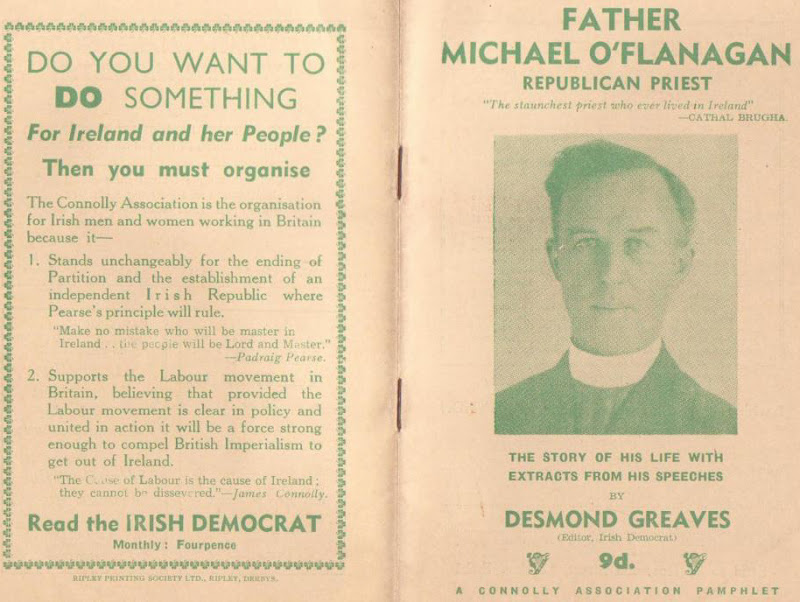
Cathal Brugha described Fr. Michael O'Flanagan as "the staunchest priest who ever lived in Ireland." This 'turbulent priest' died, aged 66, on this date (7th August) in 1942 - 82 years ago on this date.
Born to Irish speakers and into a clan of Fenians in Roscommon in 1876, Michael O'Flanagan was only 18 years young when he went to Maynooth College to study for the priesthood. He returned to his old alma mater , Summerhill College in Sligo and, at 24 years of age (in 1900), he was appointed 'Professor of Irish' in the college, from where he continued his involvement in Conradh na Gaeilge, through which he befriended Pádraig Mac Piarais and Douglas Hyde.
His church at first considered him to be a valuable asset and repeatedly sent him abroad on assignments, but less so over the years as he had a social conscience which took precedence over his church's need for him to be a 'team player' and, indeed, he embarrassed his church hierarchy when, at 37 years of age, he fully supported the Sligo dockers in their trade dispute in 1913 (even though he was working in Rome at the time, which is where he was based between 1912 and 1914) as, then as now, his religious 'betters' had more in common with the owners and bosses rather than the poorer workers.
In 1914 he was allocated to the parish of Ahamlish (North Sligo) before moving to Cliffoney, in that same county, and quickly became a true friend to the small farming community he now lived and worked with, and assisted them in their battle with the 'Congested Districts Board' who were trying to dictate the manner in which turf bogs could be used by the locals, an occasion that became known as the "Cloonerco Bog Fight".
During that 'turf war', Fr. O'Flanagan helped to organise the funeral of O'Donovan Rossa (pictured, who died on the 29th June 1915) and he spoke in Dublin City Hall when Rossa was lying in state there, which seemed to be 'the straw which broke the camel's back', as far as his Bishop (Coyne) was concerned - in October 1915, the church hierarchy attempted to transfer him to a new parish.
However, his friends and supporters in Cliffoney objected and physically prevented the new parish priest from taking up his priestly duties, a situation which lasted until Christmas Day.
Eventually, Fr. O'Flanagan was moved to Crossna, near Boyle, in County Roscommon, from where he continued to spread his own 'gospel' and that of Irish republicanism - he was vocally in favour of land reform and was strongly against Ireland taking any part in 'the First World War', 'forced' (by Westminster) or not to do so.
He worked in the background for Irish republicans during the 1916 Rising and became more politically involved in the years following same and, in October 1917, he was elected the vice-president of the then Sinn Féin organisation.
In May 1918, he condemned the English and German 'Establishments' for their encouragement to young men to join what they called "the war effort" :
"Those royal cousins who rule England and Germany will come together and clink their champagne glasses over the graves of millions of the flower of the manhood of Germany and England...", and, no sooner had he delivered those words to an appreciative audience when Bishop Coyne banned him from saying Mass in public or administering the sacraments and it would be 1938 before those duties were restored to him.
He played an active part in Sinn Féin's political victories that same year and was given the honour of opening the public session of the First Dáil Éireann in 1919 and was practically employed full-time in the 'Republican Courts' and in the development of the Dáil's land policy.
He stayed true to his political principles in 1921 and opposed the 'Treaty of Surrender', being barred from America and Australia for doing so.
He was elected president of Sinn Féin in 1933, a position which he held until 1935, but he was expelled from the organisation the following year because he breached the abstentionist policy.
He supported the Spanish Republic in its fight against Franco fascism from 1936 to 1939, which again put him at odds with his religious hierarchy, and undertook a number of speaking tours abroad in support of that fight.
Father Michael O' Flanagan, 66 years of age, died in Dublin on 7th August 1942 - 82 years ago on this date - and was buried in Glasnevin Cemetery on the 10th August. Fittingly, his graveside oration was delivered by John Joseph O'Kelly ('Sceilg') , an action that that 'turbulent priest' would have appreciated.
('1169' comment ; a headline/title like that above - 'Our Own Turf For Our Own People' - would definitely get us labelled as 'fascists/racists/far-right/ner-do-wells [!!?] etc in todays 'Woke'-infested climate and the three of us actually had a meeting about whether to change the title to 'Ireland For The Irish' instead, but sure we decided to keep the latter title for another piece later on...!)
'SINN FÉIN STATEMENT...'
From 'The United Irishman' newspaper, April 1955.
Mr McAteer assured the annual convention of the Anti-Partition League that there were happy improvements in the relationship between the "Irish Government" and the Anti-Partition League -
"We are reasonably satisfied with the new arrangements for co-operation, and we are moderately confident that it will lead to an intensification of the Anti-Partition drive, not only here but throughout the world."
At the same time, he informed the convention that the Anti-Partition League had... "..no master plan to solve partition."
It is possible that the results of the recent conference between political leaders in the twenty-six counties and representatives of the Anti-Partition League is an all-out effort to prevent Sinn Féin from succeeding where all others, on their own admission, have failed?
Issued by the Standing Committee, Sinn Féin.
(END of 'Sinn Féin Statement' and, actually, the 'end' of our 'The United Irishman' newspaper collection!
Next week [14th August 2024] we'll be re-posting articles from a 22-year-old Irish magazine [which was a great magazine once, 1980's/1990's, but went 'Woke' since then, unfortunately] and the first article is particularly timely, as it's to do with ethnicity in this State at that time which, today - 2024 - is, in our opinion, a characteristic that has changed for the worse, as far as the indigenous Irish are concerned.)
Thirty Pieces Of Silver...
On the 7th August, 1919, the British 'Chief Secretary for Ireland' (and also the '1st Baron Strathcarron'!), a Mr Ian James MacPherson, introduced a Bill in Westminster to increase the wages and improve the working conditions for their 'police force' in Ireland, the RIC.
Unemployed men were somewhat reluctant to join that semi-paramilitary grouping because the IRA were hitting back against it with some success and other Irish men and women were shunning it ; the wages were increased with fanfare to attract new recruits and to compensate for increased hardship and cost of living increases due to the fact that many shopkeepers were refusing to serve them, forcing them to obtain, usually with subterfuge, any food and other necessities from miles away.
It worked, and recruitment levels increased, as about 10,000 new members joined between January 1920 and August 1922, when the outfit was disbanded.
But their casualty rate also increased, as there were more of them presenting as targets and they were rushed into 'service' without suitable training ; between 1919 and 1922, more than 500 pro-British 'police casualties' (comprising the 'Dublin Metropolitan Police', the Auxiliaries, Black and Tans and 'Ulster Special Constabulary') were recorded ; in January 1919, the RIC claimed to have about 9,500 uniformed members and some 1,300 operational barracks in the country.
Swings and roundabouts...
==========================
SO, FAREWELL THEN, CELTIC TIGER....
It had to happen, sooner or later.
Most of the pundits and economists were too busy singing the Celtic Tiger's praises to notice, but a few critical observers worried all along about the weaknesses of a boom economy that depended so much on a few companies from one place - the United States.
By Denis O'Hearn.
From 'Magill' Annual 2002.
A populist social housing regime that provided affordable and reasonable housing to successive generations of low-income households broke down ; Irish citizens no longer have assured access to affordable housing.
In health, Ireland reduced spending as a proportion of GDP by 20 per cent between 1980 and 1996 and, even after an increase in health spending in 1998, Ireland still ranked 20th in a survey of 27 OECD countries.
Between 1970 and 1975 and 1995 and 2000, our global ranking with respect to life expectancy at birth fell by seven places - hospital waiting lists are still unacceptably long and may be on the way back up.
In education, we have performed poorly, in spite of the public image that growth is due to a highly educated population...
(MORE LATER.)
On the 7th August, 1920, IRA Volunteers attached to the Cork Number 1 Brigade were getting into position to attack a better-armed force of RIC members in their barracks in Innishannon, County Cork, when one of the rebels discharged his weapon accidentally, thus alerting the enemy ; the operation was postponed, and the Volunteers withdrew from the area.
The same IRA Brigade had, between April and July that year, rendered inoperable RIC Barracks in Blarney, Farran, Inchigeela, Clondrohid and in Cork City (MacCurtain Street).
By the end of 1920, nearly half of the 1500 RIC barracks in the country had been abandoned, and most were burned by the IRA within days of their evacuation.
Indeed, purposely, hundreds of those were rendered inoperable by the IRA on the night of the start of the fourth anniversary of the Easter Rising in 1916 - 24th April 1920!
==========================
Between thirty and forty Irish republican operatives were said to be involved in the planning etc of the overall IRA operation, but the actual ambush itself involved only about between eleven and fourteen armed IRA Volunteers from the Castletownroche Battalion, Cork Number 2 Brigade (under Tom Barry, Battalion Officer Commanding/Column Commander) and the IRA East Limerick Brigade Column (led by Donnchadh O'Hannigan and Tadhg Crowley).
The movement of a six-man RIC grouping had been monitored and an ambush position established, on the 7th August, 1920, at the townland of Scart, near
the village of Cill Dairbhre (Kildorrery, the 'Church of the Oakwood'), in North County Cork.
It was just before Noon on the 7th that the RIC members came under gunfire attack, from both sides of the road they were on, and all six were wounded.
The IRA Volunteers moved-in on the wounded forces and removed rifles, six revolvers and 250 rounds of ammunition and any other military equipment from them, taking two of them as prisoners and, once safely out of the area, released the two of them.
The other wounded RIC members were rescued by their colleagues and rushed to Fermoy Military Hospital where all but one survived - a Mr Ernest S. Watkins (29, 'Service Number 71756/LDS 2093/074B'), who was born in Monmouth, in Wales, on the 26th February 1891, and had been an RIC member for just over one month and, prior to that, worked as an engineer, leaving that trade to join the British Army and, finally, the RIC.
The next night (8th August 1920), the Crown Forces attacked the village of Kildorrery, looting houses, getting drunk and stealing from shops.
And it didn't stop there - on the 23rd November that year, a civilian - Denis O'Donnell (37), from Meadstown, near Kildorrery - was shot dead by three RIC members named Wood, Coe and Gray who were seeking to avenge the death of their colleague Mr Watkins.
Had Mr Watkins stayed in his own country, Mr O'Donnell wouldn't have died in the manner he did.
==========================
On the 7th August, 1920, the British Army re-organised itself in Ireland and established its '1st Infantry Division', consisting of two military brigades – the '15th Infantry Brigade', with its Headquarters in Belfast, covering the counties of Antrim, Armagh, Louth, Down and Monaghan, and the Derry Brigade, with its Headquarters in Derry City, and covering the counties of Donegal, Derry, Tyrone, Cavan, Fermanagh, Sligo and North Leitrim.
They sought to militarily control all 9 Counties of Ulster yet, within a few months, were professing that the province of Ulster consisted only of Six Counties...!
==========================
On the 7th August, 1920, 'The Roscommon Herald' newspaper reported that -
'...(the boycott of the RIC continues)...throughout County Leitrim the boycotting of police (sic) is carried on and there is no outside intercourse with or assistance in any way given to members of that body..'
On the 23rd April 1919, the (Republican) Dáil Éireann secretary, a Mr Diarmuid O'Hegarty, wrote out a detailed description of the policy of 'social ostracisation’ of the RIC, which had been authorised by the Dáil earlier that month. The RIC, he wrote, was to...
'...receive no social recognition from the people ; that no intercourse, except such as is absolutely necessary for business, is permitted with them ; they should not be saluted nor spoken to in the streets nor their salutes returned ; that they should not be invited to nor received in private houses as friends or guests ; that they be debarred from participation in games, sports, dances and all social functions conducted by the people, that intermarriage with them be discouraged...treated as persons, who having been adjudged guilty of treason to their country, are regarded unworthy to enjoy any of the privileges or comforts which arise from cordial relations with the public...'
And so it was!
And, actually, so it should be today, too, for the RUC/PSNI in the Occupied Six Counties and for 'An Garda Síochána' (AGS) in the Free State.
==========================
On the 6th January, 1920, IRA Volunteers held a meeting in the home of a Mr Bartholomew (Bartelmew) Walsh in the village of Glashabee, in County Cork, and the '(North) Cork Number 2 Brigade' of the IRA was formed.
The Brigade was monitored closely by GHQ Staff in Dublin and, even thought it was considered to be a successful formation, a decision was made to establish a 'Flying Column' from within its ranks and, on the 7th August that year, it was formed at a meeting held in Mourneabbey, near the town of Mallow, in County Cork (commanded by Tom Barry) attended by, among others, Patrick McCarthy, Michael O'Sullivan, Dan Browne (Newmarket Battalion), Larry Condon, John O'Mahony, Daniel Daly, Matt Flood (Fermoy Battalion), Daniel Shinnick, Jeremiah Donovan, James O'Neill, Michael O'Halloran (Castletown Roche Battalion), Patrick O'Brien, Thomas Coughlan (Charville Battalion), Daniel Vaughan (Kanturk Battalion), John Healy, Patrick Healy (Millstreet Batallion), Tadgh Byrnes, Jack Cunningham, Paddy McCarthy (from Mourneabbey), Owen Harold and Jeremiah Daly (Mallow Battalion).
When the 'Treaty of Surrender' offered a 'truce', which came into effect on the 11th July, 1921, the strength of the Cork Number 2 Brigade was 2,407 Volunteers and, overall, the IRA fielded a total 65 brigades and 297 battalions, with a strength ('on paper') of 115,550 Volunteers.
==========================
In July, 1920, courthouses in Buncrana, Carndonagh and Burnfoot, in Donegal, were burned down by the IRA to hopefully prevent any further miscarriages of 'justice' by the British political administration in Ireland.
The courthouse in Donegal Town (pictured), which was designed by local architect Michael Priestley and built in 1746, was one of only two 'Bridewells' in the county (ie it was built with basement cells), was burnt to the ground on the 7th August, 1920, following a gunbattle between the IRA and the RIC.
A Mr Harold Swan applied for compensation for the burning of the courthouse furniture, for 60 legal texts, 12,000 printed forms, and a gold mounted fountain pen.
He lodged a claim for £100 and we're not sure if he won his case, but he doesn't appear to have lodged a claim for a leather or fur coat or 60" TV...!
==========================
BEIR BUA...
The Thread of the Irish Republican Movement from The United Irishmen through to today.
Republicanism in history and today.
Published by the James Connolly/Tommy O'Neill Cumann, Republican Sinn Féin, The Liberties, Dublin.
August 1998.
('1169' comment - 'Beir Bua' translates as 'Grasp Victory' in the English language.)
REPUBLICANS AND THE STATE :
In a statement on December 8th, 1938, the surviving faithful members of the Second Dáil announced this decision...
"..confident, in delegating this sacred trust to the Army of the Republic that, in their every action towards its consummation, they will be inspired by the high ideals and the chivalry of our martyred comrades, we, as the Executive Council of Dáil Éireann, Government of the Republic, append our names.
Seán O' Ceallaigh, Ceann Comhairle,
George Count Plunkett,
Professor William Stockley,
Mary MacSwiney,
Brian Ó hUiginn,
Tom Maguire,
Cathal Ó Murchadha.
In December, 1969, following a split in the Republican Movement over the issue of the recognition of and participation in the Partition and Westminster parliaments, Thomas Maguire, as the sole surviving member of the Executive of the Second Dáil Éireann, recognised the Provisional Army Council, which remained true to the Irish Republic as the lawful Army of the Thirty-Two County Irish Republic...
(MORE LATER.)
In August, 1921, the IRA had taken over policing duties in nationalist/republican areas of Belfast and were reporting to one of their own leadership figures, a Mr Eoin O'Duffy (a republican-gamekeeper-turned-Free State-poacher).
On the 6th August, Mr O'Duffy wrote to the RIC Commissioner in Belfast, a Mr John Fitzhugh Gelston, telling him that the IRA patrols on the streets had been able to "frustrate any behaviour which might lead to serious disturbances" (ironic, considering that it was the RIC and other pro-British forces that were causing the disturbances in Ireland in the first place).
On the 7th August, the unionist/loyalist leadership in Belfast contacted Mr John Fitzhugh Gelston to object 'to the legitimacy bestowed on the IRA by the RIC (which was) resented by the unionists especially as the Truce meant a delay in the transfer of executive powers to Stormont..'
But Mr John Fitzhugh Gelston obviously survived the ticking-off (!) from his unionist/loyalist colleagues and from their political pals in Westminster because, in the 'King's Birthday Honours List' of 1923, he was 'appointed' as a 'Commander of the Order of the British Empire' (a 'CBE') in the 'Civil Division' of said 'List'.
Good on ya, Johnny - neither the IRA or the RIC could get ya, but the CBE did...!
==========================
On the 7th August, 1922, Michael Collins arrived in the Curragh, Kildare, to inspect and advise his troops stationed there, who were under the command of Commandant General John T. Prout.
He told them that "...the entire organisation and command is defective.." and placed a new Commandant-General in charge, a Mr Eamon Price.
Mr Price was the husband of Máire Nic Shiubhlaigh, an Irish actress and one-time republican activist, and was apparently not enamoured of some of his high-ranking comrades in the Free State Army - for instance, he described the FSA command staff in Kilkenny as being 'a dumping ground for cowardly, useless and otherwise buckshee officers...' ('1169' comment - WHAT?! Only the command staff...?)!
A few weeks after Mr Price's promotion (!), an FSA report on his predecessor, Mr Prout, was leaked, in which he was labelled as "..too weak as well as too guilless to handle traitorous or semi-mutinous incompetents.." - the "traitorous...semi-mutinous incompetents" was a reference to the Free State soldiers that comprised that army!
Two weeks and one day after his visit to the Curragh, Mr Collins was shot dead in Béal na Bláth, in Cork, by the IRA, but Mr Prout fared somewhat better - he was only mentally and morally wounded by being demobilised from the Free State Army in June 1924, at a time when he held the rank of Major General.
Incidentally, when Mr Collins was 'shuffling his deck' in the Curragh on the 7th August, the IRA demolished a railway bridge on the line between Kildare and Kildangan, not too far from where he was.
Sure it's just as well that he wasn't intending to get the train back to Dublin or Westminster or wherever he was going, as he might have been injured had he been on board...
==========================
Thanks for the visit, and for reading!
Sharon and the team.