ON THIS DATE (12TH MAY) 105 YEARS AGO - NO PLACE AT THAT TABLE FOR THIS CHAIR.
If we had more time, we would give a brief history and/or mention of all those Irish men and women for whom this month carries special significance, but such is the level of destruction wrought on this country by the British over an on-going period of more than 850 years, and the huge number of Irish 'dissidents' that tried to right those wrongs, we are unable to do so but, nonetheless, we will try to do those brave people justice by posting a few words about just one of them - James Connolly, executed by the British on the 12th May 1916 - 105 years ago on this date.
All shared the same objective : to remove the British military and political presence from Ireland, not to be co-opted onto its 'board of management', as those in Leinster House and Stormont have been.
James Connolly was born on June 5th, 1868, at 107, the Cowgate, Edinburgh. His parents, John and Mary Connolly, had emigrated to Edinburgh from County Monaghan in the 1850s. His father worked as a manure carter, removing dung from the streets at night, and his mother was a domestic servant who suffered from chronic bronchitis and was to die young from that ailment.
Anti-Irish feeling at the time was so bad that Irish people were forced to live in the slums of the Cowgate and the Grassmarket which became known as 'Little Ireland'. Overcrowding, poverty, disease, drunkenness and unemployment were rife - the only jobs available was selling second-hand clothes and working as a porter or a carter.
James Connolly went to St Patricks School in the Cowgate, as did his two older brothers, Thomas and John. At ten years of age, James left school and got a job with Edinburgh's 'Evening News' newspaper, where he worked as a 'devil', cleaning inky rollers and fetching beer and food for the adult workers. His brother Thomas also worked with the same newspaper.
In 1882, aged 14, James Connolly joined the British Army in which he was to remain for nearly seven years, all of it in Ireland, where he witnessed first hand the terrible treatment of the Irish people at the hands of the British. The mistreatment of the Irish by the British and the landlords led to Connolly forming an intense hatred of the British Army.
While serving in Ireland, he met his future wife, a Protestant named Lillie Reynolds. They were engaged in 1888 and the following year Connolly discharged himself from the British Army and went back to Scotland. In 1890, he and Lillie Reynolds were wed in Perth and, in the Spring of that year, James and Lillie moved to Edinburgh and lived at 22 West Port, and joined his father and brother working as labourers and then as a manure carter with Edinburgh Corporation, on a strictly temporary and casual basis.
He became active in socialist and trade union circles and became secretary of the 'Scottish Socialist Federation', almost by mistake. At the time his brother John was secretary; however, after John spoke at a rally in favour of the eight-hour day he was fired from his job with the corporation, so while he looked for work, James took over as secretary. During this time, Connolly became involved with the Independent Labour Party which Kerr Hardie formed in 1893.
In late 1894, Connolly lost his job with the corporation. He opened a cobblers shop in February 1895 at number 73 Bucclevch Street, a business venture which was not successful. At the invitation of the Scottish socialist, John Leslie, he came to Dublin in May 1896 as paid organiser of the 'Dublin Socialist Society' for £1 a week. James and Lillie Connolly and their three daughters, Nora, Mona and Aideen set sail for Dublin in 1896, where he founded the Irish Socialist Republican Party in May of 1896.
In 1898, Connolly had to return to Scotland on a lecture and fund-raising tour. Before he left Ireland, he had founded 'The Workers' Republic' newspaper, the first Irish socialist paper, from his house at number 54 Pimlico, where he lived with his wife and three daughters. Six other families, a total of 30 people, also lived in number 54 Pimlico, at the same time!
In 1902, he went on a five month lecture tour of the USA and, on returning to Dublin, he found the ISRP existed in name only. He returned to Edinburgh where he worked for the Scottish District of the Social Democratic federation. He then chaired the inaugural meeting of the Socialist Labour Party in 1903 but, when his party failed to make any headway, Connolly became disillusioned and in September 1903, he emigrated to the USA and did not return until July 1910. In the US, he founded the Irish Socialist Federation in New York, and another newspaper, 'The Harp'.
In 1910, he returned to Ireland and in June of the following year he became Belfast organiser for James Larkin's Irish Transport and General Workers Union. In 1913 he co-founded the Labour Party and in 1914 he organised, with James Larkin, opposition to the Employers Federation in the Great Lock-Out of workers that August. Larkin travelled to the USA for a lecture tour in late 1914 and James Connolly became the key figure in the Irish Labour movement.
The previous year, 1913, had also seen Connolly co-found the Irish Citizen Army, at Liberty Hall, the headquarters of the ITGWU - this organisation, the ICA, was established to defend the rights of the working people. In October 1914, Connolly returned permanently to Dublin and revived the newspaper 'The Workers' Republic' that December following the suppression of his other newspaper, 'The Irish Worker'. In 'The Workers' Republic' newspaper, Connolly published articles on guerrilla warfare and continuously attacked the group known as The Irish Volunteers for their inactivity. This group refused to allow the Irish Citizen Army to have any in-put on its Provisional Committee and had no plans in motion for armed action.
The Irish Volunteers were by this time approximately 180,000 strong and were urged by their leadership to support England in the war against Germany. It should be noted that half of the Provisional Committee of the Irish Volunteers were John Redmond's people, who was the leader of the Irish Parliamentary Party. The Irish Volunteers split, with the majority siding with Redmond and becoming known as the National Volunteers - approximately 11,000 of the membership refused to join Redmond and his people.
However, in February 1915, 'The Workers' Republic' newspaper was suppressed by the Dublin Castle authorities. Even still, Connolly grew more militant. In January 1916, the Irish Republican Brotherhood had became alarmed by Connollys ICA manoeuvres in Dublin and at Connollys impatience at the apparent lack of preparations for a rising, and the IRB decided to take James Connolly into their confidence. During the following months, he took part in the preparation for a rising and was appointed Military Commander of the Republican Forces in Dublin, including his own Irish Citizen Army. He was in command of the Republican HQ at the GPO during Easter Week, and was severely wounded. He was arrested and court-martialed following the surrender.
On May 9th, 1916, James Connolly was propped up in bed before a court-martial and sentenced to die by firing squad - he was at that time being held in the military hospital in Dublin Castle. In a leading article in the Irish Independent on May 10th William Martin Murphy, who had led the employers in the Great Lock-out of workers in 1913, urged the British Government to execute Connolly.
At dawn on May 12th 1916 - 105 years ago on this date -James Connolly was taken by ambulance from Dublin Castle to Kilmainham Jail, carried on a stretcher into the prison yard, strapped into a chair in a corner of the yard and executed by firing-squad. Connolly's body, like that of the other 14 executed leaders, was taken to the British military cemetery adjoining Arbour Hill Prison and buried, without coffin, in a mass quicklime grave.
The fact that he was one of the seven signatories of the 1916 Proclamation bears evidence of his influence. He had told the Irish Citizen Army, on 16th April, 1916, that "..the odds are a thousand to one against us, but in the event of victory, hold onto your rifles, as those with whom we are fighting may stop before our goal is reached..."
He died, strapped to a chair, but that should not be seen to infer that he wanted that chair placed at a table where a compromise would be the outcome.
James Connolly, 5th June 1868 - 12th May 1916. Executed by the British at 47 years of age.
'WOLFE TONE COMMEMORATION.'
From 'The United Irishman' newspaper, June, 1955.
WOLFE TONE COMMEMORATION, BODENSTOWN, SUNDAY 19TH JUNE.
Parade will leave Sallins at 2.30pm. Oration by Eamonn Thomas, Dublin.
Thomas White, Los Angeles, will speak on behalf of Clan na Gael, America.
Special trains will leave Kingsbridge at 12.15pm, returning from Sallins at 6.30pm.
Commemoration Ceilidhe ; in the Mansion House. Ceol Colmcille, 8.0 to 11.30, Tickets 2/-.
BREAK THE CONNECTION WITH ENGLAND.
Published by the Republican Publications, Seán Treacy House, 94 Seán Treacy Street, Dublin, and printed by the Marian Printing Company Limited, 33 Rutland Place North, North Circular Road, Dublin.
(Please note - some details here in regards to the up-coming Bodenstown Commemoration for 2021.)
(END of 'Wolfe Tone Commemoration': NEXT - 'Aithbheochaint Na Gaedhilge', from the same source.)
ON THIS DATE (12TH MAY) 105 YEARS AGO : SEÁN MacDIARMADA EXECUTED BY THE BRITISH.
Seán MacDiarmada (pictured) was born in January 1883 in Corranmore (near Kiltyclogher), in County Leitrim, and studied at the local national school, before attempting to qualify as a teacher but he failed the exams.
He worked for a short time as a gardener in Edinburgh, in Scotland, later moving to Belfast where he lived between 1905 and 1906 and, while there, he joined the 'Ancient Order of Hibernians' (AOH) but his views of the national situation became ever more radicalised and by 1906 he had been sworn in as a member of the 'Irish Republican Brotherhood'.
He was one of the major strategists behind the planning of the 1916 Easter Rising, although most of his work in that regard was done 'off radar' and at great physical discomfort to himself - he was partially disabled by polio, but never let that interfere with his work to remove the British military and political presence from Ireland.
On the 12th of May, 1916 - 105 years ago on this date - Seán MacDiarmada [and James Connolly] were executed by a British Army firing squad in Kilmainham Jail in Dublin.
His last letter, written to his comrade John Daly, read as follows -
'Kilmainham Prison,
Dublin,
May 11th 1916.
My Dear Daly,
Just a wee note to bid you Goodbye. I expect in a few hours to join Tom and the other heroes in a better world. I have been sentenced to a soldiers death - to be shot tomorrow morning .
I have nothing to say about this only that I look on it as a part of the day's work. We die that the Irish nation may live. Our blood will rebaptise and reinvigorate the old land. Knowing this it is superfluous to say how happy I feel.
I know now what I have always felt, that the Irish nation can never die. Let present day place hunters condemn our action as they will, posterity will judge us aright from the effects of our action.
I know I will meet you soon, until then GoodBye. God guard and protect you and all in No. 15. You have had a done trial, but I know quite well that Mrs. Daly and all the girls feel proud in spite of a little temporary and natural grief, that her son and the girls, their brothers as well as Tom are included in the list of honours.
Kindly remember me especially to Mrs. Clarke and tell her I am the same Seán that she always knew.
God Bless you all,
As ever,
Sincerely Yours,
Seán MacDiarmada.'
"We bleed that the nation may live. I die that the nation may live. Damn your concessions England, we want our country..." ; Seán MacDiarmada, 27th January 1883 – 12th May 1916.
ON THIS DATE (12TH MAY) 102 YEARS AGO : SEÁN HOGAN AND THE STATION OF KNOCKLONG.
Seán Hogan (pictured) was practically still in his teenage years when he was appointed as one of those in command of the 'Third Tipperary Brigade' of the IRA, a leadership group which became known by the British as 'The Big Four' - Dan Breen, Seán Treacy, Seamus Robinson and Seán Hogan.
Seán was born in Tipperary in 1901 and, at just 18 years of age, he took part in the Soloheadbeg ambush on the 21st of January in 1919, in which two Crown force personnel (James McDonnell and Patrick O'Connell) were killed as they drew their weapons. The British went all out to capture or execute those responsible and, on the 12th of May 1919 - 102 years ago on this date - Seán was taken prisoner at a friends house, the Meagher's, at Annfield, in Tipperary, and taken to Thurles RIC barracks to be held overnight, and then transported to Cork.
The following morning he was taken by a four-man armed British military escort to Knocklong train station and the five men got on board a train ; Hogan, who was handcuffed, was put sitting between RIC Sergeant Wallace and Constable Enright, both of whom were armed with revolvers, and Constables Ring and Reilly, carrying shotguns, sat opposite the three men.
Seán Hogan, pictured, thought to be about 20 years young when this photograph was taken.
An IRA unit, led by Seán Treacy, Dan Breen, Seamus Robinson and Eamonn O'Brien, and including Ned Foley, Seán Lynch, John Joe O'Brien, Ned O'Brien and Jim Scanlon (all from the East Limerick Brigade IRA) located the compartment where Seán was being held against his will and Seán Treacy and Eamonn O'Brien drew their revolvers and walked through the train to the compartment ; on entering same, they loudly instructed all present to put their hands up and called for Seán to make his way to them.
RIC Constable Enright placed his revolver against Hogan's neck, using him as a shield, but was shot dead as he did so, as both Treacy and O'Brien had fired at him (Eamonn O'Brien was to say later that they would not have shot Enright had he not attempted to attack Hogan) and Seán, still handcuffed, took that opportunity to land a two-handed punch to the face of Constable Ring, who was sitting opposite him.
Seán Treacy and RIC Sergeant Wallace were trading punches, as were Eamonn O'Brien and Constable Reilly, when one of the IRA men managed to take Reilly's shotgun from him and smashed him over the head with it. He collapsed in a heap on the carriage floor. Constable Ring, meanwhile, found himself on the platform, having exited the carriage through a window, and withdrew from the area.
Seán Treacy and RIC man Wallace were still trying to get the better of each other, with Treacy telling Wallace to give it up as he was outnumbered and had lost his prisoner, but Wallace refused to do so. Both men were now grappling for Wallace's Webley revolver and Wallace managed to get enough control over it to fire a shot, which hit Seán Treacy in the neck - in that same instance, IRA man Eamonn O'Brien fired at Wallace, killing him instantly. Treacy survived, and was recorded later as saying "I thought I was a dead man. I had to hold my head up with both hands, but I knew I could walk."
Seán Hogan remained active in the struggle : he operated in Dublin, Kilkenny and Tipperary, was involved in the 'French Ambush' and was also heavily involved in raids on various RIC barracks and remained active until the Treaty of Surrender was being discussed, a 'compromise' which he was unable to support or condemn - he left the Republican Movement at that point and returned to Tipperary, to try and earn a living as a farmer. But he couldn't, and moved to Dublin where he got married and fathered a child, but the times were tough, economically, and he and his family could only afford to live in a slum tenement building in North Great George's Street.
He was suffering from depression at this stage and voiced disappointment that the Ireland he was living in was not that which he had fought for. He died, penniless, at 67 years of age, in 1968, and was buried in Tipperary town.
The news has spread through Ireland and spread from shore to shore
Of such a deed, no living man has ever heard before
From out a guarded carriage mid a panic stricken throng
Seán Hogan, he was rescued at the station of Knocklong
When a guard of four policemen had their prisoner minded well
As the fatal train sped o’er the rails, conveying him to his cell
The prisoner then could scarce foretell, of hearts both brave and strong
That were planning for his rescue at the station of Knocklong
The shades of eve were falling fast when the train at last drew in
It was halted for an hour or so by a few courageous men
They sprang into the carriage and it did not take them long
'Hands up or die' was the rebel cry at the station of Knocklong
King George’s pampered hirelings, they shrivelled up with fear
And thought of how they placed in cells, full many a Volunteer
Now face to face with armed men, to escape, how they did long
But two of them met with traitors deaths at the station of Knocklong
From Sologhead to Limerick, such deeds as these were never seen
And devil a tear was ever shed for Wallace of Roskeen
They did old England's dirty work and did that work too long
But the renegades were numbered up at the station of Knocklong
Now rise up Mother Erin and always be of cheer
You’ll never die while at your side there stand such Volunteers
From Dingle Bay to Garryowen, the cheers will echo long
Of the rescue of Seán Hogan at the station of Knocklong.
NO RIGHT OF APPEAL...
Why the media consensus on a broad range of issues is increasingly disturbing. By John Drennan.
From 'Magill' Annual, 2002.
The media consensus in favour of moral equivalence proved it could transcend boundaries, as Fintan O'Toole tutted about the American tendency "to divide the world between the forces of God and Satan", stating that "American fundamentalism" was as bad as that of Afghanistan. Every two-bit Irish hack who weighed in against America in those first few days after September 11th was writing, in his or her head, against the vast media consensus which supported America in everything it did.
The only problem was that the consensus didn't exist ; instead, in column after column of pseudo-outspoken caution, the reaction became the norm. Call it liberal posting, call it intellectual laziness, call it what you will - Irish journalists were frenziedly reading the collected works of Robert Fisk and Nick Cohen and weighing in behind the anti-American cause without remotely understanding the issues the way that either of these journalists do.
Mary Ellen Synon's response to this blather would have been interesting. However, as we have noted, Mary Ellen was taken care of a bit earlier in the year. The real triumph of programming belonged to 'Questions And Answers' as in two consecutive weeks not one pro-American sentiment was expressed by its audience. It was about the only place in the world where Mr Osama Bin Laden would have felt comfortable. Eventually, even RTE's 60's flower-power liberal anti-American collective realised there was a need for a bit more subtlety ; after all, even 'The Irish Times' was being neutral on the war. The station's 'Robinsonistas' promptly discovered a humanitarian crisis. They were only four years late...
(MORE LATER.)
ON THIS DATE (12TH MAY) 40 YEARS AGO : 'THE BOY FROM TAMLAGHTDUFF' DIES ON HUNGER-STRIKE.
"I have no prouder boast than to say I am Irish and have been privileged to fight for the Irish people and for Ireland. If I have a duty I will perform it to the full in the unshakable belief that we are a noble race and that chains and bonds have no part in us..." - these are the words of Hunger Strike Francis Hughes, written in a letter addressed to the people of South Derry and surrounding areas five days before he embarked on his hunger strike.
He was born into a republican family on the 28th of February 1956, the youngest son amongst ten children, in Tamlaghduff, County Derry. He left school at 16 years young and started working with a relative as a painter and decorator, a job he excelled at and could have made a good living from, but the political and military atmosphere of trying to live in an occupied area made his mind up for him : in his late teenage years, like so many other young adults before and since, he joined the IRA.
In March, 1978, Francis, 23 years of age, was badly wounded after a gunbattle with British forces ("Francis Hughes was very active in the area. I arrested him after an IRA gun battle in which a soldier was killed. Hughes had escaped but a large chunk of his thigh bone had been shot away. We were there in the dark of night, with torches, following a trail of bullets, blood and a beret he'd discarded when crawling away. He hid for hours in thorn bushes until he was in such pain that he shouted to a soldier. He was very dehydrated but as he was being carried away on a stretcher, he raised a clenched fist and yelled 'Up the Ra...!" -from here) and the British breathed a sigh of relief ; 'the most wanted man in the North' had been imprisoned and neutralised. They thought.
But, on Sunday, the 15th of March, in 1981, the British had to think again - Francis Hughes joined Bobby Sands on hunger-strike. Bobby died on the 5th of May and Francis died on the 12th of May - 40 years ago on this date - still fighting against the British military and political presence in Ireland.
'As I walked through the Glenshane Pass I heard a young girl mourn
"The boy form Tamlaghtduff" ,she cried, "is two years dead and gone"
How my heart is torn apart this young man to lose
Oh I'll never see the likes again of my young Francis Hughes.
For many years his exploits were a thorn in Englands side
The hills and glens became his home there he used to hide
Once when they surrounded him he quietly slipped away
Like a fox he went to ground and kept the dogs at bay.
Moving round the countryside he often made the news
But they could never lay their hands on my brave Francis Hughes
Finally they wounded him and captured him at last
From the countryside he loved they took him to Belfast.
Oh from Musgrave Park to the Crumlin Road and then to an H-Block cell
He went straight on the blanket then on hungerstrike as well
His will to win they could never break no matter what they tried
He fought them every day he lived and he fought them as he died.
As I walked through the Glenshane Pass I heard a young girl mourn
'The boy form Tamlaghtduff 'she cried 'is two years dead and gone'
How my heart is torn apart this young man to lose
Oh I'll never see the likes again of my young Francis Hughes.'
Francis Hughes, IRA Volunteer, 1956 - 1981.
'WITH THE IRA IN THE FIGHT FOR FREEDOM.'
From 'The United Irishman' newspaper, March, 1955.
These men achieved much because they were prepared to give much. They saw the relations between themselves and their country in terms of giving, not taking. They were prepared to give their minds, their energies and, if necessary, their lives, to the service of their country and the knowledge that they were serving their country was the only reward they either sought or desired.
If we are to take up the task where they left off we must relearn this lesson of service.
Join the Republican Movement!
(END of 'With The IRA In The Fight For Freedom' ; NEXT - 'Force : Moral Or Physical?', from the same source.)
Thanks for reading,
Sharon.
ON THIS DATE (17TH FEBRUARY) 125 YEARS AGO : JOHN REDMOND'S PLEA IN WESTMINSTER FOR IRISH POLITICAL PRISONERS GOES UNHEEDED.
On the 17th February, 1896 - 125 years ago on this date - John Redmond (pictured) secured speaking time in the Westminster Parliament to discuss the plight of Irish political prisoners held in prison by the British political administration.
Such was the dire conditions endured by our prisoners, two 'Irish Unionist' (Free Stater-) members of that political administration - Horace Plunkett and W.E.H. Lecky - actually supported Mr Redmond in his attempt to secure some sort of justice for those POW's.
During his plea to 'The House', Mr Redmond said - "...many hon. Members seemed to think that because it was contended that these were political prisoners who ought to be released, the Irish Members were thereby claiming that political offences ought not to be punished. Nothing could be more absurd. What they said was that there was a distinction drawn by all the nations in the world between the treatment of political offences and offences which sprang from the ordinary criminal instincts of mankind, and in dealing with every other nation in the world except with Ireland, England had been the first to draw this distinction...
...all persons to-day would admit that John Mitchell (pictured) was a political offender, but Englishmen of his day did not admit it, and they passed a special Act of Parliament dealing with the subject of treason in order that he might be treated, not as a political offender, but as an ordinary criminal. All men of all parties admitted that the Fenians were political offenders, but anyone who listened to the speech of the hon. Member for South Mayo (Mr. Davitt) the other night, who knew his history, and heard what he suffered in prison, would recognise that though he was a political offender he was not treated as such. In this case the Government still maintained the fiction that these men were not political prisoners; but when all these men had been released, and when another generation of Englishmen looked back on these transactions, they would, perhaps, be just as willing to admit that they were political prisoners as men of the present day were willing to admit that the hon. Member for South Mayo (Mr. Davitt) and John Mitchell were political prisoners of their day...

(END of 'Occupation Forces Augmented' ; NEXT - 'New Choir' and 'Ireland's Soldiers Remembered', from the same source.)
ON THIS DATE (17TH FEBRUARY) 175 YEARS AGO : ATTEMPTED GENOCIDE RAISED IN THE BRITISH PARLIAMENT.
On the 17th February, 1846 - 175 years ago on this date - speaking in the British so-called 'House of Commons', Daniel O'Connell (pictured) raised, among other issues, the potato blight in Ireland, and the effect it was having on 'her majesty's subjects' on that island.
The 'servants of the people' in that political institution were only too aware of the suffering that the Irish were trying to live through, and O'Connell was aware of that, but he was hoping that his comments would be carried in the newspapers and reach a wider audience.
This is an extract of the speech he delivered -
"...It was certain that there was a fearful prospect of a most calamitous season before the people of Ireland. The extent of that calamity had been disputed, and there had been a time when there was a prospect of some portion of it being possibly averted..the calamity was pressing, was imminent – more pressing, more imminent, and more fearful than that House was aware of. In order to understand it, it was right that the House should be made aware of the state of Ireland before the calamity, had impended.
The last Population Returns of 1841 showed that, out of the whole rural population of Ireland, 46 per cent lived in a single room ; the entire human family and the pigs occupied the same apartment together. The next fact was, that of the civil population – that is, of the inhabitants of towns – 36 per cent lived in a single room, and that two or three families sometimes occupied the same room.
An account of all cattle, sheep, and swine, imported into Great Britain from Ireland, from the 10th day of October, 1845, to the 5th day of January, 1846 ; oxen, bulls, and cows, 32,883 ; calves, 583 ; sheep and lambs, 32,576 ; swine, 104,141..more than half the potato crop is unfit for human food, and the disease is progressing. More than half the labourers are unemployed, and are likely to continue so for the next three months, and during the months of July and August, as the farmers will not have money nor food to give them.
The agricultural labourers of Ireland suffer the greatest privations and hardships ; that they depend upon precarious and casual employment for subsistence ; that they are badly housed, badly fed, badly clothed, and badly paid for their labour ; that it would be impossible to describe adequately the sufferings and privations which the cottiers and labourers and their families in most parts of the country endure ; that in many districts their only food is the potato, their only beverage water ; that their cabins are seldom a protection against the weather ; that a bed or blanket is a rare luxury ; and that nearly in all, their pig and their manure heap constitute their only property ; that a large proportion of the entire population comes within the designation of agricultural labourers, and endure sufferings greater than the people of any other country in Europe have to sustain..." (from here.)
The finely-suited 'parliamentarians' in that institution were aware of the suffering endured by the Irish, as policies enacted and enforced by Westminster was responsible for the genocide being played-out in Ireland, but they didn't care, as they themselves were not only not affected by those conditions but actually benefited, financially, from same ; Irish land, free of impoverished 'tenants', was more valuable and easier to sell than if the same land was sold with 'troublesome tenants' on it.
That mindset is still prevalent in British 'High Society' to this day, but here's a newsflash for our snob Brit readers - we ain't goin' nowhere ; this is our country, not a political and/or military base for your good selves. Take your unwanted debris back to your own country, and leave us in peace!
'IN THE NAME OF THE LAW...'
Confidence in the Garda Siochana continues to erode as more incidents of questionable Garda 'evidence' emerge.
By Sandra Mara.
From 'The Magill Annual', 2002.
Edward Moss said he eventually made a statement when he was told (by the gardai) that he'd never work in Donegal again if he didn't. In it, he claimed that Frank McBrearty gave him £15,000 not to make a complaint. He was reluctant to go to court, but was subpoenaed to attend. 'Magill' spoke to John Fahy, Moss's solicitor in Strabane, who wrote to the gardai on his client's behalf ; "You have insisted that he attend at the Garda Station to make statements, which statements have not been made voluntarily". John Fahy put the gardai on notice that if they persisted in contacting his client he would take proceedings to restrain them from doing so.
He says he no longer works in Donegal courts because of the difficulties he encountered - "I found some gardai were intimidatory towards me as an extension of the client. I accepted that situation prevailed in the North, but I expected more from the gardai in the South*. Unfortunately, that is not the case. I'd rather take my chances in a Northern court..."
(*'1169' comment - the 'cops' (ie State security service) on this island, North and South, will collaborate with each other in all cases to do with 'security matters' ; if they believe you have got the better of them in the North then you have made enemies with them, too, in the South, and vice versa.) (MORE LATER.)
'LICENSED TO KILL...'
From 'The United Irishman' newspaper, March, 1955.
One aspect of this whole business must be emphasised over and over again ; that is, it is the deliberate policy of the Stormont junta to provoke and incite the 'B Specials' to cause these incidents. They are frantically anxious to bring about sectarian strife in the Six County area and the instrument ready fashioned for this purpose is the 'B Special police force'. It was founded for this purpose and is maintained and used today for this purpose.
Deliberately, they are organised, instructed and trained to carry on a campaign of hostility and outrage on behalf of the Orange Order against the nationalist people in the North. They are the weapon which the Stormont junta inevitably falls back on in times of stress, whether that stress arises from economic or national causes. The Stormont junta know that the continuance of the Six County puppet State cannot be justified on economic grounds any more than it can on national grounds.
It is a monstrosity on both grounds and it would long ago have fallen but for the gullibility of the bulk of the Protestant people there who allow their religious feelings to be played upon and abused, by the cute self-seeking politicians in Stormont... (MORE LATER.)
Thanks for reading, Sharon.
BORN ON THIS DATE (4TH MARCH) THE SAME DATE THAT HE DIED, AND NAMED AFTER AN IRISH HERO WHO WAS BORN ON THAT SAME DATE 120 YEARS BEFORE HIM!
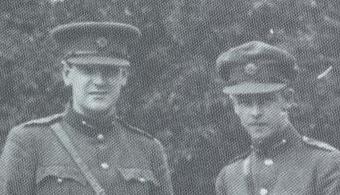
Emmet Dalton (pictured, on the right, with Michael Collins), Irish rebel-turned-Free Stater, was born in America on March 4th 1898 and died in Dublin on March 4th 1978 - his 80th birthday, and also the bicentenary of the birth of the man he was named after, and whose Cause he belittled - Robert Emmet.
Dalton was educated at the O'Connell School in Drumcondra, Dublin, and as a young adult became interested in the political teachings of John Redmond, so much so that he joined the British Army, serving as a 2nd Lieutenant with the 7th Battalion of the Dublin Fusiliers. He would have been present at the Somme in September 1916 when over 4,000 Irish soldiers died (including his friend, Tom Kettle) and, indeed, won a 'Military Cross' for '..leading forward to their final objective companies which had lost their officers. Later, whilst consolidating his position, he found himself with one sergeant, confronted by 21 of the enemy, including an officer, who surrendered when he attacked them..'. He further served the British 'war effort' in Palestine, where he trained a sniper patrol and also served as a British Army staff officer in France.
He was demobilised,in Germany, in 1919, at the age of 21, and returned to Dublin, becoming the 'Director of Training' for the Irish Republican Army, but he sold out in favour of the 'Treaty of Surrender' in 1921 and made a (Free State) name for himself by attacking republican positions from the sea, actions that his British paymasters considered as having 'turned the tide' against the Irish republican resistance, and also led the Free State attack on the Four Courts in Dublin on the 28th June 1922.
Dalton was with Michael Collins on the 22nd of August 1922 when the latter was shot dead by republican forces in West Cork (Béal na mBláth) and is said to have propped up a dying Collins to place dressings on his wound. He resigned from the Free State Army shortly after Collins was killed (his brother, Charlie, stayed on and made an equally bad name for himself), and was appointed as the clerk of the Free State Senate, but resigned from that, too, three years later, and opened a film production company, Ardmore Studios, near Bray , in Wicklow. He died, aged 80, on the 4th of March 1978, the same date and month that he had been born on, and was buried in Glasnevin Cemetery in Dublin. Rumours persist that Dalton himself shot Collins dead, as per instructions from Westminster...?
ON THIS DATE (4TH MARCH) 242 YEARS AGO : 'DARLING OF ERIN' BORN.
Robert Emmet was born on the 4th March, 1778, a son of Dr Robert Emmet and Elizabeth Mason. His father served as state physician to the vice-regal household but was a social reformer who believed that in order to achieve the emancipation of the Irish people it was first necessary to break the link with England. Robert Emmet (Jnr) was baptised on March 10th in St Peter's Church of Ireland in Aungier Street, Dublin, and attended Oswald's School in Dropping Court, off Golden Lane, Dublin. From there he went to Samuel Whytes School in Grafton Street, quite near his home, and later to the school of the Reverend Mr Lewis in Camden Street. He entered Trinity College, Dublin, in October 1793 at the age of fifteen and a half where he practiced his oratorical skills in the Historical and Debating Societies. One of his friends at TCD was the poet Thomas Moore.
There were four branches of the 'United Irishmen' in TCD and Robert Emmet was secretary of one of them but, after an inquisition, presided over by Lord Chancellor Fitzgibbon, Emmet became one of nineteen students who were expelled for United Irishmen activity. Although not active in the 1798 Rising, Robert Emmet was well known to the British authorities and by April 1799, when Habeas Corpus had been suspended, there was a warrant issued for his arrest, which he managed to evade and, early in 1801, accompanied by a Mr Malachy Delany of Cork, he travelled throughout Europe, and made Paris his headquarters - it was there that he replaced Edward Lewis as the liaison officer between Irish and French Republicans.
While in Paris, Emmet learned about rockets and weapons, and studied a two-volume treatise by a Colonel Tempelhoff which can be examined in the Royal Irish Academy, with the marginal notes given the reader some insight into Emmet's thinking. Following the signing of the 'Peace of Amiens' by France and England in March 1802 the United Irishmen that were being held as prisoners in Fort George were released and many such as Thomas Russell and Thomas Addis Emmet made there way to Paris. Emmet returned to Ireland in October 1802 and began to plan for a rising and in March 1803, at a meeting in Corbet's Hotel, 105 Capel Street, Dublin, Emmet briefed his key organisers. In April 1803 Emmet rented an isolated house in Butterfield Lane in Rathfarnham as a new base of operations and Michael Dwyer, a 1798 veteran, suggested his young niece as a suitable candidate to play the role of the 'housekeeper'. Born in or around the year 1778, Ann Devlin soon became Robert Emmet's trusted helper and served him loyally in the months ahead. Shortly afterwards he leased a premises at Marshalsea Lane, off Thomas Street, Dublin, and set up an arms depot there.
Arms depots were established in Dublin for the manufacture and storage of weapons for the incipient rising. Former soldiers mixed their practical skills with the scientific knowledge that Robert Emmet had acquired on the continent, and an innovative rocket device was produced. Elaborate plans were drawn up to take the city and in particular Dublin Castle : supporters from the surrounding counties of Kildare, Wicklow and even Wexford were pledged to assist. Emmet bided his time, waiting for an opportune moment when English troops would be withdrawn to serve in the renewed war in France, but his hand was forced when a premature explosion on the evening of July 16, 1803, at the Patrick Street depot, caused the death of John Keenan. Though there was no obvious wide scale search or arrest operation by the British following the explosion, the leadership of the movement decided to set July 23, 1803 (the following Saturday) as the date for the rising. Emmet hoped that success in Dublin would inspire other counties to follow suit. Patrick M. Geoghegan, in a recent publication, says that "..the plan for taking Dublin was breathtaking in its precision and audacity. It was nothing less that a blueprint for a dramatic coup d'état. Indeed, over a century later, Pearse and Clarke would also refer to the plan for their own rising.."
Emmet's plan depended on two factors - arms and men and, as Geoghegan states, when the time came, Robert Emmet had not enough of either - events went dramatically wrong for him. On the appointed day his plans began to unravel ; Michael Dwyer and his promised 300 men did not get the word until Sunday July 24th and, the previous day, an excess of men had moved in to Dublin from Kildare and could not be concealed in the existing depots so they spread out around the city pubs and some started drinking. Others, after inspecting the existing arsenal and finding many pikes but few muskets or blunderbusses, went home unimpressed.
Because he had alerted other countries and still had the element of surprise, Emmet decided not to postpone the Rising thus, shortly after seven o' clock on Saturday July 23rd, 1803, Robert Emmet in his green and gold uniform stood in the Thomas Street, Dublin, depot and, to the assembled rebels, read out his proclamation, declaring that the Irish nation was about to assert itself in arms against foreign rule. But again events conspired to thwart the rebels - coaches commissioned for the attack on Dublin Castle were lost and erroneous information supplied that encouraged pre-emptive strikes, meant that confusion reigned. Also, the novel rocket signals failed to detonate. Emmet's own forces, who were to have taken the Castle, dwindled away and, throughout the remainder of that evening, there were skirmishes at Thomas Street and the Coombe Barracks but he decided to terminate operations and leave the city. For the English Army, which included Daniel O' Connell, it was then merely a mopping-up operation : in the aftermath, the English arrested and tortured Anne Devlin, even offering her the enormous sum of £500 to betray Robert Emmet - she refused.
Emmet himself took refuge in the Harold's Cross area of Dublin, during which he met with his mother and Sarah Curran but, on Thursday August 25th, 1803, he was finally arrested. It has been stated by others that a £1000 reward was paid by Dublin Castle to an informer, for supplying the information which led to his capture. Robert Emmet's misfortunes did not stop on his arrest : he had the misfortune to be defended by one Leonard McNally who was trusted by the United Irishmen. However, after McNally's death in 1820 it transpired that he was a highly paid government agent and, in his role as an informer, that he had encouraged young men to join the rebels, betrayed them to Dublin Castle and would then collect fees from the United Irishmen to 'defend' those same rebels in court!
Emmet was tried before a 'Special Commission' in Green Street Court House in Dublin on September 19th, 1803. The 'trial' lasted all day and by 9.30pm he was pronounced guilty ; asked for his reaction, he delivered a speech which still inspires today. He closed by saying that he cared not for the opinion of the court but for the opinion of the future - "..when other times and other men can do justice to my character.." Robert Emmet was publicly executed on Tuesday September 20th outside St Catherine's Church in Dublin's Thomas Street. The final comment on the value of Robert Emmet's Rising must go to Séan Ó Brádaigh, who states that to speak of Emmet in terms of failure alone is to do him a grave injustice. He and the men and women of 1798 and 1803 and, indeed, those that went before them, set a course for the Irish nation, with their appeal to Protestant, Catholic and Dissenter under the common name of 'Irishman', which profoundly affected Irish life for more than two centuries and which will, we trust, eventually bear abundant fruit.
Finally, it was not only college-educated men and women like Robert Emmet (ie those who might be perceived as being 'upper class') who decided to challenge Westminster's interference in Irish affairs in 1803 : so-called 'working class' men and women also acknowledged the need for such resistance - Edward Kearney, carpenter, hanged, Thomas St / Owen Kirwin, tailor, hanged, Thomas St, September 1st 1803 / Maxwell Roche, slator, hanged, Thomas St, September 2nd 1803 / Denis Lambert Redmond, coal facer, hanged, Coalquay (Woodquay) Dublin, / John Killeen, carpenter, hanged, Thomas St, September 10th 1803 / John McCann, shoemaker, hanged at his own doorstep, Thomas St, September 10th 1803 / Felix Rourke, farm labourer, hanged, Rathcoole, Dublin, September 10th 1803 / Thomas Keenan, carpenter, hanged, Thomas St, September 11th 1803 / John Hayes, carpenter, hanged, Thomas St, September 17th 1803 / Michael Kelly, carpenter, hanged, Thomas St, September 17th 1803 / James Byrne, baker, hanged, Townsend St, Dublin, September 17th 1803 / John Begg, tailor, hanged, Palmerstown, Dublin, September 17th 1803 / Nicholas Tyrrell, factory worker, hanged, Palmerstown, Dublin, September 17th 1803 / Henry Howley, carpenter, hanged, Kilmainham Jail, Dublin, September 20th 1803 / John McIntoch, carpenter, hanged, Patrick St, Dublin, October 3rd 1803 - there are dozens more we could list here, but suffice to say that 'class' alone was not then, nor is it now, a deciding factor in challenging British military and political interference in this country. 'Justice' is the deciding factor in that equation.
'IRA CRIMINAL CONSPIRACY - A CONSPIRATOR SPEAKS AND IS BOOHED...'
From 'The United Irishman' newspaper, December 1954.
Strange Fog?
About the same time as Mr Ernest Blythe was voicing his opinion on criminal conspiracy, forgetful presumably of his own past, the President of UCD, Mr M Tierney, was uttering the following warning ; "We are living in Ireland in a strange fog of unreality which seems at the moment to have penetrated into every corner of our national consciousness and which we feel no more than the inhabitants of the Hebrides feel the fogs of winter."
Hear, hear, Mr Tierney, you are in a position to see the fog that enshrouds our national conscience, and which is merely the smokescreen (akin to a fog) which has been thrown out by the politicians in carrying out their various criminal conspiracies since December 1921. But for all that it is not a 'strange fog' - it is only strange to those who will not appreciate its source. I do not wish to be cruel, but I would suggest to the UCD Literacy and Historical Society that they should henceforth carry out 'Operation Fog' by refusing to give a platform to any person who has taken part in 'Operation Criminal Conspiracy'.
In case, Mr Editor (or my young readers), you may have any doubts as to my bona fides or my right to challenge the blithe and the not so blithe politicians, I want to inform you that I place myself in the category of 'Veteran', having been a member of the IRB up to the time it was 'taken over' by the first set of conspirators, a GHQ Staff Officer in 1921, a Battalion Commandant in 1922, a Brigade Commandant in 1923 and still acknowledging the republican stand.
Yours,
Ben Doyle.
(End of 'IRA CRIMINAL CONSPIRACY - A CONSPIRATOR SPEAKS AND IS BOOHED' ; Next - 'CORK CEREMONY', from the same source.)
ON THIS DATE (4TH MARCH) 132 YEARS AGO : "GRACE UNKNOWN...."
Grace Gifford Plunkett (pictured) was born on this date (4th March) in 1888, in Dublin. She attended art school here and in London and, in 1915, at the age of 27, she 'stepped out' with the then editor of 'The Irish Review' magazine, Joseph Plunkett, one of the founders of the 'Irish Volunteer' organisation. He was imprisoned in Kilmainham Jail in Dublin for his part in the 1916 Easter Rising and was condemned to death by firing squad : he asked Grace to marry him and, on the 3rd of May 1916, at 6pm, in Kilmainham Jail, Grace Gifford and Joseph Plunkett were married, with two prison officers as witnesses and fifteen British soldiers 'keeping guard' in the same cell. The couple were allowed ten minutes together, before Grace was removed from her husband. He was executed by the British hours later, on the 4th May, 1916.
Grace Gifford Plunkett was at that time on the Executive of the then Sinn Féin organisation, and spoke out against the Treaty of Surrender. Like all anti-treaty activists (then as now) she was constantly harassed by Free State forces and was no stranger to the inside of prison cells, and was on a 'watch list' by the Leinster House administration. She had no home, little money and was despised by the State 'authorities' - selling her drawings and illustrations gave her a small irregular income, as she moved from rented flat to rented flat and ate in the cheapest restaurants she could find. She died suddenly, and alone, on the 13th of December 1955, aged 67, in a flat in South Richmond Street in Portobello, Dublin, and was buried in Glasnevin Cemetery, Dublin.
'Rougher than Death the road I choose
Yet shall my feet not walk astray,
Though dark, my way I shall not lose
For this way is the darkest way.
Now I have chosen in the dark
The desolate way to walk alone
Yet strive to keep alive one spark
Of your known grace and grace unknown...' (from here.)
ILLEGAL ARMS : IN BAD COMPANY...
A man suspected of being one of the world's biggest dealers in illegal weapons was a director of two companies based in Ireland. By Annamarie Comiskey. From 'Magill' magazine, July 2002.
In July last year (2001), Leonid Minin was charged by Italian magistrate Dr Walter Mapelli with dealing in illegal arms. He is now in prison near Milan awaiting a second trial, which could end with a 12-year sentence. Shortly before his arrest for possessing drugs, magistrate Walter Mapelli claims that Minin chartered a plane in Ukraine to fly 113 tonnes of bullets to the Ivory Coast in West Africa ; the year before that, according to the magistrate, Minin allegedly sent 68 tonnes of small arms to the same country, which were then re-routed to Sierra Leone, a country under a UN arms embargo, by his private plane. He denies knowing that his plane was used for this purpose.
Leonid Minin's empire is backed-up by a web of companies in the Cayman Islands, Gibraltar and the Isle of Man, to name just a few of the off-shore havens he used. The magistrate is investigating this paper trail to find out if Minin was laundering the proceeds of illegal arms trafficking and his Irish interests may come under scrutiny. Limad Invest Ltd, an investment company registered at 3 College Green, Dublin 1, was incorporated in 1996 and dissolved in 1999 - Minin was one of the directors. The company had a share capital of twelve-thousand Euro's and filed annual accounts in 1997 though no trade took place. No annual accounts were filed in 1998, 1999 or 2000.
At the same address, Minin held a directorship of another company, 'Limad Energy', set-up with a meagre share capital of two-thousand four hundred Euro's ; it was also dissolved in 1999 and, again, annual accounts were filed in 1997 but not thereafter. Records show that Leonid Minin described himself as a 'businessman', with Israeli nationality and an address in Tel Aviv. He also holds passports from Germany and Ukraine. The other director, Irina Najda Sylam, described herself as a 'director', with German nationality, and living in Monaco. Mysteriously, there is no information on record of what the companies did after 1997... (MORE LATER.)
'THOUGHTS AFTER OMAGH'.
From 'The United Irishman' newspaper, November 1954.
The Irish, like all other people, are only human. They shape their lives on the pattern of their leaders and, when the leaders are noble and heroic, the people are also noble and heroic. But when the leaders are mean, cowardly, corrupt and cynical, so also are the people.
Ireland has passed through its period of meanness and cynicism. A new spirit is abroad throughout the land ; "What can I do" is the watchword replacing the old "What do I get", that has dominated Irish life and politics for the past thirty years*. It is natural and noble for a people to desire freedom ; freedom denied and subjection enforced by the might of arms is a gnawing irritant on the national life that cannot be placated by rhetorical orators or resounding resolutions.
To become free is very difficult. It cannot be achieved by wishing for it - a great effort has to be made, by the nation and by individuals, to become disciplined in preparation for the sacrifice, if necessary, of personal liberty, life, property and loved ones... (MORE LATER.)
( * '1169' comment : that 'new spirit' might very well have surfaced in the 1950's (I wasn't around then!) but it has long since disappeared and a vicious 'mé féin' attitude is, unfortunately, thriving in this corrupt State. The political system here encourages the scenario that it's 'every one for themselves' and that outlook will not change until the political system here changes. Or is changed, by whatever means necessary.)
ON THIS DATE (4TH MARCH) 216 YEARS AGO - 'CONVICTS' REVOLT : 'VINEGAR HILL' NSW UPRISING.
On this date in 1804, an uprising was held by the 'Castle Hill Convicts' in New South Wales, Australia, led by Irish rebel Phillip Cunningham, a Kerryman, born at Glenn Liath ('Grey Glen'), Moyvane. Although not a lot is known about this Irish hero, it is recorded that he moved to Clonmel, Tipperary, in the 1790's and worked as a stonemason, supplementing his income from same by opening up a small pub. Peter Cunningham and about two hundred other 'convicts' turned on the Redcoat soldiers who had imprisoned them, locked them up and broke into a weapons hut.
Martial law was declared as a result, in the Sydney area, and residents in the town of Parramatta were advised to assemble at the docks, ready to flee the area if needed. The rebels had by now based themselves on a hilltop and declared it to be their 'Vinegar Hill'. A Major George Johnson and his men from the New South Wales Corps and a detachment of fifty mercenaries from the 'Loyal Association' marched through the night and a short battle commenced in and around 'Vinegar Hill', ending the rebellion. Peter Cunningham was later executed without trial.
'The Sydney Gazette' newspaper covered(/coloured) the event, in its edition of the 11th March 1804, in the following manner -
'REBELLION AT CASTLE HILL.
Major Johnston on arriving at Toongabbee, received information that a considerable Body were on their way to the Hawkesbury: Notwithstanding the fatigue of his small Detachment in marching up from Sydney and the distance they had gone since, they immediately ran in good Order, with their followers, and after a pursuit of Seven Miles farther, Major Johnston and a Trooper, who had preceded the Detachment came up with the rear of the Insurgents at 11 o'clock, whose number have since been ascertained to be 233 men, armed with Musquets, Pistols, Swords etc., and a number of followers which they had taken from the Settlers.
After calling to them repeatedly they halted, and formed on the rise of a Hill: The Major and Trooper advanced within pistol shot, and endeavoured to persuade them to submit to the Mercy that was offered them by the Proclamation, which they refused. The Major required to see their Chiefs, who after some deliberation met them half way, between the Detachment and Insurgents, when by a great presence of mind and address the Major presented his pistol at the head of the Principal leader (Phillip Cunningham), and the Trooper following his motions, presented his Pistol also to the other leader's head (William Johnston) and drove them into the Detachment without the least opposition from the body of the Insurgents..' (more here.)
That rebellion may very well have been shortlived and its leader, Peter Cunningham, almost forgotten in our history, but it, and he, live on in the memory of every Irish republican to this day. As it should be.
ON THIS DAY NEXT WEEK (WEDNESDAY 11TH MARCH 2020).....
...we won't be posting our usual contribution, and probably won't be in a position to post anything at all until the following Wednesday (18th) ; this coming weekend (Saturday/Sunday 7th/8th March) is spoke for already with a 650-ticket raffle to be run for the Dublin Comhairle of RSF in a venue on the Dublin/Kildare border (work on which begins on the Tuesday before the actual raffle) and the 'autopsy' into same which will take place on Monday evening, 9th, in Dublin, meaning that we will not have the time to post here on Wednesday 11th. But we'll be back, as stated above, on Wednesday 18th March 2020. Thanks for checking in with us, and we'll see ya then!
Thanks for reading, Sharon.