ON THIS DATE (27TH SEPTEMBER) 65 YEARS AGO : TWO IRISH REPUBLICAN LEADERS ESCAPE FROM FREE STATE CUSTODY.
On Saturday, 27th September 1958, the Irish republican POW's in the Curragh Internment Camp in County Kildare (of which there were about 150) had put together two football teams and had organised a football match between both sides.
That activity was a distraction for the prisoners and, more importantly, for the Free State Army guards and the other prison staff members, but two of the POW's were not involved in that distraction - they were taking advantgage of it instead!
Dáithí Ó Conaill and Ruairí Ó Brádaigh were lying under a roughly-made grass 'mat' at a less-noticeable section of the metal fence that kept them interned and were using a wire cutters to remove a section of it, which they did, successfully freeing themselves from State custody.
The two men were not only republican comrades and activists, but were to become related through Dáithí's marriage, in 1964, to a fine Donegal Lady, Deirdre Caffrey, who was Ruairí's maternal first cousin (and Deirdre was also sister-in-law to another strong Irish republican, Kevin Mallon).
The successful escape attempt had been authorised by the leadership of the Movement (including Tomás Óg MacCurtain, O/C of the IRA Internees) and meant that Ruairí, who was at the time a Sinn Féin TD (while incarcerated he was elected as a Sinn Féin TD, on an abstentionist ticket, obviously, for Longford–Westmeath in the 1957 State general election), was the first such republican TD to be 'on the run' since the 1920's and, the following month (October 1958) he was appointed as Chief of Staff of the IRA by the leadership (a position he held until May 1959).
That escape (27th September 1958 - 65 years ago on this date) was the second such escape from the Curragh Internment Camp (pictured) that year.
In May, three POW's had got out through a window in the Curragh Military Hospital where they had been patients. Two of them – one from Armagh, the other from Portarlington – were recaptured near Kilcullen in County Meath and the third man, from Dublin, evaded capture for ten days until he was found at house in Gormanstown, in County Meath and, in the first week in December (1958) fourteen Irish republican internees escaped from the internment camp.
That Free State prison was closed on the 11th March 1959, as the Staters in Leinster House were comfortable within themselves that they had consolidated their position in the State.
And they still believe that to be the case...
'KEOGHBOYS OF THE 1950's...'
From 'The United Irishman' newspaper, April 1955.
The policy of 'The Irish Tenant League' was to form a political party pledged to independent opposition in parliament and it was based on a 'Union of Creeds'.
'The Restoration of the Hierarchy Act' and 'The Ecclesiastical Titles Act' started a controversy that threatened 'the Union' ; in Ireland, an ultra-catholic party was formed - 'The Catholic Defence Association' (aka 'Irish Brigade'/Pope's Brass Band').
The chief figures were William Keogh, a lawyer from Athlone, and John Sadlier, a hawker from Tipperary (...more about those two shysters here).
Nominally 'Tenant Righters', those two men caused ill-feeling inside the party, because they were so ferociously catholic. In the Westminster General Election of September, 1852, forty 'Tenant Right' members were returned, including William Keogh, John Sadlier, his brother, nephew and two cousins.
All took a solemn pledge that they would stand together in independent opposition and oppose every ministry that refused to introduce a 'Tenant Right Bill' but, when Lord Aberdeen's ministry was formed, he refused to adopt such a Bill... (MORE LATER.)
ON THIS DATE (27TH SEPTEMBER) 101 YEARS AGO : MORE REPRESSIVE LEGISLATION IMPOSED.
Irish Free State soldiers, left, were given ever more of a free reign to impose the dictat of their paymasters in Leinster House in 1922, with the passing of the gloriously misnamed 'Public Safety Act'.
On the 9th June 1927 a general election was called in the Free State and Fianna Fail won 44 seats to Cosgrave's 47 : de Valera's policy was not to enter the Free State parliament until the Oath of Allegiance to the British monarch was removed but, in that same month, Kevin O' Higgins was assassinated and the Free State government passed a law which would force future Leinster House candidates to swear on their nomination that they would take the Oath of Allegiance.
In August 1927, de Valera led the Fianna Fail elected representatives, many of them with revolvers in their pockets, into Leinster House and signed the Oath of Allegiance document. A second general election was held in September 1927 and Fianna Fail increased its vote, winning 57 seats.
In short, Free Staters were once again in power in the Free State (!) but Irish republicans continued to fight back - on the 21st September 1927, six Free State soldiers were killed in a gun battle with the IRA near Ballina in Mayo and, on that same day, the Free State barracks in Drumshambo in Leitrim was attacked and taken by republicans, during which one Stater was killed.
On the 22nd September a FS soldier was killed and several others and three civilians injured in a gun and grenade attack by the IRA on enemy troops on Eden Quay in Dublin and, on the day that the 'Public Safety Act' was being voted on in Leinster House, several hundred IRA Volunteers attacked the town of Killorglin, in Kerry, and were only denied their victory, after 24 hours of fighting, when more Free State troops arrived in force, from Tralee.
The 'Public Safety Act' had been passed in the Free State assembly by 41 votes to 18 on this date, 27th September (1922), 101 years ago, allowing for the State to execute those captured bearing arms against it and permitting State agents 'to punish anyone aiding and abetting attacks on the National (sic) Forces', and/or anyone having possession of arms or explosives 'without the proper authority' or anyone 'disobeying an Army General Order'.
'Section 5' of the Act declared that "..every person who is a member of an unlawful association at any time after it has become by virtue of this Act an unlawful association shall be guilty of a misdemeanour and shall be liable on conviction thereof to suffer penal servitude for any term not less than three years and not exceeding five years or imprisonment with or without hard labour for any term not exceeding two years..." .
'Section 28' stated that "..any person found guilty by a special court of the offence under the Firearms Act, 1925 (No. 17 of 1925) of having possession of or using or carrying a firearm without holding a firearm certificate therefor, shall if the offence was committed while this Part of this Act is in force be liable to suffer death or penal servitude for life, or any term of years not less than three years, or to imprisonment with or without hard labour for any term not exceeding two years, and shall be sentenced by such court accordingly.."
That 'Act' represented politically and morally corrupt legislation and was enacted by the then, and now, politically and morally corrupt political assembly in Leinster House.
IRELAND ON THE COUCH...
A Psychiatrist Writes.
'Magill' commissioned Professor Patricia Casey to compile an assessment of Irish society at what may emerge as the end of a period of unprecedented growth and change.
This is her report.
From 'Magill Magazine' Annual, 2002.
The worst culprits are the new estates that have been built around developing industries or the trendy apartment blocks designed to improve our inner cities.
Many of the inhabitants are mobile young people who see these houses not as homes but as temporary receptacles. Add to this the emptiness that comes from the absence of people during the day as couples go out to work, and the lack of amenities such as shops, bars or post-offices, and they become bleak places indeed. In such an environment, it is possible to be sick for days and have no callers - or to die and lie decaying without being missed.
If our sense of community is under pressure, so too is the traditional family. This is showing itself not so much in the divorce courts yet as in other more nebulous ways.
A recently published international study on depression in the community (in which I was one of the investigators) showed that one of the significant factors associated with the high rate of this condition in urban Ireland is the absence of supports, whilst the very low rate in Spain was equally linked to the protective role that strong ties, especially to the family, can have in ameliorating our stress... (MORE LATER.)
ON THIS DATE (27TH SEPTEMBER) 374 YEARS AGO : A WAR CRIMINAL AND "THE REDUCING OF CARLINGFORD".
Pictured - some of Oliver Cromwell's Irish victims, sold as slaves and 'sex workers' to the highest bidder.
On the 29th April, 1599, a baby boy, Oliver Cromwell, who had been born on the 25th, was christened in Saint John the Baptish church in Huntingdon, England.
Decades later, when someone was trawling through the birth records for that period, they came across an unofficial addendum to that particular entry : it read - "England's plague for five years.." Cromwell should need no introduction to readers of this blog, but some readers may not be aware of the significance of a particular date in this month - the 3rd September - in that creature's life : on that date in 1649, Cromwell began his nine-day siege of Drogheda after which thousands of its inhabitants were butchered, the infamous 'Death March' he forced on his enemy after the battle of Dunbar on the 3rd September 1650 and, one year later on that same date - the 3rd September - he wallowed in more blood and guts, this time in his own country, at the battle of Worcester.
And, somewhere in between wrecking havoc and stealing and selling Irish children, he found the time - on the 27th September in 1649, 374 years ago on this date - to write to his political bosses in London :
'FOR THE HONOURABLE WILLIAM LENTHALL, ESQUIRE, SPEAKER OF THE PARLIAMENT OF ENGLAND :
Dublin, 27th September 1649.
Mr. Speaker - I had not received any account from Colonel Venables - whom I sent from Tredah to endeavour the reducing of Carlingford, and so to march Northward towards a conjunction with Sir Charles Coote - until the last night.
After he came to Carlingford, having summoned the place, both the three Castles and the Fort commanding the Harbour were rendered to him. Wherein were about Forty Barrels of Powder, Seven Pieces of Cannon ; about a Thousand Muskets, and Five-hundred Pikes wanting twenty. In the entrance into the Harbour, Captain Fern, aboard your man-of-war, had some danger ; being much shot at from the Sea Fort, a bullet shooting through his main-mast. The Captain's entrance into that Harbour was a considerable adventure, and a good service ; as also was that of Captain Brandly, who, with Forty seamen, stormed a very strong Tenalia at Treda, and helped to take it ; for which he deserves an owning by you.
Venables marched from Carlingford, with a party of Horse and Dragoons, to the Newry ; leaving the place, and it was yielded before his Foot came up to him. Some other informations I have received from him, which promise well towards your Northern Interest ; which, if well prosecuted, will, I trust God, render you a good account of those parts. I have sent those things to be presented to the Council of State for their consideration. I pray God, as these mercies flow in upon you, He will give you an heart to improve them to His glory alone ; because He alone is the author of them, and of all the goodness, patience and long-suffering extending towards you. Your army has marched ; and, I believe, this night lieth at Arklow, in the County of Wicklow, by the Sea-side, between thirty and forty miles from this place. I am this day, by God’s blessing, going towards it. I crave your pardon for this trouble; and rest, your most humble servant, OLIVER CROMWELL.
P.S. I desire the Supplies moved for may be hastened. I am verily persuaded, though the burden be great, yet it is for your service. If the Garrisons we take swallow-up your men, how shall we be able to keep the field? Who knows but the Lord may pity England's sufferings, and make a short work of this? It is in His hand to do it, and therein only your servants rejoice. I humbly present the condition of Captain George Jenkin's Widow. He died presently after Tredah Storm. His Widow is in great want.
The following Officers and Soldiers were slain at the storming of Tredah: Sir Arthur Ashton, Governor; Sir Edmund Varney, Lieutenant-Colonel to Ormond’s Regiment; Colonel Fleming, Lieutenant-Colonel Finglass, Major Fitzgerald, with eight Captains, eight Lieutenants, and eight Cornets, all of Horse; Colonels Warren, Wall, and Byrn, of Foot, with their Lieutenants, Majors, etc; the Lord Taaff’s Brother, an Augustine Friar; forty-four Captains, and all their Lieutenants, Ensigns, etc; 220 Reformadoes and Troopers; 2,500 Foot-soldiers, besides the Staff-Officers, Surgeons, etc.'
This misfit had another meeting with his lucky date - 3rd September - in 1658, when he was collected from this Earth by his maker.
A pity he was spawned at all.
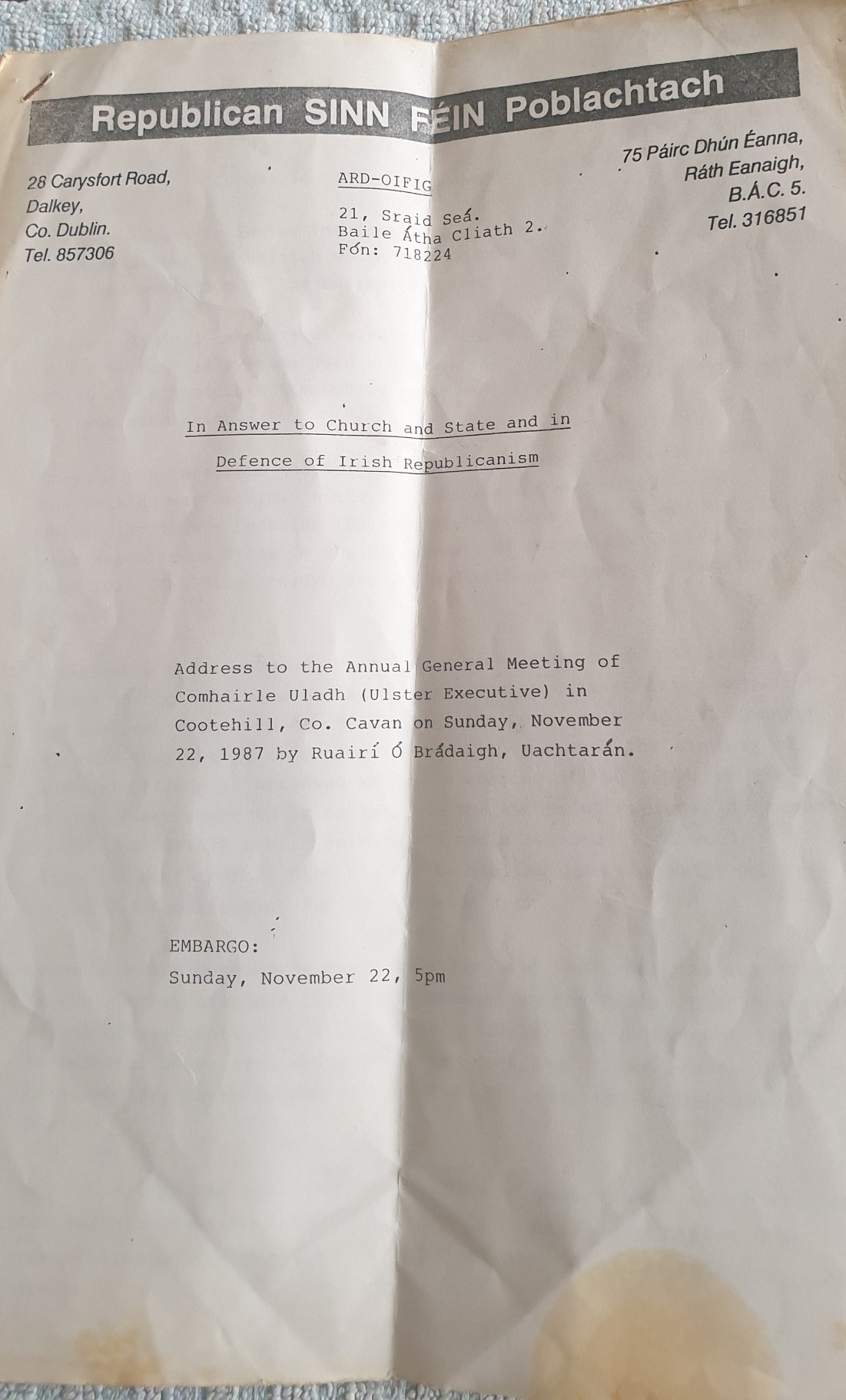
'IN ANSWER TO CHURCH AND STATE AND IN DEFENCE OF IRISH REPUBLICANISM...'
Address to the Annual General Meeting of Comhairle Uladh (Ulster Executive) in Cootehill, County Cavan, on Sunday, November 22nd, 1987, by Ruairí Ó Brádaigh, Uachtarán, Sinn Féin Poblachtach.
Comhaírle Uladh AGM, November 22nd, 1987.
But this country of ours can never be put to right until Britain withdraws her armed forces and administration from Ireland and recognises the right of the Irish people acting as a unit to determine their own future. Such is the recognised right of all peoples and the Irish have fought for it longer than most.
Irish republicanism has a high and honourable tradition. For close on two centuries it has called forth unstinting and unselfish service for the freedom of Ireland and the complete social, economic and cultural emancipation of the Irish people.
It still represents the only realistic alternative to the present colonial and neo-colonial morass which engulfs the Irish people.
It seeks to put the people, individually and collectively, in control of their own affairs in their own country. Republican Sinn Féin is confident that such an ideal will yet triumph. (END of 'In Answer To Church And State And In Defence Of Irish Republicanism' : NEXT - 'Beir Bua', from 1998.)
Our families are taking a winter break in a few days time and heading off for a multi-trip 10-day-or-so 'staycation' ('staycaution', more like it..!) and meself and the Girl Gang are doing the same ; altogether, including the children and grandchildren and the '1169' team and the Girls, there'll be twenty-eight of us, in a large, colourful and noisey convoy and, I'm told, we'll be decimatin......visiting (!) Waterford first, then heading to Galway, with a stop or two in between.
Scheduled stops, that is, but sure it's a long road that has no turnin', and we might happen across a little lay-by or two on the way!
Anyway. What has this got to do with you? Feck all, really, 'cepting for the fact that if the '1169' team are there (wherever "there" turns out to be!), we can't be here!
We don't expect to be back in Dublin (...most of them/us [that's my trans moment over..], hopefully!) until maybe between the tenth and twelfth of October, so we probably won't be in a position to post anything on the blog until at least Wednesday 18th October 2023.
I'll maybe still be a-rantin'-and-a-ravin' on Facebook and 'X', so ya could catch me there!
Thanks for the visit, and for reading : hope to see ye all on the 18th October 2023!
Sharon and the team.
ON THIS DATE (27TH APRIL) 93 YEARS AGO : DEATH OF AN IRA MAN WHO DARED AND SUFFERED - AUSTIN STACK.
Austin Stack (pictured) was born on the 7th December, 1879, in Ballymullen, Tralee, County Kerry and, at 29 years young, joined the 'Irish Republican Brotherhood' (IRB).
At the time of the 1916 Rising, he was 37 years of age and was the commandant of the Kerry Brigade of the Irish Volunteers and was arrested, by the British, with Con Collins, on the 21st April that year while planning an attack on Tralee RIC Barracks in an attempt to rescue Roger Casement.
He was court-martialed on the 14th June and sentenced to death, but this was commuted to twenty years penal servitude and he was released in the general amnesty of June 1917, and became active in the Irish Volunteers again. He opposed the Treaty of Surrender in 1921 (stating, during the debate on same - "Has any man here the hardihood to stand up and say that it was for this our fathers suffered, that it was for this our comrades have died in the field and in the barrack yard..") and took part in the subsequent Irish 'Civil War'.
He was captured in 1923 and went on hunger strike for forty-one days before being released in July 1924. When Eamon de Valera founded Fianna Fail in 1926, Stack remained with Sinn Féin and was elected Secretary of that organisation, a position he held until his death. His health was shattered due to the number of prison protests and hunger strikes for political status that he undertook. In the 1918 general election, while a prisoner in Crumlin Road Jail in Belfast, he was elected to represent West Kerry in the First (all-Ireland) Dáil as an abstentionist Sinn Féin Member of Parliament.
The British incarcerated him in Strangeways Prison in Manchester, from where he escaped in October 1919 and, during the 'Black and Tan War', as Minister for Home Affairs, he organised the republican courts which replaced the British 'legal' system in this country. Following a short fund-raising/public relations tour of America, he returned to Ireland to carry on the fight with his fellow republicans.
In the general round-up of Irish republican leaders in April 1923 (during which Liam Lynch was shot dead by Free State troops) Stack, the Deputy Chief of Staff of the rebel forces, was arrested in a farmyard in the Knockmealdown Mountains in County Tipperary - this was four days after Liam Lynch's death. Imprisoned in Kilmainham Jail in Dublin, he took part in the mass hunger-strike by republican prisoners in October 1923, which was his 5th hunger-strike in 6 years.
Shortly after the end of that forty-one day hunger-strike, in November 1923, he was released with hundreds of other political prisoners, and he married his girlfriend, Una Gordon, in 1925. In April 1929, at forty-nine years of age, he entered the Mater Hospital in Dublin for a stomach operation. He never recovered and died two days later, on 27th April 1929, and is buried in the Republican Plot, Glasnevin Cemetery, in Dublin.
A commemorative pamphlet, entitled 'What Exactly is a Republican?' was issued in memory of the man -
'The name republican in Ireland, as used amongst republicans, bears no political meaning. It stands for the devout lover of his country, trying with might and main for his country's freedom. Such a man cannot be a slave. And if not a slave in heart or in act, he cannot be guilty of the slave vices. No coercion can breed these in the freeman.
Fittingly, the question - 'What is a republican?' fails to be answered in our memorial number for Austin Stack, a man who bore and dared and suffered, remaining through it all and at the worst, the captain of his own soul. What then was Austin Stack, republican? A great lover of his country. A man without a crooked twist in him. One who thought straight, acted straight, walked the straight road unflinchingly and expected of others that they should walk it with him, as simply as he did himself.
No man could say or write of him "He had to do it". That plea of the slave was not his. His duty, as conscience and love dictated, he did. The force of England, of the English Slave State, might try coercion, as they tried it many times : it made no difference. He went his way, suffered their will, and stood his ground doggedly, smiling now and again. His determination outstood theirs, because it had a deeper foundation and a higher aim. Compromise, submission, the slave marks, did not and could not exist for him as touching himself, or the Cause for which he worked and fought, lived and died.'
Republican Ireland had lost one of her best soldiers, but we hold him safe in Glasnevin Cemetery, in Dublin.
'STIRRING BODENSTOWN COMMEMORATION...'
From 'The United Irishman' newspaper, July, 1954.
Gearóid O'Broin of Dublin stated, in his oration -
"We refuse to believe that the people of this generation, that the young men (sic) of this generation, are any less capable of making sacrifices for Ireland than the men (sic) who have gone before. To those who assert otherwise we of the Republican Movement answer with the names of Cathal Goulding, Seán Stephenson, Manus Canning and Jas McCallum in English jails and of Joe Campbell and Leo McCormack in Belfast Jail.
These young men exemplify the readiness of the young men of this generation to sacrifice themselves for Ireland.
Again, some people question the courage of the young men (sic) of today. We are told that picture houses and dance halls etc have sapped the energy and the spirit of the young men of Ireland. To people who nurse these doubts I suggest that they should make enquiries at Armagh Barracks where they will have such doubts quickly corrected..."
(MORE LATER.)
ON THIS DATE (27TH APRIL) 370 YEARS AGO - AN ENGLISH WAR CRIMINAL AND IRISH WOLFHOUNDS.
"Necessity hath no law.." - in other words, if you're in a position to do whatever it takes to 'get it done', then do it, regardless of 'it' being right or wrong or of how 'it' will affect others. Proof that Cromwell (pictured) was a semi-political gangster who would have fitted right in to any political institution here in this corrupt State.
It was on the 27th April in 1652 - 370 years ago on this date - that Mr Cromwell issued a decree stating that Irish Wolf Dogs ('Wolfhounds') were to remain in this country and the export of same was prohibited. He wanted to clear wolves from the Irish countryside and demanded that Irish Wolfhounds remain 'grounded' until that mission was complete ie he wanted his people to 'inherit' less troublesome land!
The man was more concerned about Irish Wolfhounds than he was about Irish people - pictured are some of his Irish victims, sold as slaves and 'sex workers' to the highest bidder.
On the 29th April, 1599, a baby boy, Oliver Cromwell, who had been born on the 25th, was christened in Saint John the Baptish church in Huntingdon, England. Decades later, when someone was trawling through the birth records for that period, they came across an unofficial addendum to that particular entry : it read - "England's plague for five years.."
Cromwell should need no introduction to readers of this blog, but some readers may not be aware of the significance of a particular date in that creature's life : on that date in 1649, Cromwell began his nine-day siege of Drogheda after which thousands of its inhabitants were butchered, the infamous 'Death March' he forced on his enemy after the battle of Dunbar on the 3rd September 1650 and, one year later on that same date - the 3rd September - he wallowed in more blood and guts, this time in his own country, at the battle of Worcester.
And, somewhere in between wrecking havoc and stealing and selling Irish children, he found the time to write to his political bosses in London :
'FOR THE HONOURABLE WILLIAM LENTHALL, ESQUIRE, SPEAKER OF THE PARLIAMENT OF ENGLAND :
Dublin, 27th September 1649.
Mr. Speaker - I had not received any account from Colonel Venables - whom I sent from Tredah to endeavour the reducing of Carlingford, and so to march Northward towards a conjunction with Sir Charles Coote - until the last night. After he came to Carlingford, having summoned the place, both the three Castles and the Fort commanding the Harbour were rendered to him.
Wherein were about Forty Barrels of Powder, Seven Pieces of Cannon ; about a Thousand Muskets, and Five-hundred Pikes wanting twenty. In the entrance into the Harbour, Captain Fern, aboard your man-of-war, had some danger ; being much shot at from the Sea Fort, a bullet shooting through his main-mast. The Captain's entrance into that Harbour was a considerable adventure, and a good service ; as also was that of Captain Brandly, who, with Forty seamen, stormed a very strong Tenalia at Treda, and helped to take it ; for which he deserves an owning by you.
Venables marched from Carlingford, with a party of Horse and Dragoons, to the Newry ; leaving the place, and it was yielded before his Foot came up to him. Some other informations I have received form him, which promise well towards your Northern Interest ; which, if well prosecuted, will, I trust God, render you a good account of those parts. I have sent those things to be presented to the Council of State for their consideration. I pray God, as these mercies flow in upon you, He will give you an heart to improve them to His glory alone ; because He alone is the author of them, and of all the goodness, patience and long-suffering extending towards you.
Your army has marched ; and, I believe, this night lieth at Arklow, in the County of Wicklow, by the Sea-side, between thirty and forty miles from this place. I am this day, by God’s blessing, going towards it. I crave your pardon for this trouble; and rest, your most humble servant,
OLIVER CROMWELL.
P.S. I desire the Supplies moved for may be hastened. I am verily persuaded, though the burden be great, yet it is for your service. If the Garrisons we take swallow-up your men, how shall we be able to keep the field? Who knows but the Lord may pity England's sufferings, and make a short work of this? It is in His hand to do it, and therein only your servants rejoice. I humbly present the condition of Captain George Jenkin's Widow. He died presently after Tredah Storm. His Widow is in great want.
The following Officers and Soldiers were slain at the storming of Tredah: Sir Arthur Ashton, Governor; Sir Edmund Varney, Lieutenant-Colonel to Ormond’s Regiment; Colonel Fleming, Lieutenant-Colonel Finglass, Major Fitzgerald, with eight Captains, eight Lieutenants, and eight Cornets, all of Horse ; Colonels Warren, Wall, and Byrn, of Foot, with their Lieutenants, Majors, etc ; the Lord Taaff’s Brother, an Augustine Friar ; forty-four Captains, and all their Lieutenants, Ensigns, etc; 220 Reformadoes and Troopers; 2,500 Foot-soldiers, besides the Staff-Officers, Surgeons, etc.'
This misfit had another date with his favourite day and date - 3rd September - in 1658, when he was collected from this Earth by his maker.
A pity he was spawned at all.
ON THIS DATE (27TH APRIL) 135 YEARS AGO : BIRTH OF "AN INFLUENTIAL AND FORMIDABLE" IRISH REPUBLICAN SOLDIER.
Henry James 'Harry' Boland (27th April 1887 – 2nd August 1922).
Harry Boland (pictured) was born in Phibsborough, in Dublin, on the 27th April 1887 - 135 years ago on this date.
He was a republican politician and a member of the First Dáil Éireann, a 32-County entity, not to be confused with the political assembly in Kildare Street, Dublin. He joined the 'IRB' at the same time as his older brother, Gerry, in 1904, and later joined the 'Irish Volunteers' (as did two of his brothers, Gerry and Ned) and took an active part in the Easter Rising of 1916.
During the on-going fight for freedom he operated alongside Michael Collins, who was a close friend but, when Collins signed the Treaty of Surrender, Harry Boland stayed true to his republican beliefs and fought on with the Republican Movement. He let Collins and others know what he felt about that Treaty -
I object to this Treaty because it is the very negation of all that for which we have fought. It is the first time in the history of our country that a body of representative Irishmen has ever suggested that the sovereignty of this nation should be signed away...we secured a mandate from the Irish people because we put for the first time before the people of Ireland a definite issue ; we promised that if elected we would combat the will, and deny the right of England in this country, and after four years of hard work we have succeeded in bringing Ireland to the proud position she occupied on the fifth December last.
The fight was made primarily here in Ireland, but I want to say that the fight that was made in Ireland was also reflected throughout the world ; and we — because we had a definite object — had the sympathy of liberty-loving people everywhere. I have taken one oath to the Republic and I will keep it. If I voted for that document I would work the Treaty, and I would keep my solemn word and treat as a rebel any man who would rise out against it. If I could in conscience vote for that Treaty I would do so, and if I did I would do all in my power to enforce that Treaty ; because, so sure as the honour of this nation is committed by its signature to this Treaty, so surely is Ireland dead. We are asked to commit suicide and I cannot do it. We are asked to annihilate the Irish nation. This nation has been preserved for seven hundred and fifty years, coming down in unbroken succession of great men (sic) who have inspired us to carry on. We were the heirs of a great tradition, and the tradition was that Ireland had never surrendered, that Ireland had never been beaten, and that Ireland can never be beaten.." (7th January, 1922,from here.)
It is generally considered that Harry Boland was the first man to be 'unofficially executed' by a Michael Collins-controlled Free State death squad, on the evening of Sunday 30th July/early Monday morning 31st July 1922 and, following that shooting, in the Grand Hotel in Skerries, Dublin, the State gunmen issued this statement (on Monday 31st July 1922)-
"Early this morning a small party of troops entered the Grand Hotel to place Mr. H.Boland T.D., under arrest. Mr. Boland had been actively engaged in the irregular campaign. When accosted in his bedroom he made an unsuccessful attempt to seize a gun from one of the troops and then rushed out to the door. After firing two shots at random and calling on Mr. Boland to halt, it was found necessary to fire a third shot to prevent an escape. Mr. Boland was wounded and removed to hospital. A man giving his name as John J.Murphy with residence at 3 Castlewood Avenue, Ranelagh,Dublin, who was found with Mr. Boland, was taken prisoner. Subsequently he was identified as Joseph Griffin* , an active irregular, belonging to Dublin." (*'1169' Comment - Joe Griffin was an IRA operative within the Movement's Intelligence Department.)
One of the Free State troops present at the time stated afterwards - "Mr.Boland was wanted and we went to the hotel and two or three of us entered his room. He was in bed. We wakened him and he got up out of bed and partly dressed himself. He had no gun. Suddenly he turned and rushed to tackle one of our fellows for his gun. A shot was fired over his head to desist but he continued to struggle and almost had the gun when a second shot was fired and Mr.Boland was wounded."
The bullet entered his right side near the ribs, passed through his body and came out through his left side causing very serious injuries.
A photograph of the actual bullet which killed Harry Boland....
...and his funeral service, Glasnevin Cemetery, Dublin.
Although unarmed at that moment, as admitted by his executioners, caught by surprise and outnumbered (a "small party" of Free State troops were in the room at the time) the Staters attempted to present the execution of Harry Boland as 'a killing in self-defence' ie 'he attempted to jump us and then tried to flee...'.
They had learned well from their British colleagues.
Harry Boland died from his wounds on the 2nd August 1922, in St. Vincents Hospital, Dublin and, as he lay waiting for death, he told family members that the Stater who shot him had been imprisoned with him in Lewes Prison, in England, but he refused to put a name to him.
When his sister, Kathleen, asked him who had fired the shot he refused to tell her, saying "The only thing I'll say is that it was a friend of my own that was in prison with me, I'll never tell the name and don't try to find out. I forgive him and I want no reprisals". The funeral expenses were taken care of by the Cumann na Poblachta organisation.
'Boland's mix of animal charm, gregariousness, wit and a dash of ruthlessness made him an influential and formidable character. Though not an intellectual in his manner he was a clear thinker, a forceful orator and a graceful writer....' (from here.)
Thankfully, there are those like him who continue to this day to work for the Movement....
THE NOT SO IRISH NEWS...
Rita Smyth examines the editorials of the Northern newspaper, 'The Irish News', for the first six months of 1987.
Her analysis shows how the paper reflects the political attitudes of the Stormont Castle Catholics (who dominate the SDLP*) and the conservative values of the Catholic Hierarchy, especially Bishop Cahal Daly.
(From 'Iris' magazine, October 1987.) ('1169' comment - *...and who now fill the ranks of other Stoop-like political parties in Stormont and Leinster House.)
We are being called upon to 'reconcile' ourselves to a future where all that has really changed are some of the faces that administer our oppression. Too much blood has indeed been shed in the past two decades*, too much to allow the aspiration for Irish unity to be debased and reduced to an empty formula.
When the nationalist people came onto the streets to demand their rights 19 years ago, they might have been satisfied with a 'power-sharing' parliament. Today that's no longer enough.
('1169' comment ; * "Two decades"? A PSF member/supporter wrote that article less than one year after s/he left the Movement with Adams and McGuinness to go constitutional ; it is written from a nationalist perspective rather than from a republican perspective, which explains their belief that the campaign is to achieve so-called 'civil rights' rather that that which it is for, as far as Irish republicans are concerned - the complete withdrawal, politically, militarily and jurisdictionally of the British presence from Ireland.
Also, those same people are now campaigning for the retention of the Stormont 'power-sharing parliament'! They are honest in that, when bought, they stay bought!)
(END of 'The Not So Irish News' : NEXT - 'Divided Loyalties', from 'Magill Magazine', 2002 Annual.)
'CONVERT!'
From 'The United Irishman' newspaper, March, 1955.
It would seem that Sinn Féin has made at least one notable convert. In a recent statement in the exchange arising out of the 'Yorkshire Post', Mr de Valera said that the restoration of national unity and independence was a prerequisite to the establishment of cordial relations between Dublin, Belfast and London.
This is what Sinn Féin has been urging for years and we are glad to see that it has impressed itself on one who has been so strong an adherent of the Twenty-Six County Parliament for so long. It is a complete reversal of the policy that Mr de Valera preached during the recent war for then, in his efforts to build up his defence forces, he was wont to thunder that "...the first invader to put a foot on our soil he is the enemy and we will oppose him with all our might.." !
Completely forgetting (or ignoring) that there was already an invader on our soil - an invader who should there and then have been opposed with all our might. But that would have been against our friendly neutrality ; indeed, it is believed that there was an agreement with those 'friendly enemies' for cooperation with them in the event of a German landing in the Six Counties.
But, belated though it may be, we welcome Mr de Valera's conversion. We are aware, however, that cynics will put it down to a tactical adjustment by a cute politician who is sensitive to the current trend of public opinion in the country and is endeavouring to take advantage of it.
(END of 'Convert!' ; NEXT - 'Shoneenism 1955', from the same source.)
ON THIS DATE (27TH APRIL) IN...
...1920 :
On the 27th April, 1920, about 60 Volunteers from the East Limerick Brigade of the IRA, with Thomas Malone (aka 'Seán Forde') in command, attacked the RIC barracks in Ballylanders ('Baile an Londraigh') in the Ballyhoura region of that county. There were five British 'policemen' inside the structure but they eventually surrenderd when parafin was poured in on top of them from the roof, and their weapons were liberated and the barracks destroyed.
One IRA Volunteer, Seán Meade, was seriously wounded but he recovered later, and other Volunteers who took part included Tadgh Crowley, Edmond Tobin, Jack McCarthy, Thomas Murphy, Sean O'Riordain, D O'Hannigan, Liam Scully and Peter Steepe.
======================================
...1921 :
On the 27th April, 1921, the British Army 'discovered' an IRA arms dump in a stable for horses in Baggot Lane, in Dublin City Centre. They removed a machine gun, 14 rifles, 54 revolvers and 12,442 rounds of ammunition plus information which led to the 'arrest', two days later, of 40 Volunteers from the Dublin Brigade IRA.
======================================
...1921 :
The son of a 'Church of Ireland Dean of Raphoe' (in County Donegal), Gilbert Potter (pictured, who was born in Dromahair, in County Leitrim, on the 10th July 1887) joined the RIC as soon as he was of age and, having completed his 'cadetship' in Dublin, received a promotion to 'District Inspector' on this date, 27th April, in 1901.
On the 23rd April, 1921, RIC 'District Inspector' Potter, wearing civilian clothes, was arrested by the No.1 Column of 3rd (South) Tipperary Brigade IRA and his superiors were told that he would be executed unless IRA Volunteer Thomas Traynor, a father of ten children, was released by them ; the British were holding him in Mountjoy Jail, in Dublin, and were about to hang him.
The exchange of prisoners was refused by the British and they hanged Thomas Traynor at 8am on the 25th April 1921. RIC 'DI' Gilbert Norman Potter was executed by the IRA on the 27th April 1921 and buried in the Comeragh Mountains.
The IRA forwarded-on his personal effects to his wife, Lily, in a parcel which contained a last letter from her husband, his diary, his will, a gold watch and a signet ring. In return, the British Army blew up 10 house in the South Tipperary area in an act of reprisal.
======================================
...1923 :
On the 27th April, 1923, the IRA Army Council and the (Republican) Government of the Irish Republic announced that all offensive operations would be suspended from Noon on Monday, 30th April 1923. A combination of factors had influenced that decision, including the repeated condemnation of 'the Irregulars' by the hierarchy of the Churches, internment without trial and the introduction of the death penalty for possession of arms (77 republicans were 'officially' executed).
Éamon de Valera, one of the better known 'dissidents' at the time, issued a list of terms and conditions on which they were willing to negotiate with the Free Staters, but that list was rejected by Leinster House. The Staters had the upper hand and they knew it.
======================================
...1923 :
Reports and dates differ on this incident, but we put it here for the record :
In April 1923 (17th or the 27th?) IRA Volunteer James Tierney (21) was on a fund-raising operation in Dorset Street, in Dublin, during which a tobacconist's shop was raided. He was, according to one report, disarmed by a civilian named Patrick Rooney and shot dead. But an 'incident report' issued by the Dublin No.1 Brigade of the IRA stated that "he was disarmed and shot by a CID man on Dorset Street". It was also mentioned elsewhere that the shop was a 'cover' for Free State intelligence work.
======================================
...1953 :
On the 27th April 1953, Irish revolutionary, feminist and actress Maud Gonne MacBride (pictured) died in Roebuck, Clonskeagh, in Dublin, and is buried in Glasnevin Cemetery, in the City. She was born in Surrey, in England, but moved to Ireland with her father when he was stationed here with the British Army. She had a heart and a conscience and felt for the Irish people as they struggled to break free from British misrule.
Her marriage to Irish nationalist Major John MacBride (they had a son together) lasted only a short while, and she tried to get a divorce (they were legally separated in 1906) claiming he had been violent towards her and that he also molested her then 11 year old daughter, but those claims couldn't be proven in court so she fled to France to get her and her family away from the man.
In 1900, she assisted with the foundation of the 'Inghinidhe na hÉireann' ('Daughters of Ireland', which merged with the then newly-established 'Cumann na mBan' Movement in 1914) organisation and, during a visit to Dublin by Britain's 'Famine (sic) Queen', Victoria, the women of this organisation hung a black banner over O'Connell Street in protest at her presence and placed black flags in the windows of many houses throughout the city, barricading the doors of the houses to stop the RIC when they tried to get in to pull the flags down.
To 'celebrate' the fact that the English 'Queen' was in Dublin, her lackeys here held a 'Welcome from the Children'-party for her at which only 'loyal subjects' were invited and Maud Gonne McBride and 'Inghinidhe na hÉireann' held a 'Patriotic Children's Treat'-party in Clonturk Park in Drumcondra for the poor Irish children living in the Dublin slums ; about 30,000 children attended.
Maud Gonne MacBride died, age 87, on the 27th April 1953.
======================================
...1970 :
On the 27th April, 1970, a Dublin-born Hollywood actor, Arthur Shields (pictured, younger brother of the perhaps better known actor Barry Fitzgerald) died in Santa Barbara, California, at 74 years of age, from complications related to emphysema.
He was born into a (Protestant) family in Portobello, in Dublin, and was one of the brave men and women who challenged the British Empire in 1916 ; he was captured by enemy forces and was interned in Frongoch internment camp in Merionethshire, in Wales. Following his release, he returned to Dublin and worked as an actor at the Abbey Theatre - and the rest is history...!
======================================
...1975 :
On the 27th April, 1975, three (Catholic) civilians were shot dead by the 'Protestant Action Force' (PAF), which was a covername used by the 'Ulster Volunteer Force' (UVF), during an attack on a social club in Bleary, near Lurgan, in County Down.
======================================
...1990 :
On the 27th April, 1990, the convictions of 'The Winchester Three' were overturned by the Court of Appeal in England ; those three innocent people had been sentenced for conspiring to kill Tom King ('Baron King of Bridgwater'), a former British 'Secretary of State' for the Occupied Six Counties. Upon their release, the three people were arrested and deported from Britain under the 'Prevention of Terrorism Legislation'.
Similar occurrences of British 'justice' in Ireland can be read here.
======================================
======================================
Thanks for the visit, and for reading.
Sharon and the team.