A young man (26, pictured, in later life), Patrick James Smyth, from the Mount Brown Area of Kilmainham, in Dublin, joined the anti-republican 'Dublin Metropolitan Police' grouping in March 1893 and proved to be so diligent (!) in his 'police work' that, as well as been given the nickname 'The Dog' (because of his obsessive pursuit of 'villains'), he was favoured by his bosses and, four years later, was moved up the ranks to the position of 'Detective Officer'.
He actually enjoyed the work, and stayed in that position for eleven years, then moved up the ranks again to the position of 'Detective Sergeant' in 'G Division'.
He changed desks within the British (para-)military apparatus in Ireland but, regardless of which station he manned, he practically detested those who didn't share his loyalty to 'Empire', and his 'jobsworth' preferences were noted by those he sought to practice on and, indeed, was contacted by those he practiced those preferences on and was advised to back off, but refused to do so.
He knew he was on thin ice and, as such, watched his back and made himself aware of his surroundings.
In late July (1919), on his way home to the family house (wife and eight children) in Millmount Avenue (Number 51) in Drumcondra, Dublin, he spotted a few men, stopped on the footpath, crossed the road, went up a sidelane etc and walked home by a different route.
On the 30th July, at about 11pm, he was walking along the Avenue he lived on when he was shot five times (by Volunteers Jim Slattery, Tom Ennis, Tom Keogh and Mick Kennedy) ; some of his children were in the house and ran outside to find their father on the ground, unconscious and bleeding heavily - between them, they managed to get him inside the house and got medical aid for him.
DMP 'Detective Sergeant G Division' Patrick James 'The Dog' Smyth died from his wounds in the Mater Hospital in Dublin five weeks later, on the 8th September (1919).
His death certificate listed him as 48 years of age, but his headstone states that he was 50 years of age at the time of his death. Had he heeded the advice he was offered, he wouldn't have needed either.
A British Army soldier in Dublin City Centre would not have heard those five shots ring out - at that same time, a 'Private' Francis William Mills ('Service Number 0407'), from London, and attached to the '3rd Wiltshire Regiment', was in the River Liffey, possibly as a result of having been dared to swim across it, but the poor man drowned trying to do so.
He was taken home to his own country and is buried in Manor Park Cemetery, in East London.
==========================
GAS LADS...
The massive finds of oil and gas on our western seaboard could ensure Ireland's financial security for generations.
Wealth approximating that of the Arab countries is within our grasp, but the Irish government seems content to sell off our birthright for a handful of votes and a few dollars.
In a special 'Magill' report, Sandra Mara investigates just what we are giving away, and why.
From 'Magill' magazine, March 2002.
Padhraig Campbell, SIPTU, stated -
"The 1987 changes should be referred to the Flood Tribunal because they were so drastic, and they followed on from strongly unadvised meetings between Ray Burke and the oil companies."
Ray Burke has already given evidence to the Flood Tribunal in relation to other issues.
Meanwhile, Irish rig-workers, in claims made to 'Magill Magazine', said -
"Enterprise Oil refused point-blank to hire any Irish-based rig-workers on, for instance, the drilling rig 'Petrolia', which is owned by Maersk.
They had hired the rig to drill appraisal wells at this massive gas field and, despite the fact that there had been an agreed involvement of highly skilled and experienced Irish rig-workers on rigs operating in Irish waters since drilling began in 1969, there were no Irish rig-workers initially hired..."
(MORE LATER.)
"My grandfather, Brigadier General Cuthbert Henry Tindall Lucas (pictured), was captured by the IRA in 1920 and held for over a month.
He was treated exceptionally well and eventually 'allowed' to escape.
It is one of the few good stories to come from a very dark period during the Irish War of Independence..."
- the grandaughter of Mr Lucas.
On the 26th June, 1920, an IRA Unit from the North Cork Number 2 Brigade, led by Liam Lynch, George Power, Sean Moylan (Officer Commanding Newmarket Battalion) and Patrick Clancy (Officer Commanding Kanturk Battalion) captured British Army Brigadier General Cuthbert Henry Tindall Lucas, the Commander of the 16th Brigade of the British Army in Ireland.
Two other British Army officers, a Colonel Danford and a Colonel Tyrell, were also captured.
The three British Army Officers had taken a break from marauding on that day, and were resting in a cottage in Kilbarry, County Waterford, preparing to go salmon fishing on the banks of the Blackwater River, just as the IRA Intelligence Department had told the IRA North Cork Number 2 Brigade they would be!
As they were outnumbered and outgunned, the three British operatives offered no resistance as they were put into the touring car belonging to Mr Lucas but, as they were leaving the site, Mr Danford and Mr Tyrell began talking to each other in Arabic and then suddenly tried to overpower Volunteers Lynch and Clancy in an escape attempt.
The IRA men got the better of them and, in the struggle, Mr Danford was seriously wounded ; himself and Mr Tyrell were removed from the car and made as comfortable as possible on the side of the road, and were told to stay where they were as a doctor would be sent from the next village to tend to them.
The Volunteers travelled to East Clare with their prisoner, Mr Lucas, from where they contacted the British Army leadership with the intention of exchanging their prisoner for IRA captives (Mick Fitzgerald and other Volunteers) held by them but, over the next few days, it became obvious to them that the British had no interest in, or intention of, taking part in such an exchange.
The IRA never intended to shoot Mr Lucas in cold blood, but he was now of no use or value to them ; on the 30th of July (1920) he 'escaped', according to himself, and was safely collected by his own people from Pallasgreen RIC Barracks (about 18 miles/28 km from Limerick city).
However, while being taken out of the area in a small convoy of British Army vehicles, travelling through Oola in East Limerick (on the border with Tipperary) they were attacked by a Unit from the IRA 3rd Tipperary Brigade (with Dan Breen and Seán Treacy in command) and Mr Lucas was grazed in the head by a bullet - he was lucky, but five of his 'rescuers' weren't ; two of them were killed (Privates Daniel Verey Bayliss and George B. Parker) and three were wounded, before the IRA withdrew, as British Army reinforcements were moving towards their position.
Later that day, Mr Lucas and his remaining convoy arrived in Fermoy, County Cork, with n'er a salmon between them!
Incidentally, during debriefing by his superior officers in connection with his time in IRA custody, Mr Lucas told them that he had no idea of the names of the Volunteers he encountered (he had!) and had no idea of the location where he was held (he had!).
He bore no ill wind to the IRA, Sinn Féin and/or Irish republicanism and, although opposed to their objective, at least understood and appreciated why they were fighting against the British military and political presence in Ireland.
He retired from the British Army (to Herefordshire, in England) in 1932 and died there in April 1958.
As Mr Lucas was 'escaping', a Mr Frank Brooke was in his office in Westland Row train station in Dublin (he was a Director of the Great Southern and Eastern Railways/Chairman of the Dublin and South-Eastern Railway Company) when four republican Volunteers walked in, shot him dead, and walked out again.
Mr Brooke had brought himself to the attention of the rebels by joining the pro-British 'Advisory Board' set-up by his friend, 'Lord' French, pictured (Field Marshal John Denton Pinkstone French, 1st Earl of Ypres, 'Lord Lieutenant of Ireland', KP GCB OM GCVO KCMG PC ETC ETC!) 'to maintain British authority and address the growing unrest in Ireland' and ignored advice that it would be for the best if he distanced himself from Mr French and his 'Board'.
And so it was that, on the 30th July, 1920, four Volunteers - Patrick Daly, Tomás Keogh, Vincent Byrne and James Slattery - stamped a one-way ticket for him.
==========================
ON THIS DATE (30TH JULY) 103 YEARS AGO : CAPTURE OF "AN INFLUENTIAL AND FORMIDABLE" IRISH REPUBLICAN SOLDIER.
Henry James 'Harry' Boland (27th April 1887 – 2nd August 1922). "I rise to speak against this Treaty because, in my opinion, it denies a recognition of the Irish nation...I object to it on the ground of principle, and my chief objection is because I am asked to surrender the title of Irishman and accept the title of West Briton...I object because this Treaty denies the sovereignty of the Irish nation, and I stand by the principles I have always held — that the Irish people are by right a free people.
I object to this Treaty because it is the very negation of all that for which we have fought. It is the first time in the history of our country that a body of representative Irishmen has ever suggested that the sovereignty of this nation should be signed away..we secured a mandate from the Irish people because we put for the first time before the people of Ireland a definite issue ; we promised that if elected we would combat the will, and deny the right of England in this country, and after four years of hard work we have succeeded in bringing Ireland to the proud position she occupied on the fifth December last.
The fight was made primarily here in Ireland ; but I want to say that the fight that was made in Ireland was also reflected throughout the world ; and we — because we had a definite object — had the sympathy of liberty-loving people everywhere....I have taken one oath to the Republic and I will keep it.
If I voted for that document I would work the Treaty, and I would keep my solemn word and treat as a rebel any man who would rise out against it. If I could in conscience vote for that Treaty I would do so, and if I did I would do all in my power to enforce that Treaty ; because, so sure as the honour of this nation is committed by its signature to this Treaty, so surely is Ireland dead.
We are asked to commit suicide and I cannot do it..we are asked to annihilate the Irish nation. This nation has been preserved for seven hundred and fifty years, coming down in unbroken succession of great men who have inspired us to carry on. We were the heirs of a great tradition, and the tradition was that Ireland had never surrendered, that Ireland had never been beaten, and that Ireland can never be beaten.." (7th January, 1922, from here.)
It is generally considered that Harry Boland was the first man to be 'unofficially executed' by a Michael Collins-controlled Free State death squad, on the evening of Sunday 30th July/early Monday morning 31st July 1922 and, following that shooting, in the Grand Hotel in Skerries, Dublin, the State gunmen issued this statement (on Monday 31st July 1922) -
"Early this morning a small party of troops entered the Grand Hotel to place Mr. H.Boland T.D., under arrest. Mr. Boland had been actively engaged in the irregular campaign.
When accosted in his bedroom he made an unsuccessful attempt to seize a gun from one of the troops and then rushed out to the door. After firing two shots at random and calling on Mr. Boland to halt, it was found necessary to fire a third shot to prevent an escape. Mr. Boland was wounded and removed to hospital.
A man giving his name as John J.Murphy with residence at 3 Castlewood Avenue, Ranelagh, Dublin, who was found with Mr. Boland, was taken prisoner. Subsequently he was identified as Joseph Griffin* , an active irregular, belonging to Dublin."
(*'1169' Comment - Joe Griffin was an IRA operative within the Movement's Intelligence Department.)
One of the Free State troops present at the time stated afterwards -
"Mr.Boland was wanted and we went to the hotel and two or three of us entered his room. He was in bed. We wakened him and he got up out of bed and partly dressed himself. He had no gun. Suddenly he turned and rushed to tackle one of our fellows for his gun. A shot was fired over his head to desist but he continued to struggle and almost had the gun when a second shot was fired and Mr.Boland was wounded."
The bullet entered his right side near the ribs, passed through his body and came out through his left side causing very serious injuries.
A photograph of the actual bullet which killed Harry Boland....
...and his funeral service, Glasnevin Cemetery, Dublin.
Although unarmed at that moment, as admitted by his executioners, caught by surprise and outnumbered (a "small party" of Free State troops were in the room at the time) the Staters attempted to present the execution of Harry Boland as 'a killing in self-defence' ie 'he attempted to jump us and then tried to flee...'.
They had learned well from their British colleagues.
Harry Boland died from his wounds on the 2nd August 1922, in St. Vincents Hospital, Dublin and, as he lay waiting for death, he told family members that the Stater who shot him had been imprisoned with him in Lewes Prison, in England, but he refused to put a name to him.
When his sister, Kathleen, asked him who had fired the shot he refused to tell her, saying "The only thing I'll say is that it was a friend of my own that was in prison with me, I'll never tell the name and don't try to find out. I forgive him and I want no reprisals".
The funeral expenses were taken care of by the Cumann na Poblachta organisation.
'Boland's mix of animal charm, gregariousness, wit and a dash of ruthlessness made him an influential and formidable character. Though not an intellectual in his manner he was a clear thinker, a forceful orator and a graceful writer....' (from here.)
RIP Volunteer Harry Boland.
CASH NO EXCUSE FOR RTE PUTTING DOCUMENTARY TO DEATH...
It has been a disastrous 12 months for RTE.
£23.5 million in cutbacks, a bid to increase the licence fee rejected, an enforced postponement of digital expansion, and a predicted £20 million loss to report for 2001.
By Belinda McKeon.
From 'Magill' Annual, 2002.
RTE's assumptions about the intelligence and dynamism of its audience are astonishingly insulting.
The irony is that RTE can be proven wrong even on the evidence of its own past dalliances.
When the IPU braved co-production finance for Donald Taylor Black's 'Dear Boy : The Story Of Mícheál Mac Liammóir' in 1999, admittedly amidst the publicity surrounding the centenary of Mac Liammóir's birth, it was RTE's own efforts to publicise 'Dear Boy' as an entertaining and thought-provoking piece of television which achieved the crossover to what was almost a prime-time audience.
There's a lesson here - with three television and four radio stations, as well as a top-selling magazine, RTE itself controls the most useful avenues through which to raise the profile of its own programming...
(MORE LATER.)
In 1922, the village of Bruree, in south-eastern County Limerick, was an IRA stronghold due to its strategic location, which is why the Staters, too, wanted it to be under their command.
On the 30th July, 1922, FSA Major General William Richard English Murphy (ex-British Army, hand-picked by Michael Collins to join the Staters in their treasonous fight against the Irish Republic) and his gunmen made their move - their 'Dublin Guards' Brigade attacked the town from the southeast, using armoured cars and an 18-pound field gun borrowed from the British.
The battle lasted for five hours, during which at least 13 Free State soldiers were killed and others wounded, with the IRA suffering the loss of 9 Volunteers.
Artillery reinforcements for the Staters arrived on the scene and the IRA withdrew, regrouped, rearmed, reorganised and, on the 2nd August, under the command of Volunteer Liam Deasy - using three improvised armoured cars, a trench mortar and a couple of powerful machine guns (assembled by master mechanic Jim Gray, a Cork man) - counterattacked...
Around the same time that the Staters were making a move on the village of Bruree, 57 miles (92 km) across the State, in Kilkenny, they were also making a move on Dowling's Pub on Blackmill Street, in Kilkenny City.
Kilkenny IRA Company Captain Volunteer William (Bill) Oakes was looking for a Volunteer 'runner' to deliver a carton of .303 bullets to two IRA men (Volunteers Robert Kenny and James 'Duffer' Morrissey) in Dowling's Pub and his younger brother, Samuel (21), offered to do the run.
It was after hours (doors closed, 'lock in') in the pub in the early hours of the 30th July (1922) when the three men got down to business but they were interrupted by an FSA Lieutenant, a Mr Peter Radcliffe, and other State mercenaries, banging on the door, demanding entry.
The owner of the pub, M/s Maria Dowling, told the three IRA men to leave by the back door, and she would stall the Staters for as long as she could, which she did.
No sooner had Stater Radcliffe and his gunmen gained entry at the front door than gunfire was heard from the rear of the premises ; the three IRA men, unarmed, had been met by three armed Staters at the back of the pub, and shots were fired at the Volunteers.
21-year-old Volunteer Sam Oakes was hit, and died from his wounds later that day.
RIP Volunteer Samuel Oakes.
As part of the political and military campaign to establish a 32-County Irish Republic and to hinder the progress of a pro-British 26-County Free State within that Irish Republic, the IRA defended itself from the then-new Free State Army and from those who gave the FSA and its associated entities sustineance.
On the 30th July, 1922, armed rebels gained entry to one such establishment entity, 'Kilmore House' (pictured) in the townland of Kilmore, in County Clare, the home of the Hickman family, which had connections with 'The Royal Dublin Fusiliers' and the 'Royal' Air Force.
Those inside the 'Big House' were escorted outside and held there, and the premises was set on fire (and was demolished later, leaving only ruins standing).
Between 1919 and 1923, about 275 'Big Houses' were either burned down or blown up ; they belonged to newspaper owners, State Army officers, judges, wealthy Anglo-Irish families, Irish 'nobles', members of Leinster House and/or the Free State Senate, and former members of those institutions who continued to support the Staters.
But the British-supported 'Me Féin' rot continued to fester in the Free State, and has unfortunately survived and flourished to this day...
==========================
DEATH IN THE MEDITERRANEAN...
Desmond Boomer, a Belfast engineer working in the Libyan oil-fields, disappeared seven years ago.
Officially, the plane on which he was a passenger crashed as a result of mechanical failure and pilot error.
But is that the real story?
Or were the Irishman and his fellow passengers unwitting victims of the shady war between Islamic fundamentalism and Mossad, Israel's intelligence network?
A special 'Magill' investigation by Don Mullan, author of 'Eyewitness Bloody Sunday'.
From 'Magill' magazine, January 2003.
Mysteriously, despite all of the phone calls to loved ones and friends from pilot and passengers saying they were overnighting at Djerba because of bad weather, despite the fact that the black tempest was still raging and showed no sign of abating, despite the serious mechanical difficulties experienced by the aircraft on its outbound flight, and despite the fact that there is no evidence the aircraft underwent repairs or that its captain sought the necessary insurance clearance to enable such repairs to be carried out, a Tunisian Ministry of Transport report states that Bartolo's aircraft obtained start-up clearance from Djerba Tower at 3.38am and takeoff clearance at 3.44am.
The Tunisian report states that Djerba Air Traffic Control (ATC) had difficulty maintaining radio contact with the aircraft, but that at 4.10am, on the emergency frequency, it asked the pilot to contact Maltese ATC.
It is alleged the pilot responded to this request with the word "uniform", taken by Djerba as an indication he was about to do so.
The Tunisian report then records in bold print -
"The flight is therefore closed by the Tunisian Control and transferred to Maltese Control..."
(MORE LATER.)
Thanks for reading,
Sharon and the team.
(We'll be back on Wednesday, 13th August 2025 - GRMA!)
ON THIS DATE (2ND AUGUST) 101 YEARS AGO : DEATH OF "AN INFLUENTIAL AND FORMIDABLE" IRISH REPUBLICAN SOLDIER.
Henry James 'Harry' Boland (27th April 1887 – 2nd August 1922). "I rise to speak against this Treaty because, in my opinion, it denies a recognition of the Irish nation...I object to it on the ground of principle, and my chief objection is because I am asked to surrender the title of Irishman and accept the title of West Briton...I object because this Treaty denies the sovereignty of the Irish nation, and I stand by the principles I have always held — that the Irish people are by right a free people.
I object to this Treaty because it is the very negation of all that for which we have fought. It is the first time in the history of our country that a body of representative Irishmen has ever suggested that the sovereignty of this nation should be signed away..we secured a mandate from the Irish people because we put for the first time before the people of Ireland a definite issue ; we promised that if elected we would combat the will, and deny the right of England in this country, and after four years of hard work we have succeeded in bringing Ireland to the proud position she occupied on the fifth December last.
The fight was made primarily here in Ireland ; but I want to say that the fight that was made in Ireland was also reflected throughout the world ; and we — because we had a definite object — had the sympathy of liberty-loving people everywhere....I have taken one oath to the Republic and I will keep it.
If I voted for that document I would work the Treaty, and I would keep my solemn word and treat as a rebel any man who would rise out against it. If I could in conscience vote for that Treaty I would do so, and if I did I would do all in my power to enforce that Treaty ; because, so sure as the honour of this nation is committed by its signature to this Treaty, so surely is Ireland dead.
We are asked to commit suicide and I cannot do it..we are asked to annihilate the Irish nation. This nation has been preserved for seven hundred and fifty years, coming down in unbroken succession of great men who have inspired us to carry on. We were the heirs of a great tradition, and the tradition was that Ireland had never surrendered, that Ireland had never been beaten, and that Ireland can never be beaten.." (7th January, 1922, from here.)
It is generally considered that Harry Boland was the first man to be 'unofficially executed' by a Michael Collins-controlled Free State death squad, on the evening of Sunday 30th July/early Monday morning 31st July 1922 and, following that shooting, in the Grand Hotel in Skerries, Dublin, the State gunmen issued this statement (on Monday 31st July 1922) -
"Early this morning a small party of troops entered the Grand Hotel to place Mr. H.Boland T.D., under arrest. Mr. Boland had been actively engaged in the irregular campaign.
When accosted in his bedroom he made an unsuccessful attempt to seize a gun from one of the troops and then rushed out to the door. After firing two shots at random and calling on Mr. Boland to halt, it was found necessary to fire a third shot to prevent an escape. Mr. Boland was wounded and removed to hospital.
A man giving his name as John J.Murphy with residence at 3 Castlewood Avenue, Ranelagh, Dublin, who was found with Mr. Boland, was taken prisoner. Subsequently he was identified as Joseph Griffin* , an active irregular, belonging to Dublin."
(*'1169' Comment - Joe Griffin was an IRA operative within the Movement's Intelligence Department.)
One of the Free State troops present at the time stated afterwards -
"Mr.Boland was wanted and we went to the hotel and two or three of us entered his room. He was in bed. We wakened him and he got up out of bed and partly dressed himself. He had no gun. Suddenly he turned and rushed to tackle one of our fellows for his gun. A shot was fired over his head to desist but he continued to struggle and almost had the gun when a second shot was fired and Mr.Boland was wounded."
The bullet entered his right side near the ribs, passed through his body and came out through his left side causing very serious injuries.
A photograph of the actual bullet which killed Harry Boland....
...and his funeral service, Glasnevin Cemetery, Dublin.
Although unarmed at that moment, as admitted by his executioners, caught by surprise and outnumbered (a "small party" of Free State troops were in the room at the time) the Staters attempted to present the execution of Harry Boland as 'a killing in self-defence' ie 'he attempted to jump us and then tried to flee...'.
They had learned well from their British colleagues.
Harry Boland died from his wounds on the 2nd August 1922 - 101 years ago on this date - in St. Vincents Hospital, Dublin and, as he lay waiting for death, he told family members that the Stater who shot him had been imprisoned with him in Lewes Prison, in England, but he refused to put a name to him.
When his sister, Kathleen, asked him who had fired the shot he refused to tell her, saying "The only thing I'll say is that it was a friend of my own that was in prison with me, I'll never tell the name and don't try to find out. I forgive him and I want no reprisals".
The funeral expenses were taken care of by the Cumann na Poblachta organisation.
'Boland's mix of animal charm, gregariousness, wit and a dash of ruthlessness made him an influential and formidable character. Though not an intellectual in his manner he was a clear thinker, a forceful orator and a graceful writer....' (from here.)
Thankfully, there are those like him who continue to this day to work for the Movement...
'WESTMINSTER ELECTIONS...'
From 'The United Irishman' newspaper, April 1955.
We are interested in the date of the election because, with the election, the people in the Six Counties will have the opportunity to voice their demand for freedom and the withdrawal of England's troops from Irish soil.
We must have a well-organised election machine in operation so that every single vote for separation can be cast.
We must have the necessary funds to conduct the campaign successfully.
(END of 'Westminster Elections' ; NEXT - 'Keoghboys of 1950's', from the same source.)
ON THIS DATE (2ND AUGUST) 42 YEARS AGO - DEATH OF A 'REVOLUTIONARY LARK'.
'As Ireland buries her heroes and martyrs,
Britain should hang her head in shame,
As Kieran Doherty fought for freedom
And gave his life to Ireland's name...' (from here.)
"On July 13th, 1981, we were shocked and dismayed to hear that Martin Hurson had been violently ill and had died unexpectedly and prematurely. The next significant development was the British government-sponsored intervention of the 'International Red Cross' (IRC), which tried to initiate direct dialogue between the Brits and ourselves - the Brits rejected this and suggested mediation based on their July 8th statement, which was aimed at defeating us and unproductive, and we rejected this as futile.
We pointed out to the IRC that, as the Brits were not interested in an honourable settlement, their interest in the IRC must logically be to use them ; a Red Cross delegate asked for a further break-down of our July 4th statement and was initially refused. However, after discussion, we complied and issued the August 6th statement and asked the British government, the Dublin government, the SDLP and the Catholic Church to respond to our statement. Soon Kieran Doherty, Kevin Lynch and Thomas McElwee were to be murdered by Britain.." - part of the text of a statement released by the H-Block 'Blanket Men', announcing the end of the 1981 Hunger-Strike, as published in 'IRIS' magazine, Vol. 1 No.2, November 1981.
Kieran hailed from the Andersonstown area of Belfast, being born into a family with a proud history of republican activity. He was a keen sportsman and won a minor Antrim county medal in 1971 for St. Theresa's GAC.
After seeing loyalist gangs burning nationalists out of their homes while the RUC and British army stood idly by, he joined Na Fianna Éireann in the autumn of 1971. His outstanding ability led to him progressing to the ranks of the IRA very quickly. After evading capture on a couple of occasions, he was eventually arrested in early 1973 and interned in Long Kesh until November 1975. Upon his release he reported back to the IRA for service straight away.
In April 1976 he was involved in an operation which saw his comrade Sean McDermott killed and Mairead Farrell of future Gibraltar fame arrested. In August of that year he was arrested and and remanded to Crumlin Road Jail, where he often received ill treatment for refusing to bend the knee to the screws.
In January 1978 he was sentenced to 18 years in the H-Blocks ; He joined the blanket protest immediately and found himself in relentless conflict with the screws. He always resisted their efforts to enforce degrading anal searches, and in July 1978 he had to be hospitalized after taking a severe beating.
He became fluent in his native tongue during his imprisonment, which was used as a weapon against the prison regime. As the painful struggle for political status continued, he joined the hunger strike on May 22nd 1981. In June he was elected as TD for the Cavan/Monaghan constituency during the 26-county general election with an impressive tally of 9,121 first preference votes, only 303 votes behind the sitting Free State minister for Education. He died on August 2nd 1981 - 42 years ago on this date - after 73 agonizing days of hunger strike. He was buried with full military honours in Milltown Cemetery.
He was 25 years of age.
Between the years 1917 and 1981, twenty-two Irish men died on hunger-strike in our on-going fight for Irish freedom :
Thomas Ashe, Kerry, 5 days, 25th September 1917 (force fed by tube , died as a result).
Terence MacSwiney, Cork, 74 days, 25th October 1920.
Michael Fitzgerald, Cork, 67 days, 17th October 1920.
Joseph Murphy, Cork, 76 days, 25th October 1920.
Joe Witty, Wexford, 2nd September 1923.
Dennis Barry, Cork, 34 days, 20th November 1923.
Andy O Sullivan, Cork, 40 days, 22nd November 1923.
Tony Darcy, Galway, 52 days, 16th April 1940.
Jack 'Sean' McNeela, Mayo, 55 days, 19th April 1940.
Sean McCaughey, Tyrone,22 days, 11th May 1946 (hunger and thirst strike).
Michael Gaughan, Mayo, 64 days, 3rd June 1974.
Frank Stagg, Mayo, 62 days, 12th February 1976.
Bobby Sands, Belfast, 66 days, 5th May 1981.
Frank Hughes, Bellaghy (Derry), 59 days, 12th May 1981.
Raymond McCreesh, South Armagh, 61 days, 21st May 1981.
Patsy O Hara, Derry, 61 days, 21st May 1981.
Joe McDonnell, Belfast, 61 days, 8th July 1981.
Martin Hurson, Tyrone, 46 days, 13th July 1981.
Kevin Lynch, Dungiven (Derry), 71 days, 1st August 1981.
Kieran Doherty, Belfast, 73 days, 2nd August 1981.
Tom McIlwee, Bellaghy (Derry), 62 days, 8th August 1981.
Micky Devine, Derry, 60 days, 20th August 1981.
"It is not those who can inflict the most, but those that can suffer the most who will conquer" - Terence MacSwiney.
'LAW AND SOCIETY :
IS IT TIME TO ASK QUESTIONS OF THE LEGAL PROFESSION...?
We have always been a society with a facility for the creation of myths. However, not even the most dewy-eyed devotee of the dreams of the Celtic Twilight could have invented the present status of the legal profession in Ireland.'
By John Drennan.
From 'Magill Magazine Annual, 2002.
Overwhelmingly male?
Devotees of an impenetrable scholastic language which is used to exclude the outside world?
The preserve of one class?
Defenders of the powerful and the wealthy against the voiceless masses?
Censors of a free press?
Feared by politicians and worryingly unaccountable?
These descriptions were all, at one point in modern Irish history, levelled at another large Irish institution whose day has now passed.
And yet, in our inimitable way in this State, we are happy to live unquestioningly under the template set up by the new secular church of the legal profession...
(MORE LATER.)
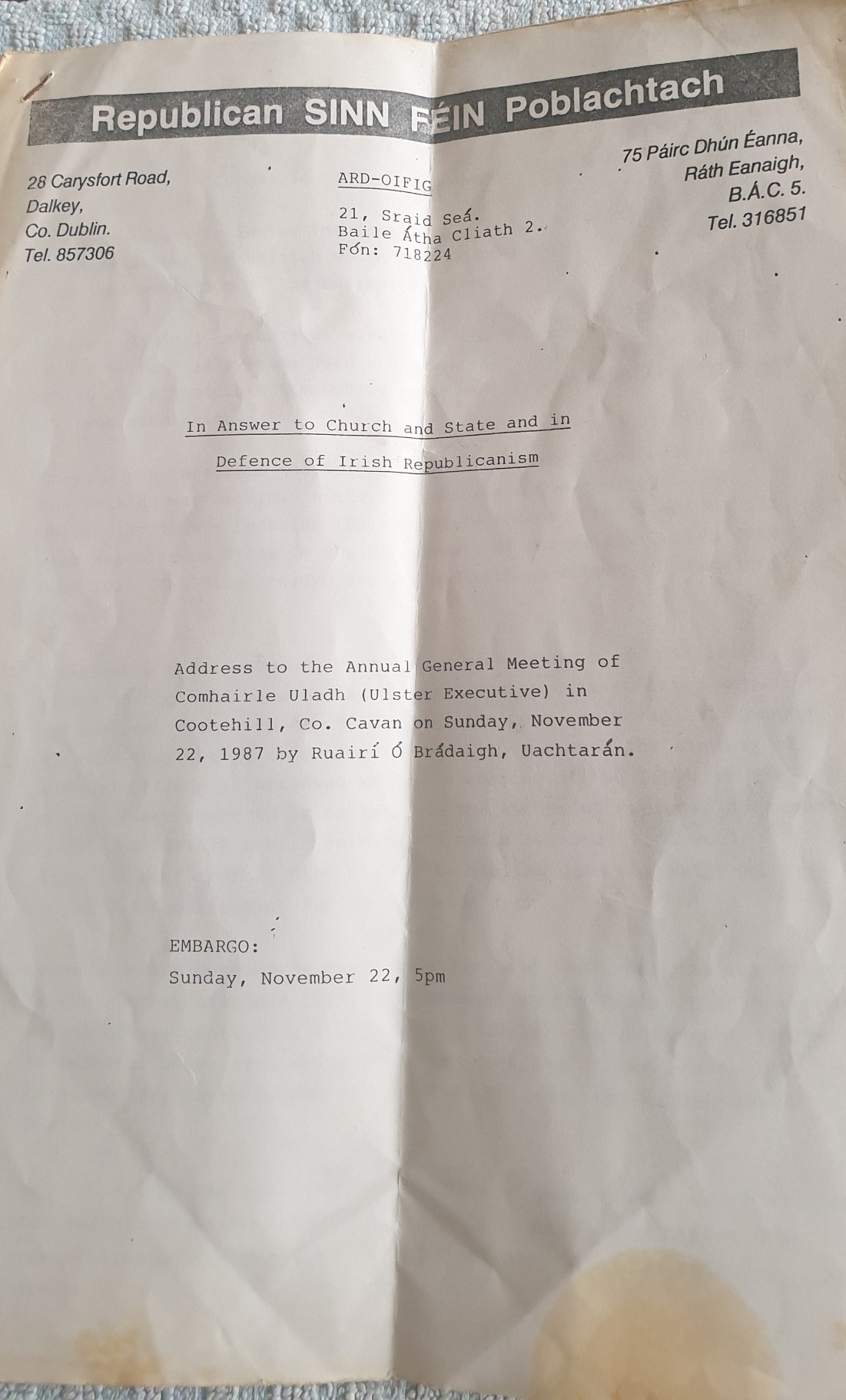
'IN ANSWER TO CHURCH AND STATE AND IN DEFENCE OF IRISH REPUBLICANISM...'
Address to the Annual General Meeting of Comhairle Uladh (Ulster Executive) in Cootehill, County Cavan, on Sunday, November 22nd, 1987, by Ruairí Ó Brádaigh, Uachtarán, Sinn Féin Poblachtach.
Comhaírle Uladh AGM, November 22nd, 1987.
The people are told they should be ashamed to be Irish and even the singing of national ballads is attacked while the wearing of the Poppy is extolled.
There seems to be no limit to the amount of national abasement sought and certain public persons and media personalities would appear to want to roll back history by hauling down our National Tricolour and substituting for it the Union Jack.
Opposition and government representatives and spokespersons are abject in their submissiveness to British demands on the Extradition Act and, as the crisis continues, the British Ambassador is a frequent visitor to Leinster House even while prolonged meetings of the Fianna Fail parliamentary party debate the purchase price on the Hillsborough Deal.
Who is calling the tune in the corridors of power these days?
We know for certain that the taxpayers of the 26 Counties are paying over one million pounds per day to support directly British rule in Ireland...
AND FINALLY...!
We couldn't let it go without mention (well...we could have, but we didn't wanna!) ; on the 2nd August 2021, we proudly posted the following piece -
'OVER ONE MILLION HITS. AND COUNTING...!
It has taken us a good few years to get here although, really, we never started this blog with a 'hits/views' objective in mind. But, having said that, it's a nice place to have arrived at!
Our 'Junior' dips in to our stat counter now and then, out of curiosity, more than as some sort of ego trip or whatever, and we know that we have regular readers from, among other places, this country - Ireland - from England, Scotland, Wales and the USA. We have had well-known film actors, authors, television 'celebrities' and politicians not only read our blog but avail of some of our output in their own work.
We have been watched by the White House and monitored by Moscow, and 'hit on' by all places in between and, over the years, we have been approached three times, by different professional entities, offering to 'monetise' this blog ie take it off a blog platform and turn it into "a real website behind a paywall". Out of courtesy (not curiosity!) we met reps from each entity and politely declined their offers.
We are not in this for financial gain. Our intention, way back when we started this blog (on the old 'Pyra Labs' platform!) was, and still is, to write about an issue which the three of us are committed to - the unjust and unwanted British military and political presence in this country.
We are Irish republicans, and proud to be so. We are the 'Irish dissidents' and the 'Irish terrorists' that the State political 'establishment' here, in Dublin, warn you against as do, no doubt, the political administrations in whatever country you are reading this in.
But we are not 'bad' people. We are, as stated, 'committed' people. We always knew we had an 'audience' out there, and we hope you'll stay with us as we strive to increase our readership.
Finally, thanks to all our sources and our fact-checkers for their assistance over the years. Sure we couldn't have done it without yis!
And thanks, again, to our many readers for checking-in on us as often as you do. Appreciated.
Sharon,
on behalf of the '1169 And Counting' team. GRMA agus slán go fóill anois.'
That was from two years ago on this date when, after years of hard graft and three keyboards (!), we finally crossed the 'million hits' barricade. And now we're striving for two million ; never bleedin' happy, are we...!
Thanks again for the visit, and for reading,
Sharon and the team.
ON THIS DATE (27TH APRIL) 93 YEARS AGO : DEATH OF AN IRA MAN WHO DARED AND SUFFERED - AUSTIN STACK.
Austin Stack (pictured) was born on the 7th December, 1879, in Ballymullen, Tralee, County Kerry and, at 29 years young, joined the 'Irish Republican Brotherhood' (IRB).
At the time of the 1916 Rising, he was 37 years of age and was the commandant of the Kerry Brigade of the Irish Volunteers and was arrested, by the British, with Con Collins, on the 21st April that year while planning an attack on Tralee RIC Barracks in an attempt to rescue Roger Casement.
He was court-martialed on the 14th June and sentenced to death, but this was commuted to twenty years penal servitude and he was released in the general amnesty of June 1917, and became active in the Irish Volunteers again. He opposed the Treaty of Surrender in 1921 (stating, during the debate on same - "Has any man here the hardihood to stand up and say that it was for this our fathers suffered, that it was for this our comrades have died in the field and in the barrack yard..") and took part in the subsequent Irish 'Civil War'.
He was captured in 1923 and went on hunger strike for forty-one days before being released in July 1924. When Eamon de Valera founded Fianna Fail in 1926, Stack remained with Sinn Féin and was elected Secretary of that organisation, a position he held until his death. His health was shattered due to the number of prison protests and hunger strikes for political status that he undertook. In the 1918 general election, while a prisoner in Crumlin Road Jail in Belfast, he was elected to represent West Kerry in the First (all-Ireland) Dáil as an abstentionist Sinn Féin Member of Parliament.
The British incarcerated him in Strangeways Prison in Manchester, from where he escaped in October 1919 and, during the 'Black and Tan War', as Minister for Home Affairs, he organised the republican courts which replaced the British 'legal' system in this country. Following a short fund-raising/public relations tour of America, he returned to Ireland to carry on the fight with his fellow republicans.
In the general round-up of Irish republican leaders in April 1923 (during which Liam Lynch was shot dead by Free State troops) Stack, the Deputy Chief of Staff of the rebel forces, was arrested in a farmyard in the Knockmealdown Mountains in County Tipperary - this was four days after Liam Lynch's death. Imprisoned in Kilmainham Jail in Dublin, he took part in the mass hunger-strike by republican prisoners in October 1923, which was his 5th hunger-strike in 6 years.
Shortly after the end of that forty-one day hunger-strike, in November 1923, he was released with hundreds of other political prisoners, and he married his girlfriend, Una Gordon, in 1925. In April 1929, at forty-nine years of age, he entered the Mater Hospital in Dublin for a stomach operation. He never recovered and died two days later, on 27th April 1929, and is buried in the Republican Plot, Glasnevin Cemetery, in Dublin.
A commemorative pamphlet, entitled 'What Exactly is a Republican?' was issued in memory of the man -
'The name republican in Ireland, as used amongst republicans, bears no political meaning. It stands for the devout lover of his country, trying with might and main for his country's freedom. Such a man cannot be a slave. And if not a slave in heart or in act, he cannot be guilty of the slave vices. No coercion can breed these in the freeman.
Fittingly, the question - 'What is a republican?' fails to be answered in our memorial number for Austin Stack, a man who bore and dared and suffered, remaining through it all and at the worst, the captain of his own soul. What then was Austin Stack, republican? A great lover of his country. A man without a crooked twist in him. One who thought straight, acted straight, walked the straight road unflinchingly and expected of others that they should walk it with him, as simply as he did himself.
No man could say or write of him "He had to do it". That plea of the slave was not his. His duty, as conscience and love dictated, he did. The force of England, of the English Slave State, might try coercion, as they tried it many times : it made no difference. He went his way, suffered their will, and stood his ground doggedly, smiling now and again. His determination outstood theirs, because it had a deeper foundation and a higher aim. Compromise, submission, the slave marks, did not and could not exist for him as touching himself, or the Cause for which he worked and fought, lived and died.'
Republican Ireland had lost one of her best soldiers, but we hold him safe in Glasnevin Cemetery, in Dublin.
'STIRRING BODENSTOWN COMMEMORATION...'
From 'The United Irishman' newspaper, July, 1954.
Gearóid O'Broin of Dublin stated, in his oration -
"We refuse to believe that the people of this generation, that the young men (sic) of this generation, are any less capable of making sacrifices for Ireland than the men (sic) who have gone before. To those who assert otherwise we of the Republican Movement answer with the names of Cathal Goulding, Seán Stephenson, Manus Canning and Jas McCallum in English jails and of Joe Campbell and Leo McCormack in Belfast Jail.
These young men exemplify the readiness of the young men of this generation to sacrifice themselves for Ireland.
Again, some people question the courage of the young men (sic) of today. We are told that picture houses and dance halls etc have sapped the energy and the spirit of the young men of Ireland. To people who nurse these doubts I suggest that they should make enquiries at Armagh Barracks where they will have such doubts quickly corrected..."
(MORE LATER.)
ON THIS DATE (27TH APRIL) 370 YEARS AGO - AN ENGLISH WAR CRIMINAL AND IRISH WOLFHOUNDS.
"Necessity hath no law.." - in other words, if you're in a position to do whatever it takes to 'get it done', then do it, regardless of 'it' being right or wrong or of how 'it' will affect others. Proof that Cromwell (pictured) was a semi-political gangster who would have fitted right in to any political institution here in this corrupt State.
It was on the 27th April in 1652 - 370 years ago on this date - that Mr Cromwell issued a decree stating that Irish Wolf Dogs ('Wolfhounds') were to remain in this country and the export of same was prohibited. He wanted to clear wolves from the Irish countryside and demanded that Irish Wolfhounds remain 'grounded' until that mission was complete ie he wanted his people to 'inherit' less troublesome land!
The man was more concerned about Irish Wolfhounds than he was about Irish people - pictured are some of his Irish victims, sold as slaves and 'sex workers' to the highest bidder.
On the 29th April, 1599, a baby boy, Oliver Cromwell, who had been born on the 25th, was christened in Saint John the Baptish church in Huntingdon, England. Decades later, when someone was trawling through the birth records for that period, they came across an unofficial addendum to that particular entry : it read - "England's plague for five years.."
Cromwell should need no introduction to readers of this blog, but some readers may not be aware of the significance of a particular date in that creature's life : on that date in 1649, Cromwell began his nine-day siege of Drogheda after which thousands of its inhabitants were butchered, the infamous 'Death March' he forced on his enemy after the battle of Dunbar on the 3rd September 1650 and, one year later on that same date - the 3rd September - he wallowed in more blood and guts, this time in his own country, at the battle of Worcester.
And, somewhere in between wrecking havoc and stealing and selling Irish children, he found the time to write to his political bosses in London :
'FOR THE HONOURABLE WILLIAM LENTHALL, ESQUIRE, SPEAKER OF THE PARLIAMENT OF ENGLAND :
Dublin, 27th September 1649.
Mr. Speaker - I had not received any account from Colonel Venables - whom I sent from Tredah to endeavour the reducing of Carlingford, and so to march Northward towards a conjunction with Sir Charles Coote - until the last night. After he came to Carlingford, having summoned the place, both the three Castles and the Fort commanding the Harbour were rendered to him.
Wherein were about Forty Barrels of Powder, Seven Pieces of Cannon ; about a Thousand Muskets, and Five-hundred Pikes wanting twenty. In the entrance into the Harbour, Captain Fern, aboard your man-of-war, had some danger ; being much shot at from the Sea Fort, a bullet shooting through his main-mast. The Captain's entrance into that Harbour was a considerable adventure, and a good service ; as also was that of Captain Brandly, who, with Forty seamen, stormed a very strong Tenalia at Treda, and helped to take it ; for which he deserves an owning by you.
Venables marched from Carlingford, with a party of Horse and Dragoons, to the Newry ; leaving the place, and it was yielded before his Foot came up to him. Some other informations I have received form him, which promise well towards your Northern Interest ; which, if well prosecuted, will, I trust God, render you a good account of those parts. I have sent those things to be presented to the Council of State for their consideration. I pray God, as these mercies flow in upon you, He will give you an heart to improve them to His glory alone ; because He alone is the author of them, and of all the goodness, patience and long-suffering extending towards you.
Your army has marched ; and, I believe, this night lieth at Arklow, in the County of Wicklow, by the Sea-side, between thirty and forty miles from this place. I am this day, by God’s blessing, going towards it. I crave your pardon for this trouble; and rest, your most humble servant,
OLIVER CROMWELL.
P.S. I desire the Supplies moved for may be hastened. I am verily persuaded, though the burden be great, yet it is for your service. If the Garrisons we take swallow-up your men, how shall we be able to keep the field? Who knows but the Lord may pity England's sufferings, and make a short work of this? It is in His hand to do it, and therein only your servants rejoice. I humbly present the condition of Captain George Jenkin's Widow. He died presently after Tredah Storm. His Widow is in great want.
The following Officers and Soldiers were slain at the storming of Tredah: Sir Arthur Ashton, Governor; Sir Edmund Varney, Lieutenant-Colonel to Ormond’s Regiment; Colonel Fleming, Lieutenant-Colonel Finglass, Major Fitzgerald, with eight Captains, eight Lieutenants, and eight Cornets, all of Horse ; Colonels Warren, Wall, and Byrn, of Foot, with their Lieutenants, Majors, etc ; the Lord Taaff’s Brother, an Augustine Friar ; forty-four Captains, and all their Lieutenants, Ensigns, etc; 220 Reformadoes and Troopers; 2,500 Foot-soldiers, besides the Staff-Officers, Surgeons, etc.'
This misfit had another date with his favourite day and date - 3rd September - in 1658, when he was collected from this Earth by his maker.
A pity he was spawned at all.
ON THIS DATE (27TH APRIL) 135 YEARS AGO : BIRTH OF "AN INFLUENTIAL AND FORMIDABLE" IRISH REPUBLICAN SOLDIER.
Henry James 'Harry' Boland (27th April 1887 – 2nd August 1922).
Harry Boland (pictured) was born in Phibsborough, in Dublin, on the 27th April 1887 - 135 years ago on this date.
He was a republican politician and a member of the First Dáil Éireann, a 32-County entity, not to be confused with the political assembly in Kildare Street, Dublin. He joined the 'IRB' at the same time as his older brother, Gerry, in 1904, and later joined the 'Irish Volunteers' (as did two of his brothers, Gerry and Ned) and took an active part in the Easter Rising of 1916.
During the on-going fight for freedom he operated alongside Michael Collins, who was a close friend but, when Collins signed the Treaty of Surrender, Harry Boland stayed true to his republican beliefs and fought on with the Republican Movement. He let Collins and others know what he felt about that Treaty -
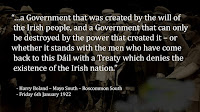
I object to this Treaty because it is the very negation of all that for which we have fought. It is the first time in the history of our country that a body of representative Irishmen has ever suggested that the sovereignty of this nation should be signed away...we secured a mandate from the Irish people because we put for the first time before the people of Ireland a definite issue ; we promised that if elected we would combat the will, and deny the right of England in this country, and after four years of hard work we have succeeded in bringing Ireland to the proud position she occupied on the fifth December last.
The fight was made primarily here in Ireland, but I want to say that the fight that was made in Ireland was also reflected throughout the world ; and we — because we had a definite object — had the sympathy of liberty-loving people everywhere. I have taken one oath to the Republic and I will keep it. If I voted for that document I would work the Treaty, and I would keep my solemn word and treat as a rebel any man who would rise out against it. If I could in conscience vote for that Treaty I would do so, and if I did I would do all in my power to enforce that Treaty ; because, so sure as the honour of this nation is committed by its signature to this Treaty, so surely is Ireland dead. We are asked to commit suicide and I cannot do it. We are asked to annihilate the Irish nation. This nation has been preserved for seven hundred and fifty years, coming down in unbroken succession of great men (sic) who have inspired us to carry on. We were the heirs of a great tradition, and the tradition was that Ireland had never surrendered, that Ireland had never been beaten, and that Ireland can never be beaten.." (7th January, 1922,from here.)
It is generally considered that Harry Boland was the first man to be 'unofficially executed' by a Michael Collins-controlled Free State death squad, on the evening of Sunday 30th July/early Monday morning 31st July 1922 and, following that shooting, in the Grand Hotel in Skerries, Dublin, the State gunmen issued this statement (on Monday 31st July 1922)-
"Early this morning a small party of troops entered the Grand Hotel to place Mr. H.Boland T.D., under arrest. Mr. Boland had been actively engaged in the irregular campaign. When accosted in his bedroom he made an unsuccessful attempt to seize a gun from one of the troops and then rushed out to the door. After firing two shots at random and calling on Mr. Boland to halt, it was found necessary to fire a third shot to prevent an escape. Mr. Boland was wounded and removed to hospital. A man giving his name as John J.Murphy with residence at 3 Castlewood Avenue, Ranelagh,Dublin, who was found with Mr. Boland, was taken prisoner. Subsequently he was identified as Joseph Griffin* , an active irregular, belonging to Dublin." (*'1169' Comment - Joe Griffin was an IRA operative within the Movement's Intelligence Department.)
One of the Free State troops present at the time stated afterwards - "Mr.Boland was wanted and we went to the hotel and two or three of us entered his room. He was in bed. We wakened him and he got up out of bed and partly dressed himself. He had no gun. Suddenly he turned and rushed to tackle one of our fellows for his gun. A shot was fired over his head to desist but he continued to struggle and almost had the gun when a second shot was fired and Mr.Boland was wounded."
The bullet entered his right side near the ribs, passed through his body and came out through his left side causing very serious injuries.
A photograph of the actual bullet which killed Harry Boland....
...and his funeral service, Glasnevin Cemetery, Dublin.
Although unarmed at that moment, as admitted by his executioners, caught by surprise and outnumbered (a "small party" of Free State troops were in the room at the time) the Staters attempted to present the execution of Harry Boland as 'a killing in self-defence' ie 'he attempted to jump us and then tried to flee...'.
They had learned well from their British colleagues.
Harry Boland died from his wounds on the 2nd August 1922, in St. Vincents Hospital, Dublin and, as he lay waiting for death, he told family members that the Stater who shot him had been imprisoned with him in Lewes Prison, in England, but he refused to put a name to him.
When his sister, Kathleen, asked him who had fired the shot he refused to tell her, saying "The only thing I'll say is that it was a friend of my own that was in prison with me, I'll never tell the name and don't try to find out. I forgive him and I want no reprisals". The funeral expenses were taken care of by the Cumann na Poblachta organisation.
'Boland's mix of animal charm, gregariousness, wit and a dash of ruthlessness made him an influential and formidable character. Though not an intellectual in his manner he was a clear thinker, a forceful orator and a graceful writer....' (from here.)
Thankfully, there are those like him who continue to this day to work for the Movement....
THE NOT SO IRISH NEWS...
Rita Smyth examines the editorials of the Northern newspaper, 'The Irish News', for the first six months of 1987.
Her analysis shows how the paper reflects the political attitudes of the Stormont Castle Catholics (who dominate the SDLP*) and the conservative values of the Catholic Hierarchy, especially Bishop Cahal Daly.
(From 'Iris' magazine, October 1987.) ('1169' comment - *...and who now fill the ranks of other Stoop-like political parties in Stormont and Leinster House.)
We are being called upon to 'reconcile' ourselves to a future where all that has really changed are some of the faces that administer our oppression. Too much blood has indeed been shed in the past two decades*, too much to allow the aspiration for Irish unity to be debased and reduced to an empty formula.
When the nationalist people came onto the streets to demand their rights 19 years ago, they might have been satisfied with a 'power-sharing' parliament. Today that's no longer enough.
('1169' comment ; * "Two decades"? A PSF member/supporter wrote that article less than one year after s/he left the Movement with Adams and McGuinness to go constitutional ; it is written from a nationalist perspective rather than from a republican perspective, which explains their belief that the campaign is to achieve so-called 'civil rights' rather that that which it is for, as far as Irish republicans are concerned - the complete withdrawal, politically, militarily and jurisdictionally of the British presence from Ireland.
Also, those same people are now campaigning for the retention of the Stormont 'power-sharing parliament'! They are honest in that, when bought, they stay bought!)
(END of 'The Not So Irish News' : NEXT - 'Divided Loyalties', from 'Magill Magazine', 2002 Annual.)
'CONVERT!'
From 'The United Irishman' newspaper, March, 1955.
It would seem that Sinn Féin has made at least one notable convert. In a recent statement in the exchange arising out of the 'Yorkshire Post', Mr de Valera said that the restoration of national unity and independence was a prerequisite to the establishment of cordial relations between Dublin, Belfast and London.
This is what Sinn Féin has been urging for years and we are glad to see that it has impressed itself on one who has been so strong an adherent of the Twenty-Six County Parliament for so long. It is a complete reversal of the policy that Mr de Valera preached during the recent war for then, in his efforts to build up his defence forces, he was wont to thunder that "...the first invader to put a foot on our soil he is the enemy and we will oppose him with all our might.." !
Completely forgetting (or ignoring) that there was already an invader on our soil - an invader who should there and then have been opposed with all our might. But that would have been against our friendly neutrality ; indeed, it is believed that there was an agreement with those 'friendly enemies' for cooperation with them in the event of a German landing in the Six Counties.
But, belated though it may be, we welcome Mr de Valera's conversion. We are aware, however, that cynics will put it down to a tactical adjustment by a cute politician who is sensitive to the current trend of public opinion in the country and is endeavouring to take advantage of it.
(END of 'Convert!' ; NEXT - 'Shoneenism 1955', from the same source.)
ON THIS DATE (27TH APRIL) IN...
...1920 :
On the 27th April, 1920, about 60 Volunteers from the East Limerick Brigade of the IRA, with Thomas Malone (aka 'Seán Forde') in command, attacked the RIC barracks in Ballylanders ('Baile an Londraigh') in the Ballyhoura region of that county. There were five British 'policemen' inside the structure but they eventually surrenderd when parafin was poured in on top of them from the roof, and their weapons were liberated and the barracks destroyed.
One IRA Volunteer, Seán Meade, was seriously wounded but he recovered later, and other Volunteers who took part included Tadgh Crowley, Edmond Tobin, Jack McCarthy, Thomas Murphy, Sean O'Riordain, D O'Hannigan, Liam Scully and Peter Steepe.
======================================
...1921 :
On the 27th April, 1921, the British Army 'discovered' an IRA arms dump in a stable for horses in Baggot Lane, in Dublin City Centre. They removed a machine gun, 14 rifles, 54 revolvers and 12,442 rounds of ammunition plus information which led to the 'arrest', two days later, of 40 Volunteers from the Dublin Brigade IRA.
======================================
...1921 :
The son of a 'Church of Ireland Dean of Raphoe' (in County Donegal), Gilbert Potter (pictured, who was born in Dromahair, in County Leitrim, on the 10th July 1887) joined the RIC as soon as he was of age and, having completed his 'cadetship' in Dublin, received a promotion to 'District Inspector' on this date, 27th April, in 1901.
On the 23rd April, 1921, RIC 'District Inspector' Potter, wearing civilian clothes, was arrested by the No.1 Column of 3rd (South) Tipperary Brigade IRA and his superiors were told that he would be executed unless IRA Volunteer Thomas Traynor, a father of ten children, was released by them ; the British were holding him in Mountjoy Jail, in Dublin, and were about to hang him.
The exchange of prisoners was refused by the British and they hanged Thomas Traynor at 8am on the 25th April 1921. RIC 'DI' Gilbert Norman Potter was executed by the IRA on the 27th April 1921 and buried in the Comeragh Mountains.
The IRA forwarded-on his personal effects to his wife, Lily, in a parcel which contained a last letter from her husband, his diary, his will, a gold watch and a signet ring. In return, the British Army blew up 10 house in the South Tipperary area in an act of reprisal.
======================================
...1923 :
On the 27th April, 1923, the IRA Army Council and the (Republican) Government of the Irish Republic announced that all offensive operations would be suspended from Noon on Monday, 30th April 1923. A combination of factors had influenced that decision, including the repeated condemnation of 'the Irregulars' by the hierarchy of the Churches, internment without trial and the introduction of the death penalty for possession of arms (77 republicans were 'officially' executed).
Éamon de Valera, one of the better known 'dissidents' at the time, issued a list of terms and conditions on which they were willing to negotiate with the Free Staters, but that list was rejected by Leinster House. The Staters had the upper hand and they knew it.
======================================
...1923 :
Reports and dates differ on this incident, but we put it here for the record :
In April 1923 (17th or the 27th?) IRA Volunteer James Tierney (21) was on a fund-raising operation in Dorset Street, in Dublin, during which a tobacconist's shop was raided. He was, according to one report, disarmed by a civilian named Patrick Rooney and shot dead. But an 'incident report' issued by the Dublin No.1 Brigade of the IRA stated that "he was disarmed and shot by a CID man on Dorset Street". It was also mentioned elsewhere that the shop was a 'cover' for Free State intelligence work.
======================================
...1953 :
On the 27th April 1953, Irish revolutionary, feminist and actress Maud Gonne MacBride (pictured) died in Roebuck, Clonskeagh, in Dublin, and is buried in Glasnevin Cemetery, in the City. She was born in Surrey, in England, but moved to Ireland with her father when he was stationed here with the British Army. She had a heart and a conscience and felt for the Irish people as they struggled to break free from British misrule.
Her marriage to Irish nationalist Major John MacBride (they had a son together) lasted only a short while, and she tried to get a divorce (they were legally separated in 1906) claiming he had been violent towards her and that he also molested her then 11 year old daughter, but those claims couldn't be proven in court so she fled to France to get her and her family away from the man.
In 1900, she assisted with the foundation of the 'Inghinidhe na hÉireann' ('Daughters of Ireland', which merged with the then newly-established 'Cumann na mBan' Movement in 1914) organisation and, during a visit to Dublin by Britain's 'Famine (sic) Queen', Victoria, the women of this organisation hung a black banner over O'Connell Street in protest at her presence and placed black flags in the windows of many houses throughout the city, barricading the doors of the houses to stop the RIC when they tried to get in to pull the flags down.
To 'celebrate' the fact that the English 'Queen' was in Dublin, her lackeys here held a 'Welcome from the Children'-party for her at which only 'loyal subjects' were invited and Maud Gonne McBride and 'Inghinidhe na hÉireann' held a 'Patriotic Children's Treat'-party in Clonturk Park in Drumcondra for the poor Irish children living in the Dublin slums ; about 30,000 children attended.
Maud Gonne MacBride died, age 87, on the 27th April 1953.
======================================
...1970 :
On the 27th April, 1970, a Dublin-born Hollywood actor, Arthur Shields (pictured, younger brother of the perhaps better known actor Barry Fitzgerald) died in Santa Barbara, California, at 74 years of age, from complications related to emphysema.
He was born into a (Protestant) family in Portobello, in Dublin, and was one of the brave men and women who challenged the British Empire in 1916 ; he was captured by enemy forces and was interned in Frongoch internment camp in Merionethshire, in Wales. Following his release, he returned to Dublin and worked as an actor at the Abbey Theatre - and the rest is history...!
======================================
...1975 :
On the 27th April, 1975, three (Catholic) civilians were shot dead by the 'Protestant Action Force' (PAF), which was a covername used by the 'Ulster Volunteer Force' (UVF), during an attack on a social club in Bleary, near Lurgan, in County Down.
======================================
...1990 :
On the 27th April, 1990, the convictions of 'The Winchester Three' were overturned by the Court of Appeal in England ; those three innocent people had been sentenced for conspiring to kill Tom King ('Baron King of Bridgwater'), a former British 'Secretary of State' for the Occupied Six Counties. Upon their release, the three people were arrested and deported from Britain under the 'Prevention of Terrorism Legislation'.
Similar occurrences of British 'justice' in Ireland can be read here.
======================================
======================================
Thanks for the visit, and for reading.
Sharon and the team.