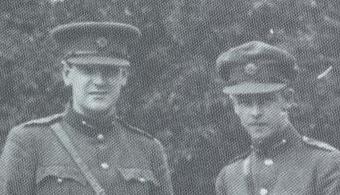
BORN ON THIS DATE (4TH MARCH) THE SAME DATE THAT HE DIED, AND NAMED AFTER AN IRISH HERO WHO WAS BORN ON THAT SAME DATE 120 YEARS BEFORE HIM!
Emmet Dalton (pictured, on the right, with Michael Collins), Irish rebel-turned-Free Stater, was born in America on March 4th 1898 and died in Dublin on March 4th 1978 - his 80th birthday, and also the bicentenary of the birth of the man he was named after, and whose Cause he belittled - Robert Emmet.
Dalton was educated at the O'Connell School in Drumcondra, Dublin, and as a young adult became interested in the political teachings of John Redmond, so much so that he joined the British Army, serving as a 2nd Lieutenant with the 7th Battalion of the Dublin Fusiliers. He would have been present at the Somme in September 1916 when over 4,000 Irish soldiers died (including his friend, Tom Kettle) and, indeed, won a 'Military Cross' for '..leading forward to their final objective companies which had lost their officers. Later, whilst consolidating his position, he found himself with one sergeant, confronted by 21 of the enemy, including an officer, who surrendered when he attacked them..'. He further served the British 'war effort' in Palestine, where he trained a sniper patrol and also served as a British Army staff officer in France.
He was demobilised,in Germany, in 1919, at the age of 21, and returned to Dublin, becoming the 'Director of Training' for the Irish Republican Army, but he sold out in favour of the 'Treaty of Surrender' in 1921 and made a (Free State) name for himself by attacking republican positions from the sea, actions that his British paymasters considered as having 'turned the tide' against the Irish republican resistance, and also led the Free State attack on the Four Courts in Dublin on the 28th June 1922.
Dalton was with Michael Collins on the 22nd of August 1922 when the latter was shot dead by republican forces in West Cork (Béal na mBláth) and is said to have propped up a dying Collins to place dressings on his wound. He resigned from the Free State Army shortly after Collins was killed (his brother, Charlie, stayed on and made an equally bad name for himself), and was appointed as the clerk of the Free State Senate, but resigned from that, too, three years later, and opened a film production company, Ardmore Studios, near Bray , in Wicklow. He died, aged 80, on the 4th of March 1978, the same date and month that he had been born on, and was buried in Glasnevin Cemetery in Dublin. Rumours persist that Dalton himself shot Collins dead, as per instructions from Westminster...?
ON THIS DATE (4TH MARCH) 242 YEARS AGO : 'DARLING OF ERIN' BORN.
Robert Emmet was born on the 4th March, 1778, a son of Dr Robert Emmet and Elizabeth Mason. His father served as state physician to the vice-regal household but was a social reformer who believed that in order to achieve the emancipation of the Irish people it was first necessary to break the link with England. Robert Emmet (Jnr) was baptised on March 10th in St Peter's Church of Ireland in Aungier Street, Dublin, and attended Oswald's School in Dropping Court, off Golden Lane, Dublin. From there he went to Samuel Whytes School in Grafton Street, quite near his home, and later to the school of the Reverend Mr Lewis in Camden Street. He entered Trinity College, Dublin, in October 1793 at the age of fifteen and a half where he practiced his oratorical skills in the Historical and Debating Societies. One of his friends at TCD was the poet Thomas Moore.
There were four branches of the 'United Irishmen' in TCD and Robert Emmet was secretary of one of them but, after an inquisition, presided over by Lord Chancellor Fitzgibbon, Emmet became one of nineteen students who were expelled for United Irishmen activity. Although not active in the 1798 Rising, Robert Emmet was well known to the British authorities and by April 1799, when Habeas Corpus had been suspended, there was a warrant issued for his arrest, which he managed to evade and, early in 1801, accompanied by a Mr Malachy Delany of Cork, he travelled throughout Europe, and made Paris his headquarters - it was there that he replaced Edward Lewis as the liaison officer between Irish and French Republicans.
While in Paris, Emmet learned about rockets and weapons, and studied a two-volume treatise by a Colonel Tempelhoff which can be examined in the Royal Irish Academy, with the marginal notes given the reader some insight into Emmet's thinking. Following the signing of the 'Peace of Amiens' by France and England in March 1802 the United Irishmen that were being held as prisoners in Fort George were released and many such as Thomas Russell and Thomas Addis Emmet made there way to Paris. Emmet returned to Ireland in October 1802 and began to plan for a rising and in March 1803, at a meeting in Corbet's Hotel, 105 Capel Street, Dublin, Emmet briefed his key organisers. In April 1803 Emmet rented an isolated house in Butterfield Lane in Rathfarnham as a new base of operations and Michael Dwyer, a 1798 veteran, suggested his young niece as a suitable candidate to play the role of the 'housekeeper'. Born in or around the year 1778, Ann Devlin soon became Robert Emmet's trusted helper and served him loyally in the months ahead. Shortly afterwards he leased a premises at Marshalsea Lane, off Thomas Street, Dublin, and set up an arms depot there.
Arms depots were established in Dublin for the manufacture and storage of weapons for the incipient rising. Former soldiers mixed their practical skills with the scientific knowledge that Robert Emmet had acquired on the continent, and an innovative rocket device was produced. Elaborate plans were drawn up to take the city and in particular Dublin Castle : supporters from the surrounding counties of Kildare, Wicklow and even Wexford were pledged to assist. Emmet bided his time, waiting for an opportune moment when English troops would be withdrawn to serve in the renewed war in France, but his hand was forced when a premature explosion on the evening of July 16, 1803, at the Patrick Street depot, caused the death of John Keenan. Though there was no obvious wide scale search or arrest operation by the British following the explosion, the leadership of the movement decided to set July 23, 1803 (the following Saturday) as the date for the rising. Emmet hoped that success in Dublin would inspire other counties to follow suit. Patrick M. Geoghegan, in a recent publication, says that "..the plan for taking Dublin was breathtaking in its precision and audacity. It was nothing less that a blueprint for a dramatic coup d'état. Indeed, over a century later, Pearse and Clarke would also refer to the plan for their own rising.."
Emmet's plan depended on two factors - arms and men and, as Geoghegan states, when the time came, Robert Emmet had not enough of either - events went dramatically wrong for him. On the appointed day his plans began to unravel ; Michael Dwyer and his promised 300 men did not get the word until Sunday July 24th and, the previous day, an excess of men had moved in to Dublin from Kildare and could not be concealed in the existing depots so they spread out around the city pubs and some started drinking. Others, after inspecting the existing arsenal and finding many pikes but few muskets or blunderbusses, went home unimpressed.
Because he had alerted other countries and still had the element of surprise, Emmet decided not to postpone the Rising thus, shortly after seven o' clock on Saturday July 23rd, 1803, Robert Emmet in his green and gold uniform stood in the Thomas Street, Dublin, depot and, to the assembled rebels, read out his proclamation, declaring that the Irish nation was about to assert itself in arms against foreign rule. But again events conspired to thwart the rebels - coaches commissioned for the attack on Dublin Castle were lost and erroneous information supplied that encouraged pre-emptive strikes, meant that confusion reigned. Also, the novel rocket signals failed to detonate. Emmet's own forces, who were to have taken the Castle, dwindled away and, throughout the remainder of that evening, there were skirmishes at Thomas Street and the Coombe Barracks but he decided to terminate operations and leave the city. For the English Army, which included Daniel O' Connell, it was then merely a mopping-up operation : in the aftermath, the English arrested and tortured Anne Devlin, even offering her the enormous sum of £500 to betray Robert Emmet - she refused.
Emmet himself took refuge in the Harold's Cross area of Dublin, during which he met with his mother and Sarah Curran but, on Thursday August 25th, 1803, he was finally arrested. It has been stated by others that a £1000 reward was paid by Dublin Castle to an informer, for supplying the information which led to his capture. Robert Emmet's misfortunes did not stop on his arrest : he had the misfortune to be defended by one Leonard McNally who was trusted by the United Irishmen. However, after McNally's death in 1820 it transpired that he was a highly paid government agent and, in his role as an informer, that he had encouraged young men to join the rebels, betrayed them to Dublin Castle and would then collect fees from the United Irishmen to 'defend' those same rebels in court!
Emmet was tried before a 'Special Commission' in Green Street Court House in Dublin on September 19th, 1803. The 'trial' lasted all day and by 9.30pm he was pronounced guilty ; asked for his reaction, he delivered a speech which still inspires today. He closed by saying that he cared not for the opinion of the court but for the opinion of the future - "..when other times and other men can do justice to my character.." Robert Emmet was publicly executed on Tuesday September 20th outside St Catherine's Church in Dublin's Thomas Street. The final comment on the value of Robert Emmet's Rising must go to Séan Ó Brádaigh, who states that to speak of Emmet in terms of failure alone is to do him a grave injustice. He and the men and women of 1798 and 1803 and, indeed, those that went before them, set a course for the Irish nation, with their appeal to Protestant, Catholic and Dissenter under the common name of 'Irishman', which profoundly affected Irish life for more than two centuries and which will, we trust, eventually bear abundant fruit.
Finally, it was not only college-educated men and women like Robert Emmet (ie those who might be perceived as being 'upper class') who decided to challenge Westminster's interference in Irish affairs in 1803 : so-called 'working class' men and women also acknowledged the need for such resistance - Edward Kearney, carpenter, hanged, Thomas St / Owen Kirwin, tailor, hanged, Thomas St, September 1st 1803 / Maxwell Roche, slator, hanged, Thomas St, September 2nd 1803 / Denis Lambert Redmond, coal facer, hanged, Coalquay (Woodquay) Dublin, / John Killeen, carpenter, hanged, Thomas St, September 10th 1803 / John McCann, shoemaker, hanged at his own doorstep, Thomas St, September 10th 1803 / Felix Rourke, farm labourer, hanged, Rathcoole, Dublin, September 10th 1803 / Thomas Keenan, carpenter, hanged, Thomas St, September 11th 1803 / John Hayes, carpenter, hanged, Thomas St, September 17th 1803 / Michael Kelly, carpenter, hanged, Thomas St, September 17th 1803 / James Byrne, baker, hanged, Townsend St, Dublin, September 17th 1803 / John Begg, tailor, hanged, Palmerstown, Dublin, September 17th 1803 / Nicholas Tyrrell, factory worker, hanged, Palmerstown, Dublin, September 17th 1803 / Henry Howley, carpenter, hanged, Kilmainham Jail, Dublin, September 20th 1803 / John McIntoch, carpenter, hanged, Patrick St, Dublin, October 3rd 1803 - there are dozens more we could list here, but suffice to say that 'class' alone was not then, nor is it now, a deciding factor in challenging British military and political interference in this country. 'Justice' is the deciding factor in that equation.
'IRA CRIMINAL CONSPIRACY - A CONSPIRATOR SPEAKS AND IS BOOHED...'
From 'The United Irishman' newspaper, December 1954.
Strange Fog?
About the same time as Mr Ernest Blythe was voicing his opinion on criminal conspiracy, forgetful presumably of his own past, the President of UCD, Mr M Tierney, was uttering the following warning ; "We are living in Ireland in a strange fog of unreality which seems at the moment to have penetrated into every corner of our national consciousness and which we feel no more than the inhabitants of the Hebrides feel the fogs of winter."
Hear, hear, Mr Tierney, you are in a position to see the fog that enshrouds our national conscience, and which is merely the smokescreen (akin to a fog) which has been thrown out by the politicians in carrying out their various criminal conspiracies since December 1921. But for all that it is not a 'strange fog' - it is only strange to those who will not appreciate its source. I do not wish to be cruel, but I would suggest to the UCD Literacy and Historical Society that they should henceforth carry out 'Operation Fog' by refusing to give a platform to any person who has taken part in 'Operation Criminal Conspiracy'.
In case, Mr Editor (or my young readers), you may have any doubts as to my bona fides or my right to challenge the blithe and the not so blithe politicians, I want to inform you that I place myself in the category of 'Veteran', having been a member of the IRB up to the time it was 'taken over' by the first set of conspirators, a GHQ Staff Officer in 1921, a Battalion Commandant in 1922, a Brigade Commandant in 1923 and still acknowledging the republican stand.
Yours,
Ben Doyle.
(End of 'IRA CRIMINAL CONSPIRACY - A CONSPIRATOR SPEAKS AND IS BOOHED' ; Next - 'CORK CEREMONY', from the same source.)
ON THIS DATE (4TH MARCH) 132 YEARS AGO : "GRACE UNKNOWN...."
Grace Gifford Plunkett (pictured) was born on this date (4th March) in 1888, in Dublin. She attended art school here and in London and, in 1915, at the age of 27, she 'stepped out' with the then editor of 'The Irish Review' magazine, Joseph Plunkett, one of the founders of the 'Irish Volunteer' organisation. He was imprisoned in Kilmainham Jail in Dublin for his part in the 1916 Easter Rising and was condemned to death by firing squad : he asked Grace to marry him and, on the 3rd of May 1916, at 6pm, in Kilmainham Jail, Grace Gifford and Joseph Plunkett were married, with two prison officers as witnesses and fifteen British soldiers 'keeping guard' in the same cell. The couple were allowed ten minutes together, before Grace was removed from her husband. He was executed by the British hours later, on the 4th May, 1916.
Grace Gifford Plunkett was at that time on the Executive of the then Sinn Féin organisation, and spoke out against the Treaty of Surrender. Like all anti-treaty activists (then as now) she was constantly harassed by Free State forces and was no stranger to the inside of prison cells, and was on a 'watch list' by the Leinster House administration. She had no home, little money and was despised by the State 'authorities' - selling her drawings and illustrations gave her a small irregular income, as she moved from rented flat to rented flat and ate in the cheapest restaurants she could find. She died suddenly, and alone, on the 13th of December 1955, aged 67, in a flat in South Richmond Street in Portobello, Dublin, and was buried in Glasnevin Cemetery, Dublin.
'Rougher than Death the road I choose
Yet shall my feet not walk astray,
Though dark, my way I shall not lose
For this way is the darkest way.
Now I have chosen in the dark
The desolate way to walk alone
Yet strive to keep alive one spark
Of your known grace and grace unknown...' (from here.)
ILLEGAL ARMS : IN BAD COMPANY...
A man suspected of being one of the world's biggest dealers in illegal weapons was a director of two companies based in Ireland. By Annamarie Comiskey. From 'Magill' magazine, July 2002.
In July last year (2001), Leonid Minin was charged by Italian magistrate Dr Walter Mapelli with dealing in illegal arms. He is now in prison near Milan awaiting a second trial, which could end with a 12-year sentence. Shortly before his arrest for possessing drugs, magistrate Walter Mapelli claims that Minin chartered a plane in Ukraine to fly 113 tonnes of bullets to the Ivory Coast in West Africa ; the year before that, according to the magistrate, Minin allegedly sent 68 tonnes of small arms to the same country, which were then re-routed to Sierra Leone, a country under a UN arms embargo, by his private plane. He denies knowing that his plane was used for this purpose.
Leonid Minin's empire is backed-up by a web of companies in the Cayman Islands, Gibraltar and the Isle of Man, to name just a few of the off-shore havens he used. The magistrate is investigating this paper trail to find out if Minin was laundering the proceeds of illegal arms trafficking and his Irish interests may come under scrutiny. Limad Invest Ltd, an investment company registered at 3 College Green, Dublin 1, was incorporated in 1996 and dissolved in 1999 - Minin was one of the directors. The company had a share capital of twelve-thousand Euro's and filed annual accounts in 1997 though no trade took place. No annual accounts were filed in 1998, 1999 or 2000.
At the same address, Minin held a directorship of another company, 'Limad Energy', set-up with a meagre share capital of two-thousand four hundred Euro's ; it was also dissolved in 1999 and, again, annual accounts were filed in 1997 but not thereafter. Records show that Leonid Minin described himself as a 'businessman', with Israeli nationality and an address in Tel Aviv. He also holds passports from Germany and Ukraine. The other director, Irina Najda Sylam, described herself as a 'director', with German nationality, and living in Monaco. Mysteriously, there is no information on record of what the companies did after 1997... (MORE LATER.)
'THOUGHTS AFTER OMAGH'.
From 'The United Irishman' newspaper, November 1954.
The Irish, like all other people, are only human. They shape their lives on the pattern of their leaders and, when the leaders are noble and heroic, the people are also noble and heroic. But when the leaders are mean, cowardly, corrupt and cynical, so also are the people.
Ireland has passed through its period of meanness and cynicism. A new spirit is abroad throughout the land ; "What can I do" is the watchword replacing the old "What do I get", that has dominated Irish life and politics for the past thirty years*. It is natural and noble for a people to desire freedom ; freedom denied and subjection enforced by the might of arms is a gnawing irritant on the national life that cannot be placated by rhetorical orators or resounding resolutions.
To become free is very difficult. It cannot be achieved by wishing for it - a great effort has to be made, by the nation and by individuals, to become disciplined in preparation for the sacrifice, if necessary, of personal liberty, life, property and loved ones... (MORE LATER.)
( * '1169' comment : that 'new spirit' might very well have surfaced in the 1950's (I wasn't around then!) but it has long since disappeared and a vicious 'mé féin' attitude is, unfortunately, thriving in this corrupt State. The political system here encourages the scenario that it's 'every one for themselves' and that outlook will not change until the political system here changes. Or is changed, by whatever means necessary.)
ON THIS DATE (4TH MARCH) 216 YEARS AGO - 'CONVICTS' REVOLT : 'VINEGAR HILL' NSW UPRISING.
On this date in 1804, an uprising was held by the 'Castle Hill Convicts' in New South Wales, Australia, led by Irish rebel Phillip Cunningham, a Kerryman, born at Glenn Liath ('Grey Glen'), Moyvane. Although not a lot is known about this Irish hero, it is recorded that he moved to Clonmel, Tipperary, in the 1790's and worked as a stonemason, supplementing his income from same by opening up a small pub. Peter Cunningham and about two hundred other 'convicts' turned on the Redcoat soldiers who had imprisoned them, locked them up and broke into a weapons hut.
Martial law was declared as a result, in the Sydney area, and residents in the town of Parramatta were advised to assemble at the docks, ready to flee the area if needed. The rebels had by now based themselves on a hilltop and declared it to be their 'Vinegar Hill'. A Major George Johnson and his men from the New South Wales Corps and a detachment of fifty mercenaries from the 'Loyal Association' marched through the night and a short battle commenced in and around 'Vinegar Hill', ending the rebellion. Peter Cunningham was later executed without trial.
'The Sydney Gazette' newspaper covered(/coloured) the event, in its edition of the 11th March 1804, in the following manner -
'REBELLION AT CASTLE HILL.
Major Johnston on arriving at Toongabbee, received information that a considerable Body were on their way to the Hawkesbury: Notwithstanding the fatigue of his small Detachment in marching up from Sydney and the distance they had gone since, they immediately ran in good Order, with their followers, and after a pursuit of Seven Miles farther, Major Johnston and a Trooper, who had preceded the Detachment came up with the rear of the Insurgents at 11 o'clock, whose number have since been ascertained to be 233 men, armed with Musquets, Pistols, Swords etc., and a number of followers which they had taken from the Settlers.
After calling to them repeatedly they halted, and formed on the rise of a Hill: The Major and Trooper advanced within pistol shot, and endeavoured to persuade them to submit to the Mercy that was offered them by the Proclamation, which they refused. The Major required to see their Chiefs, who after some deliberation met them half way, between the Detachment and Insurgents, when by a great presence of mind and address the Major presented his pistol at the head of the Principal leader (Phillip Cunningham), and the Trooper following his motions, presented his Pistol also to the other leader's head (William Johnston) and drove them into the Detachment without the least opposition from the body of the Insurgents..' (more here.)
That rebellion may very well have been shortlived and its leader, Peter Cunningham, almost forgotten in our history, but it, and he, live on in the memory of every Irish republican to this day. As it should be.
ON THIS DAY NEXT WEEK (WEDNESDAY 11TH MARCH 2020).....
...we won't be posting our usual contribution, and probably won't be in a position to post anything at all until the following Wednesday (18th) ; this coming weekend (Saturday/Sunday 7th/8th March) is spoke for already with a 650-ticket raffle to be run for the Dublin Comhairle of RSF in a venue on the Dublin/Kildare border (work on which begins on the Tuesday before the actual raffle) and the 'autopsy' into same which will take place on Monday evening, 9th, in Dublin, meaning that we will not have the time to post here on Wednesday 11th. But we'll be back, as stated above, on Wednesday 18th March 2020. Thanks for checking in with us, and we'll see ya then!
Thanks for reading, Sharon.
ON THIS DATE (26TH FEBRUARY) 166 YEARS AGO : 'GUILTY' OF HIGH TREASON BUT PARDONED AND TRANSPORTED.
On this date - 26th February - in 1854, William Smith O’Brien (pictured), leader of the 1848 'Young Irelander Rebellion', is released. He had been convicted of 'sedition' (inciting landlords and tenants to rebel) and sentenced to be hanged, drawn, and quartered. After 70,000 people in Ireland and 10,000 people from England petitioned for clemency, his sentence was reduced to deportation to Van Diemen’s Land (Tasmania). After five years in Van Diemen’s Land, he was released, but exiled from Ireland. He went to live in Brussels until 1856 when he was given an unconditional pardon and allowed to return to Ireland. He never returned to politics, and died at 61 years of age, in Wales.
On the 17th October 1803, 'Sir' Edward O'Brien (the '4th Baronet' of Dromoland Castle, County Clare) and his wife, Charlotte (nee Smith) - well established political conservatives and supporters of the Orange order - celebrated the birth of their second son, whom they named William (in later years, after inheriting land from his mother, William added the surname 'Smith' to his name). He was educated at Harrow, in London, and Trinity College in Cambridge (he was later to describe his education thus : "I learnt much that was evil and little that was good..") and, at 25 years of age (in 1828) he was elected to Westminster for the Conservative Party (for the Ennis constituency), a position he held for four years and, at 29 years young, he married Lucy Caroline Gabbett, and they had seven children together.
At 32 years of age he won a seat to represent Limerick. He was a strong supporter of Catholic emancipation and, at 40 years of age, he joined Daniel O'Connell's anti-union 'Loyal National Repeal Association', which he left three years later. Within a few years, he had joined the 'Young Irelanders' organisation and helped to establish within it a group called 'The Irish Confederation' which organised as best it could for an armed uprising in Ireland against British rule, but the timing was wrong : Ireland was suffering the holocaust, and its remaining people were too exhausted for anything other than trying to stay alive.
One of the leaders of 'The Young Irelanders', John Mitchel, was 'arrested' for writing "..wild and menacing words.." then, in April 1848, the 'Treason Felony Act' was introduced, followed by the suspension of 'Habeas Corpus' on July 25th, 1848 ; William Smith O'Brien recognised that the British were 'battening down the hatches' and, with John Mitchel in a British prison, he was in command. He called for an immediate Rising against the British and an attempt at a rebellion did take place on the 29th July 1848 in Tipperary but it failed, leading to the arrest of the leaders of the 'Confereration', Thomas Francis Meagher, Terence McManus, Patrick O'Donohoe and William Smith O'Brien (who was arrested on the 6th August 1848 and tried at a special sitting of the district court at Clonmel, Co. Tipperary : he was sentenced to death on 10th October 1848), all of whom were deemed by the British to be guilty of High Treason and were sentenced to be hung, drawn and quartered.
Following the court case, meetings were held in Ireland and England with the aim of raising a petition against the severity of the sentences and pointing out that the jury involved had recommended clemency but were ignored by the judge - over 80,000 people willingly listed their names, addresses, occupations etc (as mentioned above, in what is considered to be the first mass political petition movement) resulting in the sentences being commuted to transportation for life. The four 'dissidents' left Ireland on the 29th July 1849 for exile in Van Diemen's Land. On the 26th February 1854 - 166 years ago on this date - O'Brien won a conditional pardon which banned him from entering Ireland and he and his family moved to Brussels where, amongst other duties, he wrote a political book : he won his final pardon two years later, in May 1856, and returned to Ireland to a hero's welcome. Asked how he now felt about his actions, he replied - "I had firmly resolved not to say or write or do anything which could be interpreted as a confession on my part that I consider myself a 'criminal' in regard to the transactions of 1848.." .
His wife died in Ireland on the 13th June 1861, and he himself passed away three years later, in his 61st year, in Bangor, Wales, and is buried in Rathronan Churchyard in Limerick. The inscription on the family headstone reads - 'Here lies Edward William, eldest son of William Smith O'Brien, a just man, a lover of his people. Born 24 January 1837 Died 21 January 1909.'
William Smith O'Brien, Born 17th October 1803, Died June 1864.
Lucy Caroline O'Brien, Born 23rd September 1811 Died 13 June 1861'.
Like his son, Edward, William Smith O'Brien was 'a just man, a lover of his people..' and, least we forget, a 'dissident' of his day.
'IRA CRIMINAL CONSPIRACY - A CONSPIRATOR SPEAKS AND IS BOOHED...'
From 'The United Irishman' newspaper, December 1954.
The third criminal conspiracy was that by which the notorious 1925 agreement was arrived at in London between the Free State junta, the British Government and the Stormont junta. This agreement set-up partition in its present form and Mr. Ernest Blythe was again a party to it as a member of the Free State junta.
The fourth criminal conspiracy was that by which Mr. Blythe and his co-conspirators prevented the partition agreement from being debated and voted upon by the representatives of the Irish people, in the 26 Counties, and thereby made the agreement law, in so far as they were able, although 71 votes only were cast in its favour out of a house then composed of 153 members ; sufficient, young Irelanders, to prove that this gentleman knows the full significance of the words he used at the UCD Literary and Historical Society debate - that "Irishmen of the political class are unworthy of the heroism of our patriot dead."
But the numerous conspiracies of Messrs. Blythe and Co. failed hopelessly in their main purpose which was to end for all time the organisation - the IRA - on which they had turned turtle and the very name of which they had grown to hate. It is interesting and paradoxical to note that each of these conspiracy movements over a span of more than thirty years contained a person who may be termed 'First Lieutenant' and who hailed from our occupied Six Counties -
1) Cosgrave, Blythe and Co.
2) De Valera, Aiken and Co.
3) McBride, Kelly and Co.
You, Six County republicans, who have been thrown to the wolves, please note carefully...! (MORE LATER.)
ON THIS DATE (26TH FEBRUARY) 58 YEARS AGO : THE IRA 'BORDER CAMPAIGN' ('RESISTANCE CAMPAIGN/OPERATION HARVEST') ENDS.
On this date (26th February) in 1962, due to "lack of support", the Irish Republican Army ended what it called 'The Campaign of Resistance to British Occupation', which was also known as the 'Border Campaign'.
At the time of this IRA campaign, Eamon de Valera's Fianna Fail State administration were of the opinion that it actually began in 1954, with the raid on Gough Barracks, in Armagh, on Saturday 12th June that year (1954), in which some 300 weapons were liberated from the British Army. Fianna Fail considered that proof enough that the IRA "..had renewed its activities, was rearming, recruiting young men and engaging in drilling and other manoeuvres.." and indeed they were.
On 11th December 1956, communication was sent to the IRA Volunteers involved - over 150 men - that the operation would begin at midnight on 12th December and, at the appointed time, three IRA flying columns crossed the Free State border to attack British Army depots and administration centres, air fields, radar installations, BA barracks, courthouses, bridges, roads and custom posts : the 'Resistance Campaign/Operation Harvest', had begun proper, being co-ordinated from County Monaghan.
In a letter from the leadership of the then Sinn Féin organisation, which was signed by Maire Ni Gabhan and Miceal Treinfir and which was sent from the Sinn Féin Office, 3 Lr. Abbey Street, Dublin, the Secretary of each Cumann was instructed to read out a statement after every Mass in their area, on Sunday 16th December (1956), announcing the start of 'the Border Campaign', to achieve "..an independent, united, democratic Irish Republic. For this we shall fight until the invader is driven from our soil and victory is ours..", an announcement which, later, prompted the then Free State 'Taoiseach', Fianna Fail's Seán Lemass, to describe the IRA as being "similar to fascists" re its decision to mount such a campaign!
Although it did not achieve its objectives, the Border Campaign kept 'the National Question' in the political forefront, enabling the Republican Movement to make new connections and ensuring that valuable operational lessons were learned and documented for the next generation. On the 26th February 1962 - 58 years ago on this date - the IRA, through the Irish Republican Publicity Bureau, in a communication signed by J. McGarrity, sent out the following message -
"The leadership of the resistance movement has ordered the termination of the Campaign of Resistance to British Occupation launched on December, 1956. Instructions issued to Volunteers of the Active Service Units and of local Units in the occupied area have now been carried out. All arms and materials have been dumped and all full-time active volunteers have been withdrawn. Foremost among the factors motivating this course of action has been the attitude of the general public whose minds have been deliberately distracted from the supreme issue facing the Irish people – the unity and freedom of Ireland. The Irish resistance movement renews its pledge of eternal hostility to the British Forces of Occupation in Ireland. It calls on the Irish people for increased support and looks forward with confidence – in co-operation with the other branches of the Republican Movement – to a period of consolidation, expansion and preparation for the final and victorious phase of the struggle for the full freedom of Ireland."
Although that Campaign was called off as, indeed, were others like it over the centuries of resistance, opposition to British military and political interference in Irish affairs remains in place and has been bolstered by those 'failed campaigns'. Even when we 'lose' , we win!
ILLEGAL ARMS : IN BAD COMPANY.
A man suspected of being one of the world's biggest dealers in illegal weapons was a director of two companies based in Ireland. By Annamarie Comiskey. From 'Magill' magazine, July 2002.
The coffee may be better in Italian jails, but for Leonid Minin this is little comfort during his two-year prison sentence in Milan for possessing cocaine.
Minin, born in the Ukraine in 1947, was jailed in 2001 for possession of drugs in a Milan hotel he partly owns. When the police searched his hotel room, not only did they fine cocaine but also four prostitutes, $500,000 worth of diamonds, $35,000 in cash and a stash of papers detailing his business interests. It turned out that Minin was one of the world's allegedly most wanted illegal arms dealers, and is also believed to be involved in money laundering.
He is wanted in at least three countries, has several aliases and has avoided prosecution until now. The police went to his hotel room in Milan only after a tip-off from one of the prostitutes he had been using. Through enquiries made by 'Magill Magazine', it has come to light that Leonid Minin was also a director of two companies based in Dublin... (MORE LATER.)
'GREATER LOVE'.
From 'The United Irishman' newspaper, November 1954.
Omagh, October 1954 :
'Which is the greatest victory of their wondrous deed,
is it that they have proved so mightily brave,
that they who oft have scorned are quick to lead,
the exultation and the song of praise?
Is it that after thirty years and more
shots from our soldiers answered British guns,
too proud these men to beg and to implore
for what by right is theirs - theirs and their sons.
Great, noble Irish hearts, willing to give their all,
no service proves too great, no task too small,
but this, the wondrous thing all else above -
each fights in Ireland's cause, all out of love.
(END of 'Greater Love' ; NEXT - 'Thoughts After Omagh', from the same source.)
ON THIS DATE (26TH FEBRUARY) 97 YEARS AGO...
On the 26th February, 1923, a meeting of Anti-Treaty IRA officers assembled at Ballinageary, Co Tipperary. Officers from the First Southern Division reported that "..in a short time we would not have a man left owing to the great number of arrests and casualties..". Tom Crofts (who later joined the Fianna Fail party) reported that the Cork Brigades had suffered 29 killed and an unknown number captured in recent actions ; "..if five men are arrested in each area, we are finished..". Nevertheless, Liam Lynch, to his credit, issued a statement rejecting the possibility of a truce with the Free Staters ; he was shot dead by that enemy on the 10th of April that same year following which, in that same month, the IRA called a ceasefire and 'dumped arms' the following month. Incidentally, also on the 26th February in 1923, a Free State soldier was executed by his comrades for having defected and handing over weapons to the IRA -
'Thomas Gibson, a former National soldier, was executed in Portlaoise, County Laois on 26 February (1923) having already been court
martialled in Roscrea, County Tipperary on 18th January 1923. He was charged with : treacherously assisting the enemy, in as much as on 19th. November, 1922, being then on active service, he left PORT LAOIGHSE BARRACKS, and took with him five rifles, and one grenade cup. He was absent until 10th January, 1923, when he was arrested with two prominent Irregulars, all three being at the time in possession of arms. Volunteer Gibson was found guilty of the charge and was sentenced by the Court to suffer death by being shot. The sentence was duly confirmed and was carried out at Portlasighise on 26th February, 1923.
Gibson had deserted from Portlaoise barracks, the National Army, on 19th November 1922, and had taken with him five rifles and a grenade. He was captured, on 10th January 1923, while asleep in a safe house. According to Father Thomas Barbage, the local chaplain, this execution should not have occurred as Gibson was 'unbalanced in mind, and that his mother had been a patient in Maryboro [Portlaoise] Lunatic Asylum'. Whether this assertion is true or not, Gibson had committed treachery and, as a result, was shown no mercy...' (from here.)
The real 'treachery', which Thomas Gibson later absolved himself of, was in having anything to do with supporting the Free Staters.
ON THIS DATE (26TH FEBRUARY) IN 943 AD : THE DEATH OF KING MUIRCHERTACH OF AILEACH.
The Vikings of Dublin got a lucky break when they ambushed 'Muirchertach of the Leather Cloaks/Muirchertach na Cochall Craicinn' and slew him on this day. Muirchertach was heir apparent to the Kingship of Tara - Ireland's most prestigious Royal title.
Muirchertach, son of Niall, i.e. Muirchertach of the Leather Cloaks, King of Aileach and the Hector of the western world, was killed by the 'heathens', i.e. by Blacair, son of Gothfrith, king of the foreigner, at Glas Liatháin beside Cluain Chaín, in Fir Rois, on the first feria, fourth of the Kalends of March (26th February). Ard Macha was plundered by the same foreigners on the following day, the third of the Kalends of March.
Muirchertach was the son of Niall Glundubh who had himself been killed fighting the Vikings at Dublin in 919 AD. He had fought and won many battles and in one report is mentioned as leading a naval expedition against the Norsemen of the Hebrides. However he suffered an embarrassing episode in 939 AD when in a surprise raid his enemies' ships raided his fortress of Aileach (outside Derry) and carried him off. He was forced to ransom his own release to regain his freedom. Muirchertach, under the ancient rule of the kingship of Tara alternating between the northern and southern O'Neills, was due to replace King Donnachadh on the latter’s demise. Sometimes though ambition got the better of him and he clashed with his senior colleague and at other times co-operated with him. Muirchertach married Donnchad's daughter Flann, but relations between the two were not good. Conflict between them is recorded in AD 927, 929, and 938.

ON THIS DATE (19TH FEBRUARY) 76 YEARS AGO : DEATH OF A REBEL POACHER-TURNED-FREE STATE MILITARY GENERAL.
'JJ O'Connell (pictured) joined the Irish Volunteers in 1914, becoming Chief of Inspection in 1915. He travelled the country organising volunteer corps, as well as contributing to the Irish Volunteer's journal and delivering lectures on military tactics to both the Volunteers and Na Fianna Éireann. He also delivered a series of lectures about the famous Irish battles to the Gaelic League in Dublin (but) was not a member of the Irish Republican Brotherhood as he believed that soldiers should not be a part of secret societies...
At the time the 1916 Easter Rising, O'Connell was operating in Dublin under instruction from Joseph Plunkett. He was dispatched to Cork by Eoin MacNeill to try to prevent the Rising. Following the Rising, he was arrested and held in Frongoch internment camp from April to July 1916. In 1918 he was again arrested and interned, spending time in Wandsworth Prison with Arthur Griffith for the alleged involvement in the fabricated German Plot.
During the Irish War of Independence, he was a member of the Irish Republican Army headquarters staff, as Assistant Director of Training and, after the killing of Dick McKee, as Director of Training. He coordinated, and was the principal lecturer, for a training course for military officers. The course was run clandestinely in the premises of the Topographical Society on Gardiner Street in Dublin. A sympathetic doorkeeper allowed O'Connell's group in at night when the society was not present. Topics delivered by O'Connell included tactics, ordinance and engineering. In the IRA split after the Anglo-Irish Treaty was ratified, O'Connell took the pro-Treaty side...' (from here.)
On the 26th June, 1922, Leo Henderson and a group of 'Irregulars/Dissidents' left the then republican-occupied Four Courts, which had been taken over on the 14th of April by anti-treaty forces '..and arrived at Ferguson's garage on Dublin's Baggot Street, accusing them of doing business with Belfast ; this was, they said, in violation of the boycott the IRA had placed on the city due to violence against nationalists there. Leo Henderson, their leader, seized a number of cars at gunpoint, and was on the point of driving back to the anti-Treaty stronghold of the Four Courts when he was arrested by pro-Treaty/Free State troops. Henderson's comrades in the Four Courts in response arrested a pro-Treaty General, JJ O’Connell and, within 24 hours, Free State artillery was battering at the walls of the Four Courts in central Dublin. The first shots of the Irish Civil War were caused by a row over selling cars to Belfast...' (from here.)
Not altogether the full story, although the 'bones' of what actually happened are there ; Harry Ferguson's garage (pictured) was a well-known Belfast automobile company, with a branch on Baggot Street, in Dublin. It was known to be unsympathetic to the 'Irregulars' and had blatantly ignored an overall directive from the IRA that for-profit business dealings with Belfast should cease until business bosses in that city took steps to ensure the safety of their nationalist workforce. Leo Henderson and his men commandeered about 15 cars which had been sent, for sale, to Dublin from Belfast - the IRA's intention, as well as to be seen enforcing the 'Belfast Trade Boycott', was to use the vehicles, as part of the war effort, against the continuing British political and military presence in the Six Occupied Counties and in their campaign to overthrow the then-fledging Free State political administration.
Leo Henderson was captured by the Staters, with ex-IRA man Frank Thornton in command of them and, when the IRA leadership heard that Henderson had been 'arrested', they discussed abducting Collins himself or Richard Mulcahy in retaliation, but decided instead to seize Free State General Jeremiah Joseph (JJ) 'Ginger' O'Connell, who was Richard Mulcahy's Deputy Chief-of-Staff. At 11.15pm on the night of Tuesday, 27th June, 1922, 'Ginger' was arrested in Dublin by the IRA after an evening out with his girlfriend - the couple had gone to the theatre and, after the girlfriend was dropped home, 'Ginger' went to McGilligan's Pub in Leeson Street for a few pints. As he left the pub, the IRA seized him and held him in the republican-occupied Four Courts ; Ernie O'Malley actually telephoned Free State General Eoin O'Duffy, who was in Portobello Barracks, and told him that 'Ginger' will be returned to the Staters in exchange for Leo Henderson.
The republicans knew that 'Ginger' was valued by Collins and his renegades - he was one of the few that eagerly conveyed the 'cancel-the-Rising'-order from Eoin MacNeill in 1916 and both Collins and Mulcahy regarded him as a safe pair of hands. Collins's political and military bosses in London were notified about 'JJ Ginger' being held in republican custody and made it clear to Collins that if he and his Free State colleagues didn't take steps to remove the republicans from the Four Courts, they would - the Staters had already decided to attack their former comrades in the Four Courts and had already accepted the offer from Westminster of equipment with which to carry-out the task ; British artillery, aircraft, armoured cars, machine guns, small arms and ammunition were by then in the possession of Collins and his team, who then used the 'JJ kidnap'-incident as a further 'reason' to press ahead with the assault.

-
"This is not the will of the people ; it is the fear of the people". The conflict continued after that Treaty, and continues today. In 1973, the political establishment here and its hangers-on were amongst those telling republicans that the Sunningdale Agreement was the "solution" to the North. In 1985 they did the same with the Hillsborough Treaty. In 1998 they did the same with the Stormont Treaty.
Those responsible for the 'GFA' - Bertie Ahern, Bill Clinton, Gerry Adams, Tony Blair, John Hume, John Major etc etc were experienced enough to have recognised it for the 'false dawn' it was - and is - but were more interested in puffing-up/re-building their political 'careers' and would have attempted to sell any so-called 'settlement' to anyone foolish enough to listen to them. Indeed, such maneuvering was rife in the period leading up to, and after, that 1998 vote (it was signed-off on the 10th April 1998 by the politicians involved and put to a vote on the 22nd May that year) -
Bertie Ahern, quoted in 'The Sunday Business Post' newspaper on the 3rd May 1998, page 16, said it means that "Britain is out of the equation", AP/RN editorialised, on the 10th of September, 1998, on page 9, that the vote was "the will of the electorate in both partitioned states..", 'The Sunday Business Post', on the 13th February 2000, on page 18, said that the Stormont Treaty ('GFA') institutions were set up "as a direct result of a vote of all the people of this island...the will of the entire people of Ireland..", the 'Ireland on Sunday' newspaper, on the 28th March 1999, on page 14, said it was "the wish of almost every last man and woman in this country..".
And the codology didn't end there - AP/RN, on the 20th May 1999, on page 9, said it was "endorsed by a huge majority of this country's people..", Tim Pat Coogan, in his 'Ireland On Sunday' column on the 24th September 2000, on page 32, said that "more than 90 per cent of the people of this island voted for it..", Niall O Dowd, in his 'IOS' column on the 13th February 2000, on page 31, said that it was "the democratic wish of 95 per cent of the population in the Irish Republic and 72 per cent in the North..", Piet De Pauw, the Belgium lawyer and human-rights expert, said, in December 2000, that "the majority of the people on this island voted for it", AP/RN, on the 11th March 1999, on page 12, said "it was endorsed by 85 per cent of the people of Ireland.." and Tim Pat Coogan, again - this time in his 'IOS' column dated 7th May 2000 (page 34)- said that its institutions "were voted for by an overwhelming majority on this island..".
In the edition of 'The Sunday Business Post' newspaper that was published on the 12th April 1998 - just two days after the Stormont Treaty was signed - the editorial referred to the proposed amendments to Articles 2 and 3 of the Free State Constitution as "well meaning drivel", saying that the treaty would make us become "the laughing stock of Europe", and described that treaty as "a rescue operation for unionism". But, six weeks later - on Sunday, 24th May 1998 - the paper had changed its tune : the editorial in that edition declared that "clearly the vast majority of people on this island are prepared to invest their hope and trust for the future in what is, by any standards, a complex agreement." A 'laughing stock' indeed!
However, an examination of the actual outcome of that vote reveals the true figures, and confirms that the establishment and its supporters will still attempt to purposely distort the facts and mislead those who are foolish enough to simply take them at their word - in this State, the turnout for the 1998 Stormont Treaty poll was 56.3% and, of those, 1,442,583 (94.4%) voted 'YES' and 85,748 (5.6%) voted 'NO'. But 43.97% of those entitled to vote in the State did not do so!
In the Six Counties, the turnout was 81% and, of those, 676,966 (71.12%) voted 'YES' and 274,879 (28.88%) voted 'NO' . But 19% of those entitled to vote in the Six Counties did not do so!
The claims that 'the majority voted for it' and that it represents 'the democratic wish of 95% of the population' etc etc is a deliberate falsehood put about by those that would attempt to convince the Irish people that the struggle to achieve a just and permanent settlement has been achieved. That finality can only begin when the British give a date for their withdrawal from this country - it has not been a war of over 850 years only to say to the British that which the Stormont Treaty leads them to believe - 'stay if you want, just treat us better..'. That was never the republican objective, regardless of how well dressed and presentable those are that travel the globe claiming, in effect, that so-called 'civil rights' was the objective all along.
The same spoofery, the same spin, the ignorance, the deliberate misdirection and the same smoke and mirrors are being dished-out again in relation to the 8th February 2020 election held in this State, so much so that, in reply to Mary Lou's "We won!" statements, Fine Gael's Simon Harris was able to use the same election results to claim, correctly, that "..not everybody voted for Sinn Fein...you’d think by listening to some of the commentary that everybody voted Sinn Fein...76% of people did not vote for Sinn Fein to be in government.." (from here.) As we said at the start of this piece - the 'winners' are not allowed to collect their 'prize' unless the 'losers' permit them to do so!
Incidentally, the 8th February 2020 election was to elect members to the 31st Leinster House assembly and not, as declared by all and sundry, to "the 33rd Dáil Éireann". That latter term is a spoof, a spin, ignorant of the true position, deliberate misdirection and smoke and mirrors, like the outcome of the election itself.
'IRA CRIMINAL CONSPIRACY - A CONSPIRATOR SPEAKS AND IS BOOHED...'
From 'The United Irishman' newspaper, December 1954.
Normally one would not pay any attention to the abnormal utterances of Earnan De Blagdh, as he is known when associated with the Gaelic League or the Abbey Theatre - otherwise Mr. Ernest Blythe. But when he assumes the responsibility of speaking on behalf of the IRA veterans it is time to join issue. The veterans themselves know Mr. Blythe too well, but the young republicans of today may not be sufficiently acquainted with his career as a republican.
Figuring in his early years as an IRB (Irish Republican Brotherhood)-cum-Volunteer-cum-Gealic League organiser, Mr. Blythe did trojan work on behalf of these organisations. With his election to Leinster House ('the government of the Irish Republic') his political life began, and the blithe enthusiastic Volunteer was transformed into the compromising partition-builder whom we know today ; the first conspiracy (criminal, in the eyes of Irish republicans) which came to light was that by which the IRB engineered the signing of the Treaty of Surrender in 1921, and later put it over on the Irish people, Mr. Blythe playing a prominent part.
The second criminal conspiracy was that by which the so-called government (Provisional) and the IRB borrowed 18-pounders and other guns from Lloyd George and the British Government with which to crush the IRA and the Irish republican government, Mr. Blythe again playing his part... (MORE LATER.)
ON THIS DATE (19TH FEBRUARY) 97 YEARS AGO : IRA VOLUNTEER SHOT DEAD BY RENEGADE IRA MAN.
On this date, 19th February, in 1923, IRA officer Thomas O'Sullivan, of Ballineanig, Kerry, was shot dead by a Free State Army officer near Dingle, in that same county. The Stater who shot him was an ex-IRA man who had been expelled from the Republican Movement for misconduct and, as such, must have felt right at home with his new comrades.
This account of the death of Thomas O'Sullivan is taken from Dorothy Macardle's book 'The Tragedies Of Kerry' -
' "I had twelve children, but I had none like him," Mrs. O'Sullivan says. Tom was twenty-two years old when he was killed ; he was a teacher of Irish and a fisherman, and he was a Volunteer since the Black-and-Tan time ; he was Commandant of his Battalion when he died. They (Free Staters) came raiding for him in December, with their lorries, but his mother got him away. He was going fishing and had his hand on the kettle, going to make himself a cup of tea, when she ran in with the warning and he made out through the back door. She lifted a bucket and went up the road towards them thinking to hold them awhile in talk.
"Who's that man running?", the officer shouted to her, and she called back "I don't know at all.." "You know well, you devil!" he answered, "'Tis your son, Tom," and he went down on his knee and fired. The bullet slit Tom's jersey, but Tom was not hurt. But the danger to him seemed more than she could bear.
"Wisha, give me your gun," she said to Tom that night, "and I'll carry it into town for you." "No, mother," he answered, "that's what I'll never do. I didn't take my oath to break it," he said. "I know what's before me, and I'm satisfied to face that."
He used to come home sometimes, never to sleep, but maybe to change his clothes. He came in on the eighteenth of February (1923). His mother thought he looked troubled. "Have you any letter from Dan?" he asked her at once. Dan, his brother, was in jail. She gave him the letter and he read it under the lamp.
"Dan's all right," he said with relief in his voice, and gave her the letter again. Then he said, "Come down with me now." She went with him down the bohereen. It was getting dark and she could not well see his face. Suddenly he put his arms round her. "Goodbye, mother," he said. "Why do you talk like that, Tom," she said, half-crying, "and you always so brave?" "Ah, mother," he answered, "I'll be under locks from you soon." He took her hand then and they walked together a little further on. He was going to sleep in a house across the fields, where he'd be safe, he said. He started to go but came back to her again : "You're not ashamed of me, mother?" he asked her. It was in Irish, the speech of her heart, that she answered him.
In the dark of the night a man came to her door. It was Bob McCarthy, Tom's friend : she knew him well. "'Tis pity to be disturbing you," he said, "but the Staters are in the fields below. Where's Tom?" She told him and he ran out. She was on her knees praying when she heard a shot fired. She started up and drew the bolt and ran out. She stood, crying out her prayers and blessings, against the gable of the house when she heard another shot and another again.
The man who was with Tom hiding in a hollow knows what happened then, but he is a prisoner, sentenced to fifteen years. Only the little that he told to a fellow-prisoner, since released, is known - "They were hiding and spoke to one another, not thinking the enemy were near, but they heard a voice call out suddenly : "That's O'Sullivan! I know his talk." They knew the man who spoke. He had been expelled from the Volunteers for misconduct and was a Free State Officer now. His kind were the most vindictive, always. Tom O'Sullivan must have known that this was death. The man saw him and fired , and Tom fell. He was badly wounded and put his hands up as he lay on the ground. "I surrender to you," he said. "Get a priest for me before you do any more." The man fired again and Tom moaned, "O Jesus and Mary come against me" and died.
Bob McCarthy evaded the enemy that night. He had another month to live. It was he who came to Mrs. O'Sullivan to tell her that her son was dead...'
That Free State officer, and other sleveen's of his type, still reside in, and operate from, Leinster House, morally and physically. And republicans continue to operate outside that institution, parasite free.
'WOMEN AIDING WOMEN...'
From 'USI News' magazine, February 1989.
When acknowledged, it often gives rise to an 'us and them' mentality which can easily become crystalised along class lines. It is much more comfortable to think about domestic violence in terms of it 'never happening to me', If the people it 'happens' to are from very different backgrounds. But this requires a deeply held belief that the women it does 'happen' to somehow let/make it happen, that they are somehow at fault. They are, therefore, not to be trusted.
This conflict is, at its root, a class one, between women from vastly different backgrounds. The powerless women are those using the refuge - they are powerless in their lives and are further being denied power in the place that they have come to for refuge. It is a poor reflection on the 'Women's Movement', a movement based firmly in the middle class, that potential solidarity between women in a very basic struggle against male oppression is made impossible by an unwillingness to share/give away power.
(END of 'Women Aiding Women'. NEXT - 'Illegal Arms : In Bad Company', from 2002.)
ON THIS DATE (19TH FEBRUARY) IN 1919 AND 1921...
On the 19th February 1919 (101 years ago, on this date), British Army Private T. Kennedy died in Dublin from Bronchitis ; he was attached to the 'Royal' Welsh Fusiliers // Lance Corporal Herbert Richard Roper, 22 years of age, attached to the Norfolk Yeomanry, died in Ballinasloe from pneumonia // Lance Corporal Charles Matthews, 24 years of age, Northumberland Fusiliers, died in Belfast from pneumonia // Private John Daly, 42 years of age, from the 'Royal' Defence Corps, died at the Military Hospital in Athlone, from bronchitis, and a Sergeant Percy Dawson, 'Royal' Scots Regiment (service number 47225) died, aged 32, in Ireland, from influenza. We are not sure of how much trouble they caused in this country before they died.
On the 19th February 1921 (99 years ago, on this date) three British soldiers (privates) of the Oxford Regiment were found by IRA men, unarmed and wearing civilian clothes near Feakle, Co Clare. The soldiers said they were deserters but the IRA suspected they were spies, shot them and dumped their bodies near Woodford ; 'There had been a number of cases in the area of British soldiers posing as deserters to gather intelligence..' (from here.) 'On 22nd February 1921, during the War of Independence, the bodies of three British soldiers - Privates Williams, Walker and Morgan of the Oxford and Buckinghamshire Light Infantry - were discovered by a farmer on the Woodford to Cahir road near the shores of Lough Attorick at Poolagoond near the Clare – Galway county border. The three soldiers had been executed by the I.R.A.'s East Clare Brigade, each been shot in the head. One of them had a label hung around his neck which read "Spies. Tried by courtmartial and found guilty. All others beware..." (from here.)
It would have been best for those men had they, and their political leadership, not come to Ireland at all.
'IRA PRISONERS REMANDED : ELABORATE SECURITY PRECAUTIONS BY NORTHERN 'POLICE' '.
From 'The United Irishman' newspaper, November 1954.
Mr. Roy, the court clerk, addressing Seán Hegarty, told him that he could be brought back in 14 days or, if he so wished, on the 2nd November ; eight days, as suggested, to which Seán replied - "Tomorrow week." The Magistrate then stated - "When he does not consent, there is no point in asking the other prisoners."
As the prisoners were led handcuffed into the two Black Marias, through an avenue of police guards, eight police vans were drawn up on the High Street, with three police tenders and four police radio cars. The streets were cordoned off as the prison vans and their escorting convoy moved off from the courthouse at 11.15am for the 70-mile journey back to Belfast. The convoy was headed by a police traffic radio car and a field radio car, then two Lancia cars with armed police, the two Black Maria prison vans, two more police vans, then two other police radio cars and two further police vans. The police in towns through which the convoys passed were 'on guard' and police cars also patrolled road junctions leading into the provincial towns on the route and around Cookstown. A Royal Air Force spotter plane flew low over the countryside, reporting 'all clear', and the movement of traffic to the pilot radio car. Special security precautions were in operation also in Belfast in the vicinity of the jail.
It is possible that further hearings will take place in Belfast ; a senior police officer stated last night - "We do not wish to run any risk of losing these men."
(END of 'IRA Prisoners Remanded : Elaborate Security Precautions By Northern 'Police' '. NEXT - 'Greater Love', from the same source.)
Thanks for reading, Sharon.