ON THIS DATE (7TH DECEMBER) 143 YEARS AGO : BIRTH OF AN IRA MAN WHO DARED AND SUFFERED - AUSTIN STACK.
Austin Stack (pictured) was born on the 7th December, 1879 - 143 years ago on this date - in Ballymullen, Tralee, County Kerry and, at 29 years young, joined the 'Irish Republican Brotherhood' (IRB).
At the time of the 1916 Rising, he was 37 years of age and was the commandant of the Kerry Brigade of the Irish Volunteers and was arrested, by the British, with Con Collins, on the 21st April that year while planning an attack on Tralee RIC Barracks in an attempt to rescue Roger Casement.
He was court-martialed on the 14th June and sentenced to death, but this was commuted to twenty years penal servitude and he was released in the general amnesty of June 1917, and became active in the Irish Volunteers again.
He opposed the Treaty of Surrender in 1921 (stating, during the debate on same - "Has any man here the hardihood to stand up and say that it was for this our fathers suffered, that it was for this our comrades have died in the field and in the barrack yard..") and took part, with other Irish republicans, in the subsequent 'Civil War', when Free Staters (armed by the British) usurped the Republic.
He was captured in 1923 and went on hunger strike for forty-one days before being released in July 1924. When Eamon de Valera founded Fianna Fail in 1926, Stack remained with Sinn Féin and was elected Secretary of that organisation, a position he held until his death. His health was shattered due to the number of prison protests and hunger strikes for political status that he undertook.
In the 1918 general election, while a prisoner in Crumlin Road Jail in Belfast, he was elected to represent West Kerry in the First (all-Ireland) Dáil as an abstentionist Sinn Féin Member of Parliament. The British incarcerated him in Strangeways Prison in Manchester, from where he escaped in October 1919 and, during the 'Black and Tan War', as Minister for Home Affairs, he organised the republican courts which replaced the British 'legal' system in this country.
In the general round-up of Irish republican leaders in April 1923 (during which Liam Lynch was shot dead by Free State troops) Stack, the Deputy Chief of Staff of the rebel forces, was arrested in a farmyard in the Knockmealdown Mountains in County Tipperary - this was four days after Lynch's death. Imprisoned in Kilmainham Jail in Dublin, he took part in the mass hunger-strike by republican prisoners in October 1923, which was his 5th hunger-strike in 6 years.
Shortly after the end of that forty-one day hunger-strike, in November 1923, he was released with hundreds of other political prisoners, and he married his girlfriend, Una Gordon, in 1925. In April 1929, at forty-nine years of age, he entered the Mater Hospital in Dublin for a stomach operation. He never recovered and died two days later, on 27th April 1929. He is buried in the Republican Plot, Glasnevin Cemetery, in Dublin.
A commemorative pamphlet, entitled 'What Exactly is a Republican?' was issued in memory of the man - 'The name republican in Ireland, as used amongst republicans, bears no political meaning. It stands for the devout lover of his country, trying with might and main for his country's freedom. Such a man cannot be a slave. And if not a slave in heart or in act, he cannot be guilty of the slave vices. No coercion can breed these in the freeman.
Fittingly, the question - 'What is a republican?' fails to be answered in our memorial number for Austin Stack, a man who bore and dared and suffered, remaining through it all and at the worst, the captain of his own soul. What then was Austin Stack, republican? A great lover of his country. A man without a crooked twist in him. One who thought straight, acted straight, walked the straight road unflinchingly and expected of others that they should walk it with him, as simply as he did himself. No man could say or write of him "He had to do it". That plea of the slave was not his. His duty, as conscience and love dictated, he did.
The force of England, of the English Slave State, might try coercion, as they tried it many times : it made no difference. He went his way, suffered their will, and stood his ground doggedly, smiling now and again. His determination outstood theirs, because it had a deeper foundation and a higher aim. Compromise, submission, the slave marks, did not and could not exist for him as touching himself, or the Cause for which he worked and fough, lived and died.'
Ireland had lost one of her best soldiers.
'THE LATE PATRICK HENRY, SLIGO.'
From 'The United Irishman' newspaper, April 1955.
It is with deep regret we announce the death of Patrick Henry, Harmony Hill, Sligo, which took place on the 8th March last.
The late Pat Henry was a member of the IRA from 1917 and took a very prominent part both in the IRA and Sinn Féin during the Black and Tan war.
When the 'Treaty' was signed, although with a young family, he again rejoined his unit and up to his death was uncompromising in his republican outlook, and his home was always open to those engaged in the Republican Movement.
His funeral on the 10th March was a striking tribute to the esteem in which he was held. An oration was delivered by Mr T. McEvilly and the 'Last Post' sounded. To his family we wish to tender our deepest sympathy.
May he rest in peace.
(END of 'The Late Patrick Henry, Sligo' ; NEXT - 'The Child Is Father To The Man', from the same source.)
ON THIS DATE (7TH DECEMBER) 1,495 YEARS AGO : BIRTH OF AN IRISH SAINT AND SOLDIER.
St. Columcille (aka 'St. Columba') is an Irish saint, monk and soldier who was born on the 7th December, 527 AD in Gartan, County Donegal - 1,495 years ago on this date - and is perhaps best known for his 'Book Battle' and for being responsible for a mass hunger strike in Ireland.
Embarking on such a protest is part of a very ancient Irish tradition (although it might appear to be the case that James Connolly was the first to use it in 1913 as tool of political protest in 20th century Ireland) - fasting as a means of asserting one's rights when faced with no other means of obtaining redress is something that has been embedded in Irish culture from ancient times.
Even when the ancient Irish law system, the Laws of the Fénechus, which we popularly called the 'Brehon Laws' from the word breitheamh (a 'judge'), were first codified in AD 438, the law relating to the troscad ('hunger strike'), was ancient.
The hunger striker gave notice of their intent and, according to the law tract Di Chetharslicht Athgabhála, if the person who is being fasted against does not come to arbitration and actually allows the protester to die, then the moral judgement went against them and they endured shame and contempt until they made recompense to the family of the dead person. If they failed to make such amends, they were not only damned by society but damned in the next world. They were held to be without honour and without morality.
The ancient Irish texts are full of examples of people fasting to assert their rights and shame powerful enemies into accepting their moral obligations. St Patrick is recorded to have done so according to the 'Tripartite Life of St Patrick' and, in the 'Life of St Ailbe', we found St Lugid and St Salchin carrying out ritual fasts to protest.
King Conall Dearg of Connacht fasted when he found his rights infringed, and the entire population of Leinster is said to have fasted against St Colmcille when he rode roughshod over their rights. The poet Mairgen mac Amalgado mac Mael Ruain of the Deisi fasted against another poet Finguine over an act of perceived injustice.
The troscad continued in Irish law throughout the centuries until the English conquests proscribed the native law system and foisted English law on Ireland through a series of Acts between 1587 and 1613. Nevertheless, individual fasts against the cruelties of the English colonial administration are recorded several times over the subsequent years.
Saint Columcille ('Columba'), 'credited' (!) with spreading Christianity in what is today Scotland, died aged 76, in Iona, Scotland and, much like the 'Holy Men' of today, was not shy in claiming that (his) God was on his side -
'O God, wilt thou not drive off the fog,
which envelopes our number,
the host which has deprived us of our livelihood,
the host which proceeds around the carns!
He is a son of storm who betrays us.
My Druid, he will not refuse me,
is the Son of God, and may he side with me;
How grandly he bears his course,
the steed of Baedan before the host;
Power by Baedan of the yellow hair
will be borne from Ireland on him the steed.'
And, with that - may your God, whoever He or She is, go with you...!
'THE BRITISH STORY...
Roy Foster (pictured) in the British media.
By Barra Ó Séaghdha.
From 'Magill' Annual, 2002.
Terry Eagleton, now as confidently and knowledgeably ensconced in his Irish phase as in his previous four or five, is able to read the Irish scene far more closely than those we have been looking at.
Reviewing him in 'The Guardian' newspaper, Eagleton situates Roy Foster "in the great tradition of Anglo-Irish liberalism", but suggests too that Foster shares some of the prejudices of his class and is naively unaware, as he denounces others' ideologies, of his own ideological baggage.
"Foster's constant nationalist-knocking, far from representing some daring dissidence, is now the purest platitude in these islands," he writes. Like Foster himself and all the writers mentioned above, however, Terry Eagleton remains focused on the story of Ireland only as it unfolds within the borders of the island...
(MORE LATER.)
ON THIS DATE (7TH DECEMBER) 100 YEARS AGO : IRA EXECUTE FREE STATE ARMY BRIGADIER.
Seán Hales (pictured), a brigadier in the Free State Army and a Cumann na nGaedhal member of the Leinster House administration, was shot in Dublin on December 7th, 1922 - 100 years ago on this date - as he left a Dublin hotel, having had lunch.
The IRA had listed as targets all the elected reps who had voted for 'emergency legislation' authorising the executions of republicans. His companion, Pádraic Ó Máille, deputy speaker of the Free State parliament, was seriously injured, but still managed to get Hales into the car and drive to the nearest hospital, where he died.
Anti-republican elements in the immediate area attempted to engage the two IRA shooters but they made good their escape.
Ó Máille was an elected representative for Sinn Féin from 1918 to 1921 and was active in the IRA in the Galway region, but supported the 'Treaty of Surrender' in 1921 (he later left Cumann na nGaedhal, attempted to form his own party but then joined Fianna Fáil). Both were, at the time of the shooting, members of the Cumann na nGaedhal party which, in 1933, merged with smaller groups to form the 'Fine Gael' party (pictured here, in that same year).
'The actual killer, the playwright Ulick O'Connor was told in 1985, by Sean Caffrey, an ex-IRA Intelligence officer, was Owen Donnelly, from Glasnevin, "a rather girlish-looking, fair-haired fellow who had been a very good scholar in O'Connell Schools." "Who ordered him to do it?" I asked. "No one gave him an order," he said. "At that time the general orders issued by Liam Lynch were for anybody to shoot TDs or Senators if they could."
He was in the main room of the Intelligence Centre when Donnelly came in shortly after the killing, on the afternoon of December 7, 1922. I asked Caffrey what was his reaction when he heard Sean Hales had been killed - "I was delighted," he said, and then gave a little chuckle, as if reminiscing over something which he particularly enjoyed. "Donnelly was carrying on the fight," he said. "There are no rules in war. The winner dictates the rules..." ' (from here.)
The reaction of the Free State administration was swift and ruthless : they announced their intention to execute four of the republican prisoners being held without charge or trial in Mountjoy jail and, the following morning (December 8th, 1922, at dawn) Dick Barrett, Rory O'Connor, Liam Mellows and Joe McKelvey ('The Four Martyrs', pictured) were summarily executed by firing squad in the yard of Mountjoy jail.
The executioneers declared that the four men were executed "...as a reprisal for the assassination of Brigadier Seán Hales and as a solemn warning to those who are associated with them who are engaged in a conspiracy of assassination against the representatives of the Irish people.. (sic)"
The four men were the first of the Free State administration's executions of it's former comrades and drew condemnation from, among others, Thomas Johnson, the then leader of the State Labour Party : "Murder most foul as in the best it is - but this (is) most foul, bloody and unnatural. The four men in Mountjoy have been in your charge for five months..the Government of this country (sic) — the Government of Saorstát Eireann, announces apparently with pride that they have taken out four men, who were in their charge as prisoners, and as a reprisal for that assassination, murdered them. I wonder whether any member of the Government who has any regard for the honour of Ireland, or has any regard for the good name of the State, or has any regard for the safety of the State, will stand over an act of this kind..."
One of those who had 'regard for the honour of Ireland', at that time, anyway, was Tom Hales, one of Seán's brothers - Tom was in command of the IRA 'Flying Column' which attacked a Free State Army convoy at Béal na Bláth in West Cork on the 22nd August 1922, in which Michael Collins was killed, but he later dishonoured himself by becoming an active and vocal (elected) member of the Fianna Fáil party.
If you have a half hour to spare, you could use it wisely by watching this 'YouTube' video concerning the Hales brothers and that particular period in our history.
And, in relation to the above-mentioned 'Four Martyrs', a seminar will be held in Dublin on Sunday, 11th December 2022 -
- if you can't make that, you might get to the wreath-laying ceremony on Friday, 9th December 2022, at 10am, at the Liam Mellows Memorial in Eyre Square, in Galway City and/or to the wreath-laying ceremony at 12 Noon that same day at the Monument in Athenry, County Galway.
'You have murdered our brave Liam and Rory,
you have butchered young Richard and Joe,
and your hands with our blood are still gory,
fulfilling the work of the foe.
So take it down from the mast, Irish traitor!
It's the flag we republicans claim,
it can never belong to free staters,
for you've brought on it nothing but shame..'
(From here.)
FUNDS AND FINE GAEL'S LEADER...
Michael Lowry has so far been the focus of media attention about Fine Gael fundraising.
But the party's current leader, Enda Kenny (pictured), hosted a £1,000-a-plate dinner two days before the second mobile phone licence was awarded. And other guests say that one of the bidders for that licence was in attendance.
By Mairead Carey.
From 'Magill' magazine, January 2003.
Former Fine Gael junior minister Michael Keating, who earlier this year paid the 'Criminal Assets Bureau' €250,000 in a tax settlement, was also present.
A spokesperson for Enda Kenny declined to comment in detail on the fundraiser, saying he had insufficient information to do so. A brief statement was, however, issued on Kenny's behalf, which acknowledged that the purpose of the event was to raise funds for his re-election campaign. The statement went on -
'The main organiser was Ivan Doherty. Mr Doherty is currently in the United States and Enda Kenny has asked that he be contacted to establish the details to the extent that they can be, at this remove.'
Further questions raised by 'Magill' magazine about the appropriateness of seeking donations from businesses who were themselves seeking major government contracts went unanswered, as did queries about the state of the party's finances and Enda Kenny's attitude to corporate donations...
(MORE LATER.)
ON THIS DATE (7TH DECEMBER) 81 YEARS AGO : 'BATBOMB'-IDEA FROM A DENTIST RECEIVED WITH A SMILE!
An unusual 'On This Date' piece for us to post, but worthy of a mention, nonetheless - two months after the Japanese attacked Pearl Harbour, which occurred on 7th December 1941 - 81 years ago on this date - a dentist named Lytle S. Adams from the town of Irwin, Pennsylvania, wrote to the President of the United States stating that he should be made aware that the Japanese were simply terrified of bats.
On the 9th February 1942, Franklin Delano Roosevelt passed the letter on to William Donovan with a cover note saying "This man is NOT a nut.."
No one checked out the 'bat theory' but, as it transpired, it was untrue.
William Donovan, who made a name for himself as 'Mr. U S Intelligence', headed the 'Office of Strategic Services' (OSS), forerunner of the Central Intelligence Agency and, for the next several years, he organised the dropping of bats on Japan - sometimes the bats were just slung out of bombers, other times they were dropped by parachute!
When you throw bats out of a plane at high altitude they freeze to death. We can find no record of what the Japanese thought of this carry-on, but wonder if they considered it to be 'manna from heaven...'!
'Developed by the United States during World War II, four biological factors gave promise to this plan. First, bats occur in large numbers (four caves in Texas are each occupied by several million bats). Second, bats can carry more than their own weight in flight (females carry their young—sometimes twins).
Third, bats hibernate, and while dormant they do not require food or maintenance. Fourth, bats fly in darkness, then find secluded places (often in buildings) to hide during daylight. The plan was to release bat bombs over Japanese cities...'
(from here.)
So this 'Adam' was not actually the first 'Batman', then..
...I'll get me coat!
We won't be here on Wednesday, 14th December 2022, as we're taking at least two gangs of little 'uns to see Santa over a three-day period (that's the trouble with big families!) and sure we'll probably fit-in an outing somewhere else, in between both visits, for us bigger Elves!
But we'll be back 'on air' on Wednesday, 21st December 2022 with, among other bits and pieces, a few paragraphs on what happened in a County Council office in one of the six occupied counties in the immediate aftermath of the partition of this country...
Thanks for the visit, and for reading!
Sharon and the team.
BITS, BATS AND BRITS...!
This republican operative was captured by the Staters in 1923 and went on hunger strike for forty-one days before being released in July 1924 ; de Valera attempted to recruit him in 1926 but he stayed with the Republican Movement and continued working for the Cause, even though his health was shattered due to the number of prison protests and hunger strikes for political status that he undertook.
Between the late 16th century and the early 17th century, the English foisted a series of 'law acts' on the Irish and proscribed the native law system, which was driven underground.
In the 1920's, these two Irish republicans left the Movement and joined the Staters ; they were active in their pursuit of former comrades and, when they met one such man, they paid the price.
This Fine Gael 'Organiser' made it big, politically, in the United States but a 'Junior Minister' friend of his only made 'big' headlines here, when the 'Criminal Assets Bureau' paid him a visit and charged him €250,000 for the pleasure.
A 'bats in the belfry'-idea in the 1940's made its way to the US White House where it was studied and put into action, but it didn't have the desired results, proving only that, like dentures (and mad dentists!), bats come out in the night ; to be continued...!
Thanks for droppin' in, and for reading - see ye on Wednesday, 7th December 2022, when all the above - AND MORE!! - will be Comin' At Ya...!
Sharon and the team.
ON THIS DATE (30TH NOVEMBER) 122 YEARS AGO : DEATH OF THE IRISH 'GALLEY SLAVE / GOLDEN CHAINS' AUTHOR : OSCAR WILDE.
On the 16th October, 1854, a boy was born to a middle-class family who lived at Westland Row, Dublin : the child's father, 'Sir' William Wilde, was a doctor, and his wife, who was known to be 'unconventional' for the times that were in it - Jane Francesca Agnes (née Elgee aka 'Lady' Wilde) - was a poet who mixed in artistic and intellectual circles, and was left-leaning in her political beliefs.
The child was christened 'Oscar Fingal O'Flahertie Wills Wilde' : Oscar Wilde (pictured).
Oscar was educated in Trinity College in Dublin and then in Magdalen College in Oxford, England, and won a 'double-first' in 'Mods' (one of the hardest examinations ever devised!) and the Newdigate Prize for Poetry but, nonetheless, had to revert to lecturing and freelancing for periodicals to make a living.
However, he persevered and, in his mid-30's, made a name for himself with 'The Happy Prince', followed three years later with 'Lord Arthur Savile's Crime' and, in that same year, 'A House of Pomegranates'.
He then took the world by storm and ensured for himself a place at the top table of literary giants with his works Lady Windermere's Fan, A Woman of No Importance, An Ideal Husband and The Importance of being Earnest.
But 'life' intervened - being, as Oscar Wilde was, a gay man in the Victorian era brought with it even more dangers than for a heterosexual who 'played the field' : his affair (and letters) to his boyfriend lead to him serving two years in prison, after which he wrote 'The Ballad of Reading Gaol' - "Dear Christ! the very prison walls
Suddenly seemed to reel,
And the sky above my head became
Like a casque of scorching steel;
And, though I was a soul in pain,
My pain I could not feel." ('The Ballad of Reading Gaol', by Oscar Wilde, written after his release from Reading prison on 19 May 1897.) When he was released (at 43 years of age, in 1897) he went into exile and died, three years later, in Paris, on the 30th November 1900 - 122 years ago on this date.
Oscar was born on October 16th, 1854, in Westland Row, Dublin, and he died (at 2pm) on November 30th, 1900, in Paris, France. He was broke, financially - the last roof he lived under was a rented room in a '10th category hotel' (the Hôtel d'Alsace in Paris's Rue des BeauxArts).
He was permanently in debt and his boyfriend, 'Lord' Alfred Bruce Douglas ('Bosie'), when asked to help him out with a few bob, refused, and stated that Oscar was "wheedling at me like an old whore".
A few weeks before he died he had confided in a friend that he was "ill and without a penny", and was in debt to the amount of £400 at the time of his death.
"And now, I am dying beyond my means."
'TOMÁS MacCURTAIN COMMEMORATION...'
From 'The United Irishman' newspaper, April 1955.
In his oration, Domhnall O Cathain said -
"There is work there for us all. One of the clearest things in Irish history is that history repeats itself and runs in cycles. There have been periods of resurgence, periods of quietness. Maybe Tomás MacCurtain was lucky in his time, he was born into a resurgent Ireland, but he was ready and waiting to harness the tide and direct it into the right channel.
There is a tide in the affairs of men which taken at the flood leads on to fortune ; maybe the signs are showing again. Let us watch and be ready when the cycle has made complete revolution, when the heart of the nation throbs with new life, let us be ready.
Let the Republican Movement be there as the spearhead of a nation marching to freedom. When the great upsurge of public opinion will sweep into oblivion the unnatural barrier that divides our country, it will come only by honest endeavour on our part."
Let us be true to the heritage left us by Tomás MacCurtain, let us follow in his noble footsteps and help to realise what he lived for and what he died for.
(END of 'Tomás MacCurtain Commemoration' ; NEXT - 'The Late Patrick Henry, Sligo', from the same source.)
ON THIS DATE (30TH NOVEMBER) 187 YEARS AGO : BIRTH OF A WORDSMITH.
'On November 30th, 1835 (187 years ago on this date) the small town of Florida in Missouri witnessed the birth of its most famous son.
Samuel Langhorne Clemens (pictured) was welcomed into the world as the sixth child of John Marshall and Jane Lampton Clemens...approximately four years after his birth, in 1839, the Clemens family moved 35 miles east to the town of Hannibal. A growing port city that lay along the banks of the Mississippi, Hannibal was a frequent stop for steam boats arriving by both day and night from St. Louis and New Orleans.
Samuel's father was a judge, and he built a two-story frame house at 206 Hill Street in 1844. As a youngster, Samuel was kept indoors because of poor health. However, by age nine, he seemed to recover from his ailments and joined the rest of the town's children outside.
He then attended a private school in Hannibal. When Samuel was 12, his father died of pneumonia and, at 13, Samuel left school to become a printer's apprentice. After two short years, he joined his brother Orion's newspaper as a printer and editorial assistant. It was here that young Samuel found he enjoyed writing...' (From here.)
And, since then, millions of people have enjoyed his writings - "Loyalty to country always. Loyalty to government, when it deserves it." "Whenever you find yourself on the side of the majority, it is time to pause and reflect." And an Irish connection - 'Croker (NOT this one!) earned the undying wrath of (Samuel Langhorne Clemens) who in a mock eulogy to the Irish emmigrant got his facts wrong, but maybe not the tone, when he said -
"Yes, farewell to Croker forever, the Baron of Wantage, the last, and I dare say the least desirable, addition to English nobility...an all-round blatherskite and chief pillager of the municipal till..." ' This is the wordsmith in question...!
Born : November 30th, 1835, in Florida, Missouri, United States.Died : April 21st, 1910, in Stormfield, Redding, Connecticut, United States (...and don't ya just love the descriptive power of the term 'all-round blatherskite and chief pillager of the municipal till' ; I'll be robbin' that!)
"I think we never become really and genuinely our entire and honest selves until we are dead, and not then until we have been dead years and years. People ought to start dead, and they would be honest so much earlier."
ON THIS DATE (30TH NOVEMBER) 148 YEARS AGO : BIRTH OF A BOOZY 'BULLDOG'.
'...he had drunk an estimated 42,000 bottles of Pol Roger champagne through his life ; he thought nothing of starting the morning with cold game and a glass of hock and ending it at 3am with the best part of a bottle of cognac..' (from here) .
'Sir' Winston Leonard Spencer-Churchill, KG, OM, CH, TD, PC, DL, FRS, RA, was born in Oxfordshire, England, on this date, 30th November 1874 - 148 years ago on this date - and evolved from a little pup into a pugnace britannicii, becoming top dog in British politics twice (1940 to 1945 and again from 1951 to 1955).
During the 1921 'Treaty of Surrender' discussions it was the then British 'Colonial Secretary to Ireland', Winston Churchill, who maneuvered a friend of his, South African Judge Richard Feetham into the position of 'Chairman' of said meetings, even though Churchill himself described that particular 'talking shop' as a "toothless body". Still - no harm to have its 'Chairman' in your pocket, an old British custom, practiced to this day.
But, drunk or sober, when he was on 'empire business', he himself was anything but 'toothless' '..a man who swilled on champagne while 4 million men, women and children in Bengal starved due to his racist colonial policies...a white supremacist whose hatred for Indians led to four million starving to death - "all who resist will be killed without quarter" because the Pashtuns need "recognise the superiority of race" - the man who loathed Irish people so much he conceived different ways to terrorise them, the racist thug who waged war on black people across Africa and in Britain...he found his love for war during the time he spent in Afghanistan ("we proceeded systematically, village by village, and we destroyed the houses, filled up the wells, blew down the towers, cut down the great shady trees, burned the crops and broke the reservoirs in punitive devastation..."(from here).
Yes, indeed - men like Churchill made Britain 'Great', as in that that country has done (and continues to do) some 'great' harm on the world stage.
"We have always found the Irish a bit odd. They refuse to be English." - Winston Churchill. And we Irish have always found the English ruling political class and its 'royalty' to be a bit odd. They refuse to be civilised.
'THE BRITISH STORY...'
Roy Foster (pictured) in the British media.
By Barra Ó Séaghdha.
From 'Magill' Annual, 2002.
But no, the Professor is probably not referring to Conor Cruise O'Brien's book 'Ancestral Voices'. After all, reviewing the book for 'The Sunday Tribune', he found it as "stylish, mordant and discomfiting" as anything O'Brien had ever written, and he read "the historical sections of the book (including those dealing with very recent history) with unstinting admiration."
We must await clarification of the professor's change of mind, or an explanation of how self-indulgence is to be deplored only in certain writers. Reviewers of Roy Foster's book do not fall so totally under his charm ; Anne McHardy in 'The Observer' newspaper devotes most attention to the Adams/McCourt piece - her many substantial quotations from the essays leave little space for her own reactions.
She shows some awareness, however, of where Roy Foster is writing from - "But he opens himself to the charges he levels against others - of weaving his style of sea-hopping intellectual into the mainstream of Irish identity, and also lack of focus because, however much he obfuscates it with references to 'here' of Ireland, he must often have written in Oxford."
'The Spectator' characteristically offers a mixture of stereotyped thinking and candour ; thus Nicholas Harman's second sentence reads - "His Oxford professorship affirms his credentials as a serious historian, and his biography of the poer WB Yeats confirms that he can employ the accurate if unreadable details..."
(MORE LATER.)
ON THIS DATE (30TH NOVEMBER) 139 YEARS AGO : 'INVINCIBLE' COURT CASE BEGINS AT THE OLD BAILEY, LONDON.
Pat O'Donnell (pictured) was a member of the 'The Invincibles' ('Irish National Invincibles'), a 19th-century organisation which opposed, in arms, British interference in Ireland. He is best known for having assassinated the informer James Carey (aka 'James Power').
When Carey told on 'Skin the Goat',
O'Donnell caught him on the boat —
He wished he'd never been afloat,
The dirty skite!
It wasn't very sensible
To tell on the Invincibles —
They stood up for their principles
Day and night.
And you'll find them all in Monto, Monto, Monto
Standing up in Monto, lan-ge-roo,To you!
In November 1881, a group was formed in Dublin with the objective of "removing all the principal tyrants from the country" ; they called themselves 'The Irish National Invincibles' and, within a few months, they were to make world headlines.
The group, consisting mainly of former Fenians, decided to announce their presence in a dramatic fashion - on May 6th, 1882, they assassinated two of Britains top officials in Ireland : Chief Secretary Lord Frederick Cavendish and Under Secretary Thomas F. Burke in the Phoenix Park in Dublin, just yards from the Viceroy Lodge.
The British offered a reward of £1000 for information leading to the arrest of those responsible and put their top man in Dublin, Superintendent John Mallon of the 'G Division' of the Dublin Metropolitan Police (pictured), on the case. He arrested dozens of 'suspects' and repeatedly questioned those who were known to be in the Phoenix Park area that night, but to no avail.
Then, in November 1882, six months after the British lost their men, Superintendent John Mallon arrested a member of the Invincibles, Robert Farrell, and Mallon told him that they knew the identity of those that had carried-out the assassinations and advised Farrell to save himself - this was the same line that those previously arrested had been told but, unfortunately, Robert Farrell fell for it.
Within weeks, twenty-six men were arrested. The 'G' man, John Mallon, needed additional witnesses and evidence to build a substantial case against the men and reverted to form - three of the twenty-six men (Michael Kavanagh, James Carey and his brother, Peter) turned informers.
In April 1883, in Green Street Courthouse in Dublin, Judge O'Brien began to hear 'evidence' against thirteen of the men. Five of them - Joe Brady, Dan Curley, Michael Fagan, Thomas Caffrey and Tim Kelly - received the death sentence and the other eight men were sentenced to long periods of imprisonment (nineteen year-old Tim Kelly faced three 'trials' before eventually being convicted, the jury at the previous 'trials' having failed to agree on a verdict).
Joe Brady, Michael Fagan, Thomas Caffrey, Dan Curley and young Tim Kelly were hanged in Kilmainham Gaol in Dublin between May 14th and June 4th, 1883.
One of the informers, James Carey, was shot dead on board 'The 'Melrose' off Cape Town, South Africa, on his way to Natal to 'begin a new life' with his wife and children, on July 29th, 1883, by Donegal-man Patrick O Donnell, who was caught and escorted back to Ireland.
His 'trial' (all two hours of it) was held at the 'Old Bailey' in London on the 30th November 1883 - 139 years ago on this date - in front of Judge George Denman, a Liberal politician known to be in favour of public executions.
Pat O'Donnell was found guilty of 'wilful murder', despite having the best defence team that money could buy - his supporters had raised and spent about fifty-five thousand dollars on legal representation for him, but then, as now, the British wanted their 'pound of flesh'.
And they got it on the 17th December 1883 when they executed Patrick O'Donnell.
My name is Pat O’Donnell I was born in Donegal
I am you know a deadly foe to traitors one and all
For the shooting of James Carey I was tried and guilty found
And now upon the scaffold high my life I must lay down.
I sailed on board the ship Melrose in August 1883
James Carey was on board the ship but still unknown to me
When I found out he was Carey we had angry words and blows
The villain swore my life to take on board the ship Melrose.
I stood a while in self defence to fight before I'd die
My loaded pistol I pulled out at Carey I let fly
I gave to him a second one which pierced him through the heart
I let him have a third volley before he did depart.
Then Mrs Carey came running up to the cabin where he lay
O'Donnell you shot my husband Mrs Carey she did say
O'Donnell you shot my husband Mrs Carey loud did cry
"I only stood in self defence kind madame", answered I.
The captain had me handcuffed and in strong irons bound
He gave me up as prisoner when we landed in Capetown
They turned me back to London my trial for to stand
And the prosecutors for the crown were Carey's wife and son.
To all the evidence they swore I said it was a lie
The jury found me guilty and the judge he did reply
"You'll never more see Erin's shore, O’Donnell, you must die"
On the 17th of December upon the scaffold high.
If I had been a free man could live another year
All traitors and informers I would make them shake with fear
Saint Patrick drove the serpents from the our holy sainted land
I'd make them run before me like the hare before the hound.
Farewell to dark old Donegal the place where I was born
And likewise to the United States which ne'er was known for scorn
And twice farewell to old Gráinne Mhaol with her fields and valleys green
For never more around Erin's shore Pat O'Donnell will be seen.
That British show trial against Patrick O'Donnell began on the 30th November 1883 - 139 years ago on this date.
FUNDS AND FINE GAEL'S LEADER...
Michael Lowry has so far been the focus of media attention about Fine Gael fundraising.
But the party's current leader, Enda Kenny (pictured), hosted a £1,000-a-plate dinner two days before the second mobile phone licence was awarded. And other guests say that one of the bidders for that licence was in attendance.
By Mairead Carey.
From 'Magill' magazine, January 2003.
Enda Kenny only last month demanded a signed pledge from past and present TD's (sic) that they did not receive any money from ESAT or Denis O'Brien.
However, he has so far not stated whether or not he knew the identity of the man who attended the fundraiser held on the 23rd October 1995. The mobile phone licence decision was announced two days later.
Stewart Kenny of Paddy Power Bookmakers, who was also present at the fundraiser, has confirmed to 'Magill' magazine that he took a bet on the outcome of the mobile licence competition from a Scandinavian businessman who said he was among those vying for the licence.
Members of a consortium which was bidding for the 'National Conference Centre' contract - the competition for which was being run by the State Department of Tourism, where Enda Kenny was minister - were also at the fundraiser...
(MORE LATER.)
ON THIS DATE (30TH NOVEMBER) 355 YEARS AGO : BIRTH OF THE MAN WHO URGED THE IRISH "TO BURN EVERYTHING ENGLISH EXCEPT THEIR COAL".
"Burn everything English but their coal" - the 'Hibernian Patriot' [from the 'Drapier's Letters' collection], Jonathan Swift (pictured), an Irish author and satirist (perhaps best known for 'Gulliver's Travels' and for his position as dean of St. Patrick's Cathedral in Dublin) was born in Dublin on the 30th November 1667 - 355 years ago on this date.
His father (from whom the 'Patriot' got his first name) was an attorney, but he died before the birth of his son. As if that wasn't misfortune enough, young Jonathan suffered from Meniere's Disease and, between the bill's mounting up and her sickly son, his mother, Abigail, found that she was unable to cope and the young boy was put in the charge of her late husband's brother, Godwin, a wealthy member of the 'Gray's Inn' legal society.
His position in St. Patrick's Cathedral ensured that he had a 'pulpit' and a ready-made audience to listen to him, an opportunity he readily availed of to question English misrule in Ireland - he spoke against 'Wood's Halfpence' and in favour of 'burning everything English except their coal' and, satirically, wrote a 'modest proposal' in which he suggested that poor children should be fed to the rich ('a young healthy child well nursed is at a year old a most delicious, nourishing, and wholesome food, whether stewed, roasted, baked, or boiled..')!
In 1742, at 75 years of age, Jonathan Swift suffered a stroke, severely affecting his ability to speak, and he died three years later, on the 19th October, 1745. He was buried next to the love of his life, Esther Johnson, in St. Patrick's Cathedral in Dublin.
"It is impossible that anything so natural, so necessary, and so universal as death, should ever have been designed by providence as an evil to mankind" - Jonathan Swift.
Thanks for the visit, and for reading ; we mightn't thank ya often enough, but we do appreciate it!
Sharon and the team.
8 4 U ON THE 30TH!
We've gone back as far as the 17th century in one of our eight pieces for Wednesday, 30th November 2022, which is the period linked to a well-known author who suggested a new diet for the rich class of his day (...a different type of '8th/ate', if you like..!)
His tongue-in-cheek (!) suggestion didn't go down too well at the time and, if attempted, it really wouldn't have 'gone down' too well at all. In the early 19th century, this young man helped a family member out on a local newspaper and, by doing so, opened up a whole new world for himself and for millions of other people, and he continues to 'grab headlines' to this day.
These few paragraphs are about an alcohol-laden wayward 'bulldog' who, even when not on the booze, caused havoc and mayhem as he exposed himself for the racist thug that he was. His own people and his fan base have a full-time job trying to rehabilitate the man and his reputation, but it's a losing battle for them - he left too much evidence to the contrary.
This rat of a mouth-piece thought he had got away with his political sins and was looking forward to spending his thirty pieces of silver but he then discovered that thinking like that wasn't very sensible...
...we'll be back here on Wednesday, 30th November 2022, with the above-mentioned pieces and a few other bits as well ; see ya then!
Thanks for the visit,
Sharon and the team.
ON THIS DATE (23RD NOVEMBER) 146 YEARS AGO : BIRTH OF THE BLUFFER BATES.
'Sir' Richard Dawson Bates (pictured) was born in Strandtown, Belfast, on the 23rd November 1876 - 146 years ago on this date - and was a solicitor (in Belfast) by profession.
He was Secretary to the 'Ulster Unionist Council' at 28 years young, and held that position until he was aged 44 (ie from 1905 to 1921). In 1921, he was elected to Stormont and was appointed as the 'Minister of Home Affairs', a position he held for 22 years (from 1921 to 1943).
In 1943, at 66 years of age, he retired to the 'back benches', where he stayed until 1945.
As the British 'Minister of Home Affairs' in the Six County 'parliament', he gave himself unprecedented powers to, for instance, "..outlaw organisations...to detain or intern people indefinitely without charge or trial...(and)...to destroy houses and buildings..", amongst other 'rights'.
He was to become the envy of others with a similar mind-set : some 40 years later (ie in [April] 1963) a Mr. Vorster , then South African 'Minister for Justice', was introducing a new Coercion Bill in the South African Parliament when, no doubt thinking of 'Sir' Bates and his colleagues in Stormont and Westminster, he stated that he "..would be willing to exchange all the legislation of that sort for one clause of the Northern Ireland (sic)
Special Powers Act." Birds of a feather indeed.
'Sir' Richard Dawson Bates was a known bigot, and apparently took it as a compliment when it was said of him in Stormont (by a Senior Civil Servant) - "He has such a prejudice against Catholics that he made it clear to his Permanent Secretary that he did not want his most juvenile clerk or typist, if a Papist (Catholic), assigned for duty to his ministry."
In 1935, however, he seemed to believe that he could treat everyone like dirt, regardless of their religion - on 18th June that year (1935), 'Sir' Bates issued an 'official order' banning all parades, not just those with a republican/nationalist 'flavour' : the Orange Order objected and told Bates and his people that it was their intention to hold a parade on the 23rd June (1935) and that said parade would be going ahead.
Bates was not pleased - it was one thing to trample over the rights of the 'Papists', but the Orange Order were his own people and he expected that they would support him. Bates put his troops on notice, and repeated his 'banning order'. On the 23rd June (1935), the Orange Order took to the streets, as they said they would - and the RUC, and 'Sir' Bates, stood and watched!
At that parade, the then Orange Grand Master, a 'Sir' Joseph Davison, 'put it up' to his friend, 'Sir' Bates - "You may be perfectly certain that on the 12 July the Orangemen will be marching throughout Northern Ireland (sic).
I do not acknowledge the right of any government, Northern or Imperial, to impose conditions as to the celebration."
On the 22nd December 1938, 'Sir' (or 'Master'?) Bates introduced internment for republicans, saying - "The (Stormont) Government decided there was no alternative other than to arrest and intern well-known leaders and prominent members of this illegal organisation (IRA)." No 'backing-down' on that one.
Bates was a 'product' of the times and 'class' he was born into ; he could not help but be arrogant, a trait which was to his advantage when it came to his chosen 'career'. He died in Somerset, England, on the 10th June 1949 at 72 years of age, having been a 'proud Orangeman' for all his adult life.
'TOMÁS MacCURTAIN COMMEMORATION...'
From 'The United Irishman' newspaper, April 1955.
In his oration, Domhnall O Cathain said -
"The names and the fame of deeds of Irishmen (sic) are recorded indelibly in the hearts of their descendents but their slanderers are lost in the mists of oblivion. The present bearers of the light of freedom will be vindicated by posterity and their critics will be relegated to the place of their predecessors.
'Greater love than this no man hath than to lay down his life for his friends' ; Tomás Mac Curtain laid down his life that we might be free - in the flower of his youth, in the tree of his manhood, he was soldier and patriot.
The Treaty of Surrender dissipated all that had been achieved through his efforts and those of his comrades ; the unity of the Irish people was signed away with their freedom and today, 34 years after, there is only one way of re-uniting the Irish people. There is real unity only in the Republican Movement..."
(MORE LATER.)
ON THIS DATE (23RD NOVEMBER) 155 YEARS AGO : THREE IRISH FENIANS EXECUTED BY THE BRITISH.
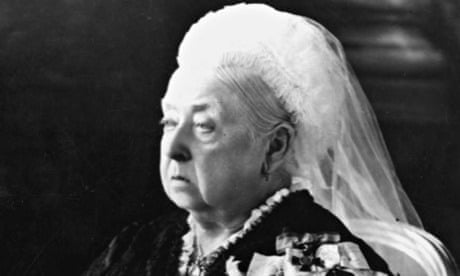
"These Irish are really shocking, abominable people. Not like any other civilised nation..." - the words of Britain's 'Queen' Victoria, on hearing about the 'Manchester Outrage', as she called it.
Her comments were replied to by one of the 'uncivilised Irish' people she was speaking about : "I will die proudly and triumphantly in defence of republican principles and the liberty of an oppressed and enslaved people..." - the words of 18-years-young William Allen, from Bandon, County Cork. The "outrage", as far as the British are concerned, anyway , began on the 11th September that year (1867) (....although, in reality, it began for us Irish in 1169) when, in the early hours of the morning of Wednesday, 11th September 1867, two men were arrested by police in Shudehill, Manchester, on suspicion that they were about to commit a robbery.
The two men were charged under the 'Vagrancy Act' and were detained in police custody, and it was then they were recognised (by fellow Irishmen in British police uniforms) as Colonel Thomas J.Kelly and Captain Timothy Deasy, two known Fenians. Their comrades in Manchester, which was the 'Bandit Country' of its day, vowed to free the two men and, on the 18th of September, 1867, as a prison van carrying the two men (and a 12-years-young boy, plus three female prisoners) was travelling on the Manchester to Salford road, on its way to 'deposit the cargo' in Belle Vue Gaol on the Hyde Road in Gorton, Manchester, accompanied by a team of 12 horse-mounted policemen, it was attacked by about 50 Fenians.
Kelly and Deasy were handcuffed and locked in two separate compartments inside the van, guarded by a police sergeant, a Charles Brett, and, as such, were unable to assist their comrades outside.
The mounted police escort fled the scene on seeing the number of attackers but Brett was obviously unable to do so : the Fenian rescuers were unable to force open the van and advised Brett that it would be for his own good to open the doors and let the prisoners go. Brett refused the offer, and was looking through the keyhole to further assess his situation when one of the rescuers decided to shoot the lock apart - the bullet went through the keyhole and hit Brett in the head, killing him instantly.
One of the female prisoners had the good sense to take the keys from his pocket and hand them out through an air vent to those outside, and Kelly and Deasy were taken to safety.
Twenty-six men were later arrested and tried for playing a part in the rescue, and five of them were detained to stand trial, on 1st November 1867, for their alleged part in what the British called the "Manchester Outrage" : all five were actually sentenced to be hanged, but one was granted clemency and another was 'pardoned' as the evidence against him was found to be perjured.
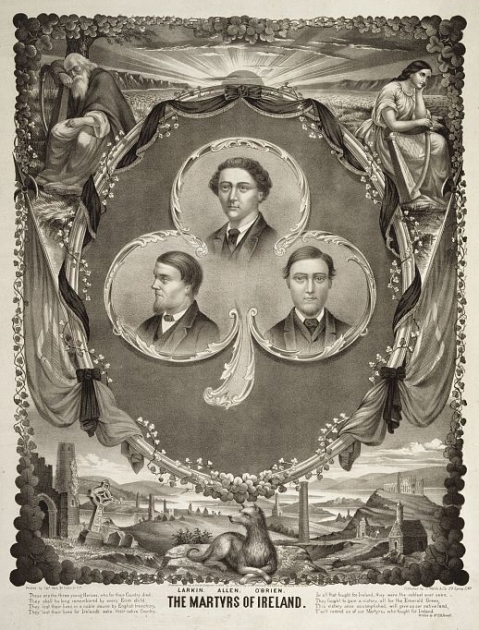
The other three - William Allen, Michael O'Brien and Michael Larkin - the 'Manchester Martyrs', were hanged in front of thousands of baying spectators on Saturday, 23rd November 1867 - 155 years ago on this date - in Salford, Manchester, outside the New Bailey Jail.
In an address to the court, William Philip Allen, 18, stated - "No man in this court regrets the death of Sergeant Brett more than I do, and I positively say, in the presence of the Almighty and ever-living God, that I am innocent ; aye, as innocent as any man in this court. I don't say this for the sake of mercy : I want no mercy — I'll have no mercy. I'll die, as many thousands have died, for the sake of their beloved land, and in defence of it.
I will die proudly and triumphantly in defence of republican principles and the liberty of an oppressed and enslaved people. Is it possible we are asked why sentence should not be passed upon us, on the evidence of prostitutes off the streets of Manchester, fellows out of work, convicted felons — aye, an Irishman sentenced to be hanged when an English dog would have got off.
I say positively and defiantly, justice has not been done me since I was arrested. If justice had been done me, I would not have been handcuffed at the preliminary investigation in Bridge Street ; and in this court, justice has not been done me in any shape or form. I was brought up here and all the prisoners by my side were allowed to wear overcoats, and I was told to take mine off. What is the principle of that? There was something in that principle, and I say positively that justice has not been done me.
As for the other prisoners, they can speak for themselves with regard to that matter. And now, with regard to the way I have been identified. I have to say that my clothes were kept for four hours by the policemen in Fairfield station and shown to parties to identify me as being one of the perpetrators of this outrage on Hyde Road. Also in Albert station there was a handkerchief kept on my head the whole night, so that I could be identified the next morning in the corridor by the witnesses.
I was ordered to leave on the handkerchief for the purpose that the witnesses could more plainly see I was one of the parties who committed the outrage. As for myself, I feel the righteousness of my every act with regard to what I have done in defence of my country. I fear not. I am fearless — fearless of the punishment that can be inflicted on me ; and with that, my lords, I have done."
However, he then added the following - "I beg to be excused. One remark more. I return Mr. Seymour and Mr. Jones my sincere and heartfelt thanks for their able eloquence and advocacy on my part in this affray. I wish also to return to Mr. Roberts the very same. My name, sir, might be wished to be known. It is not William O'Meara Allen. My name is William Philip Allen. I was born and reared in Bandon, in the County of Cork, and from that place I take my name ; and I am proud of my country, and proud of my parentage. My lords, I have done."
Michael Larkin, 32, lived in the Banagher region of County Offaly and was a tailor by trade. He was not of good health and himself and his two comrades were captured as they carried him away from the scene of the rescue. He, too, addressed the court :
"I have only got a word or two to say concerning Sergeant Brett. As my friend here said, no one could regret the man's death as much as I do. With regard to the charge of pistols and revolvers, and my using them, I call my God as witness that I neither used pistols, revolvers, nor any instrument on that day that would deprive the life of a child, let alone a man.
Nor did I go there on purpose to take life away. Certainly, my lords, I do not want to deny that I did go to give aid and assistance to those two noble heroes that were confined in that van, Kelly and Deasy. I did go to do as much as lay in my power to extricate them out of their bondage ; but I did not go to take life, nor, my lord, did anyone else. It is a misfortune there was life taken ; but if it was taken it was not done intentionally, and the man who has taken life we have not got him.
I was at the scene of action, when there were over, I dare say, 150 people standing by there when I was. I am very sorry I have to say, my lord, but I thought I had some respectable people to come up as witnesses against me ; but I am sorry to say as my friend said — I will make no more remarks concerning that. All I have to say, my lords and gentlemen, is that so far as my trial went, and the way it was conducted, I believe I have got a fair trial.
What is decreed a man in the page of life he has to fulfil, either on the gallows, drowning, a fair death in bed, or on the battle-field. So I look to the mercy of God. May God forgive all who have sworn my life away. As I am a dying man, I forgive them from the bottom of my heart. God forgive them."
Michael O'Brien, 31, from Ballymacoda in Cork, was a lieutenant in the US Army and was better known in England by the name 'William Gould'. He delivered the following speech to the court :
"I shall commence by saying that every witness who has sworn anything against me has sworn falsely. I have not had a stone in my possession since I was a boy. I had no pistol in my possession on the day when it is alleged this outrage was committed. You call it an outrage, I don't. I say further my name is Michael O'Brien. I was born in the county of Cork and have the honour to be a fellow-parishioner of Peter O'Neal Crowley, who was fighting against the British troops at Mitchelstown last March, and who fell fighting against British tyranny in Ireland.
I am a citizen of the United States of America, and if Charles Francis Adams had done his duty towards me, as he ought to do in this country, I should not be in this dock answering your questions now. Mr. Adams did not come, though I wrote to him. He did not come to see if I could not find evidence to disprove the charge, which I positively could, if he had taken the trouble of sending or coming to see what I could do.
I hope the American people will notice this part of the business."
He then read a passage from a paper he was holding - "The right of man is freedom. The great God has endowed him with affections that he may use, not smother them, and a world that may be enjoyed.
Once a man is satisfied he is doing right, and attempts to do anything with that conviction, he must be willing to face all the consequences. Ireland, with its beautiful scenery, its delightful climate, its rich and productive lands, is capable of supporting more than treble its population in ease and comfort.
Yet no man, except a paid official of the British Government, can say there is a shadow of liberty, that there is a spark of glad life amongst its plundered and persecuted inhabitants. It is to be hoped that its imbecile and tyrannical rulers will be for ever driven from her soil amidst the execrations of the world.
How beautifully the aristocrats of England moralise on the despotism of the rulers of Italy and Dahomey — in the case of Naples with what indignation did they speak of the ruin of families by the detention of its head or some loved member in a prison. Who has not heard their condemnations of the tyranny that would compel honourable and good men to spend their useful lives in hopeless banishment?
They cannot find words to express their horror of the cruelties of the King of Dahomey because he sacrificed 2,000 human beings yearly, but why don't those persons who pretend such virtuous indignation at the misgovernment of other countries look at home, and see that greater crimes than those they charge against other governments are not committed by themselves or by their sanction?
Let them look at London, and see the thousands that want bread there, while those aristocrats are rioting in luxuries and crimes. Look to Ireland ; see the hundreds of thousands of its people in misery and want. See the virtuous, beautiful and industrious women who only a few years ago — aye, and yet — are obliged to look at their children dying for want of food.
Look at what is called the majesty of the law on one side, and the long deep misery of a noble people on the other. Which are the young men of Ireland to respect — the law that murders or banishes their people or the means to resist relentless tyranny, and ending their miseries for ever under a home government? I need not answer that question here. I trust the Irish people will answer it to their satisfaction soon.
I am not astonished at my conviction. The Government of this country have the power of convicting any person. They appoint the judge ; they choose the jury ; and by means of what they call patronage (which is the means of corruption) they have the power of making the laws to suit their purposes. I am confident that my blood will rise a hundredfold against the tyrants who think proper to commit such an outrage.
In the first place, I say I was identified improperly by having chains on my hands and feet at the time of identification, and thus the witnesses who have sworn to my throwing stones and firing a pistol have sworn to what is false, for I was, as those ladies said, at the jail gates. I thank my counsel for their able defence, and also Mr. Roberts, for his attention to my case."
All three men shouted the words "God Save Ireland!" at different times during the 'trial', perhaps realising that, then, as now, the British were going to get their 'pound of flesh' one way or the other.
The three men were, as stated, hanged by the British on this date - 23rd November - 155 years ago, and are still remembered and commemorated today by Irish republicans.
'THE BRITISH STORY...'
Roy Foster (pictured) in the British media.
By Barra Ó Séaghdha.
From 'Magill' Annual, 2002.
It can hardly be denied that the years immediately before and after the anniversary produced a rich crop of sober work on the Famine (sic) ; overviews, specialised collections of essays, studies in local history, folklore and so on. Fifteen minutes in a library should be enough to reassure Jonathan Freedland and Tim Teeman that Irish history-writing has not descended into a welter of sentiment and self-indulgence, as suggested by Roy Foster's comment.
In the Teeman interview, we are also told - "You get these appalling, winsome, self-indulgent little snippets of autobiography in the middle of what should be history books. There are a number of Irish historians who used to write beautifully but now collapse genres into each other."
To whom can the good professor be referring? The year 1994 saw the publication by a prominent writer - formerly renowned for his style, wit and perceptiveness - of a historical study that presented no coherent framework of understandng, that frequently reduced the complexities of history to caricature and mumbo-jumbo about the Irish psyche, that was interrupted by irrelevant personal and family reminiscences, that grotesquely misrepresented Bloody Sunday, and that sometimes clashed on fundamental points with Roy Foster's book, 'Modern Ireland'...
(MORE LATER.)
ON THIS DATE (23RD NOVEMBER) 109 YEARS AGO : 'IRISH CITIZEN ARMY' FOUNDED.
Ireland 1915 ; The 'Irish Volunteer' movement had split ; approximately 170,000 men stayed with John Redmond and fought with England in the belief that to do so would guarantee a form of 'Home Rule' for Ireland - but about 10,000 men broke away as they had no faith in Redmond's plan.
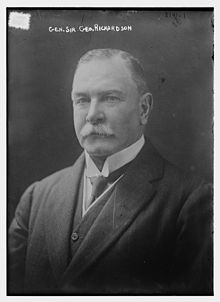
Months earlier, British 'Sir' George Richardson had taken command of the Ulster Volunteer Force (a pro-British militia) and had landed about 25,000 rifles and two-and-a-half million rounds of ammunition at Larne in County Antrim - when the British Government in Westminster attempted to move against the UVF (as they had no control over them then), British Army officers mutinied in objection.
Meanwhile, elsewhere in Ireland, other forces were recruiting : Irish republicans were re-organising ; the 'Irish Citizen Army' was recruiting for volunteers, as was Sinn Féin, the 'Irish Republican Brotherhood' and John Redmond's 'United Irish League'. There was turmoil in the country.
On the 11th of November 1913 in Dublin, in the then 68-year-old Wynn's Hotel on Lower Abbey Street, a group of Irishmen and women held a meeting to discuss the formation of an 'Irish National Volunteer Force'.
Those present at that meeting and/or at five other such meetings which were held immediately afterwards in the space of a two-week period, included Sean Fitzgibbon, John Gore, Michael J Judge, James Lenehan, Michael Lonergan, Peadar Macken, Seamus O'Connor, Colm O'Loughlin, Peter O'Reilly, Robert Page, George Walsh, Peadar White and Padraig O'Riain, amongst others (all of whom were well known in Irish nationalist circles ie Sinn Féin, Cumann na mBan, Na Fianna Éireann, the Gaelic League, the IRB, the Ancient Order of Hibernians, the Irish Parliamentary Party and the United Irish League).
Then, on the 25th November 1913, the inaugural enrolment meeting for the 'Irish Volunteers' was held at the Rotunda Rink in Dublin, to "secure the rights and liberties common to all the people of Ireland". That meeting was overseen by a provisional committee consisting of thirty members, all of whom had been elected at the above-mentioned meetings.
Previous to the formation of the 'Irish Volunteers', James Connolly and others had formed the 'Irish Citizen Army', and both groups were in competition for members, the former on a 32-county basis whereas the latter was confined to the Leinster area, although attempts were made, through trade union structures, to recruit in Cork, Belfast, Derry, Sligo, Limerick, Kilkenny, Waterford, Dundalk, Galway and Wexford, but with little success.
Also, those joining the 'Volunteers' were supplied with a uniform and other equipment while those joining the 'ICA' had to purchase their gear themselves. Relations between the two organisations were not the best, as the 'Volunteers' allowed, for instance, employers to join and this at a time when employees and other trade unionists would most likely be 'ICA' members or supporters and, actually, when the 'Volunteers' were in conference for the first time (25th November 1913) Irish Citizen Army members and supporters loudly made their presence felt and they also objected in print - their first leaflet stated that the 'Volunteers' were controlled by those who were opposed not only to trade unionism but also to workers rights regarding working conditions etc.
Within a few months, however, the animosity had lessened to the extent that there was some official co-operation between both groups at the Wolfe Tone commemoration in June 1914 and again in October that year during the events held to commemorate Charles Stewart Parnell, and both groups joined forces at Easter 1916 and took part side-by-side in the 1916 Rising, during which almost 100 women, members of Cumann na mBan and the Irish Citizen Army, played a full part in the fighting : Cumann na mBan , formed in April 1914, and the Irish Citizen Army, were in training months before the 1916 Rising.
Both groups received instruction in first aid, signalling and weapons preparation. Connolly's daughters, Nora and Agnes, who were both members of Cumann na mBan, joined other members of that organisation in travelling around the country to ascertain the strengths and weaknesses in a particular area.
'The Irish Citizen Army :
Founded as workers’ Defence corps during the Dublin Lock-Out by James Larkin and James Connolly on 23 November 1913. Their Headquarters was at Liberty Hall. The movement was eventually taken over by Connolly in the spring of 1914. He re-organised them into an armed and uniformed force whose aims were the ownership of the land of Ireland by the people of Ireland and the establishment of a Workers Republic.
The General Secretary of the Army was Sean O' Casey. About 200 members took part in the 1916 Rising in Dublin. The Irish Citizen Army supported the Irregulars/anti Treaty forces during the Civil War. A prominent influencing role in refusing to accept The Treaty was played by Constance Markievicz...' (from here.)
The 'Irish Citizen Army' was formed by James Connolly and Jack White on the 23rd November 1913 - 109 years ago on this date - and other prominent members included Seán O'Casey, Constance Markievicz, Francis Sheehy-Skeffington, P. T. Daly and Christopher Poole.
The organisation proper became inactive in the late 1930's although its ethos lives on to this day.
FUNDS AND FINE GAEL'S LEADER.
Michael Lowry has so far been the focus of media attention about Fine Gael fundraising.
But the party's current leader, Enda Kenny (pictured), hosted a £1,000-a-plate dinner two days before the second mobile phone licence was awarded. And other guests say that one of the bidders for that licence was in attendance.
By Mairead Carey.
From 'Magill' magazine, January 2003.
Fine Gael leader Enda Kenny (pictured) hosted a fundraising event days before the contract for the second mobile phone licence was awarded. Guests say that a man claiming to be a bidder for the licence was also in attendance.
The then Taoiseach John Bruton and (State) Communications Minister Michael Lowry were the guests of honour at the £1000-a-plate dinner at the Conrad Hotel in Dublin, even though Lowry had been advised by his department officials not to meet bidders.
It is not known whether any of the senior Fine Gael politicians at the dinner knew of this businessman's apparent involvement with the bidding consortium...
(MORE LATER.)
Thanks for the visit, and for reading,
Sharon and the team.