ON THIS DATE (23RD NOVEMBER) 146 YEARS AGO : BIRTH OF THE BLUFFER BATES.
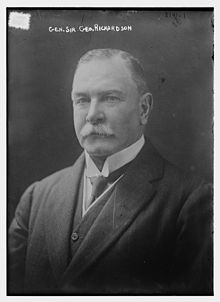
'Sir' Richard Dawson Bates (pictured) was born in Strandtown, Belfast, on the 23rd November 1876 - 146 years ago on this date - and was a solicitor (in Belfast) by profession.
He was Secretary to the 'Ulster Unionist Council' at 28 years young, and held that position until he was aged 44 (ie from 1905 to 1921). In 1921, he was elected to Stormont and was appointed as the 'Minister of Home Affairs', a position he held for 22 years (from 1921 to 1943).
In 1943, at 66 years of age, he retired to the 'back benches', where he stayed until 1945.
As the British 'Minister of Home Affairs' in the Six County 'parliament', he gave himself unprecedented powers to, for instance, "..outlaw organisations...to detain or intern people indefinitely without charge or trial...(and)...to destroy houses and buildings..", amongst other 'rights'.
He was to become the envy of others with a similar mind-set : some 40 years later (ie in [April] 1963) a Mr. Vorster , then South African 'Minister for Justice', was introducing a new Coercion Bill in the South African Parliament when, no doubt thinking of 'Sir' Bates and his colleagues in Stormont and Westminster, he stated that he "..would be willing to exchange all the legislation of that sort for one clause of the Northern Ireland (sic)
Special Powers Act." Birds of a feather indeed.
'Sir' Richard Dawson Bates was a known bigot, and apparently took it as a compliment when it was said of him in Stormont (by a Senior Civil Servant) - "He has such a prejudice against Catholics that he made it clear to his Permanent Secretary that he did not want his most juvenile clerk or typist, if a Papist (Catholic), assigned for duty to his ministry."
In 1935, however, he seemed to believe that he could treat everyone like dirt, regardless of their religion - on 18th June that year (1935), 'Sir' Bates issued an 'official order' banning all parades, not just those with a republican/nationalist 'flavour' : the Orange Order objected and told Bates and his people that it was their intention to hold a parade on the 23rd June (1935) and that said parade would be going ahead.
Bates was not pleased - it was one thing to trample over the rights of the 'Papists', but the Orange Order were his own people and he expected that they would support him. Bates put his troops on notice, and repeated his 'banning order'. On the 23rd June (1935), the Orange Order took to the streets, as they said they would - and the RUC, and 'Sir' Bates, stood and watched!
At that parade, the then Orange Grand Master, a 'Sir' Joseph Davison, 'put it up' to his friend, 'Sir' Bates - "You may be perfectly certain that on the 12 July the Orangemen will be marching throughout Northern Ireland (sic).
I do not acknowledge the right of any government, Northern or Imperial, to impose conditions as to the celebration."
On the 22nd December 1938, 'Sir' (or 'Master'?) Bates introduced internment for republicans, saying - "The (Stormont) Government decided there was no alternative other than to arrest and intern well-known leaders and prominent members of this illegal organisation (IRA)." No 'backing-down' on that one.
Bates was a 'product' of the times and 'class' he was born into ; he could not help but be arrogant, a trait which was to his advantage when it came to his chosen 'career'. He died in Somerset, England, on the 10th June 1949 at 72 years of age, having been a 'proud Orangeman' for all his adult life.
'TOMÁS MacCURTAIN COMMEMORATION...'
From 'The United Irishman' newspaper, April 1955.
In his oration, Domhnall O Cathain said -
"The names and the fame of deeds of Irishmen (sic) are recorded indelibly in the hearts of their descendents but their slanderers are lost in the mists of oblivion. The present bearers of the light of freedom will be vindicated by posterity and their critics will be relegated to the place of their predecessors.
'Greater love than this no man hath than to lay down his life for his friends' ; Tomás Mac Curtain laid down his life that we might be free - in the flower of his youth, in the tree of his manhood, he was soldier and patriot.
The Treaty of Surrender dissipated all that had been achieved through his efforts and those of his comrades ; the unity of the Irish people was signed away with their freedom and today, 34 years after, there is only one way of re-uniting the Irish people. There is real unity only in the Republican Movement..."
(MORE LATER.)
ON THIS DATE (23RD NOVEMBER) 155 YEARS AGO : THREE IRISH FENIANS EXECUTED BY THE BRITISH.
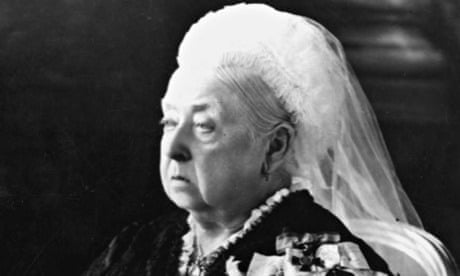
"These Irish are really shocking, abominable people. Not like any other civilised nation..." - the words of Britain's 'Queen' Victoria, on hearing about the 'Manchester Outrage', as she called it.
Her comments were replied to by one of the 'uncivilised Irish' people she was speaking about : "I will die proudly and triumphantly in defence of republican principles and the liberty of an oppressed and enslaved people..." - the words of 18-years-young William Allen, from Bandon, County Cork. The "outrage", as far as the British are concerned, anyway , began on the 11th September that year (1867) (....although, in reality, it began for us Irish in 1169) when, in the early hours of the morning of Wednesday, 11th September 1867, two men were arrested by police in Shudehill, Manchester, on suspicion that they were about to commit a robbery.
The two men were charged under the 'Vagrancy Act' and were detained in police custody, and it was then they were recognised (by fellow Irishmen in British police uniforms) as Colonel Thomas J.Kelly and Captain Timothy Deasy, two known Fenians. Their comrades in Manchester, which was the 'Bandit Country' of its day, vowed to free the two men and, on the 18th of September, 1867, as a prison van carrying the two men (and a 12-years-young boy, plus three female prisoners) was travelling on the Manchester to Salford road, on its way to 'deposit the cargo' in Belle Vue Gaol on the Hyde Road in Gorton, Manchester, accompanied by a team of 12 horse-mounted policemen, it was attacked by about 50 Fenians.
Kelly and Deasy were handcuffed and locked in two separate compartments inside the van, guarded by a police sergeant, a Charles Brett, and, as such, were unable to assist their comrades outside.
The mounted police escort fled the scene on seeing the number of attackers but Brett was obviously unable to do so : the Fenian rescuers were unable to force open the van and advised Brett that it would be for his own good to open the doors and let the prisoners go. Brett refused the offer, and was looking through the keyhole to further assess his situation when one of the rescuers decided to shoot the lock apart - the bullet went through the keyhole and hit Brett in the head, killing him instantly.
One of the female prisoners had the good sense to take the keys from his pocket and hand them out through an air vent to those outside, and Kelly and Deasy were taken to safety.
Twenty-six men were later arrested and tried for playing a part in the rescue, and five of them were detained to stand trial, on 1st November 1867, for their alleged part in what the British called the "Manchester Outrage" : all five were actually sentenced to be hanged, but one was granted clemency and another was 'pardoned' as the evidence against him was found to be perjured.
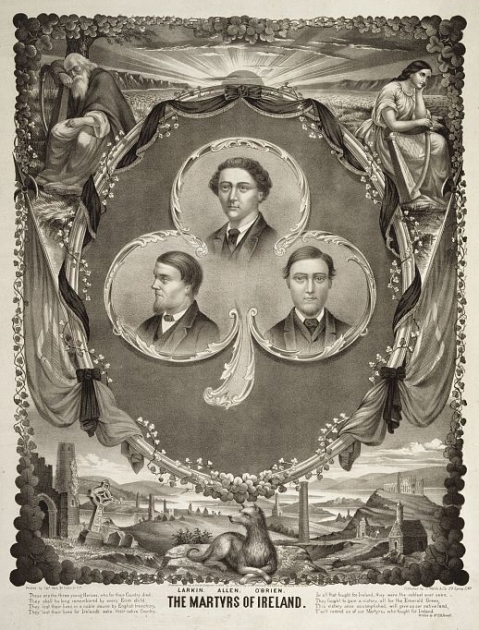
The other three - William Allen, Michael O'Brien and Michael Larkin - the 'Manchester Martyrs', were hanged in front of thousands of baying spectators on Saturday, 23rd November 1867 - 155 years ago on this date - in Salford, Manchester, outside the New Bailey Jail.
In an address to the court, William Philip Allen, 18, stated - "No man in this court regrets the death of Sergeant Brett more than I do, and I positively say, in the presence of the Almighty and ever-living God, that I am innocent ; aye, as innocent as any man in this court. I don't say this for the sake of mercy : I want no mercy — I'll have no mercy. I'll die, as many thousands have died, for the sake of their beloved land, and in defence of it.
I will die proudly and triumphantly in defence of republican principles and the liberty of an oppressed and enslaved people. Is it possible we are asked why sentence should not be passed upon us, on the evidence of prostitutes off the streets of Manchester, fellows out of work, convicted felons — aye, an Irishman sentenced to be hanged when an English dog would have got off.
I say positively and defiantly, justice has not been done me since I was arrested. If justice had been done me, I would not have been handcuffed at the preliminary investigation in Bridge Street ; and in this court, justice has not been done me in any shape or form. I was brought up here and all the prisoners by my side were allowed to wear overcoats, and I was told to take mine off. What is the principle of that? There was something in that principle, and I say positively that justice has not been done me.
As for the other prisoners, they can speak for themselves with regard to that matter. And now, with regard to the way I have been identified. I have to say that my clothes were kept for four hours by the policemen in Fairfield station and shown to parties to identify me as being one of the perpetrators of this outrage on Hyde Road. Also in Albert station there was a handkerchief kept on my head the whole night, so that I could be identified the next morning in the corridor by the witnesses.
I was ordered to leave on the handkerchief for the purpose that the witnesses could more plainly see I was one of the parties who committed the outrage. As for myself, I feel the righteousness of my every act with regard to what I have done in defence of my country. I fear not. I am fearless — fearless of the punishment that can be inflicted on me ; and with that, my lords, I have done."
However, he then added the following - "I beg to be excused. One remark more. I return Mr. Seymour and Mr. Jones my sincere and heartfelt thanks for their able eloquence and advocacy on my part in this affray. I wish also to return to Mr. Roberts the very same. My name, sir, might be wished to be known. It is not William O'Meara Allen. My name is William Philip Allen. I was born and reared in Bandon, in the County of Cork, and from that place I take my name ; and I am proud of my country, and proud of my parentage. My lords, I have done."
Michael Larkin, 32, lived in the Banagher region of County Offaly and was a tailor by trade. He was not of good health and himself and his two comrades were captured as they carried him away from the scene of the rescue. He, too, addressed the court :
"I have only got a word or two to say concerning Sergeant Brett. As my friend here said, no one could regret the man's death as much as I do. With regard to the charge of pistols and revolvers, and my using them, I call my God as witness that I neither used pistols, revolvers, nor any instrument on that day that would deprive the life of a child, let alone a man.
Nor did I go there on purpose to take life away. Certainly, my lords, I do not want to deny that I did go to give aid and assistance to those two noble heroes that were confined in that van, Kelly and Deasy. I did go to do as much as lay in my power to extricate them out of their bondage ; but I did not go to take life, nor, my lord, did anyone else. It is a misfortune there was life taken ; but if it was taken it was not done intentionally, and the man who has taken life we have not got him.
I was at the scene of action, when there were over, I dare say, 150 people standing by there when I was. I am very sorry I have to say, my lord, but I thought I had some respectable people to come up as witnesses against me ; but I am sorry to say as my friend said — I will make no more remarks concerning that. All I have to say, my lords and gentlemen, is that so far as my trial went, and the way it was conducted, I believe I have got a fair trial.
What is decreed a man in the page of life he has to fulfil, either on the gallows, drowning, a fair death in bed, or on the battle-field. So I look to the mercy of God. May God forgive all who have sworn my life away. As I am a dying man, I forgive them from the bottom of my heart. God forgive them."
Michael O'Brien, 31, from Ballymacoda in Cork, was a lieutenant in the US Army and was better known in England by the name 'William Gould'. He delivered the following speech to the court :
"I shall commence by saying that every witness who has sworn anything against me has sworn falsely. I have not had a stone in my possession since I was a boy. I had no pistol in my possession on the day when it is alleged this outrage was committed. You call it an outrage, I don't. I say further my name is Michael O'Brien. I was born in the county of Cork and have the honour to be a fellow-parishioner of Peter O'Neal Crowley, who was fighting against the British troops at Mitchelstown last March, and who fell fighting against British tyranny in Ireland.
I am a citizen of the United States of America, and if Charles Francis Adams had done his duty towards me, as he ought to do in this country, I should not be in this dock answering your questions now. Mr. Adams did not come, though I wrote to him. He did not come to see if I could not find evidence to disprove the charge, which I positively could, if he had taken the trouble of sending or coming to see what I could do.
I hope the American people will notice this part of the business."
He then read a passage from a paper he was holding - "The right of man is freedom. The great God has endowed him with affections that he may use, not smother them, and a world that may be enjoyed.
Once a man is satisfied he is doing right, and attempts to do anything with that conviction, he must be willing to face all the consequences. Ireland, with its beautiful scenery, its delightful climate, its rich and productive lands, is capable of supporting more than treble its population in ease and comfort.
Yet no man, except a paid official of the British Government, can say there is a shadow of liberty, that there is a spark of glad life amongst its plundered and persecuted inhabitants. It is to be hoped that its imbecile and tyrannical rulers will be for ever driven from her soil amidst the execrations of the world.
How beautifully the aristocrats of England moralise on the despotism of the rulers of Italy and Dahomey — in the case of Naples with what indignation did they speak of the ruin of families by the detention of its head or some loved member in a prison. Who has not heard their condemnations of the tyranny that would compel honourable and good men to spend their useful lives in hopeless banishment?
They cannot find words to express their horror of the cruelties of the King of Dahomey because he sacrificed 2,000 human beings yearly, but why don't those persons who pretend such virtuous indignation at the misgovernment of other countries look at home, and see that greater crimes than those they charge against other governments are not committed by themselves or by their sanction?
Let them look at London, and see the thousands that want bread there, while those aristocrats are rioting in luxuries and crimes. Look to Ireland ; see the hundreds of thousands of its people in misery and want. See the virtuous, beautiful and industrious women who only a few years ago — aye, and yet — are obliged to look at their children dying for want of food.
Look at what is called the majesty of the law on one side, and the long deep misery of a noble people on the other. Which are the young men of Ireland to respect — the law that murders or banishes their people or the means to resist relentless tyranny, and ending their miseries for ever under a home government? I need not answer that question here. I trust the Irish people will answer it to their satisfaction soon.
I am not astonished at my conviction. The Government of this country have the power of convicting any person. They appoint the judge ; they choose the jury ; and by means of what they call patronage (which is the means of corruption) they have the power of making the laws to suit their purposes. I am confident that my blood will rise a hundredfold against the tyrants who think proper to commit such an outrage.
In the first place, I say I was identified improperly by having chains on my hands and feet at the time of identification, and thus the witnesses who have sworn to my throwing stones and firing a pistol have sworn to what is false, for I was, as those ladies said, at the jail gates. I thank my counsel for their able defence, and also Mr. Roberts, for his attention to my case."
All three men shouted the words "God Save Ireland!" at different times during the 'trial', perhaps realising that, then, as now, the British were going to get their 'pound of flesh' one way or the other.
The three men were, as stated, hanged by the British on this date - 23rd November - 155 years ago, and are still remembered and commemorated today by Irish republicans.
'THE BRITISH STORY...'
Roy Foster (pictured) in the British media.
By Barra Ó Séaghdha.
From 'Magill' Annual, 2002.
It can hardly be denied that the years immediately before and after the anniversary produced a rich crop of sober work on the Famine (sic) ; overviews, specialised collections of essays, studies in local history, folklore and so on. Fifteen minutes in a library should be enough to reassure Jonathan Freedland and Tim Teeman that Irish history-writing has not descended into a welter of sentiment and self-indulgence, as suggested by Roy Foster's comment.
In the Teeman interview, we are also told - "You get these appalling, winsome, self-indulgent little snippets of autobiography in the middle of what should be history books. There are a number of Irish historians who used to write beautifully but now collapse genres into each other."
To whom can the good professor be referring? The year 1994 saw the publication by a prominent writer - formerly renowned for his style, wit and perceptiveness - of a historical study that presented no coherent framework of understandng, that frequently reduced the complexities of history to caricature and mumbo-jumbo about the Irish psyche, that was interrupted by irrelevant personal and family reminiscences, that grotesquely misrepresented Bloody Sunday, and that sometimes clashed on fundamental points with Roy Foster's book, 'Modern Ireland'...
(MORE LATER.)
ON THIS DATE (23RD NOVEMBER) 109 YEARS AGO : 'IRISH CITIZEN ARMY' FOUNDED.
Ireland 1915 ; The 'Irish Volunteer' movement had split ; approximately 170,000 men stayed with John Redmond and fought with England in the belief that to do so would guarantee a form of 'Home Rule' for Ireland - but about 10,000 men broke away as they had no faith in Redmond's plan.
Months earlier, British 'Sir' George Richardson had taken command of the Ulster Volunteer Force (a pro-British militia) and had landed about 25,000 rifles and two-and-a-half million rounds of ammunition at Larne in County Antrim - when the British Government in Westminster attempted to move against the UVF (as they had no control over them then), British Army officers mutinied in objection.
Meanwhile, elsewhere in Ireland, other forces were recruiting : Irish republicans were re-organising ; the 'Irish Citizen Army' was recruiting for volunteers, as was Sinn Féin, the 'Irish Republican Brotherhood' and John Redmond's 'United Irish League'. There was turmoil in the country.
On the 11th of November 1913 in Dublin, in the then 68-year-old Wynn's Hotel on Lower Abbey Street, a group of Irishmen and women held a meeting to discuss the formation of an 'Irish National Volunteer Force'.
Those present at that meeting and/or at five other such meetings which were held immediately afterwards in the space of a two-week period, included Sean Fitzgibbon, John Gore, Michael J Judge, James Lenehan, Michael Lonergan, Peadar Macken, Seamus O'Connor, Colm O'Loughlin, Peter O'Reilly, Robert Page, George Walsh, Peadar White and Padraig O'Riain, amongst others (all of whom were well known in Irish nationalist circles ie Sinn Féin, Cumann na mBan, Na Fianna Éireann, the Gaelic League, the IRB, the Ancient Order of Hibernians, the Irish Parliamentary Party and the United Irish League).
Then, on the 25th November 1913, the inaugural enrolment meeting for the 'Irish Volunteers' was held at the Rotunda Rink in Dublin, to "secure the rights and liberties common to all the people of Ireland". That meeting was overseen by a provisional committee consisting of thirty members, all of whom had been elected at the above-mentioned meetings.
Previous to the formation of the 'Irish Volunteers', James Connolly and others had formed the 'Irish Citizen Army', and both groups were in competition for members, the former on a 32-county basis whereas the latter was confined to the Leinster area, although attempts were made, through trade union structures, to recruit in Cork, Belfast, Derry, Sligo, Limerick, Kilkenny, Waterford, Dundalk, Galway and Wexford, but with little success.
Also, those joining the 'Volunteers' were supplied with a uniform and other equipment while those joining the 'ICA' had to purchase their gear themselves. Relations between the two organisations were not the best, as the 'Volunteers' allowed, for instance, employers to join and this at a time when employees and other trade unionists would most likely be 'ICA' members or supporters and, actually, when the 'Volunteers' were in conference for the first time (25th November 1913) Irish Citizen Army members and supporters loudly made their presence felt and they also objected in print - their first leaflet stated that the 'Volunteers' were controlled by those who were opposed not only to trade unionism but also to workers rights regarding working conditions etc.
Within a few months, however, the animosity had lessened to the extent that there was some official co-operation between both groups at the Wolfe Tone commemoration in June 1914 and again in October that year during the events held to commemorate Charles Stewart Parnell, and both groups joined forces at Easter 1916 and took part side-by-side in the 1916 Rising, during which almost 100 women, members of Cumann na mBan and the Irish Citizen Army, played a full part in the fighting : Cumann na mBan , formed in April 1914, and the Irish Citizen Army, were in training months before the 1916 Rising.
Both groups received instruction in first aid, signalling and weapons preparation. Connolly's daughters, Nora and Agnes, who were both members of Cumann na mBan, joined other members of that organisation in travelling around the country to ascertain the strengths and weaknesses in a particular area.
'The Irish Citizen Army :
Founded as workers’ Defence corps during the Dublin Lock-Out by James Larkin and James Connolly on 23 November 1913. Their Headquarters was at Liberty Hall. The movement was eventually taken over by Connolly in the spring of 1914. He re-organised them into an armed and uniformed force whose aims were the ownership of the land of Ireland by the people of Ireland and the establishment of a Workers Republic.
The General Secretary of the Army was Sean O' Casey. About 200 members took part in the 1916 Rising in Dublin. The Irish Citizen Army supported the Irregulars/anti Treaty forces during the Civil War. A prominent influencing role in refusing to accept The Treaty was played by Constance Markievicz...' (from here.)
The 'Irish Citizen Army' was formed by James Connolly and Jack White on the 23rd November 1913 - 109 years ago on this date - and other prominent members included Seán O'Casey, Constance Markievicz, Francis Sheehy-Skeffington, P. T. Daly and Christopher Poole.
The organisation proper became inactive in the late 1930's although its ethos lives on to this day.
FUNDS AND FINE GAEL'S LEADER.
Michael Lowry has so far been the focus of media attention about Fine Gael fundraising.
But the party's current leader, Enda Kenny (pictured), hosted a £1,000-a-plate dinner two days before the second mobile phone licence was awarded. And other guests say that one of the bidders for that licence was in attendance.
By Mairead Carey.
From 'Magill' magazine, January 2003.
Fine Gael leader Enda Kenny (pictured) hosted a fundraising event days before the contract for the second mobile phone licence was awarded. Guests say that a man claiming to be a bidder for the licence was also in attendance.
The then Taoiseach John Bruton and (State) Communications Minister Michael Lowry were the guests of honour at the £1000-a-plate dinner at the Conrad Hotel in Dublin, even though Lowry had been advised by his department officials not to meet bidders.
It is not known whether any of the senior Fine Gael politicians at the dinner knew of this businessman's apparent involvement with the bidding consortium...
(MORE LATER.)
Thanks for the visit, and for reading,
Sharon and the team.
ON THIS DATE (5TH OCTOBER) 39 YEARS AGO : BRITISH DIPLOCK 'JUSTICE' FURTHER EXPOSED.
On this date - 5th October - in 1983, British 'Lord Chief Justice' Robert Lynd Erskine Lowry, during a 'trial' based on the 'word' of an IRA informer, had no choice but to dismiss part of the tout's so-called 'evidence', stating that he found same "..so unsatisfactory and inconsistent that I could not contemplate allowing myself, as a tribunal of fact, to say that guilt has been proved beyond a reasonable doubt..."
The background to the above is as follows : even by North of Ireland standards, where dramatic political developments have a tendency to follow one another with unnerving rapidity, October 1983 and the weeks that followed was an unusually active period in the psychological warfare between the British government and the republican struggle that continues to focus around the use of paid perjurers.
It was a month which, at least in terms of propaganda, republicans won on points - but it also heavily underlined the British government's commitment to the perjurer strategy in the face of mounting opposition. The retractions by Robert Lean (Belfast) and Patrick McGurk [mentioned here] (Dungannon) of their incriminating statements against a total of 37 people accused of republican activities, by Lean on October 19th and by McGurk on October 24th, was a crushing embarrassment to the RUC. Robert Lean, in particular, had been portrayed in 'leaks' to a sensationalist media to be the IRA's No.2 in Belfast, and in a classic exercise in 'trial by media' the RUC claimed that his evidence had secured the imprisonment of the IRA's Chief of Staff and its Belfast Brigade Officer Commanding ; both of the individuals against whom these claims had been made were among those released two days after Lean's retraction.
Patrick McGurk's retraction a few days later was equally damaging to the image cultivated by the RUC around its use of perjurers. He had implicated nine Dungannon men as far back as February 1982, five of whom had been held on remand for twenty months - the longest remand period involved in any of the perjurer cases. On September 20th 1982, the RUC, apparently doubtful that Patrick McGurk would go through with his 'evidence' if produced in court, instead invoked the obsolete 'Bill of Indictment' to by-pass the preliminary enquiry stage of the case against the nine accused.
This meant that, until his return to Dungannon on Wednesday 26th October, Patrick McGurk had been held incommunicado, without access to family or friends, throughout the 20-month period. If, as seems to be the case, Patrick McGurk was unwilling to testify but was prevented by the RUC from retracting and prevented from contacting his family, it makes a nonsense of RUC assertions that - once having been given immunity from prosecution - their perjurers (or 'converted terrorists' in RUC jargon!) are 'free agents' voluntarily in protective custody. Not surprisingly, some of the defendants in the McGurk case are said to be considering suing the RUC for wrongful imprisonment.
The Robert Lean (pictured) episode, too, has gone a long way to publicly undermining propaganda about 'converted terrorists' and 'free agents' : not only did Robert Lean feel so unfree that he felt it necessary to escape from 'protective custody' in Palace Barracks, Hollywood, County Down, by climbing out of a window and stealing the car of his RUC 'minder' but, on leaving a press conference in West Belfast the following afternoon, he was immediately arrested under Section 12 and held in Castlereagh for a further seven days!
Apparently, the RUC seriously intended to charge him with a killing on 'new evidence' obtained from the perjurer, William Skelly (named here), who had originally implicated Robert Lean, in a revenge act for his retraction, but the RUC finally changed their minds. It is highly improbable that the (British) Crown Prosecutor could have persuaded even a Diplock Court that the informer William Skelly had forgotten this 'evidence' until after Robert Lean retracted, and then miraculously remembered it!
The inference that the RUC had been aware of 'evidence' linking Robert Lean to a killing at the outset, but had suppressed it in order to do a 'deal' with him, and so imprison prominent republicans, would have been unavoidable. Most damaging of all from the RUC's viewpoint was Robert Lean's assertion that his 'deal' for immunity was to sign statements already prepared by the RUC incriminating specific individuals wanted 'out of the way' by them. Top of the list was Gerry Adams, but it seems the RUC were unable to charge him because Robert Lean refused to co-operate with a face-to-face confrontation.
On their release, two of those actually imprisoned on Lean's statements - Edward Carmichael and Ivor Bell (both men referenced here) - confirmed that they had also been offered immunity if they would incriminate Sinn Féin elected representatives, Adams, Danny Morrison and Martin Mcguinness. Additionally, Edward Carmichael had been offered £300,000 and Ivor Bell was told to "..name my own figure.." The RUC were not having a one-hundred per cent success rate with their informer/perjurer strategy, but they were not prepared to give up on it.
But if the RUC's optimism for the potential of their perjurer strategy has been tempered by a series of retractions in recent months - Walter McCrory (Derry), Charles Dillon (County Derry), Robert Lean and Patrick McGurk - and if they have been forced to the realisation that it will continue to be an imperfect strategy, with perjurers as much subject to the persuasion of the nationalist community's abhorrence of their actions as they are to RUC threats and inducements, nevertheless the third major event in this momentous month ensured the continued successful use of paid perjurers as a means of securing convictions.
It was an event that marked a further and fundamental diminishing in the standard of evidence required in Diplock Courts for conviction : (British) Lord Chief Justice Lowry's sentencing of seven men on IRA charges, in Belfast Crown Court, on Wednesday 26th October, on the uncorroborated evidence of Kevin McGrady, was incredible even by Diplock 'standards'.
Three weeks earlier, on October 5th 1983 - 39 years ago on this date - he had released two of the ten defendants and thrown out 13 of the original 45 charges (including charges of murder), saying that in respect of those he found Kevin McGrady's evidence "...so unsatisfactory and inconsistent that I could not contemplate allowing myself, as a tribunal of fact, to say that guilt has been proved beyond a reasonable doubt.." yet, in his final summation on the 25th of that month - despite acknowledging that McGrady's evidence had contained "..some glaring absurdities.." and was "..contradictory, bizarre and in some respects incredible.." - and, despite finding the remaining eight defendants innocent of a further 19 charges, Lowry nonetheless returned verdicts of guilty against seven of them on the remaining 13 charges!
In one case, the former Sinn Féin National Organiser, Jim Gibney (then 28 years of age), was sentenced to terms of 12 years and 5 years on two charges, even though he was cleared of no less than 20 other charges on Kevin MGrady's "bizarre" 'evidence'!
British 'Lord Chief Justice' Lowry rubbed salt into the wounds of incredulity by using his summation for the purposes of a policy statement on the use of perjurers, in which he formally signalled the willingness of the northern judiciary to accept uncorroborated evidence of an 'accomplice witness' as the sole basis for a conviction.
Arguing that the judiciary was, and remained, independent of the (Westminster) 'Northern Ireland' Office and was not in any form of collusion, Lowry stated - "The resort to supergrasses has been described by some people as a method of convicting suspected terrorists. But the expression 'method of conviction' is a complete misnomer, since it is likely to give the impression that the Executive and Judges are together implementing a trial process with the joint object of convicting and imprisoning suspects.
It is for the Executive to prosecute a case if, on the available evidence, that seems to be the right course. But the function of the Judges, acting quite independently, has not altered ; it is simply to decide whether or not in any individual case the allegations of the prosecutor have been proved."
Two days before Lowry made that statement, the British Attorney-General, Sir Michael Havers (forever tainted, and rightly so, by his involvement in the 'Guildford Four' case), had spoken about the "financial arrangements" made with those informers.
Havers, in a statement obviously timed to coincide with British Chief Justice Lowry's comments in the wake of the Robert Lean/Patrick McGurk affair, also defended the 'independence' of the judiciary - but added, in response to loyalist criticisms of the system, that in future all "financial arrangements (made with) accomplice witnesses" would be disclosed to defence counsels.
The utter worthlessness of this 'concession' lies of course in the fact that the RUC deny, and will continue to deny, that cash bribes - such as Edward Carmichael's offer from the British of £300,000 - are made to perjurers in the first place. Havers' 'sincerity' should be judged in the light of his flagrant dishonesty in saying that the practice surrounding the use of "accomplice witnesses" was identical in England, Scotland and Wales with its use in the North of Ireland!
The Lowry verdict in the McGrady trial was a crucial one for the future of the perjurer strategy ; although the principle of accepting uncorroborated perjurer evidence had earlier been accepted by the judiciary in the UVF Joe Bennett (referenced here) trial which ended on April 11th 1983 with convictions for 14 of the 16 accused, and in the Christopher Black trial in which Judge Basil Kelly convicted 35 of the 38 defendants on August 5th.
Both judges in these cases had gone to considerable lengths to emphasise the 'credibility' of informers Bennett and Black and the general consistency "in all important respects" of their testimony. While this was incredible enough, the fact that Lowry convicted on McGrady's 'evidence', which was substantially bizarre, contradictory and unsatisfactory, is an indication that the judiciary in the North of Ireland has fallen completely into line, contrary to Lowry's denial, with the political objective of securing convictions, and has cynically redefined even the previously low standards regarding acceptable evidence.
British judges in the North of Ireland were defending the use of informers to obtain convictions at the same time as that perjurer system had started to come under attack from a variety of directions, while among the nationalist community itself - buoyed by the retractions and less open than it initially was to demoralisation over the issue (since it has seen the IRA's continued ability to inflict losses on the British) - there have been the unmistakable signs of a 'fight back'.
The first clear example of this was the mass rally at Beechmount Avenue in West Belfast on September 11th, 1983, which announced the holding of an open conference in Dungannon on October 2nd 1983 to establish a broad-based committee on the non-exclusive lines of the National H-Block/Armagh Committee established during the hunger-strikes of 1981.
Up until that point public protest action on the perjurer issue had mainly been confined to small and isolated groups, such as 'Relatives For Justice' and 'Campaign Against The Show Trials' (CAST), which, although active, had drawn support primarily from relatives of the victims - in much the same way as the 'Relatives Action Committee' had campaigned between 1976-79 on the H-Blocks.
The Dungannon conference announced the setting up of a new 'umbrella' organisation, the 'Stop the Show Trials Campaign', calling for an end to the use of perjurers, an end to show trials and the release of all the sentenced and remanded victims of perjurers. It voted to mount a campaign of political opposition to the perjurer system, at the same time embracing those sections of the community whose opposition to the use of perjurers is based on humanitarian or civil liberties motives and who endorse the campaign's central demands.
It is inevitable that the campaign structure, and mobilisations, will focus heavily on the North, though it is envisaged that support groups will be established in the 26 Counties and abroad. However, not all Irish nationalists were opposed to the perjurer system - to date, the response on the perjurer issue from sections of the catholic establishment has been a muted one, explicable by their obvious ambivalence to a strategy which although seriously eroding the already blackened 'judicial process' is clearly seen to be aimed at undermining the political advance of republicanism - a shared objective, after all, with the catholic hierarchy and the SDLP.
In response to such a taunt by West Belfast MP Gerry Adams on September 11th 1983, SDLP spokesperson Seamus Mallon retorted that the use of perjurers was 'law bending' but the thrust of his attack was aimed not at the British but at Sinn Féin and republican resistance.
On September 28th 1983, however, the SDLP met the 'Relatives for Justice' group and condemned the use of perjurers - though they have maintained a low profile on the issue since then.
And what of the Catholic church on the issue? They have maintained a low profile on that subject, with the exception of Dr. Edward Daly, Bishop of Derry, and a handful of priests, who have condemned the use of perjurers. Bishop Cahal Daly, previously so vocal on political issues, has adopted a studious silence. For his part, Dungannon priest Fr. Denis Faul, having failed to limit the opposition to perjurers to relatives (whose emotions, his experience during the hunger-strikes leads him to believe, can, at critical points, be exploited against republicans) has concentrated much of his efforts on vitriolic attacks on Sinn Féin - on one occasion going as far as to allege that Sinn Féin were 'using' the perjurer campaign to finance their involvement in the EEC elections!
Also ranged against the use of perjurers have been the SDLP-controlled Derry Council, the Belfast and District Trades Council and a number of British MP's and British and American legal figures. British Labour MP, Martin Flannery, has said that the use of perjurers is bringing "the whole of the British system of justice into disrepute. It is the kind of thing that Hitler and company engaged in.." The use of paid perjurers by Westminster was welcomed by some Unionists but condemned by others - sometimes both 'pro' and 'anti' camps were in the same political party.
While so far the real pressure exerted within the nationalist community on the perjurer system has been largely 'internal' (perjurers retracting in response to their families' efforts), since the Stormont administration will only feel pressurised by 'external' political pressure from nationalists when the campaign achieves its full impetus, there is undoubtedly strong concern among sections of the loyalist community too, which may eventually cause headaches for the British government.
That concern stems, obviously enough, not from any opposition to the clinging of the northern judiciary to the coat-tails of Stormont, which after all is unionist policy, but from the increasingly heavy losses which perjurers are inflicting on loyalist paramilitary groups, and the spin-off effect which this undoubtedly has on loyalist political parties, particularly the DUP. Although the 'Official Unionist Party' has taken a strong line in support of paid perjurers under their 'law and order' spokesperson, Edgar Graham, individual members of the 'OUP' including John Carson, have identified themselves with a campaign of opposition.
In April of this year (1983), DUP leader Ian Paisley condemned the use of perjurers as 'undermining the rule of law' and he specifically opposed the granting of immunity to perjurers. Immediately after the informer Robert Lean's 'evidence' began to lead to the arrest of several prominent republicans, the DUP appeared to modify its stance considerably when leading spokespersons Peter Robinson and Jim Allister - at a press conference on September 13th, from which, strangely, Ian Paisley was absent - supported the use of uncorroborated evidence and only opposed the granting of total immunity, implying that perjurers should instead be given heavily reduced sentences for their own admitted involvement.
Significantly, in a 'Panorama' programme screened on BBC 1 television on October 24th - after Robert Lean's retraction - Ian Paisley again appeared to resolutely oppose the use of perjurers : more than most politicians, he, arguably, has a great deal to lose from future loyalist perjurers bringing up parts of his past life!
For loyalists, under greater pressure from the judiciary than for a long time, the use of paid perjurers must be causing a further crisis of identity and resulting in a heavy demoralisation. But for nationalists, existing under a constant regime of repression, the situation is clearer-cut and the option a simple one - resistance.
With scores of nationalists and republicans still imprisoned on the 'word' of paid perjurers, there is certainly no room for complacency despite recent retractions and the ever-present hope of more, but there is now a will and an ability to mobilise on the issue in the nationalist community that was not fully there before.
And, finally, 'Establishment' policy in relation to touts has not changed over the decades, whether in the Occupied Six Counties or the Free State ; this tout, for example, was a member of an 'Establishment' Leinster House-based political party which once condemned touts and the 'policy of touting'. A so-called 'republican' (!) poacher-turned-State poacher, if you like!
(This is an edited version of a piece we first posted here in 2005.)
'TOMÁS MacCURTAIN COMMEMORATION...'
From 'The United Irishman' newspaper, April 1955.
In his oration, Domhnall O Cathain said -
"The Movement gained momentum ; slowly but surely, progress was reported in every part of Ireland, until now we were no longer on the defensive.
The sick and bleeding body of the separatist movement was convalescent - groggy and weak after after absorbing intense punishment but nevertheless convalescent, on its feet and slowly gaining strength. Then came the wonderful stimulant.
The injection, the vitamins necessary to the ailing body were provided in a quick daylight raid on Armagh Barracks and a short sharp battle on the square of Omagh Barracks. The separatists had again reached the ear of the people.
The break that had been waited for and hoped for and prayed for had come. Out of the depths of darkness rang the voice of a reawakened resurgent Ireland..."
(MORE LATER.)
ON THIS DATE (5TH OCTOBER) 48 YEARS AGO : GUILDFORD EXPLOSIONS AND TRAVESTY.
The Guildford pub bombings occurred on the 5th October 1974 - 48 years ago on this date - when the IRA detonated two 6-pound (2.7-kilogram) gelignite bombs at two pubs in Guildford, Surrey, in England.
The pubs - the 'Horse and Groom' and the 'Seven Stars' - were targeted because they were popular with British Army personnel stationed at Pirbright barracks. Four soldiers and one civilian were killed and sixty-five people were wounded.
On the 22nd October, 1975, Patrick Armstrong, Gerard Conlon, Paul Hill, and Carole Richardson (who became known as the 'Guildford Four') were found guilty at the Old Bailey in London of causing explosions in that city in October 1974, and all four were sentenced to life imprisonment. Following an appeal, the four were finally released on the 19th October, 1989, after the court of appeal decided that the 'confessions' had been fabricated by the police.
In a linked case, members of the Maguire family, the 'Maguire Seven', were convicted on the 3rd March, 1976, of possession of explosives (even though no explosives were found) and some served 10 years in prison before the convictions were overturned.
Judith Ward, another innocent person who sampled British 'justice', wrote a book- 'Ambushed ; My Story', which makes for interesting reading and allows the reader to draw comparisons with the injustices suffered by the 'Maguire Seven', the 'Birmingham Six' and the 'Guildford Four' ; a total of 18 innocent people, including Judith Ward (13 men, 3 women and two children) who, between them, spent a total of 216 years in prison.
Anne Marie Maguire, a mother of 5 children, was menstruating heavily and denied all toiletries for a week and was beaten senseless. Carole Richardson, who didn't even know she was pregnant, miscarried in Brixton Prison days after her arrest.
Westminster didn't care who was found 'guilty' once they satisfied the gutter press and it's readership that 'justice had been served', and they continue with that policy to this day - 'The Craigavon Two', Brendan McConville and John-Paul Wootton, are the 'Guildford/Birmingham' etc examples of 'British justice' in Ireland today.
ON THIS DATE (5TH OCTOBER) 15 YEARS AGO : FUNERAL MASS HELD FOR IRISH REPUBLICAN ICON.
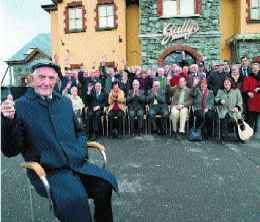
Dan Keating (pictured), from Ballygamboon, Castlemaine, County Kerry, celebrating his 105th birthday with members of Republican Sinn Féin at Gally's Bar and Restaurant, Tralee, County Kerry, on the 2nd January 2007.
DAN Keating was born in 1902 in the townland of Ballygamboon, Castlemaine, Co Kerry.
In 1917, he went to work in Tralee at Jerry McSweeney's Grocery, Bar and Bakery. Jerry McSweeney's uncle, Richard Laide, was shot in the attack on Gortalea barracks which was the first barracks to be attacked in Ireland.
Dan joined the Fianna in Tralee in 1918 and about two years later he joined the Irish Republican Army. Others to join at that time were Gerry Moyles, Donnchadh Donoghue, Tommy Vale, John Riordan (Kerry All-Ireland footballer), Jerry O'Connor (better known as 'Uncy'), Matt Moroney and Paddy and Billy Griffin.
Dan met a soldier who used to frequent the bar where he worked and during conversations procured a rifle from him, which was then handed over to Johnny O'Connor of the Farmers' Bridge unit. Dan was later to join this unit which included men of the calibre of Johnny Duggan, Johnny O'Connor, Timmy Galvin, Moss Galvin, Jack Corkery, Jim Ryle, Mick Hogan and Jamesy Whiston.
This unit was very active from 1920 to 1924 and many of its members took part in the Headford ambush which claimed the lives of approximately 20 British soldiers. Volunteers Danny Allman and Jimmy Baily also lost their lives at Headford.
Dan took part in the ambush at Castlemaine in which eight RIC and Black-and-Tans were killed. Gerry Moyles was severely injured in this encounter. The last ambush in Kerry took place in Castleisland on the night before the Truce and Dan also participated in this. Four RIC members were killed in this action and Volunteers Jack Shanahan, Jack Prenderville, John McMahon and John Flynn also lost their lives.
In 1922 Dan was transferred to a unit in Tralee which was commanded by Tommy Barton of Ballyroe when they occupied Ballymullen barracks for a period of three months, and also took part in the attack on Listowel barracks, now occupied by the Free Staters, in which one Free Stater was shot dead.
In Limerick, Dan, along with comrades from Kerry, fought the Free State troops over a period of ten days - republican Volunteers Patrick Foran, Charlie O'Hanlon and Tom McLoughlin lost their lives there, then Dan was sent to Tipperary to instruct Gerry Moyles to return to Kilmallock but on the way they were surrounded by Free Staters. After a battle at Two Mile Bridge, Dan and his comrades were taken prisoner and held in Thurles barracks for two days before being conveyed to Portlaoise jail where he was held for six months.
This was to be the first of many times Dan was interned by the Free State. During this period in Portlaoise the jail was burned and Volunteer Paddy Hickey from Dublin was shot dead. Dan was then transferred to the Curragh Internment Camp and was held there until March 1923. A Free State soldier named Bergin from Nenagh, who became friendly with the republican prisoners and acted as a courier to republicans on the outside, was executed by the Staters.
Dan was charged with possession of a shotgun in 1930 and was issued a summons but did not attend court and was fined £1. In the true republican tradition he refused to pay and was sent to Limerick and held for one week. During a court case in Tralee involving Johnny O'Connor and Mick Kennedy, in which they refused to recognise the court, their supporters in the courthouse cheered loudly and when things died down the judge ordered Dan Keating to be brought up before him and gave him three months for contempt.
Dan was jailed in Cork with Johnny O'Connor but after a hunger strike by Johnny both were released after three weeks. The next time Dan was interned was after O'Duffy's visit to Tralee ; he was sentenced to six months in Arbour Hill. Dan was later captured in Carrigans in Clonmel by a policeman who had previously arrested him in Tralee and was taken first to Thurles and from there to the Curragh where he was held for three years and six months.
In this period the camp was burned and Barney Casey from Longford was shot dead. Dan was also on active service in England during the early 1940s.
He returned to work in Dublin and operated as a barman in the Eagle House, James Street, the Cornet and the Kilmardenny public houses. His other great interest was Gaelic games, and indeed between football and hurling he has attended more than 140 All-Ireland senior finals including replays, which must be a record in itself.
When Dan retired he returned to Kerry in 1978 and resided at Ballygamboon, Castlemaine. In 2004, Dan Keating replaced George Harrison of Mayo and New York as the fourth Patron of Sinn Féin Poblachtach since 1986, following in the footsteps of such illustrious republicans as Comdt-General Tom Maguire and Michael Flannery of Tipperary and New York. During his long, healthy and adventurous lifetime Dan has seen many splits and deviations from republican principles, but he remained loyal and true to the end.
Dan Keating, born on January 2nd 1902, died in Tralee on October 2nd, 2007 - 105 years of age - after a short illness. His funeral mass was held on this date - 5th October - 15 years ago, in Kiltallagh Church, Castlemaine, in Kerry.
I measc Laochra na nGael go raibh sé.
'THE BRITISH STORY'.
Roy Foster (pictured) in the British media.
By Barra Ó Séaghdha.
From 'Magill' Annual, 2002.
Even as a schoolboy, Roy Foster did not subscribe to official versions of Irish history.
He remembers exam papers where the answers were implicitly flagging up the liberationist struggle ; fortunately, his history teacher was a Quaker, a sceptic, so Foster "got the idea that there wasn't one, indivisible story."
His new book shows how fact and myth are confused in Ireland and analyses "how nostalgia rather than reality shapes a false, if comforting, understanding of past events."
This is how Tim Teeman of the 'Times' of London introduces "the fiery Roy Foster" in an entirely adulatory interview headed 'Greentinted spectacles of Irish history'. Can we look to 'The Guardian's' Jonathan Freedland for something a little more bracing...?
(MORE LATER.)
'FORTH HIS BANNERS GO...'
Jer O'Leary (pictured) has become bannermaker to the radical and labour movement. Brian Trench reports on the growing recognition of his art.
From 'Magill' magazine, May 1987.
Starting by designing and executing banners for his own union, the ITGWU, Jer O'Leary has since been commissioned by all of the general unions and by a number of the white-collar and craft unions to do banners for them too.
He has also designed banners for soccer clubs and is proud that a banner of his - for the Oliver Plunkett Hurling and Football Club in Phibsboro, north Dublin - won a prize in a competition at Croke Park. He was proud, too, when a banner commissioned by the 'Irish Anti-Apartheid Movement' to mark the 75th anniversary of the 'African National Congress' (ANC) was presented in Dublin's Mansion House last December to an executive member of the 'ANC'.
The commissions he has on hand currently have come from a Newry cumann of (P) Sinn Féin and from playwright John Arden, for a forthcoming theatre production...
(MORE LATER.)
ON THIS DATE (5TH OCTOBER) IN...
...1916 :
On the 18th November, 1916, 'The Cork Examiner' newspaper carried the following report -
'Private Michael Burke, Irish Guards, killed in France October 5th, 1916. He had volunteered from the RIC, in which he had served nearly four years in Killorglin and Cahirdaniel, Co. Kerry. He joined the colours at the outbreak of the war. He was youngest son of the late John Burke, Scart, Ardfinnan, Co. Tipperary.'
Sad that he should die 'in the service' of a foreign 'empire', whether in Ireland or elsewhere.
======================================
...1920 :
On Tuesday evening, 5th October 1920, Volunteers from different parts of County Clare met up, as arranged, in the village of Feakle, in County Clare, to finalise the plan for an operation they intended to carry out the next day.
The following morning, they took over the post office and waited for an RIC patrol which they knew would be passing the building and, as the six-man team of British operatives were passing by, one of them, William Stanley, was shot dead, and one of his colleagues, Francis Doherty, was severly wounded, and died from his wounds later.
The IRA men then withdrew from the area.
======================================
...1922 :
On the 7th October, 1922, 'The Northern Whig' newspaper reported that, on the 5th October, a Mrs Mary Sherlock, who lived on Vulcan Street, in Ballymacarrett, in Belfast, was out shopping on the Newtownards Road when she was shot in the head by a gang who had followed her into a grocery shop in the loyalist area of East Belfast.
It was reported that two revolver shots were fired at her head and the poor woman fell to the ground, bleeding, and died later in hospital.
======================================
...1922 :
Two Free State Army Privates, Peter Martin and Patrick Byrne, died on the 5th October 1922, and are both '...interred in the area surrounding (Michael) Collins' Grave in Glasnevin..'
That's the only information we can find on them ; hope their families, at least, remembers them properly, even if the State doesn't.
======================================
...1963 :
'The Belfast Telegraph' newspaper of the 5th October, 1963, carried a report on a Mr John Cecil Wilson, of 420 Oldfield Park Road, Belfast, who was said to be the last surviving RIC man to serve in Belfast.
Mr Wilson (!) was a Carlow man who joined the RIC in 1920 and was first placed 'in the service of the crown' in Listowel, in County Kerry and then in Portarlington, on the Offaly/Laois border.
When the RIC was 'disbanded' (...more like just got a name change and a different uniform) in 1922, Mr Wilson joined the new grouping, the RUC, and was stationed in Henry Street Barracks in Belfast from 1922 until 1927.
In 1927, he was moved to the Shankill Road and remained there until 1939, when he was placed in the Springfield Road Barracks for a year, then to Brown Square for a year, then to Oldfield Park Barracks from 1941 until 1962.
His final year working for the (half-)crown (1962-1963) was spent in Musgrave Barracks. We're not sure if he ever made it back to Tom Hanks, even though he got around a good bit...
======================================
...1968 :
On the 5th October, 1968, the RUC attacked a group of demonstrators in Derry who were holding a peaceful rally for 'civil rights'. An estimated 400 people lined up on the street with a further 200 watching from the footpaths.
That British 'police force' baton-charged the small parade at Duke Street, in Derry, who were campaigning for five key demands -
one man (sic), one vote,
an end to housing discrimination,
an end to discrimination by public authorities,
the abolition of the 'B Specials police reserve' and an end to political gerrymandering.
That was only the second 'civil rights' march in the campaign of marches which commenced with 3,000 people marching from Coalisland to Dungannon on the 24th August, 1968. Irish republicans, on the other hand, wanted then - and now - a complete British military and political withdrawal. We never said to Westminster, nor will we - 'stay if you want, just treat us better'.
======================================
...1977 :
On Wednesday, 5th October 1977, Seamus Costello, the founder member and leader of the 'Irish Republican Socialist Party' (IRSP), was shot dead near the North Strand, in Dublin. Both the 'Official Irish Republican Army' (OIRA) and the 'Provisional IRA' denied that they were responsible for the killing.
'There was an earlier attempt made on Seamus Costello's life in Waterford on May 7th, 1975 : Costello had spoken at a meeting in the city that night and on his way to the home of one of the organisers, the car in which they were travelling was raked with machine gun fire by a passenger on a motorbike. The motorbike keeled over and it was this which saved Costello's life at the time.
We have been informed that both men on the motorbike were senior members of the Official IRA in Dublin, who were attached to the GHQ Staff of that organisation. It is believed that the gun used in the attempted murder was later found by Gardai but not identified by them as such...' - from 'THUGGERY : THE UGLY FACE OF SINN FEIN THE WORKERS PARTY ; THE MURDER OF SEAMUS COSTELLO' ('MAGILL' magazine , April 1982, covered here.)
======================================
...1978 :
On Thursday, 5th October 1978, the three leaders of the 'Peace People' - Betty Williams, Mairead Corrigan, and Ciaran McKeown - announced that they intended to step down from the organisation. This misguided grouping eventually fell apart over finances.
======================================
...1979 :
On Friday, 5th October 1979, the British Labour Party conference voted against a resolution calling for a British political and military withdrawal from the six occupied counties of Ireland.
The leadership of the British Labour Party have never been a friend of Irish freedom, as to be so would ostracise them from what they believe to be their place in the political 'pecking order' in their country and parliament.
======================================
=======================
=======================
ON THIS DATE (5TH OCTOBER) 14 YEARS AGO : FAIRY TALES IN FAIRYHOUSE!
This a piece we found in our archives from 2008 - and it's still as relevant today, on this 5th October, as it was then :
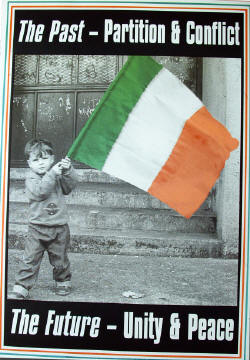
MICHAEL COLLINS LOOKS ON AS PARTITION AND CONFLICT ARE SAID BY 'THE REBELS' TO BE 'IN THE PAST..'
(Click here for better image of the so-called 'Past and Future' poster.)
One of our regular readers found himself with a few hours to spare on (Sunday) 5th October 2008 (14 years ago on this date) so himself and his Missus headed-out to the County of Meath to have a browse around Fairyhouse Market.
Whilst browsing the hundreds of stalls and units etc they came across a stall operated by Provisional Sinn Féin at which he noticed, incredulously, that not only were they selling framed prints of Free Stater Michael Collins but they had one such framed print located right beside a framed poster which declared that partition in Ireland and the political conflict it feeds are things of the past!
Our reader asked one of the PSF stall holders if they would agree that they were being a wee bit premature in saying that partition and conflict in Ireland are in the past and proceeded to give a brief history lesson to the hapless rep and asked how they could possibly support the notion that partition and the conflict which arises from it can be said 'to be over' as this country is still partitioned by Westminster, which maintains an armed, and political, presence here?
The garbled reply was as dense as the framed poster - "But things are a lot better...we're almost there....the leadership know what they're doing....things are looking up...."
Our man walked away, shaking his head in despair, and wondering how such people can be left in charge of a market stall, never mind how they can 'claim ownership' to the best way to resolve the not yet resolved issue of partition and the conflict that arises from it.
Needless to say, our man wasn't buying it..!
ON THIS DATE (5TH OCTOBER) 101 YEARS AGO : 'RIC GREASE MONKEYS' DISRESPECTED!
On the 5th October 1921 - 101 years ago on this date - mechanics working for the RIC on their fleet of weaponised cars etc were promised, in writing, certain terms and conditions, which they were happy with, only to have same removed, in writing, two days later!
Obviously, they objected to having been treated in that manner, and 'upped their game' when their actual yearly contracts of employment were interfered with by their management in a manner that reduced them to 'employees on a weekly contract'.
A political rep raised the issue for them in Westminster on the 20th February 1922 -
"As regards these constable mechanics, they were originally engaged to serve on a yearly contract. In a question I pointed out to the Chief Secretary that these men were engaged on a yearly contract, that it was subsequently modified into a monthly contract, and finally into a weekly contract, and he denied that that was the case.
I have chapter and verse here for my statement. I have in my hand the notices calling for recruits and each one states that it is a yearly contract. It says :
'Here is a job for you at good pay. Are you a motor driver or a mechanic? If so, join the transport section of the Royal Irish Constabulary.'
Then follow the conditions offered upon a yearly contract. These men were serving on a yearly contract and they have been discharged with a sum of £10 as a gratuity. Some of them were actually sent off on the date on which their contract expired without any notice whatever. Some of them were sent away from Dublin and were told that they would have to pay their own passage money home, although I know that that matter has been put right since.
That is how they started. Last June, 30 were treated in that way. They were told to find their way back to England and pay their fares themselves. The matter was raised in this House. I have a paper signed by three sergeants and four constables, dated the 14th November, stating that on the preceding day they were notified that their services were no longer required and that their duty would cease from that date. They were also told to find their way home without their passages being paid.