ON THIS DATE (25TH OCTOBER) 106 YEARS AGO : SINN FÉIN ADOPTS A REPUBLICAN CONSTITUTION.
"The Constitution of this new movement which you have adopted is one which it may be well to lay stress on. It says that this organisation of Sinn Féin aims at securing international recognition of Ireland as an independent Irish Republic.
That is what I stand for, what I stood for in East Clare and it is because I stand for that that I was elected here. I said in East Clare when I was elected that I regarded that election as a monument to the dead. I regard my election here as a monument to the brave dead, and I believe that this is proof that they were right, that what they fought for — the complete and absolute freedom and separation from England — was the pious wish of every Irish heart..."
- part of a speech delivered by Éamon de Valera to the Sinn Féin Ard Fheis in the Mansion House, in Dublin, on the 25th/26th October, 1917.
A report on that Ard Fheis, by Fr. Patrick Gaynor, can be read here.
That Sinn Féin Ard Fheis, Chaired by Arthur Griffith, was of particular interest and importance to Mr. Griffith, as it signalled a move away from his 'Dual Monarchy' policy in favour of republican principles ; in short, Arthur Griffith insisted that Ireland should come into its own, alongside Britain, with the two entities (for want of a better description!) forming a 'dual monarchy' ie a 'shared monarch', but with two 'separate' political administrations, according to Mr. Griffith which, he believed, would be more palatable to Westminster (but which proved to be less palatable to Irish republicans who insisted - and still do - on a clean break from the British).
Some of the more than 2,000 delegates present, perturbed by the objections to the so-called 'republican slant' of the proceedings, began a walk-out from the Ard Fheis but eventually the issue was somewhat settled there and then, in-house, and the proceedings continued.
Incidentally, at that time, there were 3,300 Sinn Féin Clubs (Cumainn), over 250,000 members and the organisation was financially healthy, with about £1,200 in its kitty.
However, between the jigs and the reels (!), one of the motions passed at that Ard Fheis, on the 25th October 1917 - 106 years ago on this date - read :
'1 -
The name of this organisation shall be Sinn Féin.
2 -
Sinn Féin aims at securing the international recognition of Ireland as an independent Irish Republic. Having achieved that status the Irish people may by referendum freely choose their own form of Government.
3 -
This object shall be attained through the Sinn Féin Organisation.
4 -
WHEREAS no law made without the authority and consent of the Irish people is or ever can be binding on their conscience, therefore in accordance with the Resolution of Sinn Féin adopted in Convention, 1905, a Constituent Assembly shall be convoked, comprising persons chosen by the Irish Constituencies as the supreme national authority to speak and act in the name of the Irish people and to devise and formulate measures for the welfare of the whole people of Ireland.
Such as :
The introduction of a Protective System for Irish industries and Commerce by combined action of the Irish County Councils, Urban Councils, Rural Councils, Poor Law Boards, Harbour Boards, and other bodies directly responsible to the Irish people.
The establishment and maintenance under the direction of a National Assembly or other authority approved by the people of Ireland of an Irish Consular Service for the advancement of Irish Commerce and Irish interests generally.
The re-establishment of an Irish Mercantile Marine to facilitate direct trading between Ireland and the countries of Continental Europe, America, Africa, and the Far East.
The industrial survey of Ireland and the development of its mineral resources under the auspices of a National Assembly or other national authority approved by the people of Ireland.
The establishment of a National Stock Exchange.
The creation of a National Civil Service, embracing all the employee of the County Councils, Rural Councils, Poor law Boards, Harbour Boards, and other bodies responsible to the Irish people, by the institution of a common national qualifying examination and a local competitive examination (the latter at the discretion of the local bodies).
The establishment of Sinn Féin Courts of Arbitration for the speedy and satisfactory adjustment of disputes.
The development of transit by rail road and water, of waste lands for the national benefit by a national authority approved by the people of Ireland.
The development of the Irish Sea Fisheries by National Assembly or other National authority approved by the people of Ireland.
The reform of education, to render its basis national and industrial by the compulsory teaching of the Irish language, Irish history and Irish agricultural and manufacturing potentialities in the primary system, and, in addition, to elevate to a position of dominance in the University system Irish agriculture and economics.
The abolition of the Poor Law System and substitution in its stead of adequate outdoor relief to the aged and infirm, and the employment of the able-bodied in the reclamation of waste lands, afforestation and other national and reproductive works.
A special meeting of the Executive may be summoned on three days' notice by the President on requisition presented to him signed by six members of the Executive specifying the object for which the meeting is called.
In case of an urgent emergency the President shall call all members of the Executive to an urgency meeting, and may take action in the name of the Executive in case he secures the approval of an absolute minority of the entire Executive. The action taken is to be reported for confirmation at next ordinary meeting of the Executive.
That where Irish resources are being developed, or where industries exist, Sinn Féiners should make it their business to secure that workers are paid a living wage.
That the equality of men and women in this Organisation be emphasised in all speeches and leaflets.'
The above political motion was way ahead of its time, and still serves as a demonstration of the forward thinking, fairness and 'street-level' democratic values that traditional Irish republicans have for the Irish people, and Ireland itself, unlike the sleeveen time-servers in Leinster House.
'FIRST THINGS FIRST.'
From 'The United Irishman' newspaper, April 1955.
The flare of publicity given to the interview by Mr. John Aloysius Costello with 'The Yorkshire Post' newspaper and the subsequent statements and counter-statements by himself, Mr, de Valera and various members of the Stormont junta have given a brief temporary revival to the politicians standby - the 'partition problem'.
But the editorial statement by 'The Yorkshire Post' is very candid on the matter. It states -
'...nor could we contemplate an arrangement which would deprive us in time of war of the use of the Ulster ports..'
That is the authentic voice of England ; it is saying in 1955 what Lloyd George said in 1920 -"Ulster, whether she wills it or not, must not be allowed merge with the rest of Ireland."
England feels that her imperial defence system requires that a grip be kept on the Irish side of the North Channel and irrespective of the wishes of the people concerned, she is determined to maintain that grip...(MORE LATER.)
ON THIS DATE (25TH OCTOBER) 41 YEARS AGO : BRITISH HANDLERS FINALISED THEIR PLANS TO ALLOW THEIR IRA INFORMER TO BREAK HIS 20-MONTH PERIOD OF INCOMMUNICADO HIDING.
One of the many so-called 'Irish republicans' that turned 'supergrass' on their one-time 'comrades' who were allegedly involved in militant republicanism was Tyrone man Patrick McGurk, who attempted to implicate nine men as being members of 'proscribed organisations'.
On the 20th of September, 1982, the RUC, apparently doubtful that he would go through with his 'evidence' if produced in court, instead invoked the obsolete 'Bill of Indictment' to by-pass the preliminary enquiry stage of the case against the nine accused. This meant that, until his return to Dungannon on the following day (Wednesday 26th October 1982) McGurk had been held incommunicado, without access to family or friends, throughout the 20-month period that the British kept him in a 'safe house', for his own protection.
It wasn't only in the republican community that the use by the British of so-called 'supergrasses' was questioned, as this exchange in Leinster House highlights :
"I will take the case of Mr. X as a clear example of the injustice of trial by supergrass, of which the British Government approve. I hope the Minister and the Government will take a serious interest in the whole affair and request the British Government to take the necessary action immediately to resolve these injustices.
Mr. X was 24 years of age in February 1982. He had no history of involvement in guerrilla activities whatsoever. In 1979 he married his wife Kathleen and they have two children, a boy and a girl. His daughter was six months old when he was arrested at 4.30 a.m. and brought to Gough Barracks in Armagh.
On Tuesday, 9th February 1982 an RUC man came to the room in the barracks and asked the interrogators "Who is this?" One of them answered "Mr. X." The RUC man turned back towards the other room and repeated the name, whereupon a man, unknown to Mr. X, appeared at the doorway. The interrogators asked the newcomer "Do you know this man?" The man at the door nodded. They asked "Have you made any statements against him?" Again the man nodded. They asked "Are you prepared to give evidence against this man?" Again the man nodded. The newcomer was then led away.
That man was Patrick McGurk (pictured), supergrass, newly recruited.
Mr. X was not the first victim of the new tactics. Mr. X was charged with possession of land mines at Ballygawley Road near Dungannon between 1st January and 31st December 1978. He was also charged with an arson attack on the Ulsterbus depot in Dungannon in May 1978. Mr. X made no statement while in custody and the only evidence against him were alleged statements made by McGurk. He was transferred to Crumlin Road prison in Belfast in custody for the next 21 months.
There is no precise location for the alleged incidents. Ballygawley Road is at least ten miles long. There was no precise date given for the alleged incidents. There were no explosions and no casualties. There was never any evidence of a bomb. Such a charge that cannot be pinned down make an alibi impossible. On 21st April 1982 Mr. X was brought up for bail. Under the Emergency Provisions Act, 1978, the conditions of bail are such that, instead of the prosecution having to prove that the prisoner would be a danger to society if released, the defence has to prove that he or she would not.
As this is extremely difficult, very few prisoners are granted bail and it was not surprising that Mr. X was refused. He was returned to Crumlin Road prison and was remanded in custody again.
The next development was in September 1982, five months after the bail refusal, when the preliminary inquiry should have taken place. This is when the accused are faced by the accusers who have to give evidence against them in an open court, so that the court can decide whether or not there is sufficient evidence to merit a continuation of the proceedings. The surprise was that there was to be no preliminary inquiry as Lord Chief Justice Lowry had granted a bill of indictment to the Director of Public Prosecutions the night before. This dispensed with the preliminary inquiry. Mr. X and others who stood in the courtroom that morning were returned to Crumlin Road prison and so rests the future of Mr. X. This is one of the many examples of the injustice of the supergrass trial system in Northern Ireland (sic) of which the British Government approve..." (From here.)
Incidentally, one of those named by McGurk was Patrick Joseph Kelly, who was arrested by the British in February 1982 but released in October 1983 due to lack of evidence after a trial that lasted fifteen minutes.
Today, British 'supergrasses' in Ireland are dressed in suits, given jobs, a salary, expenses, office staff and a position and title with which to implement British rule in their own country and are cheered-on in doing so by the same political establishment they once fought against.
And they relish their 'success' in doing so.
(The 'Supergrass' system is still in operation in Ireland [examples here and here] and will no doubt remain in the 'weapons arsenal' of both Westminster and Leinster House, to be used against Irish republican activists. The only way to bring that corrupt system to an end is to remove the British political and military presence from Ireland.)
IRELAND ON THE COUCH...
A Psychiatrist Writes.
'Magill' commissioned Professor Patricia Casey to compile an assessment of Irish society at what may emerge as the end of a period of unprecedented growth and change.
This is her report.
From 'Magill Magazine' Annual, 2002.
Born into such instability, children are at risk of emotional deprivation and ultimately of growing up with distorted views of parenthood, which they will take with them into adulthood.
A complicating factor is our increasing mobility, which has also distanced children from the modifying influence of grandparents and cousins. The family in modern Ireland is therefore increasingly likely to be cohabiting, unstable and inward-looking as it is devoid of the steadying hand of the extended family.
Meanwhile, the push to encourage women into the workplace continues, even if it is against the will of some.
In 1999, the Minister for Finance added his weight to this by penalising, through individualisation of the tax system, those families in which one parent stayed at home. This resulted in something of a minor revolt and the minister was forced to delay his plans, although they are proceeding apace again.
The publication of a recent EU report finding that Ireland has the lowest proportion of women in the workforce of any EU country (sic) was recently a cause of political concern rather than national (sic) pride...
(MORE LATER.)
ON THIS DATE (25TH OCTOBER) 103 YEARS AGO : DEATH OF TWO IRISH HUNGER-STRIKERS.
Joseph Murphy (left of pic) and Terence MacSwiney : both men died on hunger-strike on this date - 25th October - in 1920, 103 years ago.
In his book 'History of the Irish Working Class', Peter Beresford Ellis wrote : "On October 25th, 1920, Lord Mayor of Cork, Terence MacSwiney - poet, dramatist and scholar, died on the 74th day of a hunger-strike while in Brixton Prison, London. A young Vietnamese dishwasher in the Carlton Hotel in London broke down and cried when he heard the news - "A Nation which has such citizens will never surrender". His name was Nguyen Ai Quoc who, in 1941, adopted the name Ho Chi Minh and took the lessons of the Irish anti-imperialist fight to his own country..."
Terence MacSwiney, his wife Muriel and their daughter, Máire, photographed in 1919.
He was the Commandant of the 1st Cork Brigade of the IRA and was elected as the Lord Mayor of Cork. He died after 74 days on hunger strike in Brixton Prison, England, on the 25th October, 1920, and his body lay in Southwark Cathedral in London where tens of thousands of people paid their respects.
'Joe Murphy (pictured) was born in Lynn, Massachusetts in the USA. He had 14 siblings, with only 5 surviving (and) was one of 3 children born in America, but he did not have American citizenship.
The Murphy family returned to their native Cork and settled in Pouladuff Road, in the suburbs...he joined H Company, 2nd Battalion of the Cork No.1 Brigade of the IRA in Cork city (and) would eventually rise to the rank of Commandant..but would be expelled from the IRA for "bringing the army into disrepute", although it's not clear what the exact reason for this was. Joe would later be arrested by the British for possession of a bomb to be used in an attack on British forces (but) it is likely these were trumped-up charges by the British even though Murphy was not a member of the IRA at this time...' (from here.)
Two gallant Corkmen who perished on hunger strike on October 25th 1920 - 103 years ago on this date.
(A special mention here, and a heartfelt 'Fáilte!', to our readers in Lynn, in Massachusetts, who we know are 'tuned-in' : we appreciate you taking the time to do so, and we hope you'll keep in touch. Go raibh maith agat!)
BEIR BUA...
The Thread of the Irish Republican Movement from The United Irishmen through to today.
Republicanism in history and today.
Published by the James Connolly/Tommy O'Neill Cumann, Republican Sinn Féin, The Liberties, Dublin.
August 1998.
('1169' comment - 'Beir Bua' translates as 'Grasp Victory' in the English language.)
Tá traidisiún láidir is uaibhreach againn go bhfuil iontach cruinn agus spreagúil sa leabhrán seo.
Cuireann sé síos ár scéal, scéal spairn na hÉireann ar son saoirse, agus tá muid ábalta a lán fulaingt is crógacht a fheicáll sna spairin sin ó míle ocht gcéad nócha a hocht go dtí an lá seo.
Is leabhrán é seo go bhfuil leis an croí agus tnúth na saoirse ; leis an t-anam agus ár gcreid ndobhriste, agus leis an cheann is an obair déanta a bheith.
It was just a simple working class and fairly insignificant revolutionary who once declared that "...actions, not words, count most in life, especially in the life of a revolutionary organisation...."
(MORE LATER.)
Thanks for the visit, and for reading!
Sharon and the team.
ON THIS DATE (5TH OCTOBER) 39 YEARS AGO : BRITISH DIPLOCK 'JUSTICE' FURTHER EXPOSED.
On this date - 5th October - in 1983, British 'Lord Chief Justice' Robert Lynd Erskine Lowry, during a 'trial' based on the 'word' of an IRA informer, had no choice but to dismiss part of the tout's so-called 'evidence', stating that he found same "..so unsatisfactory and inconsistent that I could not contemplate allowing myself, as a tribunal of fact, to say that guilt has been proved beyond a reasonable doubt..."
The background to the above is as follows : even by North of Ireland standards, where dramatic political developments have a tendency to follow one another with unnerving rapidity, October 1983 and the weeks that followed was an unusually active period in the psychological warfare between the British government and the republican struggle that continues to focus around the use of paid perjurers.
It was a month which, at least in terms of propaganda, republicans won on points - but it also heavily underlined the British government's commitment to the perjurer strategy in the face of mounting opposition. The retractions by Robert Lean (Belfast) and Patrick McGurk [mentioned here] (Dungannon) of their incriminating statements against a total of 37 people accused of republican activities, by Lean on October 19th and by McGurk on October 24th, was a crushing embarrassment to the RUC. Robert Lean, in particular, had been portrayed in 'leaks' to a sensationalist media to be the IRA's No.2 in Belfast, and in a classic exercise in 'trial by media' the RUC claimed that his evidence had secured the imprisonment of the IRA's Chief of Staff and its Belfast Brigade Officer Commanding ; both of the individuals against whom these claims had been made were among those released two days after Lean's retraction.
Patrick McGurk's retraction a few days later was equally damaging to the image cultivated by the RUC around its use of perjurers. He had implicated nine Dungannon men as far back as February 1982, five of whom had been held on remand for twenty months - the longest remand period involved in any of the perjurer cases. On September 20th 1982, the RUC, apparently doubtful that Patrick McGurk would go through with his 'evidence' if produced in court, instead invoked the obsolete 'Bill of Indictment' to by-pass the preliminary enquiry stage of the case against the nine accused.
This meant that, until his return to Dungannon on Wednesday 26th October, Patrick McGurk had been held incommunicado, without access to family or friends, throughout the 20-month period. If, as seems to be the case, Patrick McGurk was unwilling to testify but was prevented by the RUC from retracting and prevented from contacting his family, it makes a nonsense of RUC assertions that - once having been given immunity from prosecution - their perjurers (or 'converted terrorists' in RUC jargon!) are 'free agents' voluntarily in protective custody. Not surprisingly, some of the defendants in the McGurk case are said to be considering suing the RUC for wrongful imprisonment.
The Robert Lean (pictured) episode, too, has gone a long way to publicly undermining propaganda about 'converted terrorists' and 'free agents' : not only did Robert Lean feel so unfree that he felt it necessary to escape from 'protective custody' in Palace Barracks, Hollywood, County Down, by climbing out of a window and stealing the car of his RUC 'minder' but, on leaving a press conference in West Belfast the following afternoon, he was immediately arrested under Section 12 and held in Castlereagh for a further seven days!
Apparently, the RUC seriously intended to charge him with a killing on 'new evidence' obtained from the perjurer, William Skelly (named here), who had originally implicated Robert Lean, in a revenge act for his retraction, but the RUC finally changed their minds. It is highly improbable that the (British) Crown Prosecutor could have persuaded even a Diplock Court that the informer William Skelly had forgotten this 'evidence' until after Robert Lean retracted, and then miraculously remembered it!
The inference that the RUC had been aware of 'evidence' linking Robert Lean to a killing at the outset, but had suppressed it in order to do a 'deal' with him, and so imprison prominent republicans, would have been unavoidable. Most damaging of all from the RUC's viewpoint was Robert Lean's assertion that his 'deal' for immunity was to sign statements already prepared by the RUC incriminating specific individuals wanted 'out of the way' by them. Top of the list was Gerry Adams, but it seems the RUC were unable to charge him because Robert Lean refused to co-operate with a face-to-face confrontation.
On their release, two of those actually imprisoned on Lean's statements - Edward Carmichael and Ivor Bell (both men referenced here) - confirmed that they had also been offered immunity if they would incriminate Sinn Féin elected representatives, Adams, Danny Morrison and Martin Mcguinness. Additionally, Edward Carmichael had been offered £300,000 and Ivor Bell was told to "..name my own figure.." The RUC were not having a one-hundred per cent success rate with their informer/perjurer strategy, but they were not prepared to give up on it.
But if the RUC's optimism for the potential of their perjurer strategy has been tempered by a series of retractions in recent months - Walter McCrory (Derry), Charles Dillon (County Derry), Robert Lean and Patrick McGurk - and if they have been forced to the realisation that it will continue to be an imperfect strategy, with perjurers as much subject to the persuasion of the nationalist community's abhorrence of their actions as they are to RUC threats and inducements, nevertheless the third major event in this momentous month ensured the continued successful use of paid perjurers as a means of securing convictions.
It was an event that marked a further and fundamental diminishing in the standard of evidence required in Diplock Courts for conviction : (British) Lord Chief Justice Lowry's sentencing of seven men on IRA charges, in Belfast Crown Court, on Wednesday 26th October, on the uncorroborated evidence of Kevin McGrady, was incredible even by Diplock 'standards'.
Three weeks earlier, on October 5th 1983 - 39 years ago on this date - he had released two of the ten defendants and thrown out 13 of the original 45 charges (including charges of murder), saying that in respect of those he found Kevin McGrady's evidence "...so unsatisfactory and inconsistent that I could not contemplate allowing myself, as a tribunal of fact, to say that guilt has been proved beyond a reasonable doubt.." yet, in his final summation on the 25th of that month - despite acknowledging that McGrady's evidence had contained "..some glaring absurdities.." and was "..contradictory, bizarre and in some respects incredible.." - and, despite finding the remaining eight defendants innocent of a further 19 charges, Lowry nonetheless returned verdicts of guilty against seven of them on the remaining 13 charges!
In one case, the former Sinn Féin National Organiser, Jim Gibney (then 28 years of age), was sentenced to terms of 12 years and 5 years on two charges, even though he was cleared of no less than 20 other charges on Kevin MGrady's "bizarre" 'evidence'!
British 'Lord Chief Justice' Lowry rubbed salt into the wounds of incredulity by using his summation for the purposes of a policy statement on the use of perjurers, in which he formally signalled the willingness of the northern judiciary to accept uncorroborated evidence of an 'accomplice witness' as the sole basis for a conviction.
Arguing that the judiciary was, and remained, independent of the (Westminster) 'Northern Ireland' Office and was not in any form of collusion, Lowry stated - "The resort to supergrasses has been described by some people as a method of convicting suspected terrorists. But the expression 'method of conviction' is a complete misnomer, since it is likely to give the impression that the Executive and Judges are together implementing a trial process with the joint object of convicting and imprisoning suspects.
It is for the Executive to prosecute a case if, on the available evidence, that seems to be the right course. But the function of the Judges, acting quite independently, has not altered ; it is simply to decide whether or not in any individual case the allegations of the prosecutor have been proved."
Two days before Lowry made that statement, the British Attorney-General, Sir Michael Havers (forever tainted, and rightly so, by his involvement in the 'Guildford Four' case), had spoken about the "financial arrangements" made with those informers.
Havers, in a statement obviously timed to coincide with British Chief Justice Lowry's comments in the wake of the Robert Lean/Patrick McGurk affair, also defended the 'independence' of the judiciary - but added, in response to loyalist criticisms of the system, that in future all "financial arrangements (made with) accomplice witnesses" would be disclosed to defence counsels.
The utter worthlessness of this 'concession' lies of course in the fact that the RUC deny, and will continue to deny, that cash bribes - such as Edward Carmichael's offer from the British of £300,000 - are made to perjurers in the first place. Havers' 'sincerity' should be judged in the light of his flagrant dishonesty in saying that the practice surrounding the use of "accomplice witnesses" was identical in England, Scotland and Wales with its use in the North of Ireland!
The Lowry verdict in the McGrady trial was a crucial one for the future of the perjurer strategy ; although the principle of accepting uncorroborated perjurer evidence had earlier been accepted by the judiciary in the UVF Joe Bennett (referenced here) trial which ended on April 11th 1983 with convictions for 14 of the 16 accused, and in the Christopher Black trial in which Judge Basil Kelly convicted 35 of the 38 defendants on August 5th.
Both judges in these cases had gone to considerable lengths to emphasise the 'credibility' of informers Bennett and Black and the general consistency "in all important respects" of their testimony. While this was incredible enough, the fact that Lowry convicted on McGrady's 'evidence', which was substantially bizarre, contradictory and unsatisfactory, is an indication that the judiciary in the North of Ireland has fallen completely into line, contrary to Lowry's denial, with the political objective of securing convictions, and has cynically redefined even the previously low standards regarding acceptable evidence.
British judges in the North of Ireland were defending the use of informers to obtain convictions at the same time as that perjurer system had started to come under attack from a variety of directions, while among the nationalist community itself - buoyed by the retractions and less open than it initially was to demoralisation over the issue (since it has seen the IRA's continued ability to inflict losses on the British) - there have been the unmistakable signs of a 'fight back'.
The first clear example of this was the mass rally at Beechmount Avenue in West Belfast on September 11th, 1983, which announced the holding of an open conference in Dungannon on October 2nd 1983 to establish a broad-based committee on the non-exclusive lines of the National H-Block/Armagh Committee established during the hunger-strikes of 1981.
Up until that point public protest action on the perjurer issue had mainly been confined to small and isolated groups, such as 'Relatives For Justice' and 'Campaign Against The Show Trials' (CAST), which, although active, had drawn support primarily from relatives of the victims - in much the same way as the 'Relatives Action Committee' had campaigned between 1976-79 on the H-Blocks.
The Dungannon conference announced the setting up of a new 'umbrella' organisation, the 'Stop the Show Trials Campaign', calling for an end to the use of perjurers, an end to show trials and the release of all the sentenced and remanded victims of perjurers. It voted to mount a campaign of political opposition to the perjurer system, at the same time embracing those sections of the community whose opposition to the use of perjurers is based on humanitarian or civil liberties motives and who endorse the campaign's central demands.
It is inevitable that the campaign structure, and mobilisations, will focus heavily on the North, though it is envisaged that support groups will be established in the 26 Counties and abroad. However, not all Irish nationalists were opposed to the perjurer system - to date, the response on the perjurer issue from sections of the catholic establishment has been a muted one, explicable by their obvious ambivalence to a strategy which although seriously eroding the already blackened 'judicial process' is clearly seen to be aimed at undermining the political advance of republicanism - a shared objective, after all, with the catholic hierarchy and the SDLP.
In response to such a taunt by West Belfast MP Gerry Adams on September 11th 1983, SDLP spokesperson Seamus Mallon retorted that the use of perjurers was 'law bending' but the thrust of his attack was aimed not at the British but at Sinn Féin and republican resistance.
On September 28th 1983, however, the SDLP met the 'Relatives for Justice' group and condemned the use of perjurers - though they have maintained a low profile on the issue since then.
And what of the Catholic church on the issue? They have maintained a low profile on that subject, with the exception of Dr. Edward Daly, Bishop of Derry, and a handful of priests, who have condemned the use of perjurers. Bishop Cahal Daly, previously so vocal on political issues, has adopted a studious silence. For his part, Dungannon priest Fr. Denis Faul, having failed to limit the opposition to perjurers to relatives (whose emotions, his experience during the hunger-strikes leads him to believe, can, at critical points, be exploited against republicans) has concentrated much of his efforts on vitriolic attacks on Sinn Féin - on one occasion going as far as to allege that Sinn Féin were 'using' the perjurer campaign to finance their involvement in the EEC elections!
Also ranged against the use of perjurers have been the SDLP-controlled Derry Council, the Belfast and District Trades Council and a number of British MP's and British and American legal figures. British Labour MP, Martin Flannery, has said that the use of perjurers is bringing "the whole of the British system of justice into disrepute. It is the kind of thing that Hitler and company engaged in.." The use of paid perjurers by Westminster was welcomed by some Unionists but condemned by others - sometimes both 'pro' and 'anti' camps were in the same political party.
While so far the real pressure exerted within the nationalist community on the perjurer system has been largely 'internal' (perjurers retracting in response to their families' efforts), since the Stormont administration will only feel pressurised by 'external' political pressure from nationalists when the campaign achieves its full impetus, there is undoubtedly strong concern among sections of the loyalist community too, which may eventually cause headaches for the British government.
That concern stems, obviously enough, not from any opposition to the clinging of the northern judiciary to the coat-tails of Stormont, which after all is unionist policy, but from the increasingly heavy losses which perjurers are inflicting on loyalist paramilitary groups, and the spin-off effect which this undoubtedly has on loyalist political parties, particularly the DUP. Although the 'Official Unionist Party' has taken a strong line in support of paid perjurers under their 'law and order' spokesperson, Edgar Graham, individual members of the 'OUP' including John Carson, have identified themselves with a campaign of opposition.
In April of this year (1983), DUP leader Ian Paisley condemned the use of perjurers as 'undermining the rule of law' and he specifically opposed the granting of immunity to perjurers. Immediately after the informer Robert Lean's 'evidence' began to lead to the arrest of several prominent republicans, the DUP appeared to modify its stance considerably when leading spokespersons Peter Robinson and Jim Allister - at a press conference on September 13th, from which, strangely, Ian Paisley was absent - supported the use of uncorroborated evidence and only opposed the granting of total immunity, implying that perjurers should instead be given heavily reduced sentences for their own admitted involvement.
Significantly, in a 'Panorama' programme screened on BBC 1 television on October 24th - after Robert Lean's retraction - Ian Paisley again appeared to resolutely oppose the use of perjurers : more than most politicians, he, arguably, has a great deal to lose from future loyalist perjurers bringing up parts of his past life!
For loyalists, under greater pressure from the judiciary than for a long time, the use of paid perjurers must be causing a further crisis of identity and resulting in a heavy demoralisation. But for nationalists, existing under a constant regime of repression, the situation is clearer-cut and the option a simple one - resistance.
With scores of nationalists and republicans still imprisoned on the 'word' of paid perjurers, there is certainly no room for complacency despite recent retractions and the ever-present hope of more, but there is now a will and an ability to mobilise on the issue in the nationalist community that was not fully there before.
And, finally, 'Establishment' policy in relation to touts has not changed over the decades, whether in the Occupied Six Counties or the Free State ; this tout, for example, was a member of an 'Establishment' Leinster House-based political party which once condemned touts and the 'policy of touting'. A so-called 'republican' (!) poacher-turned-State poacher, if you like!
(This is an edited version of a piece we first posted here in 2005.)
'TOMÁS MacCURTAIN COMMEMORATION...'
From 'The United Irishman' newspaper, April 1955.
In his oration, Domhnall O Cathain said -
"The Movement gained momentum ; slowly but surely, progress was reported in every part of Ireland, until now we were no longer on the defensive.
The sick and bleeding body of the separatist movement was convalescent - groggy and weak after after absorbing intense punishment but nevertheless convalescent, on its feet and slowly gaining strength. Then came the wonderful stimulant.
The injection, the vitamins necessary to the ailing body were provided in a quick daylight raid on Armagh Barracks and a short sharp battle on the square of Omagh Barracks. The separatists had again reached the ear of the people.
The break that had been waited for and hoped for and prayed for had come. Out of the depths of darkness rang the voice of a reawakened resurgent Ireland..."
(MORE LATER.)
ON THIS DATE (5TH OCTOBER) 48 YEARS AGO : GUILDFORD EXPLOSIONS AND TRAVESTY.
The Guildford pub bombings occurred on the 5th October 1974 - 48 years ago on this date - when the IRA detonated two 6-pound (2.7-kilogram) gelignite bombs at two pubs in Guildford, Surrey, in England.
The pubs - the 'Horse and Groom' and the 'Seven Stars' - were targeted because they were popular with British Army personnel stationed at Pirbright barracks. Four soldiers and one civilian were killed and sixty-five people were wounded.
On the 22nd October, 1975, Patrick Armstrong, Gerard Conlon, Paul Hill, and Carole Richardson (who became known as the 'Guildford Four') were found guilty at the Old Bailey in London of causing explosions in that city in October 1974, and all four were sentenced to life imprisonment. Following an appeal, the four were finally released on the 19th October, 1989, after the court of appeal decided that the 'confessions' had been fabricated by the police.
In a linked case, members of the Maguire family, the 'Maguire Seven', were convicted on the 3rd March, 1976, of possession of explosives (even though no explosives were found) and some served 10 years in prison before the convictions were overturned.
Judith Ward, another innocent person who sampled British 'justice', wrote a book- 'Ambushed ; My Story', which makes for interesting reading and allows the reader to draw comparisons with the injustices suffered by the 'Maguire Seven', the 'Birmingham Six' and the 'Guildford Four' ; a total of 18 innocent people, including Judith Ward (13 men, 3 women and two children) who, between them, spent a total of 216 years in prison.
Anne Marie Maguire, a mother of 5 children, was menstruating heavily and denied all toiletries for a week and was beaten senseless. Carole Richardson, who didn't even know she was pregnant, miscarried in Brixton Prison days after her arrest.
Westminster didn't care who was found 'guilty' once they satisfied the gutter press and it's readership that 'justice had been served', and they continue with that policy to this day - 'The Craigavon Two', Brendan McConville and John-Paul Wootton, are the 'Guildford/Birmingham' etc examples of 'British justice' in Ireland today.
ON THIS DATE (5TH OCTOBER) 15 YEARS AGO : FUNERAL MASS HELD FOR IRISH REPUBLICAN ICON.
Dan Keating (pictured), from Ballygamboon, Castlemaine, County Kerry, celebrating his 105th birthday with members of Republican Sinn Féin at Gally's Bar and Restaurant, Tralee, County Kerry, on the 2nd January 2007.
DAN Keating was born in 1902 in the townland of Ballygamboon, Castlemaine, Co Kerry.
In 1917, he went to work in Tralee at Jerry McSweeney's Grocery, Bar and Bakery. Jerry McSweeney's uncle, Richard Laide, was shot in the attack on Gortalea barracks which was the first barracks to be attacked in Ireland.
Dan joined the Fianna in Tralee in 1918 and about two years later he joined the Irish Republican Army. Others to join at that time were Gerry Moyles, Donnchadh Donoghue, Tommy Vale, John Riordan (Kerry All-Ireland footballer), Jerry O'Connor (better known as 'Uncy'), Matt Moroney and Paddy and Billy Griffin.
Dan met a soldier who used to frequent the bar where he worked and during conversations procured a rifle from him, which was then handed over to Johnny O'Connor of the Farmers' Bridge unit. Dan was later to join this unit which included men of the calibre of Johnny Duggan, Johnny O'Connor, Timmy Galvin, Moss Galvin, Jack Corkery, Jim Ryle, Mick Hogan and Jamesy Whiston.
This unit was very active from 1920 to 1924 and many of its members took part in the Headford ambush which claimed the lives of approximately 20 British soldiers. Volunteers Danny Allman and Jimmy Baily also lost their lives at Headford.
Dan took part in the ambush at Castlemaine in which eight RIC and Black-and-Tans were killed. Gerry Moyles was severely injured in this encounter. The last ambush in Kerry took place in Castleisland on the night before the Truce and Dan also participated in this. Four RIC members were killed in this action and Volunteers Jack Shanahan, Jack Prenderville, John McMahon and John Flynn also lost their lives.
In 1922 Dan was transferred to a unit in Tralee which was commanded by Tommy Barton of Ballyroe when they occupied Ballymullen barracks for a period of three months, and also took part in the attack on Listowel barracks, now occupied by the Free Staters, in which one Free Stater was shot dead.
In Limerick, Dan, along with comrades from Kerry, fought the Free State troops over a period of ten days - republican Volunteers Patrick Foran, Charlie O'Hanlon and Tom McLoughlin lost their lives there, then Dan was sent to Tipperary to instruct Gerry Moyles to return to Kilmallock but on the way they were surrounded by Free Staters. After a battle at Two Mile Bridge, Dan and his comrades were taken prisoner and held in Thurles barracks for two days before being conveyed to Portlaoise jail where he was held for six months.
This was to be the first of many times Dan was interned by the Free State. During this period in Portlaoise the jail was burned and Volunteer Paddy Hickey from Dublin was shot dead. Dan was then transferred to the Curragh Internment Camp and was held there until March 1923. A Free State soldier named Bergin from Nenagh, who became friendly with the republican prisoners and acted as a courier to republicans on the outside, was executed by the Staters.
Dan was charged with possession of a shotgun in 1930 and was issued a summons but did not attend court and was fined £1. In the true republican tradition he refused to pay and was sent to Limerick and held for one week. During a court case in Tralee involving Johnny O'Connor and Mick Kennedy, in which they refused to recognise the court, their supporters in the courthouse cheered loudly and when things died down the judge ordered Dan Keating to be brought up before him and gave him three months for contempt.
Dan was jailed in Cork with Johnny O'Connor but after a hunger strike by Johnny both were released after three weeks. The next time Dan was interned was after O'Duffy's visit to Tralee ; he was sentenced to six months in Arbour Hill. Dan was later captured in Carrigans in Clonmel by a policeman who had previously arrested him in Tralee and was taken first to Thurles and from there to the Curragh where he was held for three years and six months.
In this period the camp was burned and Barney Casey from Longford was shot dead. Dan was also on active service in England during the early 1940s.
He returned to work in Dublin and operated as a barman in the Eagle House, James Street, the Cornet and the Kilmardenny public houses. His other great interest was Gaelic games, and indeed between football and hurling he has attended more than 140 All-Ireland senior finals including replays, which must be a record in itself.
When Dan retired he returned to Kerry in 1978 and resided at Ballygamboon, Castlemaine. In 2004, Dan Keating replaced George Harrison of Mayo and New York as the fourth Patron of Sinn Féin Poblachtach since 1986, following in the footsteps of such illustrious republicans as Comdt-General Tom Maguire and Michael Flannery of Tipperary and New York. During his long, healthy and adventurous lifetime Dan has seen many splits and deviations from republican principles, but he remained loyal and true to the end.
Dan Keating, born on January 2nd 1902, died in Tralee on October 2nd, 2007 - 105 years of age - after a short illness. His funeral mass was held on this date - 5th October - 15 years ago, in Kiltallagh Church, Castlemaine, in Kerry.
I measc Laochra na nGael go raibh sé.
'THE BRITISH STORY'.
Roy Foster (pictured) in the British media.
By Barra Ó Séaghdha.
From 'Magill' Annual, 2002.
Even as a schoolboy, Roy Foster did not subscribe to official versions of Irish history.
He remembers exam papers where the answers were implicitly flagging up the liberationist struggle ; fortunately, his history teacher was a Quaker, a sceptic, so Foster "got the idea that there wasn't one, indivisible story."
His new book shows how fact and myth are confused in Ireland and analyses "how nostalgia rather than reality shapes a false, if comforting, understanding of past events."
This is how Tim Teeman of the 'Times' of London introduces "the fiery Roy Foster" in an entirely adulatory interview headed 'Greentinted spectacles of Irish history'. Can we look to 'The Guardian's' Jonathan Freedland for something a little more bracing...?
(MORE LATER.)
'FORTH HIS BANNERS GO...'
Jer O'Leary (pictured) has become bannermaker to the radical and labour movement. Brian Trench reports on the growing recognition of his art.
From 'Magill' magazine, May 1987.
Starting by designing and executing banners for his own union, the ITGWU, Jer O'Leary has since been commissioned by all of the general unions and by a number of the white-collar and craft unions to do banners for them too.
He has also designed banners for soccer clubs and is proud that a banner of his - for the Oliver Plunkett Hurling and Football Club in Phibsboro, north Dublin - won a prize in a competition at Croke Park. He was proud, too, when a banner commissioned by the 'Irish Anti-Apartheid Movement' to mark the 75th anniversary of the 'African National Congress' (ANC) was presented in Dublin's Mansion House last December to an executive member of the 'ANC'.
The commissions he has on hand currently have come from a Newry cumann of (P) Sinn Féin and from playwright John Arden, for a forthcoming theatre production...
(MORE LATER.)
ON THIS DATE (5TH OCTOBER) IN...
...1916 :
On the 18th November, 1916, 'The Cork Examiner' newspaper carried the following report -
'Private Michael Burke, Irish Guards, killed in France October 5th, 1916. He had volunteered from the RIC, in which he had served nearly four years in Killorglin and Cahirdaniel, Co. Kerry. He joined the colours at the outbreak of the war. He was youngest son of the late John Burke, Scart, Ardfinnan, Co. Tipperary.'
Sad that he should die 'in the service' of a foreign 'empire', whether in Ireland or elsewhere.
======================================
...1920 :
On Tuesday evening, 5th October 1920, Volunteers from different parts of County Clare met up, as arranged, in the village of Feakle, in County Clare, to finalise the plan for an operation they intended to carry out the next day.
The following morning, they took over the post office and waited for an RIC patrol which they knew would be passing the building and, as the six-man team of British operatives were passing by, one of them, William Stanley, was shot dead, and one of his colleagues, Francis Doherty, was severly wounded, and died from his wounds later.
The IRA men then withdrew from the area.
======================================
...1922 :
On the 7th October, 1922, 'The Northern Whig' newspaper reported that, on the 5th October, a Mrs Mary Sherlock, who lived on Vulcan Street, in Ballymacarrett, in Belfast, was out shopping on the Newtownards Road when she was shot in the head by a gang who had followed her into a grocery shop in the loyalist area of East Belfast.
It was reported that two revolver shots were fired at her head and the poor woman fell to the ground, bleeding, and died later in hospital.
======================================
...1922 :
Two Free State Army Privates, Peter Martin and Patrick Byrne, died on the 5th October 1922, and are both '...interred in the area surrounding (Michael) Collins' Grave in Glasnevin..'
That's the only information we can find on them ; hope their families, at least, remembers them properly, even if the State doesn't.
======================================
...1963 :
'The Belfast Telegraph' newspaper of the 5th October, 1963, carried a report on a Mr John Cecil Wilson, of 420 Oldfield Park Road, Belfast, who was said to be the last surviving RIC man to serve in Belfast.
Mr Wilson (!) was a Carlow man who joined the RIC in 1920 and was first placed 'in the service of the crown' in Listowel, in County Kerry and then in Portarlington, on the Offaly/Laois border.
When the RIC was 'disbanded' (...more like just got a name change and a different uniform) in 1922, Mr Wilson joined the new grouping, the RUC, and was stationed in Henry Street Barracks in Belfast from 1922 until 1927.
In 1927, he was moved to the Shankill Road and remained there until 1939, when he was placed in the Springfield Road Barracks for a year, then to Brown Square for a year, then to Oldfield Park Barracks from 1941 until 1962.
His final year working for the (half-)crown (1962-1963) was spent in Musgrave Barracks. We're not sure if he ever made it back to Tom Hanks, even though he got around a good bit...
======================================
...1968 :
On the 5th October, 1968, the RUC attacked a group of demonstrators in Derry who were holding a peaceful rally for 'civil rights'. An estimated 400 people lined up on the street with a further 200 watching from the footpaths.
That British 'police force' baton-charged the small parade at Duke Street, in Derry, who were campaigning for five key demands -
one man (sic), one vote,
an end to housing discrimination,
an end to discrimination by public authorities,
the abolition of the 'B Specials police reserve' and an end to political gerrymandering.
That was only the second 'civil rights' march in the campaign of marches which commenced with 3,000 people marching from Coalisland to Dungannon on the 24th August, 1968. Irish republicans, on the other hand, wanted then - and now - a complete British military and political withdrawal. We never said to Westminster, nor will we - 'stay if you want, just treat us better'.
======================================
...1977 :
On Wednesday, 5th October 1977, Seamus Costello, the founder member and leader of the 'Irish Republican Socialist Party' (IRSP), was shot dead near the North Strand, in Dublin. Both the 'Official Irish Republican Army' (OIRA) and the 'Provisional IRA' denied that they were responsible for the killing.
'There was an earlier attempt made on Seamus Costello's life in Waterford on May 7th, 1975 : Costello had spoken at a meeting in the city that night and on his way to the home of one of the organisers, the car in which they were travelling was raked with machine gun fire by a passenger on a motorbike. The motorbike keeled over and it was this which saved Costello's life at the time.
We have been informed that both men on the motorbike were senior members of the Official IRA in Dublin, who were attached to the GHQ Staff of that organisation. It is believed that the gun used in the attempted murder was later found by Gardai but not identified by them as such...' - from 'THUGGERY : THE UGLY FACE OF SINN FEIN THE WORKERS PARTY ; THE MURDER OF SEAMUS COSTELLO' ('MAGILL' magazine , April 1982, covered here.)
======================================
...1978 :
On Thursday, 5th October 1978, the three leaders of the 'Peace People' - Betty Williams, Mairead Corrigan, and Ciaran McKeown - announced that they intended to step down from the organisation. This misguided grouping eventually fell apart over finances.
======================================
...1979 :
On Friday, 5th October 1979, the British Labour Party conference voted against a resolution calling for a British political and military withdrawal from the six occupied counties of Ireland.
The leadership of the British Labour Party have never been a friend of Irish freedom, as to be so would ostracise them from what they believe to be their place in the political 'pecking order' in their country and parliament.
======================================
=======================
=======================
ON THIS DATE (5TH OCTOBER) 14 YEARS AGO : FAIRY TALES IN FAIRYHOUSE!
This a piece we found in our archives from 2008 - and it's still as relevant today, on this 5th October, as it was then :
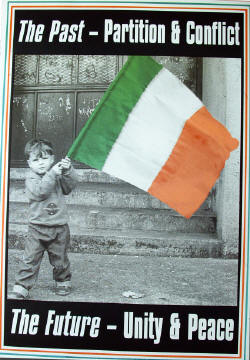
MICHAEL COLLINS LOOKS ON AS PARTITION AND CONFLICT ARE SAID BY 'THE REBELS' TO BE 'IN THE PAST..'
(Click here for better image of the so-called 'Past and Future' poster.)
One of our regular readers found himself with a few hours to spare on (Sunday) 5th October 2008 (14 years ago on this date) so himself and his Missus headed-out to the County of Meath to have a browse around Fairyhouse Market.
Whilst browsing the hundreds of stalls and units etc they came across a stall operated by Provisional Sinn Féin at which he noticed, incredulously, that not only were they selling framed prints of Free Stater Michael Collins but they had one such framed print located right beside a framed poster which declared that partition in Ireland and the political conflict it feeds are things of the past!
Our reader asked one of the PSF stall holders if they would agree that they were being a wee bit premature in saying that partition and conflict in Ireland are in the past and proceeded to give a brief history lesson to the hapless rep and asked how they could possibly support the notion that partition and the conflict which arises from it can be said 'to be over' as this country is still partitioned by Westminster, which maintains an armed, and political, presence here?
The garbled reply was as dense as the framed poster - "But things are a lot better...we're almost there....the leadership know what they're doing....things are looking up...."
Our man walked away, shaking his head in despair, and wondering how such people can be left in charge of a market stall, never mind how they can 'claim ownership' to the best way to resolve the not yet resolved issue of partition and the conflict that arises from it.
Needless to say, our man wasn't buying it..!
ON THIS DATE (5TH OCTOBER) 101 YEARS AGO : 'RIC GREASE MONKEYS' DISRESPECTED!
On the 5th October 1921 - 101 years ago on this date - mechanics working for the RIC on their fleet of weaponised cars etc were promised, in writing, certain terms and conditions, which they were happy with, only to have same removed, in writing, two days later!
Obviously, they objected to having been treated in that manner, and 'upped their game' when their actual yearly contracts of employment were interfered with by their management in a manner that reduced them to 'employees on a weekly contract'.
A political rep raised the issue for them in Westminster on the 20th February 1922 -
"As regards these constable mechanics, they were originally engaged to serve on a yearly contract. In a question I pointed out to the Chief Secretary that these men were engaged on a yearly contract, that it was subsequently modified into a monthly contract, and finally into a weekly contract, and he denied that that was the case.
I have chapter and verse here for my statement. I have in my hand the notices calling for recruits and each one states that it is a yearly contract. It says :
'Here is a job for you at good pay. Are you a motor driver or a mechanic? If so, join the transport section of the Royal Irish Constabulary.'
Then follow the conditions offered upon a yearly contract. These men were serving on a yearly contract and they have been discharged with a sum of £10 as a gratuity. Some of them were actually sent off on the date on which their contract expired without any notice whatever. Some of them were sent away from Dublin and were told that they would have to pay their own passage money home, although I know that that matter has been put right since.
That is how they started. Last June, 30 were treated in that way. They were told to find their way back to England and pay their fares themselves. The matter was raised in this House. I have a paper signed by three sergeants and four constables, dated the 14th November, stating that on the preceding day they were notified that their services were no longer required and that their duty would cease from that date. They were also told to find their way home without their passages being paid.