ON THIS DATE (24TH SEPTEMBER) 227 YEARS AGO..."HE DRAWS ANOTHER PISTOL AND SHOOTS THE GUNNER..."
"....suddenly Bartholomew Teeling broke from the Franco-Irish forces and charged forward on his horse.
One may imagine the scene: the British at first watch incredulously, then a scattered fire of muskets. Teeling is unharmed, galloping onwards. The British sharpshooter by the cannon coolly takes aim. Teeling eyes him and suddenly swerves his horse ; the shot goes past him.
The sharpshooter curses and reloads. Another ragged volley from the infantry and again they miss...the French and the Irish are cheering but they can’t believe he will make it. Teeling’s horse leaps a ditch and gallops on past the infantry, foam flying from the animal's body – the sharpshooter looks up at him, loses his nerve and fumbles the charging of his musket.
Teeling is up at the gun, he has drawn his pistol and shoots the sharpshooter dead. He draws another pistol and shoots the gunner.
The Irish and French are ecstatic and charge forward. The British are stunned ; some stand but most of the British infantry flee from the superior numbers and leave the cannon in the hands of the insurrectionist forces, as well as 60 dead and 100 taken prisoner..."
(from here.)
Another author wrote, re the above scene, which took place at the Battle of Collooney - "...this was the turning point of the battle. The troops despatched from Knockbeg had reached Beal Ban and were already rushing down on the British flank. The other column was advancing at a rapid pace against the front.
There was no safety for Verecker from this double danger, except in retreat ; and as the Ballysadare road was no longer practicable, he ordered his men to cross the river and make for Sligo..."
Bartholomew Teeling (pictured, above) was only 24 years of age when he was captured at the Battle of Ballinamuck, Longford, as were another 500 or so Irish and French fighters. The French soldiers were treated as POW's but the Irish soldiers were executed - Teeling was hanged by the British on the 24th September 1798 at Provost Prison in Arbour Hill, Dublin, before his body was thrown into the 'Croppy Pit'.
He attempted to read the following statement from the scaffold, but was not permitted by the 'authorities' to do so :
"Fellow-citizens, I have been condemned by a military tribunal to suffer what they call an ignominious death, but what appears, from the number of its illustrious victims, to be glorious in the highest degree.
It is not in the power of men to abase virtue nor the man who dies for it. His death must be glorious in the field of battle or on the scaffold.
The same Tribunal which has condemned me — citizens, I do not speak to you here of the constitutional right of such a Tribunal — has stamped me a traitor.
If to have been active in endeavouring to put a stop to the blood-thirsty policy of an oppressive Government has been treason, I am guilty. If to have endeavoured to give my native country a place among the nations of the earth was treason, then I am guilty indeed. If to have been active in endeavouring to remove the fangs of oppression from the head of the devoted Irish peasant was treason, I am guilty.
Finally, if to have striven to make my fellow-men love each other was guilt, then I am guilty.
You, my countrymen, may perhaps one day be able to tell whether these were the acts of a traitor or deserved death. My own heart tells me they were not and, conscious of my innocence, I would not change my present situation for that of the highest of my enemies.
Fellow-citizens, I leave you with the heartfelt satisfaction of having kept my oath as a United Irishman, and also with the glorious prospect of the success of the cause in which we have been engaged.
Persevere, my beloved countrymen.
Your cause is the cause of Truth.
It must and will ultimately triumph."
RIP Bartholomew Teeling, Irish Rebel, 1774-1798.
"You cannot in the existing state in Ireland punish a policeman (sic) who shoots a man whom he has every reason to suspect is concerned in police murders.
That kind of thing (ie shooting an RIC member) can only be met by reprisals..."
- the words of a Mr David Lloyd George ('1st Earl Lloyd-George of Dwyfor' etc!), the British Prime Minister at the time, as recounted (on the 24th September 1920) by a colleague of his, a Mr Herbert Albert Laurens Fisher (pictured), an MP for the constituency of Sheffield Hallam and, at that time, the President of the British Board of Education.
In effect, that would be a 'licence to kill' - to shoot dead anyone who 'looks suspect'!
On the same date that Mr Fisher was fondly recounting the words of Mr George, a Mr Henry Owens (30, 'Service Number 4180426'), a soldier in the British Army's 'Royal Welch Fusiliers', was in a military barracks ('New Barracks') in Limerick, when he was shot, dying shortly afterwards from the wound.
The shooting was said to have been carried out, 'accidentally', by one of his own comrades.
==========================
GAS LADS...
The massive finds of oil and gas on our western seaboard could ensure Ireland's financial security for generations.
Wealth approximating that of the Arab countries is within our grasp, but the Irish government seems content to sell off our birthright for a handful of votes and a few dollars.
In a special 'Magill' report, Sandra Mara investigates just what we are giving away, and why.
From 'Magill' magazine, March 2002.
However, 'Enterprise Oil' refused to meet with SIPTU and there followed a series of peaceful protests by Irish rig-workers.
The company then moved operations to Ayr on the west coast of Scotland and outsourced the bulk of its goods and services requirements.
For its part, the company says it has no objection to hiring Irish rig-workers ; "absolutely not.." spokesperson Pat Keating told 'Magill' magazine, "...my understanding of the issue is that rigs come in on contract for two, three or five months, and have specialist work forces which come with them.
You can't just send anybody out on a rig ; it would be a delight to have Irish workers, but there's not enough specialist Irish staff out there. So that issue really is a red herring..."
As for Ray Burke's rather generous terms, Pat Keating says they would have had little impact on Enterprise Oil's decision to drill here...
(MORE LATER.)
ON THIS DATE (24TH SEPTEMBER) 108 YEARS AGO : BRITISH PLANS FINALISED TO FORCE-FEED AN IRISH HUNGER-STRIKER.
"You cannot put a rope around the neck of an idea...you cannot confine it in the strongest prison cell that your slaves could ever build.." - the words of Séan O'Casey, in relation to the murder of Thomas Ashe.
The funeral procession in Dublin, 30th September 1917 (pictured), for Thomas Ashe, an IRB leader, who died on the 25th September that year, after being force fed by his British jailers.
He was the first Irish republican to die as a result of a hunger-strike and, between that year and 1981, twenty-one other Irish republicans died on hunger-strike.
The jury at the inquest into his death found "..that the deceased, Thomas Ashe, according to the medical evidence of Professor McWeeney, Sir Arthur Chance, and Sir Thomas Myles, died from heart failure and congestion of the lungs on the 25th September, 1917 and that his death was caused by the punishment of taking away from the cell bed, bedding and boots and allowing him to be on the cold floor for 50 hours, and then subjecting him to forcible feeding in his weak condition after hunger-striking for five or six days.."
Michael Collins organised the funeral and transformed it into a national demonstration against British misrule in Ireland ; armed 'Irish Republican Brotherhood' Volunteers in full uniform flanked the coffin, followed by 9,000 other IRB Volunteers, and approximately 30,000 people lined the streets.
A volley of shots was fired over Ashe's grave, following which Michael Collins stated - "Nothing more remains to be said. That volley which we have just heard is the only speech which it is proper to make over the grave of a dead Fenian."
The London-based 'Daily Express' newspaper perhaps summed it up best when it stated, re the funeral of Thomas Ashe, that what had happened had made '100,000 Sinn Féiners out of 100,000 constitutional nationalists.'
The level of support shown gave a boost to Irish republicans, and this was noted by the 'establishment' in Westminster - 'The Daily Mail' newspaper claimed that, a month earlier, Sinn Féin, despite its electoral successes, had been a waning force. That newspaper said -
'..It had no practical programme, for the programme of going further than anyone else cannot be so described. It was not making headway. But Sinn Féin today is pretty nearly another name for the vast bulk of youth in Ireland...'
Thomas Patrick Ashe’s activities and interests included cultural and physical force nationalism as well as trade unionism and socialism. He also commanded the 5th Battalion of the Dublin Brigade Volunteers who won the Battle of Ashbourne on the 29th of April 1916. Born in Lispole, County Kerry on the 12th of January 1885, he was the seventh of ten siblings.
He qualified as a teacher in 1905 at De La Salle College, Waterford and, after teaching briefly in Kinnard, County Kerry, in 1906 he became principal of Corduff National School in Lusk, County Dublin.
Thomas Ashe was a fluent Irish speaker and a member of the Keating branch of the Gaelic League and was an accomplished sportsman and musician setting up the Roundtowers GAA Club as well as helping to establish the Lusk Pipe Band (pictured). He was also a talented singer and poet who was committed to Conradh na Gaeilge.
Politically, he was a member of the 'Irish Republican Brotherhood' (IRB) and established IRB circles in Dublin and Kerry and eventually became President of the IRB Supreme Council in 1917. While he was actively and intellectually nationalist he was also inspired by contemporary socialism. Ashe rejected conservative Home Rule politicians and as part of that rejection he espoused the Labour policies of James Larkin.
Writing in a letter to his brother Gregory he said "We are all here on Larkin's side. He'll beat hell out of the snobbish, mean, seoinín employers yet, and more power to him".
Ashe supported the unionisation of north Dublin farm labourers and his activities brought him into conflict with landowners such as Thomas Kettle in 1912. During the infamous lockout in 1913 he was a frequent visitor to Liberty Hall and become a friend of James Connolly.
Long prior to its publication in 1916, Thomas Ashe was a practitioner of Connolly’s dictum that "the cause of labour is the cause of Ireland, the cause of Ireland is the cause of labour". In 1914 Ashe travelled to the United States where he raised a substantial sum of money for both the Gaelic League and the newly formed Irish Volunteers of which he was an early member.
He founded the Volunteers in Lusk and established a firm foundation of practical and theoretical military training, and provided charismatic leadership first as Adjutant and then as O/C (Officer Commanding) the 5th Battalion of the Dublin Brigade.
He inspired fierce loyalty and encouraged personal initiative in his junior officers and was therefore able to confidently delegate command to Charlie Weston, Joseph Lawless, Edward Rooney and others during the Rising. Most significantly, he took advantage of the arrival of Richard Mulcahy at Finglas Glen on the Tuesday of the Rising and appointed him second in command.
The two men knew one another through the IRB and Gaelic League and Ashe recognized Mulcahy’s tactical abilities. As a result Ashe allowed himself to be persuaded by Mulcahy not to withdraw following the unexpected arrival of the motorised force at the Rath crossroads. At Ashbourne on the 28th of April Ashe also demonstrated great personal courage, first exposing himself to fire while calling on the RIC in the fortified barracks to surrender and then actively leading his Volunteers against the RIC during the Battle.
After the 1916 Rising he was court-martialled (on the 8th of May 1916) and was sentenced to death. The sentence was commuted to penal servitude for life.
He was incarcerated in a variety of English prisons before being released in the June 1917 general amnesty, immediately returned to Ireland, toured the country reorganising the IRB and incited civil opposition to British rule.
In August 1917, after a speech in Ballinalee, County Longford, he was arrested by the RIC and charged with "speeches calculated to cause disaffection".
He was detained in the Curragh camp and later sentenced to a year's hard labour in Mountjoy Jail. There he became O/C of the Volunteer prisoners, and demanded prisoner-of-war status and, as a result, he was punished by the Governor.
He went on hunger strike on the 20th September 1917 and five days later died as a result of force-feeding by the prison authorities ; he was just 32 years of age.
The death of Thomas Ashe resulted in POW status being conceded to the Volunteer prisoners two days later.
Thomas Ashe's funeral was the first public funeral after the Rising and provided a focal point for public disaffection with British rule. His body lay in state in Dublin City Hall before being escorted by armed Volunteers to Glasnevin Cemetery ; 30,000 people attended the burial where three volleys were fired over the grave (pictured) and the Last Post was sounded.
While imprisoned in Lewes Jail in 1916, Thomas Ashe had written his poem 'Let Me Carry Your Cross for Ireland, Lord' which later provided the inspiration for the Battle of Ashbourne memorial unveiled by Sean T. O'Kelly on Easter Sunday, 26th April 1959 at the Rath Cross in Ashbourne :
Let me carry your Cross for Ireland, Lord
The hour of her trial draws near,
And the pangs and the pains of the sacrifice
May be borne by comrades dear.
But, Lord, take me from the offering throng,
There are many far less prepared,
Through anxious and all as they are to die
That Ireland may be spared.
Let me carry your Cross for Ireland, Lord
My cares in this world are few,
and few are the tears will for me fall
When I go on my way to You.
Spare Oh! Spare to their loved ones dear
The brother and son and sire,
That the cause we love may never die
In the land of our Heart's desire!
Let me carry your Cross for Ireland, Lord!
Let me suffer the pain and shame
I bow my head to their rage and hate,
And I take on myself the blame.
Let them do with my body whate'er they will,
My spirit I offer to You,
That the faithful few who heard her call
May be spared to Roisin Dubh.
Let me carry your Cross for Ireland, Lord!
For Ireland weak with tears,
For the aged man of the clouded brow,
And the child of tender years;
For the empty homes of her golden plains,
For the hopes of her future, Too!
Let me carry your Cross for Ireland, Lord!
For the cause of Roisin Dubh.
RIP Volunteer Thomas Ashe, 12th January 1885 – 25th September 1917.
ON THIS DATE (24TH SEPTEMBER) 49 YEARS AGO : "A THUNDERING DISGRACE" COMMENT MADE PUBLIC.
Ireland, 1970's : turmoil in the country, due to the then-as-now unwanted political and military interference here by Westminster.
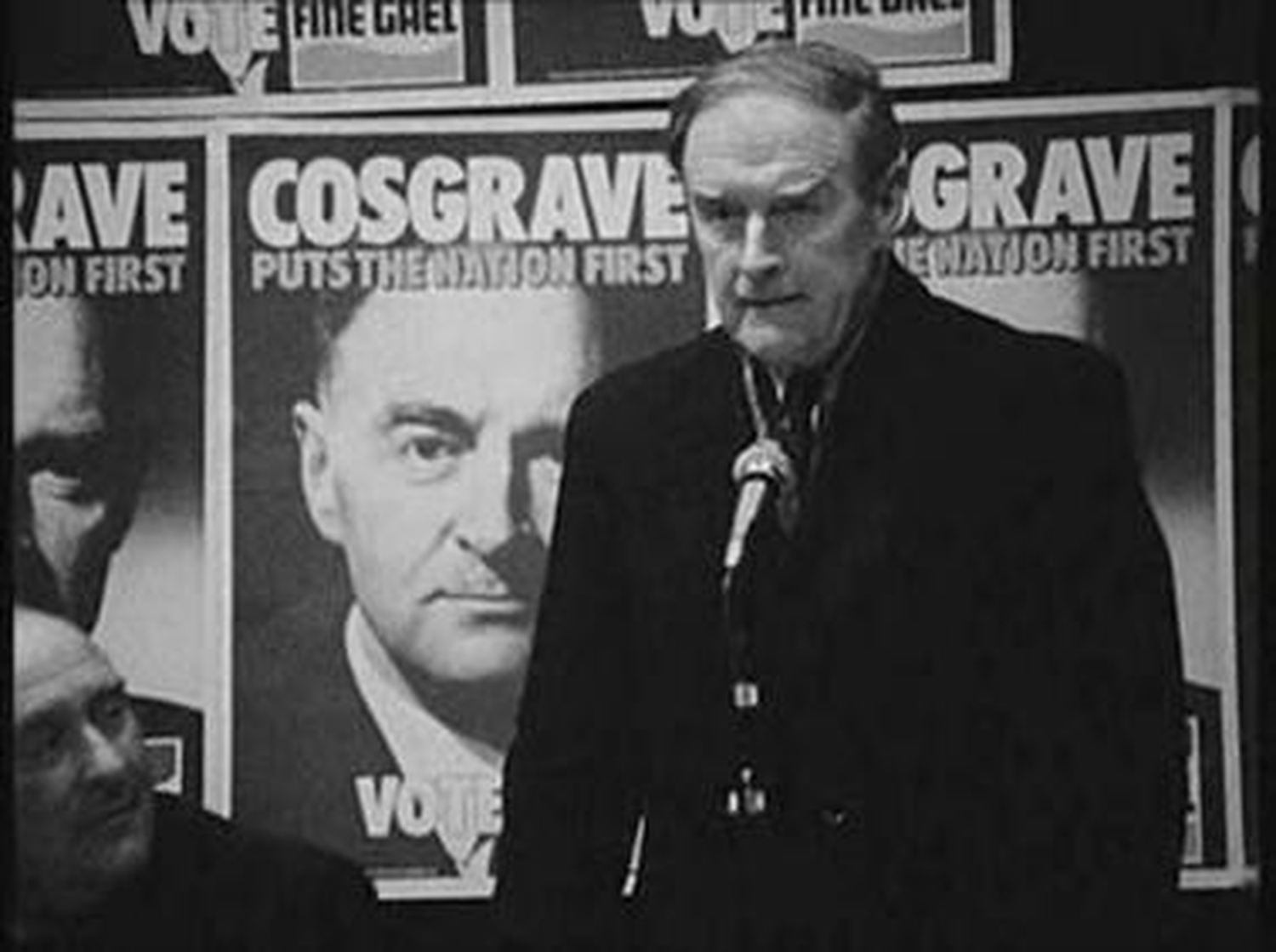
The Leinster House administration was headed-up at the time by Fine Gael's Liam Cosgrave , and among the many harsh laws introduced, enforced and 'improved on' by the Blueshirts was a censorship act, 'Section 31'.
The then Free State President was a Fianna Fail man, Cearbhall Ó Dálaigh , said to be a compromise candidate by the powers-that-be at the time, as he fitted the requirements dictated by the 'establishment' (ie 'a safe pair of hands').
He was previously the Free State Attorney General and Chief Justice of the FS Supreme Court, and was given the Office, unopposed, in 1974, following the death of Erskine Hamilton Childers.
But it was that legal training which raised a red flag with him in relation to a piece of legislation which the Blueshirt Leinster House administration wanted him to 'rubber stamp' - the 'Emergency Powers Act', and the fact that Ó Dálaigh and Cosgrave didn't agree with each other, socially or politically, came into play : Ó Dálaigh refused to simply 'sign off' on the 'EPA' without first testing its constitutionally.
On the 24th of September, 1976 - 49 years ago on this date - it became known that Mr Ó Dálaigh had spent four hours the day before consulting with a bunch of posh suits known as the Free State 'Council of State' on whether or not it would be best practice to refer the legislation to the Free State Supreme Court to test its constitutionality before he could declare it to be 'the law' and it was decided that that would be the best thing to do, a decision which annoyed the Blueshirt administration.
Just over three weeks later (ie on the 15th October 1976) the FS Supreme Court declared that the 'EPA' was a legitimate piece of legislation and it was only then that Ó Dálaigh deemed it necessary to sign-off on it, which he did, reluctantly (or so it was claimed at the time) but that 'victory' wasn't enough for Cosgrave and his people - they considered themselves to have been disrespected by the actions of Mr Ó Dálaigh and, three days later (ie on the 18th October 1976), they could contain themselves no longer.
It was on that date that the Free State Minister of Defence, Paddy Donegan, was opening a new Free State army barracks in Mullingar, County Westmeath (having, seemingly, forgot that Mr Ó Dálaigh was the Commander-In-Chief of said army!) that he made a remark (he was concussed at the time, he later claimed!) which was to haunt him for the rest of his life.
He had 'kicked himself up the transom', if you like, which wouldn't have caused as much damage as firing a shotgun over dwellings in which people lived - more about that 'eccentric' (!) Free State politician can be read here...
On the 24th September, 1921, during a speech he delivered in Dundee in Scotland, a Mr Winston Leonard Spencer Churchill (pictured), British PM, stated that if the Treaty (of Surrender) was not accepted by the Irish...
"..our course would be very unpleasant, but it would also be very simple.
Not peace, but certain war ; real war, not mere bushranging, would follow such a course..."
Later in that speech, Mr Churchill admitted that one of the main reasons why the British needed an end to their terror campaign in Ireland was because "it would remove the greatest obstacle which has ever existed to Anglo-American unity.." ie trade, business, money : slaughtering the Irish was not a good business card to approach the Americans with...
...meanwhile, on that same date, the IRA were doing some approach work themselves, in connection with that same subject - the (Treaty) Truce - which had come into effect on Monday, July 11th 1921, to allow for negotiations between both sides.
The Officer Commanding of the West Limerick Brigade approached the Battalion Commanders in his operational area and instructed them that, as the Truce talks were winding-up, they should advise their fighters to be ready for battle as the outcome of the talks may demand it.
While IRA fighters in Limerick (and other areas in the country) were being briefed by their officers, rioting broke out about 200 miles/320 km up the road in Belfast.
British loyalists, disgusted that 'their side might be about to loose ground to Irish republicans', behaved as expected - they rioted.
A gang of them met up and proceeded to the Short Strand and Newtownards Road area of the city but they met resistance on the way and there and, in the ensuing street fight, two of their number (both aged 19) - James McMinn, from Reid's Place, and Alexander Harrison, from Frazer Street - died when a bomb was thrown at the gang, and about 20 of their colleagues were injured.
==========================
CASH NO EXCUSE FOR RTE PUTTING DOCUMENTARY TO DEATH...
It has been a disastrous 12 months for RTE.
£23.5 million in cutbacks, a bid to increase the licence fee rejected, an enforced postponement of digital expansion, and a predicted £20 million loss to report for 2001.
By Belinda McKeon .
From 'Magill' Annual, 2002.
RTE should remember that its audience has always come through for it when it has taken intelligent risks with programming - it should have faith in that audience, it should have faith in its independent programmers, and it should have faith in itself.
Because, ultimately, it is for itself that the station needs to move forward, not for a minister and her pack of accountants.
(END of 'Cash No Excuse For RTE Putting Documentary To Death' : NEXT - 'William Jefferson Clinton', from the same source.)
"We consider it imperative that some sort of Government, whether a Provisional or a Republican or a military one, should be inaugurated at once..."
- the words written by Volunteer leader Ernie O'Malley (pictured, aka 'B. Stuart'), in a letter he sent, on the 24th September, 1922, to Volunteer leader Liam Lynch.
At that time, the IRA had launched a 'September Offensive' and was attacking Free State forces as opposed to simply defending themselves from FSA attacks on them, and the rebels had success enough to worry the Stater politicians to the point that they introduced, that same month, a death penalty for IRA members.
Perhaps their colleagues in Westminster were paying them a bounty on each ex-comrade they executed...?
As Volunteer Lynch was reading that letter, an IRA Active Service Unit had opened fire on a FSA guard post in Glendalough, in County Wicklow, and was getting the upper hand when the fight was interrupted by the arrival of a 50-strong FSA patrol.
The IRA ASU was now outnumbered and outgunned, and was forced to retreat, with two Volunteers wounded and three captured.
And, on that same date (the 24th), an already captured IRA fighter, Volunteer Patrick Mangan (age 20, Third Battalion of the Cork No. 2 Brigade), from the village of Carrignagower, near Lismore, in County Waterford, was shot by a FSA sentry during a disturbance in Cork Jail.
The IRA POW'S (numbering about 400 Volunteers) refused to return to their cells from the recreation yard and, after being forced to move inside the prison by FSA soldiers/prison guards using their rifle butts, the prisoners rioted in the corridors.
Shots were fired over their heads which dispersed some of the POW's and, when a second round was fired at them, Volunteer Mangan fell to the ground, wounded. He died from that wound the next day.
Attempting to explain and excuse their actions, the Staters put out a statement -
"One party of prisoners, amongst whom was the deceased, still remained on the corridors, shouting and defiant. The sentry was again ordered to fire, and Mangan fell wounded..."
Volunteer Mangan died the following day from the wound.
The Staters held a 'Military Inquiry' (!) into the shooting and issued the following statement afterwards -
"Patrick Mangan met his death as the result of a shot fired by a sentry in the execution of his duty, and the officer who gave the order to fire was justified, as the prisoners had sufficient warnings and ample time to comply with the order to return to their cells..."
Volunteer Patrick Mangan, from the village of Carrignagower, near Lismore, in County Waterford, was attached to the Third Battalion of the Cork No. 2 Brigade, and operated mostly as as a dispatach rider. He was captured by the Staters in Fermoy, County Cork, in August 1922 and imprisoned in Cork Jail.
He is buried in Lismore Old Cemetery in County Cork, and is named on the IRA memorial in Kilcrumper Cemetery in that town.
RIP Volunteer Patrick Mangan.
On that same Sunday (24th September 1922), a pastoral letter from the RC Bishop of Cork, a Mr Daniel Coughlan, was read out at all Masses in the diocese, in which Mr Coughlan stated that "the killing of National (sic) soldiers is murder...", and went on to state that any person taking part in an ambush in which British soldiers were injured, held as hostages, or killed ("murdered", he called it) would be promptly excommunicated by the Catholic Church!
Mr Coughlan, or Cohalan, which he preferred, was known for his loyalty to the Crown and was also known - among the public - as 'Danny Boy', a reference to his pro-British leanings.
Just another quisling in a long line of quislings.
==========================
DEATH IN THE MEDITERRANEAN...
Desmond Boomer, a Belfast engineer working in the Libyan oil-fields, disappeared seven years ago.
Officially, the plane on which he was a passenger crashed as a result of mechanical failure and pilot error.
But is that the real story?
Or were the Irishman and his fellow passengers unwitting victims of the shady war between Islamic fundamentalism and Mossad, Israel's intelligence network?
A special 'Magill' investigation by Don Mullan, author of 'Eyewitness Bloody Sunday'.
From 'Magill' magazine, January 2003.
Cormac Boomer, an engineer by profession, told 'Magill' magazine -
"On the 16th May, 1997, I examined and photographed the alleged wreckage.
It is obviouse the condition of it was not compatible with having spent ten months in the salt brine of the Mediterranean.
There was no indication of salt pigment or the corrosion one would expect to find in such circumstances.
It is claimed the aircraft fell from a height of 9,000 feet into the sea in a severe storm but it is strange, therefore, that the cable looms do not show any indication of the stretch, arc or rupture one would expect from the ripping-apart which would occur in an aircraft descending in a headlong plunge.
From my visual inspection and the photographic evidence it is obvious the ends of those cables have been severed with a cutting tool..."
(MORE LATER.)
ON THIS DATE (24TH SEPTEMBER) 42 YEARS AGO - IRA H-BLOCK PRISON ESCAPE PLAN FINALISED BY IRA POW'S.
THE LONG KESH ESCAPE - SUNDAY 25th SEPTEMBER 1983. From 'IRIS' magazine, November 1983.
"We perceived the escape as a military operation from beginning to end. It could not have been achieved in any other way, and the ASU - as Volunteers in the Irish Republican Army - were under strict orders throughout from an Operations Officer whose judgement was crucial and whose every order had to be obeyed.
Every Volunteer was under a tight brief.." - IRA statement.
It was this precision of planning, exclusively revealed in a detailed interview by key ASU personnel involved, that lay behind the almost incredible escape of 38 Republicans on Sunday 25th September 1983 from what is generally believed to be the most secure prison in Western Europe - the H-Blocks of Long Kesh (near Lisburn, South Belfast).
At 2.15pm that day, three IRA Volunteers carrying concealed pistols fitted with silencers, which had been smuggled into the prison, moved into the 'Central Administration' area (the 'Circle') of H7-Block on the pretext of cleaning out a store. Fifteen minutes later they were joined by a fourth armed Volunteer ; control of the 'Circle', with its numerous alarm bells, was vital for the escape's success and had to be carried out simultaneously with the overpowering of prison Screws in the four wings of H7-Block.
Minutes later three other Volunteers - armed with pistols, hammers or chisels - took up key positions near Screws positioned by alarm buttons, on the pretext of carrying out orderly duties, while Brendan 'Bic' McFarlane (the H-Block Officer Commanding during the hunger-strike) was allowed through two locked grilles into the hall of the Block on cleaning duties - his job was to arrest the Screw there and, on a given signal - once everyone was in position - IRA Volunteers overpowered and arrested all the prison Screws in the Block, many of the Volunteers subsequently changing into their uniforms.
During the seizure of control one Screw - on duty in a locked control room - was shot twice in the head when he ignored orders to lie on the floor and instead made a lunge for the alarm. Control of the Block was completed when 'Bic' McFarlane, accompanied by two IRA Volunteers dressed as Screws, arrested the Screw on duty in the front gate enclosure. It was now about 2.45pm.
Some time later the food lorry bringing evening meals to H7 (pictured) arrived ; 37 IRA Volunteers climbed into the back while another lay on the floor of the cab holding a gun on the Screw driving the lorry. The lorry then drove through a series of 'security gates' in the Long Kesh complex manned by unsuspecting Screws and in full view of armed British sentry posts.
It eventually arrived at a 'tally hut' close to a back gate of the prison camp ; the plan was to arrest the Screws in the 'tally hut' and, leaving five Volunteers in control, drive the food lorry a further quarter mile to the front gate 'tally hut' which the escapees would then take control of, leaving two Volunteers there, before driving out in the food lorry to freedom.
Meanwhile, the five Volunteers in the first 'tally hut' would obtain a Screw's car from the adjoining car park, drive to the front gate where the two Volunteers in control there would clamber into the boot, and also make their escape. That was the plan of escape ; unfortunately, it was not to be - the plan of escape began to go wrong at the first 'tally-hut' due to there being larger numbers of Screws coming on duty than anticipated.
While the escapees kept arresting more and more Screws, the situation got out of control and the alarm was raised.
At this point the escapees were forced to make a run for it on foot across fields, many of them successfully commandeering local cars. In the final melee several Screws were stabbed and one escapee, Harry Murray (pictured), was shot and wounded.
It was inevitable, given the eventual breakdown of the plan, that there would be some re-arrests, some within minutes and some within two days of the break-out. Nonetheless, the massive total of 19 Republican prisoners of war did successfully escape and eventually reach freedom - to the massive embarrassment of the British and the jubilation of Nationalists throughout the 32 Counties !
The 19 H-Block escapees that were then at liberty are - Kevin Barry Artt, (24) North Belfast ; Paul Brennan (30) Ballymurphy ; Seamus Campbell (26) Coalisland, County Tyrone ; James Clarke (27) Letterkenny, County Donegal ; Seamus Clarke (27) Ardoyne ; Gerard Fryer (24) Turf Lodge ; Dermot Finucane (22) Lenadoon ; Kieran Fleming (23) Derry ; Anthony Kelly (22) Derry ; Gerry Kelly (30) Belfast ; Anthony McAllister (25) Belfast ; Gerard McDonnell (32) Belfast ; Seamus McElwair (22) Scotstown, County Monaghan ; Brendan McFarane (31) Ardoyne ; Padraic McKearney (29) Moy, County Tyrone ; Dermot McNally (26) Lurgantarry, North Armagh ; Robert Russell (25) Ballymurphy ; Terence Kirby (27) Andersonstown and James Smith (38) Ardoyne.
Thanks for the visit, and for reading - appreciated, especially (because we're greedy!) as we're trying to get to 3 million hits (...did ya notice that we now have over two million hits..?!).
Sure we're never bleedin' happy...!
Sharon and the team.
(We'll be back on Wednesday, 8th October, 2025.)
ON THIS DATE (12TH JANUARY) 83 YEARS AGO : REPUBLICAN GOVERNMENT ULTIMATUM DELIVERED TO WESTMINSTER.
An ultimatum from the Government of the Irish Republic was delivered to the then British Foreign Secretary, 'Lord' Halifax, on this date (12th January) 83 years ago ;
'I have the honour to inform you that the Government of the Irish Republic [32 counties], having as its first duty towards its people the establishment and maintenance of peace and order here, demand the withdrawal of all British armed forces stationed in Ireland. The occupation of our territory by troops of another nation and the persistent subvention here of activities directly against the expressed national will and in the interests of a foreign power, prevent the expansion and development of our institution in consonance with our social needs and purposes, and must cease.
The Government of the Irish Republic believe that a period of four days is sufficient notice for your Government to signify its intentions in the matter of the military evacuation and for the issue of your Declaration of Abdication in respect of our country. Our Government reserves the right of appropriate action without further notice if upon the expiration of this period of grace, these conditions remain unfulfilled...'
The ultimatum was ignored.
On Friday, the 25th August (a few days before Hitler's German army invaded Poland) an IRA man from Cork, Joby O'Sullivan, was strolling through Broadgate, in Coventry, wheeling a push bike, on his way to a police station. The bike repeatedly got stuck in tram tracks on the road and, frustrated, he removed it from the road and propped it up against a wall. The bike had an armed bomb in the basket that was fixed to the handlebars, which had been wired up to an alarm clock timer, which was set for about 2.30pm. He left it there, and walked away.
The five-pound bomb exploded prematurely, killing five people and injuring dozens more - it was one of about 150 IRA bombing incidents in England at that time, targeting infrastructure such as electricity stations, post offices, gas stations and government buildings.
Not long after the explosion, Peter Barnes (who was in London on the day of the explosion) was arrested at the lodgings he was staying in and, three days after that, James McCormack (aka 'James Richards') was pulled-in along with the other tenants of the house he was staying in.
The 'trial' began in December (1939) and both men were convicted and sentenced to death by hanging. Throughout the court case, James McCormack remained silent until he told the court - "As a soldier of the Irish Republican Army, I am not afraid to die, for I am dying in a just cause."
Peter Barnes stated to the court - "I would like to say as I am going before my God, as I am condemned to death, I am innocent, and later I am sure it will all come out that I had neither hand, act or part in it. That is all I have to say."
In his last letter (to his brother) he wrote - 'If some news does not come in the next few hours all is over. The priest is not long gone out, so I am reconciled to what God knows best. There will be a Mass said for us in the morning before we go to our death. Thank God I have nothing to be afraid of. I am an innocent man and, as I have said before, it will be known yet that I am.'
In the last letter he ever wrote, James McCormack said - 'This is my farewell letter, as I have been just told I have to die in the morning. As I know I am dying for a just cause, I shall walk out tomorrow smiling, as I shall be thinking of God and of the good men who went before me for the same cause.' (That letter was addressed to his sister, as both of his parents were dead.)
In Winson Green Prison, Birmingham, at 8.50am on Wednesday, 7th February 1940, the two men received a final blessing. Minutes later they walked together to the scaffold and were hanged by four executioners. Their bodies were brought back to Ireland and re-interred in their native soil in Mullingar on the 6th July, 1969.
'Once again the blood of martyrs
flows upon the scaffold high
once again the vengeful tyrant
has decreed that men must die.
They shall come to speed the dawning
when from their ashes they'll arise
Peter Barnes and James Mc Cormack
for our sake they have lived and died.'
'THE ARMAGH ACTION...'
This dramatic account of the action was given to one of our representatives in an interview with one of the men who took part.
From 'The United Irishman' newspaper, July, 1954.
WE MOVE IN...
The IRA man walked up to the sentry at the gate of Gough British Military Barracks in Armagh ;"How does a fellow go about joining the Army, mate?" he asked.
From behind, he indicated the 'all clear' signal and we moved casually towards the gate. It was exactly 2.40. "On a Saturday...?", queried the sentry. "I'm not particular whether I join on a Saturday or a Sunday" , our man replied. "Well, personally, I think you're a fucking idiot to join at all", replied the sentry, obviously fed up with his lot. "What's the pay like?", asked our man. "Hold on, chum", the sentry replied, "and I'll get Simpson and the corporal over here to fix you up..".
The sentry whistled and two men came over and, as they did, the four of us reached the gate. Three simply walked past and directly into the guardroom. The fourth man stood directly behind the three Tommies. "What'll I do for you?", asked Simpson, when he came over to our man at the gate. "Stay where you are, act natural, and don't move", our man replied, showing them his Colt.45 ; the corporal laughed. "It's no joke," our man said, cocking the gun, "but in case you think it is, take a look over your shoulder."
The three of them looked around and a Volunteer uncovered the Thompson sub-machine gun, looked menacingly at them and they paled. He nodded towards the guardroom and said "Get in there, quickly." They did as they were told.
The sentry was ordered to stay where he was and continue as if nothing had happened. This was the first move in the plan - to let the ordinary barrack routine carry-on as if there was nothing unusual afoot. The Volunteer kept him covered : "What's going on..?" asked the sentry. "Don't ask questions, it's not your business. Just take it easy and look natural", replied the Volunteer...
(MORE LATER.)
ON THIS DATE (12TH JANUARY) 137 YEARS AGO : BIRTH OF THOMAS PATRICK ASHE.
"You cannot put a rope around the neck of an idea...you cannot confine it in the strongest prison cell that your slaves could ever build.." - the words of Séan O'Casey, in relation to the murder of Thomas Ashe (pictured).
Thomas Patrick Ashe, an IRB leader, was the first Irish republican to die as a result of a hunger-strike and, between that year and 1981, twenty-one other Irish republicans died on hunger-strike.
The jury at the inquest into his death found "..that the deceased, Thomas Ashe, according to the medical evidence of Professor McWeeney, Sir Arthur Chance, and Sir Thomas Myles, died from heart failure and congestion of the lungs on the 25th September, 1917 and that his death was caused by the punishment of taking away from the cell bed, bedding and boots and allowing him to be on the cold floor for 50 hours, and then subjecting him to forcible feeding in his weak condition after hunger-striking for five or six days.."
Michael Collins organised the funeral and transformed it into a national demonstration against British misrule in Ireland ; armed 'Irish Republican Brotherhood' Volunteers in full uniform flanked the coffin, followed by 9,000 other IRB Volunteers, and approximately 30,000 people lined the streets. A volley of shots was fired over Ashe's grave, following which Michael Collins stated - "Nothing more remains to be said. That volley which we have just heard is the only speech which it is proper to make over the grave of a dead Fenian."
The London-based 'Daily Express' newspaper perhaps summed it up best when it stated, re the funeral of Thomas Ashe, that what had happened had made '100,000 Sinn Féiners out of 100,000 constitutional nationalists.' The level of support shown gave a boost to Irish republicans, and this was noted by the 'establishment' in Westminster - 'The Daily Mail' newspaper claimed that, a month earlier, Sinn Féin, despite its electoral successes, had been a waning force. That newspaper said - '..It had no practical programme, for the programme of going further than anyone else cannot be so described. It was not making headway. But Sinn Féin today is pretty nearly another name for the vast bulk of youth in Ireland...'
Thomas Patrick Ashe’s activities and interests included cultural and physical force nationalism as well as trade unionism and socialism. He also commanded the 5th Battalion of the Dublin Brigade Volunteers who won the Battle of Ashbourne on the 28th of April 1916.
Born in Lispole, County Kerry on the 12th of January 1885 - 137 years ago on this date - he was the seventh of ten siblings. He qualified as a teacher in 1905 at De La Salle College, Waterford and after teaching briefly in Kinnard, County Kerry, in 1906 he became principal of Corduff National School in Lusk, County Dublin. Thomas Ashe was a fluent Irish speaker and a member of the Keating branch of the Gaelic League and was an accomplished sportsman and musician, setting up the Roundtowers GAA Club as well as helping to establish the Lusk Pipe Band (pictured). He was also a talented singer and poet who was committed to Conradh na Gaeilge.
Politically, he was a member of the 'Irish Republican Brotherhood' (IRB) and established IRB circles in Dublin and Kerry and eventually became President of the IRB Supreme Council in 1917. While he was actively and intellectually nationalist he was also inspired by contemporary socialism. Ashe rejected conservative Home Rule politicians and as part of that rejection he espoused the Labour policies of James Larkin. Writing in a letter to his brother Gregory he said "We are all here on Larkin's side. He'll beat hell out of the snobbish, mean, seoinín employers yet, and more power to him". Ashe supported the unionisation of north Dublin farm labourers and his activities brought him into conflict with landowners such as Thomas Kettle in 1912.
During the infamous lockout in 1913 he was a frequent visitor to Liberty Hall and become a friend of James Connolly. Long prior to its publication in 1916, Thomas Ashe was a practitioner of Connolly’s dictum that "the cause of labour is the cause of Ireland, the cause of Ireland is the cause of labour". In 1914 Ashe travelled to the United States where he raised a substantial sum of money for both the Gaelic League and the newly formed Irish Volunteers of which he was an early member.
Ashe founded the Volunteers in Lusk and established a firm foundation of practical and theoretical military training. He provided charismatic leadership first as Adjutant and then as O/C (Officer Commanding) the 5th Battalion of the Dublin Brigade. He inspired fierce loyalty and encouraged personal initiative in his junior officers and was therefore able to confidently delegate command to Charlie Weston, Joseph Lawless, Edward Rooney and others during the Rising. Most significantly, he took advantage of the arrival of Richard Mulcahy at Finglas Glen on the Tuesday of the Rising and appointed him second in command. The two men knew one another through the IRB and Gaelic League and Ashe recognized Mulcahy’s tactical abilities.
As a result Ashe allowed himself to be persuaded by Mulcahy not to withdraw following the unexpected arrival of the motorised force at the Rath crossroads. At Ashbourne on the 28th of April Ashe also demonstrated great personal courage, first exposing himself to fire while calling on the RIC in the fortified barracks to surrender and then actively leading his Volunteers against the RIC during the Battle.
After the 1916 Rising he was court-martialled (on the 8th of May 1916) and was sentenced to death. The sentence was commuted to penal servitude for life ; he was incarcerated in a variety of English prisons before being released in the June 1917 general amnesty. He immediately returned to Ireland and toured the country reorganising the IRB and inciting civil opposition to British rule.
In August 1917, after a speech in Ballinalee, County Longford, he was arrested by the RIC and charged with "speeches calculated to cause disaffection". He was detained in the Curragh camp and later sentenced to a year's hard labour in Mountjoy Jail. There he became O/C of the Volunteer prisoners, and demanded prisoner-of-war status. As a result he was punished by the Governor. He went on hunger strike on the 20th September 1917 and five days later died as a result of force-feeding by the British prison authorities. He was just 32 years old ; the inquest into his death stated that the prison staff had performed an "inhuman and dangerous operation on the prisoner, and other acts of unfeeling and barbaric conduct". His death resulted in POW status being conceded to the Volunteer prisoners two days later.
Thomas Ashe's funeral was the first public funeral after the 1916 Rising and provided a focal point for public disaffection with British rule. His body lay in state in Dublin City Hall before being escorted by armed Volunteers to Glasnevin Cemetery ; 30,000 people attended the burial where three volleys were fired over the grave (pictured) and the Last Post was sounded.
While imprisoned in Lewes Jail in 1916, Thomas Ashe had written his poem 'Let Me Carry Your Cross for Ireland, Lord' which later provided the inspiration for the Battle of Ashbourne memorial unveiled by Sean T. O'Kelly on Easter Sunday, 26th April 1959 at the Rath Cross in Ashbourne :
Let me carry your Cross for Ireland, Lord
The hour of her trial draws near,
And the pangs and the pains of the sacrifice
May be borne by comrades dear.
But, Lord, take me from the offering throng,
There are many far less prepared,
Through anxious and all as they are to die
That Ireland may be spared.
Let me carry your Cross for Ireland, Lord
My cares in this world are few,
and few are the tears will for me fall
When I go on my way to You.
Spare Oh! Spare to their loved ones dear
The brother and son and sire,
That the cause we love may never die
In the land of our Heart's desire!
Let me carry your Cross for Ireland, Lord!
Let me suffer the pain and shame
I bow my head to their rage and hate,
And I take on myself the blame.
Let them do with my body whate'er they will,
My spirit I offer to You,
That the faithful few who heard her call
May be spared to Roisin Dubh.
Let me carry your Cross for Ireland, Lord!
For Ireland weak with tears,
For the aged man of the clouded brow,
And the child of tender years;
For the empty homes of her golden plains,
For the hopes of her future, Too!
Let me carry your Cross for Ireland, Lord!
For the cause of Roisin Dubh.
Thomas Patrick Ashe, born in Lispole, County Kerry, 12th January 1885, died in Mountjoy Jail in Dublin 25th September 1917, at 32 years of age.
THE NOT SO IRISH NEWS...
Rita Smyth examines the editorials of the Northern newspaper, 'The Irish News', for the first six months of 1987.
Her analysis shows how the paper reflects the political attitudes of the Stormont Castle Catholics (who dominate the SDLP*) and the conservative values of the Catholic Hierarchy, especially Bishop Cahal Daly.
(From 'Iris' magazine, October 1987.) ('1169' comment - *...and who now fill the ranks of other Stoop-like political parties in Stormont and Leinster House.)
The problem for 'The Irish News' leader-writers is to combine this argument with one for nationalists to "mutally respect" the tradition which has 'traditionally' tramped on their rights. This paradox is resolved by laying the blame on unionist politicians, who we are to believe are no longer representative of the unionist electorare - there is "..a growing groundswell of opinion within the unionist community which wants their leaders to get talking now about a devolved government based on cross-community acceptance.." (February 27th) and a "widening gulf between grassroots loyalist movements and the unionist leadership..(an)..expression of moderation is beginning to assert influence" (April 14th).
The tactical divisions among unionists are made much of - "Nothing can now hide the reality that the unionist people are sick, sore and tired of the circus antics paraded in their name...the unionist veto has been overtaken by a modern world and no longer exists..". From where does this new spirit of unionist goodwill and moderation spring? From none other than the voice of peace and reconciliation that nationalists in the Six Counties have come to know so well ; the UDA. Many trees were martyred to convince us of that one!
Heralding the publication of the UDA document 'Common Sense', on January 30th, 'The Irish News' stated - "Those who have consistently maintained that the breakthrough on the loyalist side of the political divide would come from the grassroots will have been heartened by yesterday's publication...(this is the)..beginnings of disillusionment" with the unionist establishment leadership... (MORE LATER.)
ON THIS DATE (12TH JANUARY) 46 YEARS AGO : 'TRIAL' OF 'THE MAGUIRE SEVEN' BEGINS.
On the 12th January 1976 - 46 years ago on this date - the trial of the so-called 'Maguire Seven' began at the Old Bailey in London ; they had been arrested on the 3rd December 1974 and were on 'trial' for possession of explosives. The case was linked to that of the so-called 'Guildford Four' and the making of the bombs used in the explosions in Guildford on the 5th October in 1974.
The 'Maguire Seven' were convicted, on the 3rd of March 1976, of possession of explosives (although none were found) and some of those innocent people served 10 years in prison before the convictions were overturned.
Anne Maguire, 40 years of age, sentenced to 14 years in prison, Patrick Maguire (Anne's husband), 42, 14 years, Patrick Maguire Jnr (son of Anne and Patrick) 14, 4 years, Vincent Maguire (son of Anne and Patrick) 17, 5 years, Sean Smyth (brother of Anne Maguire) 37, 12 years, Patrick O'Neill (family friend) 35, 12 years, and Patrick 'Giuseppe' Conlon (brother-in-law of Anne) 52, 12 years. 'Giuseppe' died in prison in 1980.
Chief Constable Peter Matthews, of Surrey police, who led the investigation, stated -"We are delighted with the verdicts. These are the people we were after. We have cut off a major supply pipeline to the terrorist. We are only sorry we did not find the bombs."
Mr. Matthews was well rewarded for his 'service to British justice' : in 1974 he was announced as an 'Officer of the Order of the British Empire' (OBE), in 1978 he was 'promoted' to the position of 'Commander of the Royal Victorian Order' (CVO) and in 1981 he was 'Knighted' and then appointed as the 'Deputy Lieutenant of Surrey'. He obviously 'played cricket' with the Top Tier in Westminster. He died on the 6th January 2003.
(The following is an edited version of an article we posted here in 2005 ; it was originally penned by an Irish journalist in 1984.)
There are two main types of Irish political prisoners in British jails - those who say they are members of the Provisional IRA and those who say they are innocent. The phenomenon of political prisoners who go on protesting their innocence is virtually unknown in the North of Ireland and the 26 Counties, with the obvious exception of the Nicky Kelly case. Yet in Britain three separate sets of Irish people have been jailed on murder or bombing charges, who have maintained that they were wrongfully imprisoned.
In ten years of reporting in Northern Ireland (sic), I never found a case where an innocent man or woman was sentenced to imprisonment. There were, of course, many criticisms that could be levelled at the justice system, but locking up the wrong people was not one of them ('1169' Comment - how many of the so-called 'Supergrass Trials' did the author attend? None, apparently..). In England, however, serious doubts surround the convictions of a total of 17 people jailed in connection with the IRA bombing campaign of 1974 - six for the Birmingham pub bombings, four for pub bombings in Guildford and Woolwich, and seven in the 'Auntie Annie's Bomb Factory' case.
In the 'Auntie Annie' case, Patrick Maguire, his wife Annie, two of their teenage sons, two other relatives and a friend were all jailed. The story began in late 1974, following IRA bombs at pubs in guidford and Woolwich which killed seven people and injured a hundred more. The police picked-up two young Belfastmen, Gerry Conlon and Paul Hill, and interrogated them. Conlon is said to have confessed to the bombings, adding that Annie Maguire, his aunt, showed him and others how to make bombs in the kitchen of her London home. Paul Hill is said to have confirmed this.
The police raided the Maguire house, arrested the occupants and searched the place : nothing was found in the search and none of the people would admit to knowing anything about bombs. But forensic tests on the fingernails of six of the people, and on a pair of kitchen gloves used by Annie Maguire, were said to have yielded traces of nitroglycerine. On this 'evidence', the seven defendants were found guilty of handling explosives.
Patrick and Annie Maguire were sentenced to fourteen years, the judge remarking that he wished he could jail them for life. Annie's brother, Sean Smyth, also got fourteen years. Annie's sixteen year old son Vincent got five years, and her thirteen year old son Patrick got four years. Her brother-in-law, Guiseppe Conlon, and a family friend, Patrick O'Neill , both got twelve years.
Closer examination of the facts surrounding the Guildford and Woolwich bombings raised enough doubts to lead even Sir John Biggs-Davidson, a 'pillar of the Establishment' who does not lightly criticise the courts, to conclude that a miscarraige of justice took place. Gerry Conlon and Paul Hill, who allegedly confessed to the Guildford and Woolwich bombings and implicated Conlon's Auntie Annie, were later jailed for sentences which stand in the 'Guinness Book Of Records' as the longest ever handed down in Britain - natural life and thirty-five years, respectively.
Yet doubt was cast on this conviction too when four admitted IRA men, on trial for other bombings and killings, said they had bombed Guildford and Woolwich too. This was clearly unwelcome news to the authorities, for when the IRA men were tried they were simply not charged with the Guildford and Woolwich killings.
Why should first Gerry Conlon and then Paul Hill (pictured) have implicated Annie Maguire? Patrick Maguire, just out of prison, said that they told him they would have named anybody to stop the police beating them. The police were certainly looking for a woman bomber at that stage, and may have been pressing for the name of a woman.
The Maguire family advance the theory that Gerry Conlon may have named Annie Maguire in the belief that nobody could possibly believe she was a bombmaker. Unless Annie Maguire is one of history's great mistresses of disguise and deception, she does not fit the bill as a terrorist. She and her husband had left Belfast twenty years earlier and took no interest in Irish politics or the 'Troubles'.
She, her husband and her son Vincent were all members of Paddington Conservative Club. A bust of Winston Churchill stood on her mantlepiece. In the children's bedroom two Union Jacks were pinned on the wall. The family had never been in trouble with the police ; indeed, her son, Vincent, one of those jailed, had earlier applied to join the police cadets, and been turned down only because of his eyesight.
The Conlon-Hill trial took place first, and the 'popular' papers carried headlines such as 'Auntie Annie's Bomb Kitchen' when their statements were read out in court. Even before her own trial she had been publicly named as a terrorist. And she was tried before the same judge who put Conlon and Hill into the guinness book of records. With all the defendants pleading not guilty - and all recognising the court, which the IRA at the time did not do - the prosecution case rested on the forensic evidence of nitroglycerine traces.
This evidence was highly controversial : the test - 'Thin Layer Chromtography' (TLC) - had been carried out by an eighteen year old apprentice with only three months experience. This youth had forgotten to photograph the evidence, as was normally done. The amount of nitroglycerine which he said he had detected was minute - equivalent to one millionth of a grain of sugar. And this amount was so small that it had been destroyed by the test itself meaning that the result could not be checked.
The defence called John Yallop OBE, an internationally-recognised authority on explosives ; he had spent thirty-two years as a (British) 'Home Office' explosives expert and was a former head of the British government's explosives laboratory who had written more than sixty scientific papers on explosives and related topics, and appeared in the courts as an expert witness on more than 400 occasions ; and he had actually invented the 'Thin Layer Chromtography' (TLC) test!
The 'gist' of John Yallop's evidence was that the test, as conducted, had not conclusively proved the existence of nitroglycerine. He suggested that other substances could produce the same results in the test - household substances might do it.
One of the defendants, Guiseppe Conlon (pictured), was a particularly pathetic figure ; aged fifty-two, he suffered from Chronic Tuberculosis and had not worked for eleven years. He arrived at the Maguire house only hours before the police raid, on his first visit to England for seventeen years. He had come to inquire about his son Gerry, who had just been arrested. Guiseppe died in prison in 1980.
40-year-old Irish born Anne Maguire, from North London, was convicted of possessing nitro-glycerine, which was then allegedly passed on for use to the IRA. Her husband, Patrick Maguire, 42 was also sentenced to 14 years imprisonment. Her two younger sons, Vincent, 17, and Patrick, 14, were given five and four years respectively. Mrs Maguire’s brother, William Smyth, 37, brother-in-law Patrick 'Giuseppe' Conlon, 52, and family friend Patrick O'Neill, 35, were each sentenced to 12 years imprisonment.
Forced (beaten) confessions, contaminated forensic kits, and sloppy police practices ensured their conviction and imprisonment. Throughout the six-week trial at the Old Bailey all seven continually protested their innocence ; they sought leave to appeal their convictions immediately and were refused. Despite this, a growing body of disparate groups pressed for a re-examination of the case.
In 1989, detectives from Avon and Somerset Constabulary, investigating the handling of the case, found significant pieces of evidence in relation to Surrey Police's handling of the Guildford Four and their statements. The convictions of the 'Maguire Seven' were quashed in 1991.
'TODAY IS THE DAY TO JOIN THE REPUBLICAN MOVEMENT...'
From 'The United Irishman' newspaper, March, 1955.
An active civil organisation backed by a strong military arm can smash England, but not without your help. Will we fail to win tomorrow because you failed to join today? Here are some contact addresses -
WATERFORD : Edward Browne, 6 St. Carthage Terrace, Waterford.
N. Cleary, Abbeyside, South Quay, Dungarvan.
DOWN : Dan Sheridan, 2 Caulfield Place, Newry.
LOUTH : Seamus Rafferty, Lower Faughart, Dundalk.
Brendan Quigley, Trinity Gardens, Drogheda.
SLIGO : Seamus Dolan, Martin Savage Terrace.
ROSCOMMON SOUTH : Thomas McDermott, Lismaha, Mount Talbot.
OFFALY : Walter Mitchell, Rahan, Tullamore, Offaly.
ARMAGH : Paddy O'Hagan, Lathbirget, Mullaghbawn.
DUBLIN : Rossa O'Broin, c/o 'The United Irishman', Seán Treacy House, 94 Seán Treacy Street.
CORK : Derek McKenna, Thomas Ashe Hall, Cork City.
LIMERICK : Paddy Mulcahy, Dublin Road, Limerick.
(END of 'Today Is The Day To Join The Republican Movement' ; NEXT - 'Sinn Féin Notes', from the same source.)
ON THIS DATE (12TH JANUARY) 101 YEARS AGO : IRA 'FISH TRAIN AMBUSH'
On the 12th January 1921 - 101 years ago on this date - a unit of about 150 British soldiers (from the Dorset Regiment) boarded a specially scheduled train in Derry, on their way to Burtonport, in Donegal, searching for arms and/or IRA 'on-the-runs'.
The IRA in the area were aware of the movements of the Dorset Regiment as Dan Kelly, the Derry Intelligence Officer, had received a tip-off that an unscheduled train, said to be transporting 'fish', was to travel from Derry to Burtonport on the 12th January. Joe Sweeney (pictured - the Officer Commanding of the No.1 Donegal Brigade) was in charge of the Donegal operation, and an ambush was organised at Meenbanad, near Kincasslagh train station.
The train was due to pass through the Meenbanad townland area between 5am and 7am, and it was about one mile from that village that the IRA had 'set out their stall', between two high embankments ; the Volunteers had positioned themselves in staggered formation on each embankment, after blocking the train tracks with rubble. Scouts gave the signal that the 'fish train' was on its way and, as it got to the ambush position, it partly derailed as it drove into the baricade of rubble.
The IRA fired into the carriages and continued doing so for about twenty minutes. Patrick ('Kit') O'Donnell (Lieutenant, Dungloe Company) stated afterwards – "When the train came into the ambush, No. 1 section opened fire. It continued on until opposite my section, where it stopped, and we then opened up on the carriages, firing down the embankment at point blank range.
I was using a rifle ; most of the others had rifles. Some of our men threw Mills bombs. Parts of the carriages began to fly in splinters. There was a machine gun mounted on the engine, but they got no chance to use it. The soldiers in the carriages made no attempt to fight. We kept up fire on the train for about 20 minutes and then withdrew. I will say that the whole of our party did not exceed 22 men.."
Later reports stated that some of the 'fishmongers' on board were wounded but that there was no fatalities. After the ambush, the British soldiers dismounted and marched to Burtonport as another train had been sent there to rescue them but it, in turn, was ambushed at Crolly Station ; IRA Volunteer Seamus McCann (pictured), who had joined the Movement in Derry in 1918, was present at Crolly Station when that ambush took place - "We moved to a cutting about 150 yards from the station (known locally as 'Paddy Ghráinne’s Cutting') and, as we had not time to lift the rails in order to stop the train, we used large boulders to block the railway line and we then lined ourselves on each side of the cutting. In this operation the Derry Flying Column were armed with rifles and hand grenades and the Dungloe men were armed with shotguns.
The main body of the Column took up positions on the hills overlooking the station. Peadar O'Donnell, who was in charge of this operation, sent a scout to the station with orders to find out if there were civilians on the train and to send an agreed signal to inform us if there were civilians on the train. The train arrived at the station and Peadar received the signal 'no civilians' and we got ready to attack. As soon as the train arrived within effective distance for rifle fire from our positions, we opened a rapid fire on the train. This fire was maintained until the train had passed through the hill from which our men were firing. After the Crolly train ambush, the column evacuated the area to a place in the heart of the mountains, named Brockagh..."
British 'fish' almost had their chips that day...
ON THIS DATE (12TH JANUARY) IN...
..1729 :
Edmund Burke - history student, politician (a member of the 'Whig Party' [constitutional monarchists]), orator, statesman and philosopher - was born at 12 Arran Quay in Dublin on this day in 1729.
He graduated from Trinity College, in Dublin, in 1748, and became a major figure in British politics during the 18th century, having established the basic format of college historical societies which honed the debating techniques of society members and are still used to this day. He made a name for himself as a vocal critic on the lack of property rights of tenants, the issue of absentee 'landlords', trade issues between Britain and its colonies, land confiscations, inheritance laws and the onus placed by the establishment on cultural and religious status.
He was against the manner in which the big employer of the day, the 'East India Company', operated, and often 'annoyed the House' by comparing how London treated the Indian people and the Irish ; he was shouted down on more than one occasion for voicing his disdain for 'the Empire', yet he himself benefited, financially, from the slave-led sugar industry in the Caribbean and tried to side-step the 'troublesome Irishman' tag by describing himself as "an Englishman".
He died of stomach cancer on the 9th July, 1797, at 68 years of age, in Beaconsfield, Buckinghamshire, in England, and is buried in the grounds of St Mary and All Saints Church in that town.
================================
..1880 :
Frank Fahy (pictured) was born on the 12th January in 1880 in the townland of Glanatallin, in Kilchreest, County Galway, and worked as a teacher and then as a barrister.
At 38 years of age (in 1918) he was elected as a Sinn Féin Member of Parliament (MP) for Galway South, but did not take his seat in the British administration, opting instead to join the revolutionary First Dáil, and was re-elected in the 1921 election as an anti-Treaty member of that institution.
He ruined his political reputation in 1926 by joining Fianna Fáil but was rewarded by other like-minded individuals in Leinster House for doing so when, in 1932, they voted him in as 'Ceann Comhairle' (Chairperson) of that establishment, a position he held for almost twenty years.
He died on the 14th July 1953 and is buried in Deans Grange Cemetery in Dublin but, obviously, not in the Republican Plot.
================================
..1922 :
On the 12th January, 1922, two IRA men, Thomas McShea and Patrick Johnston, and a prison warder with republican leanings, Patrick Leonard (who was a part-timer, having secured the job through his father, a prison warder in Clonmel, County Tipperary), received the death sentence in Crumlin Road Courthouse in Belfast, from the then new 'Lord Chief Justice of Northern Ireland' (sic), Denis Henry, for their part in a failed escape attempt from Derry Jail on the 2nd December 1920, during which two members of the RIC (Michael Gorman and William Lyttle) were killed.
Fourteen IRA prisoners opened their cell doors using duplicate keys and overpowered the warders, two of whom were subdued with too much chloroform, which killed them. As the IRA men scaled the prison wall they were spotted and were captured soon afterwards.
Patrick Johnston, Thomas McShea and Patrick Leonard were 'scheduled for execution by hanging' on the 9th February 1922. The evidence against them included a list allegedly found in a bus, on the 14th January 1922, which was carrying players from the Monaghan Gaelic 'football team', who were 'arrested' by the USC outside the village of Dromore in County Tyrone. Ten men were arrested, including Major-General Dan Hogan, Officer Commanding of the 5th Northern Division IRA (a then-republican gamekeeper-later-turned Free State Army poacher), and the above-mentioned list that was allegedly found was a plan of action to secure the release of three republican operatives from Derry Jail - Patrick Johnston, Thomas McShea and Patrick Leonard.
All three prisoners were only notified on the 8th February - the day before they were to be executed - that the death sentences had been commuted to fifteen years penal servitude in the cases of both Patrick Johnston and Thomas McShea, and 'life at penal servitude' (usually translated then as twenty years before release) for Patrick Leonard ; the decision had been made much earlier, but it was apparently decided to let the three men suffer mentality, as well as physically, until what they believed to be their second-last day on this earth.
================================
..1922 :
12th January 1922 ; the IRB effectively puts itself out of business.
The Treaty of Surrender was signed by Michael Collins and his people on the 6th December 1921 and the leadership of the Irish Republican Brotherhood held at least two meetings in that month to discuss the 'offer' and then advised its membership to support ratification of that Treaty.
That leadership (the 'Supreme Council') consisted of 15 members, eleven of whom supported the Treaty and four of whom were against it (at the time of the 1916 Rising, the Council consisted of eleven members, but after the organisation was reordered in 1917 it contained fifteen members).
On the 10th January 1922 it met again and, on the 12th January, a Council statement was issued confirming its position as arrived at on the 12th December 1921, that is that the IRB will continue to take instruction from, and support, what it described as 'Dáil Éireann' (which was by then a Free State political administration, due to the fact that, on the 7th January, 1922, that institution had voted by 64 votes to 57 to accept the 'Treaty').
Michael Collins, Seán Hurley and Seán MacEoin, among others, fully supported that position but opposition was voiced by Liam Lynch, David Daly and Florrie O'Donoghue (aka 'George Egan', a republican gamekeeper turned Free State poacher), among others.
The IRB was split and, in effect, it ceased to be a functioning military force after January/February 1922, although it remained 'in existence', on paper, until 1924.
Incidentally, it was on the 12th January, 1922, that the British Army began its evacuation from dozens of military barracks in the newly-spawned Irish Free State, an operation which took nearly a year to complete, and which allowed Leinster House politicians to stick their chests out for that year and claim to have 'put the Brits on the run'. The Staters were further assisted by their Mother Parliament in Westminster when, by coincidence, no doubt - on the 12th January 1922 - 'Sir' Winston Churchill, the then 'Secretary of State for the Colonies', announced an amnesty for all Irish political prisoners -
"The King has been pleased, at the moment when the Provisional Irish Government is due to take effect, to grant general amnesty with respect to all offences committed in Ireland from political motives prior to the operation of the truce, July 11th, last. The release of the prisoners to which amnesty applies may begin forthwith. It is the King's confident hope that this act of oblivion will aid in powerfully establishing relations of friendship and good-will between the peoples of Great Britain and Ireland."
The amnesty also applied to over 1,000 political prisoners still in confinement 'on the mainland', as those in Leinster House would see it. Then, as now, Free State politicians would claim ownership of any 'false dawn' but won't claim responsibility for leaving six of our counties under the political and military jurisdictional control of Westminster.
================================
..1922 :
Records indicate that, on the 12th January 1922, four or five grenades/bombs were thrown simultaneously by loyalists at a group of Catholic civilians in the Clonard area of Belfast and one such device was thrown at children who were playing in Herbert Street, in the Ardoyne area of Belfast, injuring six of those children. 'The Belfast Telegraph' newspaper erroneously reported the Herbert Street outrage as an IRA attack.
================================
..1922 :
Na Fianna Éireann member Joseph Burns was cleaning weapons with two IRA men on the night of Thursday 12th January 1922/early hours of the 13th, when one of the guns went off, killing him. His name was inscribed on the County Antrim Monument to Republican Dead in Milltown Cemetery in Belfast but his death was not recorded in any newspaper report of the day.
The reason why his death was not militarily waked at the time was given by his mother when the 'Military Service Pension Collection' (MSPC) file was being updated in 1932 : "I had to take his death quietly as the police (sic - RIC) were making active enquiries in the case..", which may also explain why his date of death has also been listed as having occurred on the 18th April, 1922.
================================
..1923 :
In 1917, at 18 years of age, Patrick Lynch, from Ballyfore, Daingean, in County Offaly, joined the 'Irish Volunteers' to fight against the British military presence in Ireland ; in 1922, he joined the then-new Free State Army to fight against those who were fighting against the British military presence in Ireland.
State Army Private Lynch was on his way to Mass at Geashill, in County Offaly, on Sunday, 7th January 1923, with a group of his FSA militia colleagues when they were ambushed by the IRA and he was wounded. He died from those wounds in the Curragh Military Hospital in Kildare on Friday, 12th January 1923.
================================
..1923 :
A 'Leinster House member' and a Free State Senator -
'Shortly after 8 pm on the 12th January 1923, John C. Dinneen answered the door to his residence on Morehampton Road and found himself confronted by six youths, who seized and dragged him out, breaking the little finger of his right hand in the struggle. When he plaintively asked if he could at least put on his boots instead of the slippers he had, he was refused. The pistols brandished in his face deterred any further resistance – as they did to a couple of passers-by about to come to the rescue – and Dinneen was bundled into the waiting motorcar and driven away...'
'Dr Oliver St John Gogarty, a member of the newly-formed Senate, was relaxing in his bath (on the 12th January 1923) when his maid alerted him to the presence of four strangers on his doorstep – or, rather, right outside his bathroom, as the newcomers had followed the woman upstairs. Two remained on the stairs while the other pair entered the bathroom, where they 'asked' Gogarty to come along with them, his medical services purportedly needed for an injured friend of theirs...' (more here..)
================================
..1952 :
Happy 71st Birthday to musician Stephen Travers (pictured)!
Stephen was born on the 12th January, 1951, in Carrick-on-Suir in South Tipperary, and is well known as a member of the Dublin-based 'Miami Showband' group which has seven 'Number One' hits to its credit.
He was 24 years young in 1975 when the group were the victims of a brutal paramilitary attack. As the band headed back to Dublin after a tour, their minibus was stopped by members of the British Army and their colleagues in the 'Ulster Volunteer Force'. They were ordered out of the bus and to line up on the roadside. The British militia members tried to plant a time-delayed bomb on the bus, but it detonated killing some of them ; the other militia members opened fire, killing three and injuring two of the band.
(Stephen) Travers was one of the band members that survived the attack, which became known as 'the Miami Showband Massacre'...Stephen was injured and Fran, Brian and Tony tragically lost their lives...'
'Stephen's heroic battle against the might of the British establishment concluded on December 13th, 2021. Under the threat by the current British government to bar all prosecutions related to the so-called 'Troubles', he made the difficult decision to allow them to settle....from an early age, it was obvious that he was a gifted musician and, by the beginning of the 1970s, he was one of the most admired bass guitarists in Ireland.
In 1975, having played with some of the most respected bands in the country, he joined Ireland's legendary Miami Showband. But, just two months later, in the early hours of July 31st, on their way home to Dublin from an engagement in the north of Ireland, three members of the band were murdered by British security forces in collusion with the Loyalist terrorist organisation, The Ulster Volunteer Force (The UVF), and Stephen was shot with an explosive dum-dum bullet and left for dead among the terrible carnage that will live forever in Irish history as The Miami Showband Massacre...' (from here.)
Perseverance. We've got it in spades.
================================
..1976 :
The then British Prime Minister, Harold Wilson, stated, on the 12th January 1976, that a United Ireland was not a solution which any British political party would wish to "impose on the region" ; in that same speech, he forgot to make a reference to the fact that he and his type imposed a 'disunited Ireland' under threat of "immediate and terrible war". He also forget to apologise for the then 800 years that he and his type have been interfering in Irish affairs. The speech in which he left out more than what he said can be read here.
================================
..1980 :
An RUC member, William David Purse, died 'on duty' at the Seaview football ground on the Shore Road in Skegoneill, Belfast, on the 12th January, 1980, when he and his foot patrol were ambushed by the IRA.
===============================
===============================
Thanks for the visit, and for reading,Sharon and the team.