On the 5th November, 1920 (listed in some sources as the 8th November), 21-year-old IRA Volunteer Michael Maguire, from Ardfert, in County Kerry, who earned his living as a shopkeeper, was 'arrested' by the Black and Tans and taken to the British Army barracks in the town of Causeway, a distance of about 14 miles (12 km) from the shop he worked in, in Ardfert.
Volunteer Maguire was then shot dead in that barracks.
No doubt in celebratory mood, the Tans took to the streets again and came across a mother and daughter - Teresa Ann O'Connell, 15 years young, and Ellen (née Landers), from the North Commons area.
It was said later that the Tans were of the opinion that young Teresa Ann was a member of Cumann na mBan, so they shot her - she died in the arms of her mother.
Days afterwards, another version of the murder was being whispered in the area - that two of the Tans were in dispute over which one was the best shot and, it seems, the 15-year-old child was just target practice...
(It should be noted that the murder of Teresa Ann O'Connell was never 'officially registered' with the 'British National Archives' in Kew, London, and the British military file on the poor girl was sealed until 1949, after which it was deemed to be an 'Open Document, Open Description, Public Record'. 29 years after the murder...)
RIP Volunteer Michael Maguire and Teresa Ann O'Connell.
On the same date that the Tans were practicing their shooting skills in Kerry, down the road and about 70 miles (101 km) across the country, in County Cork, the British Army's Hampshire Regiment, 2nd Battalion, was, it later claimed, out in force (between twenty and thirty of them) in the town of Youghal "investigating an attack on the police (sic) barracks..."
But there was no such attack.
The 'Hampshire Tigers', as that regiment called themselves, had been in the town earlier and had attempted to bully and intimidate the locals, who fought back as best they could ; now those armed thugs were back to, they later claimed, look into reports that an armed man had been seen in the vicinity of a barber shop in the town.
'The Cork Examiner' newspaper (which was a genuine newspaper then) reported that...
"..a party of twenty or thirty troops, fully armed, left the barracks for the town, where they started firing indiscriminately with rifles and revolvers and the letting-off of hand-grenades, with Verey lights and bombs adding to the pandemonium.
One soldier was killed, more than probably by the wild firing of a comrade.
On their way back to the barracks, they seriously wounded a poor man named Casey, the father of four young children, one an infant..."
During their first incursion into Youghal, the 'Tigers' had smashed the windows of Bransfield Barbers as part of the general mayhem they inflicted on the town, and were now back with bigger numbers, allegedly "searching for an armed man".
During their indiscriminate shooting and bombing, one of their own - a Mr William George King (22), from Liss, in East Hampshire, in England - was shot dead by, they claimed...
'...a bullet fired from across the street or from the barber shop's backyard. Private King was part of a group of soldiers who entered Bransfield's Barber Shop in Youghal to search for a reported armed man.
While inside the shop, King was shot. Accounts differ slightly, but suggest he was hit either as he was breaking into the backyard or by a civilian with a revolver who disappeared out the back.
Other soldiers testified that they were fired upon by IRA men from shops across the street, which is likely how King was killed - by a revolver bullet fired at close range from the yard of a house from which fire was opened on the troops...'
Whether shot dead by his own during the disruption they were causing or by an IRA Volunteer, Mr King is buried in England, his own country, in Saint Mary's Churchyard in Liss, East Hampshire.
At the same time that Mr King was 'visiting' a barber shop in the town of Youghal, some of his Crown Force comrades (from the 'Royal Marine Artillery 8th Battalion') were in the coastguard station in the village of Union Hall, in Cork.
Three rifle shots rang out in the building, and three 'Royal Marine' soldiers fell to the floor, wounded.
One of them, or one of their other colleagues had, it was later claimed, accidentally (!) fired three rounds from his rifle, all of which hit a fellow soldier.
Two of them recovered, but the third man - a Mr Percy Victor Starling (26), 'Service Number 13560' (with seven years 'service') from Brierly Hill in the 'Ceremonial County' of Staffordshire, in England - died three days later from his wound.
Mr Starling is buried in the Old Church Cemetery, on the outskirts of the town of Cobh, in Cork.
Incidentally, that graveyard contains three mass graves and several individual graves, including the remains of 193 victims of the passenger ship 'RMS Lusitania', which was sunk by a German torpedo off the Old Head of Kinsale in May 1915 with the loss of more than 1,100 lives.
Also, there are about 130 'Commonwealth' burials of the 1914-1918 period commemorated in that cemetery, 14 non-'World War' service burials are located there, and one Belgian Foreign National is buried in that graveyard.
Mr Starling (who had only got married three weeks before he was shot) joined them there on the 8th October 1920.
==========================
GAS LADS...
The massive finds of oil and gas on our western seaboard could ensure Ireland's financial security for generations.
Wealth approximating that of the Arab countries is within our grasp, but the Irish government seems content to sell off our birthright for a handful of votes and a few dollars.
In a special 'Magill' report, Sandra Mara investigates just what we are giving away, and why.
From 'Magill' magazine, March 2002.
The business and commercial assets of INPC, the State-owned oil company, were sold off in another disposal of the family silver to the American oil company 'Tosco', raising concerns in the EU at the time.
In the Dáil (sic), Joe Higgins opposed the deal, saying that "the safety record of Tosco in the US was appalling".
At the time of the sale, Tosco was in the process of being taken over by Phillips, the American oil multinational ; the deal was clearly a good one for Tosco and Phillips, who now have not alone the product, but the markets and distribution facilities within Ireland.
Fergus Cahill of Phillips was a former head of INPC many years ago and, when INPC was brought to the marklet, Tosco made a successful bid for it...
(MORE LATER.)
ON THIS DATE (5TH NOVEMBER) 24 YEARS AGO : OFFICIAL CONFIRMATION THAT BRITISH PARAMILITARIES HAD A CHANGE OF NAME AND UNIFORM.
On the 10th October, 1969, 'The Hunt Report' recommended that the RUC (which had been formed on the 5th April 1922) should be changed into an unarmed force, that the 'B Specials' (the 'Ulster Special Constabulary') should be disbanded and a new reserve force be established, to be known as the 'Ulster Defence Regiment'.
The RUC name was given to the then-existing RIC force on the 1st June 1922 in an attempted sleight-of-hand manoeuvre to present an existing pro-British paramilitary force as a 'new entity' and that 'new entity' - the RUC - was, in turn, amalgamated into the 'new' PSNI on the 4th November 2001 - 24 years ago - and announced, in the media, as 'progress', on the 5th.
This was another tweaking of the name and uniform of a paramilitary outfit (and they've done it again!), as the 'police force' in that part of Ireland are still administered by Westminster and are as anti-republican as they were when they bore the 'RIC' name, and maintain the same structure and objective as when they were known by that latter name.
The more gullible in Leinster House and elsewhere among us (although they are well salaried to be so or, at least, to give the impression that they are that gullible) profess themselves convinced that a new day has dawned, ignoring the fact that the shadow in the room is caused by an elephant that they themselves have encouraged.
A UVF GUNRUNNER ON BEHALF OF THE SETTLERS : COLONEL FREDERICK HUGH CRAWFORD CBE, DIED ON THIS DATE (5TH NOVEMBER) 73 YEARS AGO.
Born in Belfast on the 21st August 1861, died in his 92nd year on the 5th November 1952.
His father, James, was a factory owner in Belfast (manufacturing starch) but Frederick struck out on his own, becoming an engineer with a shipping firm before taking to a military life, which brought him into the Boer War.
"From these settlers sprang a people, the Ulster-Scot, who have made themselves felt in the history of the British Empire and, in no small measure, in that of the United States of America....I am ashamed to call myself an Irishman.
Thank God I am not one. I am an Ulsterman, a very different breed..."
- Mr Crawford, describing himself, echoing the misguided feelings of his friends in the UUC, UVF and the URC.
On the night of the 24th April, 1914, Frederick Crawford, the 'Director of Ordnance HQ Staff UVF' (who was cooperating re acquiring arms with, and for, the 'Ulster Unionist Council') and the main instigator in an operation in which over 25,000 guns were successfully smuggled into Ireland, witnessed his plans come to fruition - for at least the previous four years, he and some other members of the 'Ulster Reform Club' had been making serious inquiries about obtaining arms and ammunition to be used, as they saw it, for 'the protection of fellow Ulstermen'.
Advertisements had been placed in newspapers in France, Belgium, Germany and Austrian newspapers seeking to purchase '10,000 second-hand rifles and two million rounds of ammunition...' and, indeed, between August 1913 and September 1914, it is known that Crawford and his colleagues in the UVF/URC/UUC obtained at least three million rounds of .303 ammunition and 500 rifles, including Martini Enfield carbines, Lee Metford rifles, Vetterlis and BSA .22 miniature rifles, all accompanied by their respective bayonets, and six Maxim machine guns (from the Vickers Company in London for £300 each).
The ads were placed and paid for by a 'H.Matthews, Ulster Reform Club' (Crawford's middle name was Hugh and his mother's maiden name was Matthews) an action which some members of the Club objected to, leading to Crawford resigning from that group (and describing the objectors as "a hindrance"): he described that period in his life as being "...so crowded with excitement and incidents that I can only remember some of them, and not always in the order in which they happened.."
Mr Crawford and his UVF/URC/UUC colleagues had ordered some munitions from a company in Hamburg, in Germany, and had paid a hefty deposit up front but, months later, as they had not heard from the company, Crawford was sent there to see what the delay was and discovered that the German boss, who was in Austria while Crawford was in Germany, had informed Westminster about the order and was asked by that institution not to proceed with same - the deposit would not be returned and the deal was off, as far as the company was concerned.
Crawford tracked him down, in Austria, and called him and his company "swindlers" and was then told of a similar 'deal' involving that arms company regarding Mexican purchasers who also got swindled but, on that occasion, words and bullets were exchanged, the latter from gun barrels!
At 60 years of age (in 1921) he was named in the British 'Royal Honours List' as a 'CBE' (' Commander of the Order of the British Empire') and he wrote his memoirs in 1934 at 73 years of age.
He died, in his 92nd year, in 1952, on the 5th November - 73 years ago on this date - and is buried in the City Cemetery in the Falls Road in Belfast.
The then British PM, 'Sir' Basil Brooke, described him as "...a fearless fighter in the historic fight to keep Ulster British.."
Whatever about his 'successes on the battlefield', he was apparently less successful in his family life -
"What sort of man was my Father ? .....as a boy and as a man he was never very intelligent.
He was an unconscious bully and for that reason unloved by his children.
Each in turn left the home as soon as we became adults and were able to do so. The U.V.F rifles - I think about 15,000 were stored and kept in good condition in a shed in the grounds of Harland and Wolff where I once saw them. For legal reasons they were in my father’s name.
After the retreat from Dunkirk, Britain was desperately short of arms and wanted to purchase the U.V.F rifles. As you are now aware my father was not a very intelligent person and a hopeless business man. My father’s chartered accountant sent word to him to say that Sir Dawson Bates wanted to meet him about something important.
Accordingly my father went to the accountant’s office where his old friend Sir Dawson Bates was waiting for him, “Ah Fred, so glad you’ve come”. The three, my father, the accountant and Sir Dawson Bates sat down at a table.
There Sir Dawson carefully explained the desperate need Britain had for arms and asked my father, for patriotic reasons, to release the rifles – it would only be a simple matter of signing a prepared document.
My father, in the presence of the Accountant and Sir Dawson Bates, for patriotic reasons, signed the document without reading it.
It conveyed ownership of the rifles from my father to Sir Dawson Bates who sold them to the British Government for I believe £2 a barrel - an unholy trio had been cheating him for years ; his estate agent who collected all revenues due to my father was keeping most of it.
His Chartered Accountant was presenting false figures for income tax purposes and all this skulduggery was made legal by the co-operation of his trusted friend, his solicitor..." (from here.)
Colonel Frederick Crawford CBE proudly worked for, and aided and abetted, British imperialism only to be used, abused and cheated by that same system.
A lesson (which will no doubt go unheeded) to be learned, even at this late stage, by those who, today, work that imperialist system in this country, north and south.
On the 5th November, 1921, a Mr David Lloyd George ('1st Earl Lloyd-George of Dwyfo'), the then British Prime Minister, and a Mr James Craig ('1st Viscount Craigavon PC, PCNI, DL' ETC!), the then 'Stormont Prime Minister' in the then (and now!) nine-county Province of Ulster, had a chat between themselves in Downing Street, London.
Mr George was strongly considering placing the new Stormont 'parliament' in a subordinate political position to an All-Ireland 'parliament' (a 'peace-offering on paper' to the Irish rebels?) in what was to become the so-called 'Free State', and must have been so happy (!) when he found that Mr Craig was luke-warm about the suggestion, and didn't completely dismiss it out of hand.
Or was Mr Craig simply buying time for himself, and intending to get one over on his colleague, Mr George?
For t'was on the 6th November (1921) - the following day - that Mr Craig took himself off to the office of the then British 'Secretary of State for War', a Mr 'Sir' Laming Worthington-Evans ('1st Baronet', pictured, above), and he also had a chat with British Field Marshal Mr 'Sir' Henry Hughes Wilson (also a '1st Baronet'!), who was the then 'British Chief of the Imperial Staff', don't ya know...
It apparently didn't take much convincing for the pair of '1st Baronets' (...pair of wha', Shar...?!) to come to the conclusion that Mr Craig himself should, essentially, be placed in command of two of the pro-British paramilitary forces in Ireland - the RIC and the 'A,B,C Special Constabulary'- which he was.
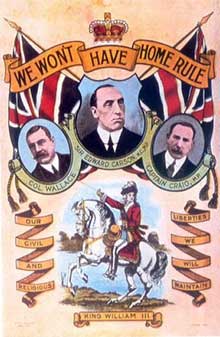
With this newly-acquired authority under his belt, Mr Craig went back to Downing Street and advised Mr George (and anyone else that would listen to him!) that he would not be in favour of the 'subordinate parliament' idea, and a Mr 'Sir' Edward Carson (top pic, on the left, sitting, the 'Attorney General and Solicitor General for England, Wales and Ireland') supported him in saying that, as did a Mr Andrew Bonar Law, a well-got British politician (top pic, on the right, standing and, at that time, the soon-to-be British Prime Minister himself).
"Bonar Law is rampaging. He is seeing red on the subject of Ulster..."
- Mr Neville Chamberlain, who was British PM from May 28th 1937, to May 10th 1940.
Mr Chamberlain also voiced concern that other political 'big wigs' - such as Mr George Nathaniel Curzon, the 'Right Honourable Sir' Laming Worthington-Evans ('Bt GBE' ETC!) and a Mr Stanley Baldwin (another soon-to-be British PM) who were known to be supporters of the Bonar Law fella, would use the opportunity to assist in outing Mr George from office.
"A despairing Llyod George, more depressed than at any time since the conference had begun, finally accepted that Craig would 'not budge an inch'; he told Thomas Jones (British civil servant) to prepare (Arthur) Griffith and (Michael) Collins for the break-up of the conference..."
- Historian Ronan Fanning.
Westminster's main man in the North of Ireland, Mr James Craig, had pulled a quick one on his boss in London!
==========================
ON THIS DATE (5TH NOVEMBER) 51 YEARS AGO : DAY ONE OF 18 YEARS - JUDITH THERESA WARD 'CONVICTED ON ALL COUNTS'.
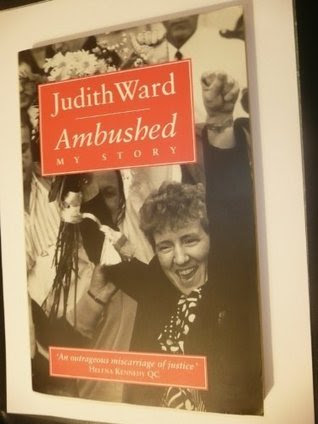
Judith Ward (pictured), an 'IRA activist', was arraigned on the 3rd October 1974 at Wakefield Crown Court, West Yorkshire, England, on an indictment containing 15 counts : Count 1: causing an explosion likely to endanger life or property on the 10th September 1973, at Euston Station, Count 2: a similar count relating to the explosion on the motorcoach on the M62 on the 4th February 1974, Counts 3-14: twelve counts of murder relating to each of the persons killed in the explosion on the motorcoach and Count 15: causing an explosion as before on February 12, 1974, at the National Defence College at Latimer.
She pleaded "not guilty" to all counts but, on the 4th November 1974, she was convicted on all counts, by a majority of ten to two on Count 1 and unanimously on all the others.
She was sentenced to five years' imprisonment on Count 1, 20 years' imprisonment concurrently on Count 2, life imprisonment for the murder Counts 3-14 and to 10 years on Count 15, to be served consecutively to the 20 years on Count 2, making a determinate sentence of 30 years.
It took eighteen years of campaigning to have her conviction quashed, which it was on the 11th May 1992 and it transpired that she had changed her 'confession' several times and that the police and the prosecution selected various parts of each 'confession' to assemble a version which they felt comfortable with!
One of the main pieces of forensic evidence against her was the alleged presence of traces of nitroglycerine on her hands, in her caravan and in her bag. Thin layer chromatography and the Griess test were used to establish the presence of nitroglycerine but later evidence showed that positive results using these methods could be obtained with materials innocently picked up from, for instance, shoe polish, and that several of the forensic scientists involved had either withheld evidence or exaggerated its importance.
Her book, 'Ambushed - My Story' makes for interesting reading and allows the reader to draw comparisons with the injustices suffered by the Maguire Seven, the Birmingham Six and the Guildford Four ; a total of 18 innocent people, including Judith Ward (13 men, 3 women and two children) who, between them, spent a total of 216 years in prison.
Anne Maguire, a mother of 5 children, was menstruating heavily and denied all toiletries for a week, and was beaten senseless and Carol Richardson, who didn't even know she was pregnant, miscarried in Brixton Prison days after her arrest.
Pat O'Neill, who had minutes before entered the Maguires house to arrange for a baby-sitter when the police arrived, was told by a cop to swear that he saw a big cardboard box on Maguires table or else he would be done, but he refused to lie - he served eleven years. On his release, he found his marriage was broken beyond repair and that his six children had left the family home.
How many more Irish children will have to 'leave the family home' before the British eventually give a date for their political and military withdrawal from Ireland, because the situation as it now (and still) exists here is that their very presence continues to be objected to by Irish republicans and continues to give rise to unrest.
And, if our history is to be used as a yardstick, that will always be the case, regardless of where the outsider comes from.
WILLIAM JEFFERSON CLINTON...
Had the electoral rules entitled him to run again for the White House in 2000, few are in any doubt that Bill Clinton would be at this present moment in time relaxing in the Oval House, toying with a fat cuban and possibly smoking a cigar...
From 'Magill' Annual, 2002.
As Beckett once said -
"When you're up to your neck in shit, all you can do is sing..."
And what better blustering tenor to hear emanating from the Park in a few years than that of Wild Bill?
Harangued by unresolved court cases, heavily in debt, at the mercy of continually prying journalists and still smiling, his essential indomitable insouciance could be a lesson to us all in these times of coming hardship.
True, Bill's side of the deal would bring him about the same level of real power as wielded by the average president of an American high school class, but a man of his wiles could easily use the country (sic) to establish a world-wide power base opposed to George Bush's America, and few would be opposed to renaming the Presidential abode something a bit more fiesty, such as 'Kandahar'.
In terms of our next President, 'Magill' suggests William Jefferson Clinton ; if he has taught us anything, it is that anything is possible if you can manage to bend the rules and just keep smiling.
(END of 'William Jefferson Clinton' ; NEXT - 'Unspun : The Stories That Hit The Headlines', from 2002.)
NOVEMBER, 71 YEARS AGO : 'ISSUED BY THE ARMY COUNCIL, ÓGLAIGH NA hÉIREANN, NOVEMBER 1954...'
From 'The United Irishman' newspaper, December 1954.
"The people of Ireland have a decision to make ; let them think well on it, because they will stand at the bar of history to answer for it and let it not be said of this generation that they failed those who once again have hurled defiance at the crumbling ramparts of that imperial and blood-stained power which for so long has kept our country under the iron heel of oppression.
England still holds part of our land by force and, in the eight hundred years of occupation, never once has she given the slightest measure of amelioration except under force or the threat of force.
The dispassionate logical conclusion to be drawn from the history of the two countries is that Ireland can only achieve unity and freedom when the whole people of Ireland tell the British Army to get out or be driven out..."
Today, British politicians continue to claim jurisdictional control over six Irish counties and they militarily enforce that control. There are an acknowledged ('officially admitted') 1,830 British military personnel in that part of Ireland ('1,740 BA, 80 RAF, 10 'Royal' Navy') and then there are the other intruders, armed with knives and machetes.
They, too, need to be removed...
On the 5th November, 1922, the newspapers covered an FSA attack the previous day in which the IRA Commandant of the Northern, Eastern and Western Commands (and the Assistant Chief of Staff of the Republican Army), Earnán Ó Máille (Ernest Bernard Malley, pictured), was in his temporary Headquarters in Ailesbury Road in Dublin (Sighle Humphreys's home) when armed Free Staters broke down the door and rushed in.
A gunfight ensued, during which Commandant Ó Máille was seriously wounded, as was M/s Eileen Flanagan, the housekeeper, and a Stater soldier, a Mr Peter McCartney (from County Leitrim) was shot dead.
Commandant Ó Máille was 'arrested' by the Staters, and taken prisoner.
Within weeks he undertook a hunger-strike (which he endured for forty-one days) and, in July 1924, was the last POW to be released from internment, in very poor health.
He went to Europe and then North Africa to gather his strength and returned to Ireland after two years, tried to take up from where he left off in his medical studies but for various reasons couldn't do so, went to America to meet exiled Irish republicans for discussions about launching a pro-Irish newspaper, a fund-raising venture which also took him to Mexico.
Nothing came of the newspaper attempt, but he did begin to write about his experiences in the war in Ireland, returned home and, on the 27th September, 1935, in London, married his sweetheart, Helen Huntington Hooker (pictured).
Commandant Ernie O'Malley died, at 59 years of age, in Howth, County Dublin, on the 25th March, 1957.
RIP Volunteer Earnán Ó Máille.
On the same date that the newspapers reported on the IRA HQ raid (5th November 1922), about 165km (105 miles) up the road in Belfast, a Mr 'Sir' Richard Dawson Bates ('1st Baronet OBE PC JP DL' ETC ETC!), the Stormont 'Minister of Home Affairs', acknowledged to himself and to his political crony buddies that the sectarian nature of their Six-County 'Statelet' needed a gloss of white-washing.
He issued internment orders against four 'Ulster Protestant Association' (UPA) anti-republican paramilitaries in Belfast and, in the following six weeks, another 12 'UPA' members had been interned and still others jailed for firearm offences.
However, his placed cloak didn't cover all the misdeeds of the failed political entity he sought to control -
"There can be no denying that this (temporary removal of the UPA threat) could have been achieved earlier and lives saved had the Stormont government been willing to use its powers as fully against loyalists as it did against nationalists..."
- author Patrick Buckland.
No matter how you try to dress-up a rotten tooth, it's still a rotten tooth...
As Master Bates (!) was showing his cloak to the media, Volunteers attached to the No. 4 Brigade of the 3rd Western Division of the IRA, acting under orders from their Commanding Officer, Volunteer Francis Joseph Carty (a republican gamekeeper-turned-Free State-poacher), were approaching two men in the village of Tubbercurry, in the county of Sligo.
Those two men were shot dead.
Four days previous to those shootings, eight Volunteers from that IRA Division had been 'arrested' by the Staters, on foot of information supplied to them by those two men.
IRA Chief of Staff, Volunteer Liam Lynch, heard of the shootings and issued an order that the IRA Officers responsible for that operation should be suspended from operational duties, as they were in direct contravention of IRA General Order No.6, which stipulated that those accused of spying will be tried in an IRA court, not shot dead without trial.
The COS order was issued and received...but not enforced.
As the two spies were falling to the ground in Sligo, about 240km (150 miles) down the country in Kilkenny, an IRA POW, Volunteer Robert Kenny (mentioned here), was escaping from Kilkenny Jail, rumoured later to have done so with the assistance of an FSA sentry, proving that not all spies are bad...
==========================
DEATH IN THE MEDITERRANEAN...
Desmond Boomer, a Belfast engineer working in the Libyan oil-fields, disappeared seven years ago.
Officially, the plane on which he was a passenger crashed as a result of mechanical failure and pilot error.
But is that the real story?
Or were the Irishman and his fellow passengers unwitting victims of the shady war between Islamic fundamentalism and Mossad, Israel's intelligence network?
A special 'Magill' investigation by Don Mullan, author of 'Eyewitness Bloody Sunday'.
From 'Magill' magazine, January 2003.
The Tunisian report states that at 3.58am Captain Bartolo told Djerba ATC that his estimated time of arrival at the Maltese boundary would be 4.10am and that following this communication all efforts to contact the Captain failed, but it is claimed that, at 4.10am, "the Djerba controller switches onto emergency equipment and calls aircraft 9H-ABU."
The Tunisian report states that the pilot relayed the position of the aircraft and acknowledged Djerba ATC's request to contact Maltese Control.
Presumably, by then, with a depleted battery, Captain Bartolo would have realised he was in very serious trouble, but the Tunisian report clearly states "the pilot had not indicated any anomalies during his flight in Tunisian airspace..."
(MORE LATER.)
On the 5th November, 1924, newspapers in the State announced that, the previous day, the Leinster House administration "had declared an amnesty by discontinuing criminal proceedings for crimes committed during the Civil War* (*the war in defence of the All-Ireland Republic, June 1922 - May 1923 ; 'officially', that is...)..."
The (on-going) republican struggle was not then, and is not now, a "criminal proceeding", nor is it a "crime" to fight for an Ireland for the Irish!
The historian William Kissane greeted the Leinster House declaration by stating that it "marked the real end of the Irish civil war..." ; as we said above - 'officially', that is...
On the same day that those newspapers assisted Stater politicians in demeaning the republican struggle, other politicians, local to the area, in Naas No. 1 Rural District Council, discussed and passed a motion expressing sympathy to the parents and relatives of seven IRA Volunteers who were executed by Leinster House operatives in 1922 and who were re-interred, in 1924, in Grey Abbey Graveyard in Kildare.
Those local politicians also condemned "the disrespectful attitude of the Free State military at the graveside..."
The seven executed Volunteers were placed (dumped) in holes in the ground in the Curragh Detention Barracks "after being found guilty of various acts against the State during the Irish Civil War..." : in 1924, their remains were exhumed, placed in state, and were re-buried in Grey Abbey with a new gravestone erected over their graves.
RIP Commandant Brian Moore, Volunteer Patrick Nolan, Volunteer Patrick Mangan, Volunteer Patrick Bagnall, Volunteer Jackie Johnston, Volunteer Stephen White and Volunteer James O'Connor (who was later re-interred in his native Tipperary).
==========================
ON THIS DATE (5TH NOVEMBER) 376 YEARS AGO : LAST DAY ALIVE ON EARTH FOR A BRAVE IRISH REBEL...
Eoghan Ruadh O’Neill : "We thought you would not die, we were sure you would not go, and leave us in our utmost need to Cromwell’s cruel blow..."
Eoghan Ruadh O'Neill (Owen Roe O'Neill), a seventeenth-century Irish soldier, son of Art O'Neill and younger brother of Hugh O'Neill, died on 6th November 1649 in Cloughoughter Castle in County Cavan, at the age of 59.
His mother was born into the O'Raghallaigh clan in that county.
Eoghan Ruadh was considered by Charles I of England to be a loyal subject and soldier but, at 37 years of age, he petitioned the Spanish monarchy to invade Ireland and called for Ireland to be placed under Spanish protection, but nothing came of his endeavours.
However, he maintained his opposition to the English presence in Ireland and, in 1642, at the age of 52, he arrived back in Ireland with 300 soldiers to play his part in the Rising that was then one year old.
He sought to overturn the 'Ulster Plantation' and return the lands to those that had been evicted by the English.
In August 1649, Oliver Cromwell landed in Ireland, supported by at least 20,000 armed men, prompting O'Neill to join forces with the Earl of Ormond to fight for Irish ways but O'Neill died shortly afterwards, apparently poisoned.
Thomas Davis wrote the following Lament for Eoghan Ruadh O'Neill :
Did they dare, did they dare, to slay Eoghan Ruadh O’Neill?
Yes, they slew with poison him they feared to meet with steel.
May God wither up their hearts! May their blood cease to flow,
May they walk in living death, who poisoned Eoghan Ruadh.
Though it break my heart to hear, say again the bitter words.
From Derry, against Cromwell, he marched to measure swords:
But the weapon of the Sassanach met him on his way.
And he died at Cloch Uachtar, upon St. Leonard’s day.
Wail, wail ye for the Mighty One. Wail, wail ye for the Dead,
Quench the hearth, and hold the breath—with ashes strew the head.
How tenderly we loved him. How deeply we deplore!
Holy Saviour! but to think we shall never see him more!
Sagest in the council was he, kindest in the hall,
Sure we never won a battle—’twas Eoghan won them all.
Had he lived—had he lived—our dear country had been free:
But he’s dead, but he’s dead, and ’tis slaves we’ll ever be.
O’Farrell and Clanricarde, Preston and Red Hugh,
Audley and MacMahon—ye valiant, wise and true:
But—what are ye all to our darling who is gone?
The Rudder of our Ship was he, our Castle’s corner stone.
Wail, wail him through the Island! Weep, weep for our pride!
Would that on the battlefield our gallant chief had died!
Weep the Victor of Beinn Burb—weep him, young and old:
Weep for him, ye women—your beautiful lies cold!
We thought you would not die—we were sure you would not go,
And leave us in our utmost need to Cromwell’s cruel blow—
Sheep without a shepherd, when the snow shuts out the sky—
O! why did you leave us, Eoghan? Why did you die?
Soft as woman’s was your voice, O’Neill! bright was your eye,
O! why did you leave us, Eoghan? Why did you die?
Your troubles are all over, you’re at rest with God on high,
But we’re slaves, and we’re orphans, Eoghan! — why did you die?
It is from that spirit that traditional Irish republicans take heart - knowing that even though we have lost 'fights' in the past, the 'battle' itself is not yet over...
Thanks for the visit, and for reading - appreciated.
Sharon and the team.
(We'll be back on Wednesday, 19th November, 2025.)
ON THIS DATE (24TH SEPTEMBER) 227 YEARS AGO..."HE DRAWS ANOTHER PISTOL AND SHOOTS THE GUNNER..."
"....suddenly Bartholomew Teeling broke from the Franco-Irish forces and charged forward on his horse.
One may imagine the scene: the British at first watch incredulously, then a scattered fire of muskets. Teeling is unharmed, galloping onwards. The British sharpshooter by the cannon coolly takes aim. Teeling eyes him and suddenly swerves his horse ; the shot goes past him.
The sharpshooter curses and reloads. Another ragged volley from the infantry and again they miss...the French and the Irish are cheering but they can’t believe he will make it. Teeling’s horse leaps a ditch and gallops on past the infantry, foam flying from the animal's body – the sharpshooter looks up at him, loses his nerve and fumbles the charging of his musket.
Teeling is up at the gun, he has drawn his pistol and shoots the sharpshooter dead. He draws another pistol and shoots the gunner.
The Irish and French are ecstatic and charge forward. The British are stunned ; some stand but most of the British infantry flee from the superior numbers and leave the cannon in the hands of the insurrectionist forces, as well as 60 dead and 100 taken prisoner..."
(from here.)
Another author wrote, re the above scene, which took place at the Battle of Collooney - "...this was the turning point of the battle. The troops despatched from Knockbeg had reached Beal Ban and were already rushing down on the British flank. The other column was advancing at a rapid pace against the front.
There was no safety for Verecker from this double danger, except in retreat ; and as the Ballysadare road was no longer practicable, he ordered his men to cross the river and make for Sligo..."
Bartholomew Teeling (pictured, above) was only 24 years of age when he was captured at the Battle of Ballinamuck, Longford, as were another 500 or so Irish and French fighters. The French soldiers were treated as POW's but the Irish soldiers were executed - Teeling was hanged by the British on the 24th September 1798 at Provost Prison in Arbour Hill, Dublin, before his body was thrown into the 'Croppy Pit'.
He attempted to read the following statement from the scaffold, but was not permitted by the 'authorities' to do so :
"Fellow-citizens, I have been condemned by a military tribunal to suffer what they call an ignominious death, but what appears, from the number of its illustrious victims, to be glorious in the highest degree.
It is not in the power of men to abase virtue nor the man who dies for it. His death must be glorious in the field of battle or on the scaffold.
The same Tribunal which has condemned me — citizens, I do not speak to you here of the constitutional right of such a Tribunal — has stamped me a traitor.
If to have been active in endeavouring to put a stop to the blood-thirsty policy of an oppressive Government has been treason, I am guilty. If to have endeavoured to give my native country a place among the nations of the earth was treason, then I am guilty indeed. If to have been active in endeavouring to remove the fangs of oppression from the head of the devoted Irish peasant was treason, I am guilty.
Finally, if to have striven to make my fellow-men love each other was guilt, then I am guilty.
You, my countrymen, may perhaps one day be able to tell whether these were the acts of a traitor or deserved death. My own heart tells me they were not and, conscious of my innocence, I would not change my present situation for that of the highest of my enemies.
Fellow-citizens, I leave you with the heartfelt satisfaction of having kept my oath as a United Irishman, and also with the glorious prospect of the success of the cause in which we have been engaged.
Persevere, my beloved countrymen.
Your cause is the cause of Truth.
It must and will ultimately triumph."
RIP Bartholomew Teeling, Irish Rebel, 1774-1798.
"You cannot in the existing state in Ireland punish a policeman (sic) who shoots a man whom he has every reason to suspect is concerned in police murders.
That kind of thing (ie shooting an RIC member) can only be met by reprisals..."
- the words of a Mr David Lloyd George ('1st Earl Lloyd-George of Dwyfor' etc!), the British Prime Minister at the time, as recounted (on the 24th September 1920) by a colleague of his, a Mr Herbert Albert Laurens Fisher (pictured), an MP for the constituency of Sheffield Hallam and, at that time, the President of the British Board of Education.
In effect, that would be a 'licence to kill' - to shoot dead anyone who 'looks suspect'!
On the same date that Mr Fisher was fondly recounting the words of Mr George, a Mr Henry Owens (30, 'Service Number 4180426'), a soldier in the British Army's 'Royal Welch Fusiliers', was in a military barracks ('New Barracks') in Limerick, when he was shot, dying shortly afterwards from the wound.
The shooting was said to have been carried out, 'accidentally', by one of his own comrades.
==========================
GAS LADS...
The massive finds of oil and gas on our western seaboard could ensure Ireland's financial security for generations.
Wealth approximating that of the Arab countries is within our grasp, but the Irish government seems content to sell off our birthright for a handful of votes and a few dollars.
In a special 'Magill' report, Sandra Mara investigates just what we are giving away, and why.
From 'Magill' magazine, March 2002.
However, 'Enterprise Oil' refused to meet with SIPTU and there followed a series of peaceful protests by Irish rig-workers.
The company then moved operations to Ayr on the west coast of Scotland and outsourced the bulk of its goods and services requirements.
For its part, the company says it has no objection to hiring Irish rig-workers ; "absolutely not.." spokesperson Pat Keating told 'Magill' magazine, "...my understanding of the issue is that rigs come in on contract for two, three or five months, and have specialist work forces which come with them.
You can't just send anybody out on a rig ; it would be a delight to have Irish workers, but there's not enough specialist Irish staff out there. So that issue really is a red herring..."
As for Ray Burke's rather generous terms, Pat Keating says they would have had little impact on Enterprise Oil's decision to drill here...
(MORE LATER.)
ON THIS DATE (24TH SEPTEMBER) 108 YEARS AGO : BRITISH PLANS FINALISED TO FORCE-FEED AN IRISH HUNGER-STRIKER.
"You cannot put a rope around the neck of an idea...you cannot confine it in the strongest prison cell that your slaves could ever build.." - the words of Séan O'Casey, in relation to the murder of Thomas Ashe.
The funeral procession in Dublin, 30th September 1917 (pictured), for Thomas Ashe, an IRB leader, who died on the 25th September that year, after being force fed by his British jailers.
He was the first Irish republican to die as a result of a hunger-strike and, between that year and 1981, twenty-one other Irish republicans died on hunger-strike.
The jury at the inquest into his death found "..that the deceased, Thomas Ashe, according to the medical evidence of Professor McWeeney, Sir Arthur Chance, and Sir Thomas Myles, died from heart failure and congestion of the lungs on the 25th September, 1917 and that his death was caused by the punishment of taking away from the cell bed, bedding and boots and allowing him to be on the cold floor for 50 hours, and then subjecting him to forcible feeding in his weak condition after hunger-striking for five or six days.."
Michael Collins organised the funeral and transformed it into a national demonstration against British misrule in Ireland ; armed 'Irish Republican Brotherhood' Volunteers in full uniform flanked the coffin, followed by 9,000 other IRB Volunteers, and approximately 30,000 people lined the streets.
A volley of shots was fired over Ashe's grave, following which Michael Collins stated - "Nothing more remains to be said. That volley which we have just heard is the only speech which it is proper to make over the grave of a dead Fenian."
The London-based 'Daily Express' newspaper perhaps summed it up best when it stated, re the funeral of Thomas Ashe, that what had happened had made '100,000 Sinn Féiners out of 100,000 constitutional nationalists.'
The level of support shown gave a boost to Irish republicans, and this was noted by the 'establishment' in Westminster - 'The Daily Mail' newspaper claimed that, a month earlier, Sinn Féin, despite its electoral successes, had been a waning force. That newspaper said -
'..It had no practical programme, for the programme of going further than anyone else cannot be so described. It was not making headway. But Sinn Féin today is pretty nearly another name for the vast bulk of youth in Ireland...'
Thomas Patrick Ashe’s activities and interests included cultural and physical force nationalism as well as trade unionism and socialism. He also commanded the 5th Battalion of the Dublin Brigade Volunteers who won the Battle of Ashbourne on the 29th of April 1916. Born in Lispole, County Kerry on the 12th of January 1885, he was the seventh of ten siblings.
He qualified as a teacher in 1905 at De La Salle College, Waterford and, after teaching briefly in Kinnard, County Kerry, in 1906 he became principal of Corduff National School in Lusk, County Dublin.
Thomas Ashe was a fluent Irish speaker and a member of the Keating branch of the Gaelic League and was an accomplished sportsman and musician setting up the Roundtowers GAA Club as well as helping to establish the Lusk Pipe Band (pictured). He was also a talented singer and poet who was committed to Conradh na Gaeilge.
Politically, he was a member of the 'Irish Republican Brotherhood' (IRB) and established IRB circles in Dublin and Kerry and eventually became President of the IRB Supreme Council in 1917. While he was actively and intellectually nationalist he was also inspired by contemporary socialism. Ashe rejected conservative Home Rule politicians and as part of that rejection he espoused the Labour policies of James Larkin.
Writing in a letter to his brother Gregory he said "We are all here on Larkin's side. He'll beat hell out of the snobbish, mean, seoinín employers yet, and more power to him".
Ashe supported the unionisation of north Dublin farm labourers and his activities brought him into conflict with landowners such as Thomas Kettle in 1912. During the infamous lockout in 1913 he was a frequent visitor to Liberty Hall and become a friend of James Connolly.
Long prior to its publication in 1916, Thomas Ashe was a practitioner of Connolly’s dictum that "the cause of labour is the cause of Ireland, the cause of Ireland is the cause of labour". In 1914 Ashe travelled to the United States where he raised a substantial sum of money for both the Gaelic League and the newly formed Irish Volunteers of which he was an early member.
He founded the Volunteers in Lusk and established a firm foundation of practical and theoretical military training, and provided charismatic leadership first as Adjutant and then as O/C (Officer Commanding) the 5th Battalion of the Dublin Brigade.
He inspired fierce loyalty and encouraged personal initiative in his junior officers and was therefore able to confidently delegate command to Charlie Weston, Joseph Lawless, Edward Rooney and others during the Rising. Most significantly, he took advantage of the arrival of Richard Mulcahy at Finglas Glen on the Tuesday of the Rising and appointed him second in command.
The two men knew one another through the IRB and Gaelic League and Ashe recognized Mulcahy’s tactical abilities. As a result Ashe allowed himself to be persuaded by Mulcahy not to withdraw following the unexpected arrival of the motorised force at the Rath crossroads. At Ashbourne on the 28th of April Ashe also demonstrated great personal courage, first exposing himself to fire while calling on the RIC in the fortified barracks to surrender and then actively leading his Volunteers against the RIC during the Battle.
After the 1916 Rising he was court-martialled (on the 8th of May 1916) and was sentenced to death. The sentence was commuted to penal servitude for life.
He was incarcerated in a variety of English prisons before being released in the June 1917 general amnesty, immediately returned to Ireland, toured the country reorganising the IRB and incited civil opposition to British rule.
In August 1917, after a speech in Ballinalee, County Longford, he was arrested by the RIC and charged with "speeches calculated to cause disaffection".
He was detained in the Curragh camp and later sentenced to a year's hard labour in Mountjoy Jail. There he became O/C of the Volunteer prisoners, and demanded prisoner-of-war status and, as a result, he was punished by the Governor.
He went on hunger strike on the 20th September 1917 and five days later died as a result of force-feeding by the prison authorities ; he was just 32 years of age.
The death of Thomas Ashe resulted in POW status being conceded to the Volunteer prisoners two days later.
Thomas Ashe's funeral was the first public funeral after the Rising and provided a focal point for public disaffection with British rule. His body lay in state in Dublin City Hall before being escorted by armed Volunteers to Glasnevin Cemetery ; 30,000 people attended the burial where three volleys were fired over the grave (pictured) and the Last Post was sounded.
While imprisoned in Lewes Jail in 1916, Thomas Ashe had written his poem 'Let Me Carry Your Cross for Ireland, Lord' which later provided the inspiration for the Battle of Ashbourne memorial unveiled by Sean T. O'Kelly on Easter Sunday, 26th April 1959 at the Rath Cross in Ashbourne :
Let me carry your Cross for Ireland, Lord
The hour of her trial draws near,
And the pangs and the pains of the sacrifice
May be borne by comrades dear.
But, Lord, take me from the offering throng,
There are many far less prepared,
Through anxious and all as they are to die
That Ireland may be spared.
Let me carry your Cross for Ireland, Lord
My cares in this world are few,
and few are the tears will for me fall
When I go on my way to You.
Spare Oh! Spare to their loved ones dear
The brother and son and sire,
That the cause we love may never die
In the land of our Heart's desire!
Let me carry your Cross for Ireland, Lord!
Let me suffer the pain and shame
I bow my head to their rage and hate,
And I take on myself the blame.
Let them do with my body whate'er they will,
My spirit I offer to You,
That the faithful few who heard her call
May be spared to Roisin Dubh.
Let me carry your Cross for Ireland, Lord!
For Ireland weak with tears,
For the aged man of the clouded brow,
And the child of tender years;
For the empty homes of her golden plains,
For the hopes of her future, Too!
Let me carry your Cross for Ireland, Lord!
For the cause of Roisin Dubh.
RIP Volunteer Thomas Ashe, 12th January 1885 – 25th September 1917.
ON THIS DATE (24TH SEPTEMBER) 49 YEARS AGO : "A THUNDERING DISGRACE" COMMENT MADE PUBLIC.
Ireland, 1970's : turmoil in the country, due to the then-as-now unwanted political and military interference here by Westminster.
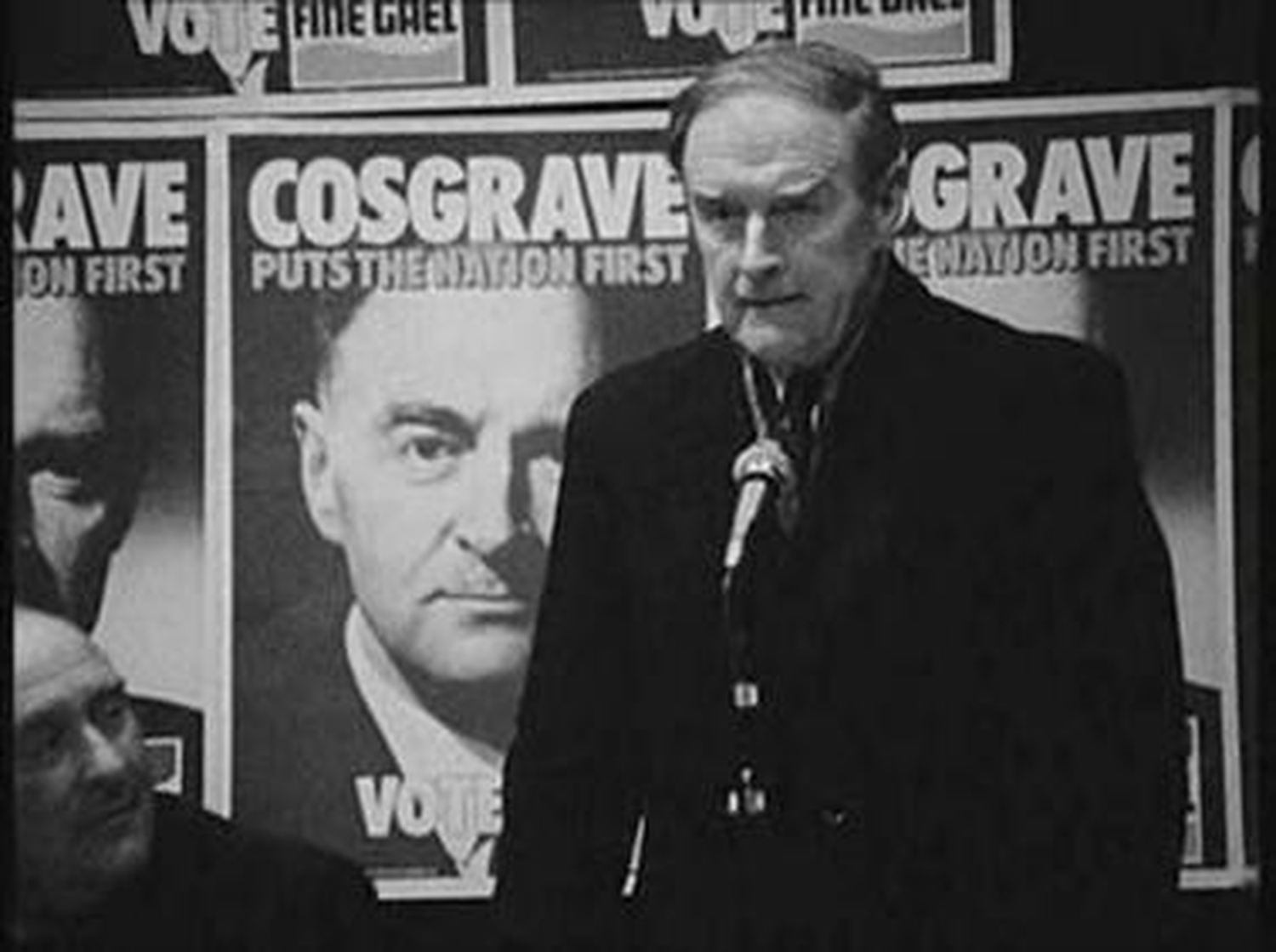
The Leinster House administration was headed-up at the time by Fine Gael's Liam Cosgrave , and among the many harsh laws introduced, enforced and 'improved on' by the Blueshirts was a censorship act, 'Section 31'.
The then Free State President was a Fianna Fail man, Cearbhall Ó Dálaigh , said to be a compromise candidate by the powers-that-be at the time, as he fitted the requirements dictated by the 'establishment' (ie 'a safe pair of hands').
He was previously the Free State Attorney General and Chief Justice of the FS Supreme Court, and was given the Office, unopposed, in 1974, following the death of Erskine Hamilton Childers.
But it was that legal training which raised a red flag with him in relation to a piece of legislation which the Blueshirt Leinster House administration wanted him to 'rubber stamp' - the 'Emergency Powers Act', and the fact that Ó Dálaigh and Cosgrave didn't agree with each other, socially or politically, came into play : Ó Dálaigh refused to simply 'sign off' on the 'EPA' without first testing its constitutionally.
On the 24th of September, 1976 - 49 years ago on this date - it became known that Mr Ó Dálaigh had spent four hours the day before consulting with a bunch of posh suits known as the Free State 'Council of State' on whether or not it would be best practice to refer the legislation to the Free State Supreme Court to test its constitutionality before he could declare it to be 'the law' and it was decided that that would be the best thing to do, a decision which annoyed the Blueshirt administration.
Just over three weeks later (ie on the 15th October 1976) the FS Supreme Court declared that the 'EPA' was a legitimate piece of legislation and it was only then that Ó Dálaigh deemed it necessary to sign-off on it, which he did, reluctantly (or so it was claimed at the time) but that 'victory' wasn't enough for Cosgrave and his people - they considered themselves to have been disrespected by the actions of Mr Ó Dálaigh and, three days later (ie on the 18th October 1976), they could contain themselves no longer.
It was on that date that the Free State Minister of Defence, Paddy Donegan, was opening a new Free State army barracks in Mullingar, County Westmeath (having, seemingly, forgot that Mr Ó Dálaigh was the Commander-In-Chief of said army!) that he made a remark (he was concussed at the time, he later claimed!) which was to haunt him for the rest of his life.
He had 'kicked himself up the transom', if you like, which wouldn't have caused as much damage as firing a shotgun over dwellings in which people lived - more about that 'eccentric' (!) Free State politician can be read here...
On the 24th September, 1921, during a speech he delivered in Dundee in Scotland, a Mr Winston Leonard Spencer Churchill (pictured), British PM, stated that if the Treaty (of Surrender) was not accepted by the Irish...
"..our course would be very unpleasant, but it would also be very simple.
Not peace, but certain war ; real war, not mere bushranging, would follow such a course..."
Later in that speech, Mr Churchill admitted that one of the main reasons why the British needed an end to their terror campaign in Ireland was because "it would remove the greatest obstacle which has ever existed to Anglo-American unity.." ie trade, business, money : slaughtering the Irish was not a good business card to approach the Americans with...
...meanwhile, on that same date, the IRA were doing some approach work themselves, in connection with that same subject - the (Treaty) Truce - which had come into effect on Monday, July 11th 1921, to allow for negotiations between both sides.
The Officer Commanding of the West Limerick Brigade approached the Battalion Commanders in his operational area and instructed them that, as the Truce talks were winding-up, they should advise their fighters to be ready for battle as the outcome of the talks may demand it.
While IRA fighters in Limerick (and other areas in the country) were being briefed by their officers, rioting broke out about 200 miles/320 km up the road in Belfast.
British loyalists, disgusted that 'their side might be about to loose ground to Irish republicans', behaved as expected - they rioted.
A gang of them met up and proceeded to the Short Strand and Newtownards Road area of the city but they met resistance on the way and there and, in the ensuing street fight, two of their number (both aged 19) - James McMinn, from Reid's Place, and Alexander Harrison, from Frazer Street - died when a bomb was thrown at the gang, and about 20 of their colleagues were injured.
==========================
CASH NO EXCUSE FOR RTE PUTTING DOCUMENTARY TO DEATH...
It has been a disastrous 12 months for RTE.
£23.5 million in cutbacks, a bid to increase the licence fee rejected, an enforced postponement of digital expansion, and a predicted £20 million loss to report for 2001.
By Belinda McKeon .
From 'Magill' Annual, 2002.
RTE should remember that its audience has always come through for it when it has taken intelligent risks with programming - it should have faith in that audience, it should have faith in its independent programmers, and it should have faith in itself.
Because, ultimately, it is for itself that the station needs to move forward, not for a minister and her pack of accountants.
(END of 'Cash No Excuse For RTE Putting Documentary To Death' : NEXT - 'William Jefferson Clinton', from the same source.)
"We consider it imperative that some sort of Government, whether a Provisional or a Republican or a military one, should be inaugurated at once..."
- the words written by Volunteer leader Ernie O'Malley (pictured, aka 'B. Stuart'), in a letter he sent, on the 24th September, 1922, to Volunteer leader Liam Lynch.
At that time, the IRA had launched a 'September Offensive' and was attacking Free State forces as opposed to simply defending themselves from FSA attacks on them, and the rebels had success enough to worry the Stater politicians to the point that they introduced, that same month, a death penalty for IRA members.
Perhaps their colleagues in Westminster were paying them a bounty on each ex-comrade they executed...?
As Volunteer Lynch was reading that letter, an IRA Active Service Unit had opened fire on a FSA guard post in Glendalough, in County Wicklow, and was getting the upper hand when the fight was interrupted by the arrival of a 50-strong FSA patrol.
The IRA ASU was now outnumbered and outgunned, and was forced to retreat, with two Volunteers wounded and three captured.
And, on that same date (the 24th), an already captured IRA fighter, Volunteer Patrick Mangan (age 20, Third Battalion of the Cork No. 2 Brigade), from the village of Carrignagower, near Lismore, in County Waterford, was shot by a FSA sentry during a disturbance in Cork Jail.
The IRA POW'S (numbering about 400 Volunteers) refused to return to their cells from the recreation yard and, after being forced to move inside the prison by FSA soldiers/prison guards using their rifle butts, the prisoners rioted in the corridors.
Shots were fired over their heads which dispersed some of the POW's and, when a second round was fired at them, Volunteer Mangan fell to the ground, wounded. He died from that wound the next day.
Attempting to explain and excuse their actions, the Staters put out a statement -
"One party of prisoners, amongst whom was the deceased, still remained on the corridors, shouting and defiant. The sentry was again ordered to fire, and Mangan fell wounded..."
Volunteer Mangan died the following day from the wound.
The Staters held a 'Military Inquiry' (!) into the shooting and issued the following statement afterwards -
"Patrick Mangan met his death as the result of a shot fired by a sentry in the execution of his duty, and the officer who gave the order to fire was justified, as the prisoners had sufficient warnings and ample time to comply with the order to return to their cells..."
Volunteer Patrick Mangan, from the village of Carrignagower, near Lismore, in County Waterford, was attached to the Third Battalion of the Cork No. 2 Brigade, and operated mostly as as a dispatach rider. He was captured by the Staters in Fermoy, County Cork, in August 1922 and imprisoned in Cork Jail.
He is buried in Lismore Old Cemetery in County Cork, and is named on the IRA memorial in Kilcrumper Cemetery in that town.
RIP Volunteer Patrick Mangan.
On that same Sunday (24th September 1922), a pastoral letter from the RC Bishop of Cork, a Mr Daniel Coughlan, was read out at all Masses in the diocese, in which Mr Coughlan stated that "the killing of National (sic) soldiers is murder...", and went on to state that any person taking part in an ambush in which British soldiers were injured, held as hostages, or killed ("murdered", he called it) would be promptly excommunicated by the Catholic Church!
Mr Coughlan, or Cohalan, which he preferred, was known for his loyalty to the Crown and was also known - among the public - as 'Danny Boy', a reference to his pro-British leanings.
Just another quisling in a long line of quislings.
==========================
DEATH IN THE MEDITERRANEAN...
Desmond Boomer, a Belfast engineer working in the Libyan oil-fields, disappeared seven years ago.
Officially, the plane on which he was a passenger crashed as a result of mechanical failure and pilot error.
But is that the real story?
Or were the Irishman and his fellow passengers unwitting victims of the shady war between Islamic fundamentalism and Mossad, Israel's intelligence network?
A special 'Magill' investigation by Don Mullan, author of 'Eyewitness Bloody Sunday'.
From 'Magill' magazine, January 2003.
Cormac Boomer, an engineer by profession, told 'Magill' magazine -
"On the 16th May, 1997, I examined and photographed the alleged wreckage.
It is obviouse the condition of it was not compatible with having spent ten months in the salt brine of the Mediterranean.
There was no indication of salt pigment or the corrosion one would expect to find in such circumstances.
It is claimed the aircraft fell from a height of 9,000 feet into the sea in a severe storm but it is strange, therefore, that the cable looms do not show any indication of the stretch, arc or rupture one would expect from the ripping-apart which would occur in an aircraft descending in a headlong plunge.
From my visual inspection and the photographic evidence it is obvious the ends of those cables have been severed with a cutting tool..."
(MORE LATER.)
ON THIS DATE (24TH SEPTEMBER) 42 YEARS AGO - IRA H-BLOCK PRISON ESCAPE PLAN FINALISED BY IRA POW'S.
THE LONG KESH ESCAPE - SUNDAY 25th SEPTEMBER 1983. From 'IRIS' magazine, November 1983.
"We perceived the escape as a military operation from beginning to end. It could not have been achieved in any other way, and the ASU - as Volunteers in the Irish Republican Army - were under strict orders throughout from an Operations Officer whose judgement was crucial and whose every order had to be obeyed.
Every Volunteer was under a tight brief.." - IRA statement.
It was this precision of planning, exclusively revealed in a detailed interview by key ASU personnel involved, that lay behind the almost incredible escape of 38 Republicans on Sunday 25th September 1983 from what is generally believed to be the most secure prison in Western Europe - the H-Blocks of Long Kesh (near Lisburn, South Belfast).
At 2.15pm that day, three IRA Volunteers carrying concealed pistols fitted with silencers, which had been smuggled into the prison, moved into the 'Central Administration' area (the 'Circle') of H7-Block on the pretext of cleaning out a store. Fifteen minutes later they were joined by a fourth armed Volunteer ; control of the 'Circle', with its numerous alarm bells, was vital for the escape's success and had to be carried out simultaneously with the overpowering of prison Screws in the four wings of H7-Block.
Minutes later three other Volunteers - armed with pistols, hammers or chisels - took up key positions near Screws positioned by alarm buttons, on the pretext of carrying out orderly duties, while Brendan 'Bic' McFarlane (the H-Block Officer Commanding during the hunger-strike) was allowed through two locked grilles into the hall of the Block on cleaning duties - his job was to arrest the Screw there and, on a given signal - once everyone was in position - IRA Volunteers overpowered and arrested all the prison Screws in the Block, many of the Volunteers subsequently changing into their uniforms.
During the seizure of control one Screw - on duty in a locked control room - was shot twice in the head when he ignored orders to lie on the floor and instead made a lunge for the alarm. Control of the Block was completed when 'Bic' McFarlane, accompanied by two IRA Volunteers dressed as Screws, arrested the Screw on duty in the front gate enclosure. It was now about 2.45pm.
Some time later the food lorry bringing evening meals to H7 (pictured) arrived ; 37 IRA Volunteers climbed into the back while another lay on the floor of the cab holding a gun on the Screw driving the lorry. The lorry then drove through a series of 'security gates' in the Long Kesh complex manned by unsuspecting Screws and in full view of armed British sentry posts.
It eventually arrived at a 'tally hut' close to a back gate of the prison camp ; the plan was to arrest the Screws in the 'tally hut' and, leaving five Volunteers in control, drive the food lorry a further quarter mile to the front gate 'tally hut' which the escapees would then take control of, leaving two Volunteers there, before driving out in the food lorry to freedom.
Meanwhile, the five Volunteers in the first 'tally hut' would obtain a Screw's car from the adjoining car park, drive to the front gate where the two Volunteers in control there would clamber into the boot, and also make their escape. That was the plan of escape ; unfortunately, it was not to be - the plan of escape began to go wrong at the first 'tally-hut' due to there being larger numbers of Screws coming on duty than anticipated.
While the escapees kept arresting more and more Screws, the situation got out of control and the alarm was raised.
At this point the escapees were forced to make a run for it on foot across fields, many of them successfully commandeering local cars. In the final melee several Screws were stabbed and one escapee, Harry Murray (pictured), was shot and wounded.
It was inevitable, given the eventual breakdown of the plan, that there would be some re-arrests, some within minutes and some within two days of the break-out. Nonetheless, the massive total of 19 Republican prisoners of war did successfully escape and eventually reach freedom - to the massive embarrassment of the British and the jubilation of Nationalists throughout the 32 Counties !
The 19 H-Block escapees that were then at liberty are - Kevin Barry Artt, (24) North Belfast ; Paul Brennan (30) Ballymurphy ; Seamus Campbell (26) Coalisland, County Tyrone ; James Clarke (27) Letterkenny, County Donegal ; Seamus Clarke (27) Ardoyne ; Gerard Fryer (24) Turf Lodge ; Dermot Finucane (22) Lenadoon ; Kieran Fleming (23) Derry ; Anthony Kelly (22) Derry ; Gerry Kelly (30) Belfast ; Anthony McAllister (25) Belfast ; Gerard McDonnell (32) Belfast ; Seamus McElwair (22) Scotstown, County Monaghan ; Brendan McFarane (31) Ardoyne ; Padraic McKearney (29) Moy, County Tyrone ; Dermot McNally (26) Lurgantarry, North Armagh ; Robert Russell (25) Ballymurphy ; Terence Kirby (27) Andersonstown and James Smith (38) Ardoyne.
Thanks for the visit, and for reading - appreciated, especially (because we're greedy!) as we're trying to get to 3 million hits (...did ya notice that we now have over two million hits..?!).
Sure we're never bleedin' happy...!
Sharon and the team.
(We'll be back on Wednesday, 8th October, 2025.)