ON THIS DATE (2ND AUGUST) 101 YEARS AGO : DEATH OF "AN INFLUENTIAL AND FORMIDABLE" IRISH REPUBLICAN SOLDIER.
Henry James 'Harry' Boland (27th April 1887 – 2nd August 1922). "I rise to speak against this Treaty because, in my opinion, it denies a recognition of the Irish nation...I object to it on the ground of principle, and my chief objection is because I am asked to surrender the title of Irishman and accept the title of West Briton...I object because this Treaty denies the sovereignty of the Irish nation, and I stand by the principles I have always held — that the Irish people are by right a free people.
I object to this Treaty because it is the very negation of all that for which we have fought. It is the first time in the history of our country that a body of representative Irishmen has ever suggested that the sovereignty of this nation should be signed away..we secured a mandate from the Irish people because we put for the first time before the people of Ireland a definite issue ; we promised that if elected we would combat the will, and deny the right of England in this country, and after four years of hard work we have succeeded in bringing Ireland to the proud position she occupied on the fifth December last.
The fight was made primarily here in Ireland ; but I want to say that the fight that was made in Ireland was also reflected throughout the world ; and we — because we had a definite object — had the sympathy of liberty-loving people everywhere....I have taken one oath to the Republic and I will keep it.
If I voted for that document I would work the Treaty, and I would keep my solemn word and treat as a rebel any man who would rise out against it. If I could in conscience vote for that Treaty I would do so, and if I did I would do all in my power to enforce that Treaty ; because, so sure as the honour of this nation is committed by its signature to this Treaty, so surely is Ireland dead.
We are asked to commit suicide and I cannot do it..we are asked to annihilate the Irish nation. This nation has been preserved for seven hundred and fifty years, coming down in unbroken succession of great men who have inspired us to carry on. We were the heirs of a great tradition, and the tradition was that Ireland had never surrendered, that Ireland had never been beaten, and that Ireland can never be beaten.." (7th January, 1922, from here.)
It is generally considered that Harry Boland was the first man to be 'unofficially executed' by a Michael Collins-controlled Free State death squad, on the evening of Sunday 30th July/early Monday morning 31st July 1922 and, following that shooting, in the Grand Hotel in Skerries, Dublin, the State gunmen issued this statement (on Monday 31st July 1922) -
"Early this morning a small party of troops entered the Grand Hotel to place Mr. H.Boland T.D., under arrest. Mr. Boland had been actively engaged in the irregular campaign.
When accosted in his bedroom he made an unsuccessful attempt to seize a gun from one of the troops and then rushed out to the door. After firing two shots at random and calling on Mr. Boland to halt, it was found necessary to fire a third shot to prevent an escape. Mr. Boland was wounded and removed to hospital.
A man giving his name as John J.Murphy with residence at 3 Castlewood Avenue, Ranelagh, Dublin, who was found with Mr. Boland, was taken prisoner. Subsequently he was identified as Joseph Griffin* , an active irregular, belonging to Dublin."
(*'1169' Comment - Joe Griffin was an IRA operative within the Movement's Intelligence Department.)
One of the Free State troops present at the time stated afterwards -
"Mr.Boland was wanted and we went to the hotel and two or three of us entered his room. He was in bed. We wakened him and he got up out of bed and partly dressed himself. He had no gun. Suddenly he turned and rushed to tackle one of our fellows for his gun. A shot was fired over his head to desist but he continued to struggle and almost had the gun when a second shot was fired and Mr.Boland was wounded."
The bullet entered his right side near the ribs, passed through his body and came out through his left side causing very serious injuries.
A photograph of the actual bullet which killed Harry Boland....
...and his funeral service, Glasnevin Cemetery, Dublin.
Although unarmed at that moment, as admitted by his executioners, caught by surprise and outnumbered (a "small party" of Free State troops were in the room at the time) the Staters attempted to present the execution of Harry Boland as 'a killing in self-defence' ie 'he attempted to jump us and then tried to flee...'.
They had learned well from their British colleagues.
Harry Boland died from his wounds on the 2nd August 1922 - 101 years ago on this date - in St. Vincents Hospital, Dublin and, as he lay waiting for death, he told family members that the Stater who shot him had been imprisoned with him in Lewes Prison, in England, but he refused to put a name to him.
When his sister, Kathleen, asked him who had fired the shot he refused to tell her, saying "The only thing I'll say is that it was a friend of my own that was in prison with me, I'll never tell the name and don't try to find out. I forgive him and I want no reprisals".
The funeral expenses were taken care of by the Cumann na Poblachta organisation.
'Boland's mix of animal charm, gregariousness, wit and a dash of ruthlessness made him an influential and formidable character. Though not an intellectual in his manner he was a clear thinker, a forceful orator and a graceful writer....' (from here.)
Thankfully, there are those like him who continue to this day to work for the Movement...
'WESTMINSTER ELECTIONS...'
From 'The United Irishman' newspaper, April 1955.
We are interested in the date of the election because, with the election, the people in the Six Counties will have the opportunity to voice their demand for freedom and the withdrawal of England's troops from Irish soil.
We must have a well-organised election machine in operation so that every single vote for separation can be cast.
We must have the necessary funds to conduct the campaign successfully.
(END of 'Westminster Elections' ; NEXT - 'Keoghboys of 1950's', from the same source.)
ON THIS DATE (2ND AUGUST) 42 YEARS AGO - DEATH OF A 'REVOLUTIONARY LARK'.
'As Ireland buries her heroes and martyrs,
Britain should hang her head in shame,
As Kieran Doherty fought for freedom
And gave his life to Ireland's name...' (from here.)
"On July 13th, 1981, we were shocked and dismayed to hear that Martin Hurson had been violently ill and had died unexpectedly and prematurely. The next significant development was the British government-sponsored intervention of the 'International Red Cross' (IRC), which tried to initiate direct dialogue between the Brits and ourselves - the Brits rejected this and suggested mediation based on their July 8th statement, which was aimed at defeating us and unproductive, and we rejected this as futile.
We pointed out to the IRC that, as the Brits were not interested in an honourable settlement, their interest in the IRC must logically be to use them ; a Red Cross delegate asked for a further break-down of our July 4th statement and was initially refused. However, after discussion, we complied and issued the August 6th statement and asked the British government, the Dublin government, the SDLP and the Catholic Church to respond to our statement. Soon Kieran Doherty, Kevin Lynch and Thomas McElwee were to be murdered by Britain.." - part of the text of a statement released by the H-Block 'Blanket Men', announcing the end of the 1981 Hunger-Strike, as published in 'IRIS' magazine, Vol. 1 No.2, November 1981.
Kieran hailed from the Andersonstown area of Belfast, being born into a family with a proud history of republican activity. He was a keen sportsman and won a minor Antrim county medal in 1971 for St. Theresa's GAC.
After seeing loyalist gangs burning nationalists out of their homes while the RUC and British army stood idly by, he joined Na Fianna Éireann in the autumn of 1971. His outstanding ability led to him progressing to the ranks of the IRA very quickly. After evading capture on a couple of occasions, he was eventually arrested in early 1973 and interned in Long Kesh until November 1975. Upon his release he reported back to the IRA for service straight away.
In April 1976 he was involved in an operation which saw his comrade Sean McDermott killed and Mairead Farrell of future Gibraltar fame arrested. In August of that year he was arrested and and remanded to Crumlin Road Jail, where he often received ill treatment for refusing to bend the knee to the screws.
In January 1978 he was sentenced to 18 years in the H-Blocks ; He joined the blanket protest immediately and found himself in relentless conflict with the screws. He always resisted their efforts to enforce degrading anal searches, and in July 1978 he had to be hospitalized after taking a severe beating.
He became fluent in his native tongue during his imprisonment, which was used as a weapon against the prison regime. As the painful struggle for political status continued, he joined the hunger strike on May 22nd 1981. In June he was elected as TD for the Cavan/Monaghan constituency during the 26-county general election with an impressive tally of 9,121 first preference votes, only 303 votes behind the sitting Free State minister for Education. He died on August 2nd 1981 - 42 years ago on this date - after 73 agonizing days of hunger strike. He was buried with full military honours in Milltown Cemetery.
He was 25 years of age.
Between the years 1917 and 1981, twenty-two Irish men died on hunger-strike in our on-going fight for Irish freedom :
Thomas Ashe, Kerry, 5 days, 25th September 1917 (force fed by tube , died as a result).
Terence MacSwiney, Cork, 74 days, 25th October 1920.
Michael Fitzgerald, Cork, 67 days, 17th October 1920.
Joseph Murphy, Cork, 76 days, 25th October 1920.
Joe Witty, Wexford, 2nd September 1923.
Dennis Barry, Cork, 34 days, 20th November 1923.
Andy O Sullivan, Cork, 40 days, 22nd November 1923.
Tony Darcy, Galway, 52 days, 16th April 1940.
Jack 'Sean' McNeela, Mayo, 55 days, 19th April 1940.
Sean McCaughey, Tyrone,22 days, 11th May 1946 (hunger and thirst strike).
Michael Gaughan, Mayo, 64 days, 3rd June 1974.
Frank Stagg, Mayo, 62 days, 12th February 1976.
Bobby Sands, Belfast, 66 days, 5th May 1981.
Frank Hughes, Bellaghy (Derry), 59 days, 12th May 1981.
Raymond McCreesh, South Armagh, 61 days, 21st May 1981.
Patsy O Hara, Derry, 61 days, 21st May 1981.
Joe McDonnell, Belfast, 61 days, 8th July 1981.
Martin Hurson, Tyrone, 46 days, 13th July 1981.
Kevin Lynch, Dungiven (Derry), 71 days, 1st August 1981.
Kieran Doherty, Belfast, 73 days, 2nd August 1981.
Tom McIlwee, Bellaghy (Derry), 62 days, 8th August 1981.
Micky Devine, Derry, 60 days, 20th August 1981.
"It is not those who can inflict the most, but those that can suffer the most who will conquer" - Terence MacSwiney.
'LAW AND SOCIETY :
IS IT TIME TO ASK QUESTIONS OF THE LEGAL PROFESSION...?
We have always been a society with a facility for the creation of myths. However, not even the most dewy-eyed devotee of the dreams of the Celtic Twilight could have invented the present status of the legal profession in Ireland.'
By John Drennan.
From 'Magill Magazine Annual, 2002.
Overwhelmingly male?
Devotees of an impenetrable scholastic language which is used to exclude the outside world?
The preserve of one class?
Defenders of the powerful and the wealthy against the voiceless masses?
Censors of a free press?
Feared by politicians and worryingly unaccountable?
These descriptions were all, at one point in modern Irish history, levelled at another large Irish institution whose day has now passed.
And yet, in our inimitable way in this State, we are happy to live unquestioningly under the template set up by the new secular church of the legal profession...
(MORE LATER.)
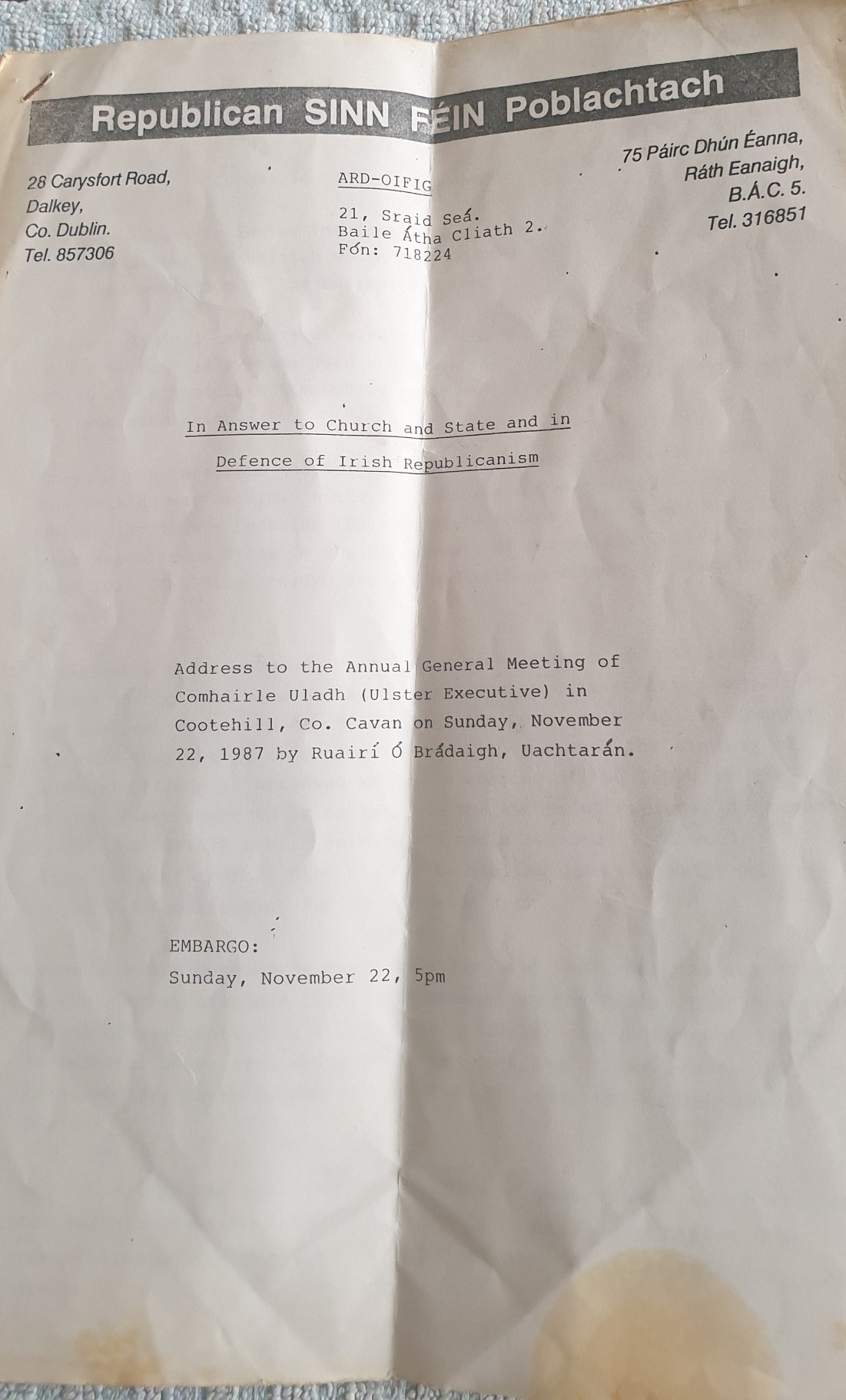
'IN ANSWER TO CHURCH AND STATE AND IN DEFENCE OF IRISH REPUBLICANISM...'
Address to the Annual General Meeting of Comhairle Uladh (Ulster Executive) in Cootehill, County Cavan, on Sunday, November 22nd, 1987, by Ruairí Ó Brádaigh, Uachtarán, Sinn Féin Poblachtach.
Comhaírle Uladh AGM, November 22nd, 1987.
The people are told they should be ashamed to be Irish and even the singing of national ballads is attacked while the wearing of the Poppy is extolled.
There seems to be no limit to the amount of national abasement sought and certain public persons and media personalities would appear to want to roll back history by hauling down our National Tricolour and substituting for it the Union Jack.
Opposition and government representatives and spokespersons are abject in their submissiveness to British demands on the Extradition Act and, as the crisis continues, the British Ambassador is a frequent visitor to Leinster House even while prolonged meetings of the Fianna Fail parliamentary party debate the purchase price on the Hillsborough Deal.
Who is calling the tune in the corridors of power these days?
We know for certain that the taxpayers of the 26 Counties are paying over one million pounds per day to support directly British rule in Ireland...
AND FINALLY...!
We couldn't let it go without mention (well...we could have, but we didn't wanna!) ; on the 2nd August 2021, we proudly posted the following piece -
'OVER ONE MILLION HITS. AND COUNTING...!
It has taken us a good few years to get here although, really, we never started this blog with a 'hits/views' objective in mind. But, having said that, it's a nice place to have arrived at!
Our 'Junior' dips in to our stat counter now and then, out of curiosity, more than as some sort of ego trip or whatever, and we know that we have regular readers from, among other places, this country - Ireland - from England, Scotland, Wales and the USA. We have had well-known film actors, authors, television 'celebrities' and politicians not only read our blog but avail of some of our output in their own work.
We have been watched by the White House and monitored by Moscow, and 'hit on' by all places in between and, over the years, we have been approached three times, by different professional entities, offering to 'monetise' this blog ie take it off a blog platform and turn it into "a real website behind a paywall". Out of courtesy (not curiosity!) we met reps from each entity and politely declined their offers.
We are not in this for financial gain. Our intention, way back when we started this blog (on the old 'Pyra Labs' platform!) was, and still is, to write about an issue which the three of us are committed to - the unjust and unwanted British military and political presence in this country.
We are Irish republicans, and proud to be so. We are the 'Irish dissidents' and the 'Irish terrorists' that the State political 'establishment' here, in Dublin, warn you against as do, no doubt, the political administrations in whatever country you are reading this in.
But we are not 'bad' people. We are, as stated, 'committed' people. We always knew we had an 'audience' out there, and we hope you'll stay with us as we strive to increase our readership.
Finally, thanks to all our sources and our fact-checkers for their assistance over the years. Sure we couldn't have done it without yis!
And thanks, again, to our many readers for checking-in on us as often as you do. Appreciated.
Sharon,
on behalf of the '1169 And Counting' team. GRMA agus slán go fóill anois.'
That was from two years ago on this date when, after years of hard graft and three keyboards (!), we finally crossed the 'million hits' barricade. And now we're striving for two million ; never bleedin' happy, are we...!
Thanks again for the visit, and for reading,
Sharon and the team.
This IRA Volunteer is said to have been shot by a one-time prison comrade of his, on the 'un-official' instructions given to the gunman (and his colleagues) by a high-ranking Free Stater...
From 1955 - 'These elections offer the people in the Six Counties the opportunity to voice their demand for freedom and the withdrawal of England's troops from Irish soil...'
As a young boy, this republican joined Na Fianna Éireann in 1971 and progressed to the ranks of the IRA very quickly. He escaped capture on a number of occasions but was eventually 'arrested' by the British in 1973 and interned in Long Kesh until 1975. When released, he reported back to the IRA for active service straight away...
From 1987 - "The people are told they should be ashamed to be Irish and even the singing of national ballads is attacked while the wearing of the Poppy is extolled. There seems to be no limit to the amount of national abasement sought..."
We'll be filling-in the missing pieces to the above on Wednesday, 2nd August 2023, and the lads tell me that we'll also have a few paragraphs about a very young 'millionaire' related (!) to this blog. Yeah - your guess is as good as mine...!
Thanks for the visit - please check back with us again on Wednesday, 2nd August 2023.
See yis then!
Sharon and the team.
ON THIS DATE (26TH JULY) 109 YEARS AGO : HOWTH GUNS AND A BRITISH MASSACRE ON THE DUBLIN QUAYS.
'A nationalist depiction of the shootings at Bachelor's Walk, in which British troops killed three civilians...' (from here.)
In the early afternoon of Sunday, 26th July, 1914 - 109 years ago on this date - a consignment of over one-thousand rifles and ammunition for same was landed at Howth harbour, in Dublin, and unloaded by the newly-formed 'Irish Volunteers', assisted by members of Na Fianna Éireann.
On its way in to Dublin city, the republican convoy was halted by a force of about fifty British RIC 'policemen' and over one-hundred British soldiers from the 'Kings Own Scottish Borderers', known as the 'Kosbies'.
 Thomas MacDonagh.
 Darrell Figgis.
And we're back in Dublin, mostly in one piece (!), after our assault on the South-East - Waterford, Kilkenny, Carlow, Wexford and Tipp - where eight (supposed) adults and eleven children introduced ourselves (!) to various venues and establishments in mostly flying visits (...not always our choice!) but, happy to say, we didn't loose any of our group. Not permanently, anyway...!
And, among other items on our list, is the blog post, and we'll be back here on Wednesday, 26th July 2023, with these few items :
Families out for a walk, in July 1914, on the Dublin Quays, had no idea of how the group of armed British soldiers, also on the Quays, were going to tell them how to disperse...
From 1955 - 'Imperial policy never changes unless it is forced by outside circumstances to change...'
A brilliantly confused famous Irishman (and 'Superman'!) talks about the Irish 'famine' and how it effected his family...
In Ireland, poor widows and helpless chimney sweeps do not, apparently, live in the real world...
From 1987 - "A veritable tidal wave of hysteria has been launched at the Irish people through the mass media ; a hate campaign against Irish republicans has been worked up day by day over the past two weeks..."
Thanks for droppin' by - hope ya check in with us again on Wednesday, 26th July 2023.
See yis then!
Sharon and the team.
IRELAND, 1921 : THE IRA "EXPRESSED A WISH TO MEET THEM IN AN OPEN FIGHT SOON.."
On the 6th of May, 1921, IRA Commandant Michael J. Marren, who was in command of at least forty Volunteers (with Thady McGowan as second-in-command ; incidentally, both men were carpenters by trade and, in May 1920, they had made a coffin for use in an IRA operation, during which 60 IRA Volunteers acted as a funeral party...but that's another story...!), placed his men along both sides of the railway line near Seefin ((Suí Finn), in County Sligo. The group were armed with between ten and fifteen rifles and various other firearms.
On one side a hilly bank about 35 feet high and some 125 yards long was occupied by some of the Volunteers and one of them, a scout (possibly Volunteer Edward Doherty, who had carried out operations like this before), had been sent ahead to a near-by train station (in Kilfree) where he was to board a train containing enemy forces travelling in the direction of Seefin ; a train arrived in that train station on which British forces were travelling in the direction of the ambush position and the IRA scout got onboard.
When the train was approaching the IRA ambush position, at about 2pm, the scout gave the signal that there were armed enemy forces on board and Michael Marren and Thady McGowan stood on the line and stopped it at Seefin level crossing (between Kilfree Junction and Ballymote) with a red flag, after signalling to the engine-driver to stop.
The train pulled up to a halt, and a few Volunteers took control of the engine compartment : Michael Marren (carrying a 'Peter the Painter' handgun on him) and Thady McGowan (carrying a revolver in his pocket) boarded the train at one end and slowly made their way through the carriages, while two other armed Volunteers, Frank Higgins (from Culfadda) and Pa Coleman (from Ballymote) made their way, slowly, through the carriages, from the other end of the train. All civilians on board were ordered to leave the train, which they did.
When they came near the carriage where the British Auxiliaries and RIC men were, the British invaders opened fire on the IRA men, who immediately took cover between the carriages.
The IRA Volunteers on the railway bank then opened heavy fire on the carriages occupied by the British forces, and the gun battle lasted for approximately thirty minutes, but then the eleven British Auxiliaries and their two RIC colleagues surrendered ; they were disarmed, and any ammunition and paperwork they were carrying was taken from them and the train was allowed to proceed on its journey until it arrived at a point between Kilfree and Boyle where the IRA men stopped the train and got off it.
During the earlier gunfight, a calf grazing in a nearby field was killed, but there were no IRA casualties in the operation.
'The Freemans Journal' newspaper of May 9th, 1921, reported - "It is stated that the Auxiliaries thanked the Republicans on parting for the courteous treatment they received and that the latter expressed a wish to meet them in an open fight soon..."
A British Army Major, Edward Sidney C. Grune (pictured), was on board that train and later recounted his experience of meeting the enemy at such close quarters -
"All off! Everybody off the train! Everybody off the train, and hurry up!
I found myself looking at the bank of a high cutting, over the top of which projected a varied assortment of rifle barrels. I crossed quickly to the other side of the carriage and, looking out of the window, saw a number of men standing with their various weapons at the 'ready position' along the full length of the train.
The guard of the train next came bolting along the corridor, and asked, 'Are you armed?' but he was too agitated to wait for a reply.
I was handed over to the man who appeared to me to be the leader of the raiding party. A small notebook which had been taken away from me unluckily contained an old visiting card of mine. I was asked if the name on the card was mine, and as my name was on the back of my collar, I thought it best to agree.
I was then asked what I was doing, and I replied that I was just going into Boyle for the afternoon. I was asked if I was travelling on duty,
and replied in the negative, and that I was going in for a dance that evening.
There were about fifty or sixty men employed on the raid. Both sides of the train had been picqueted, some were removing the mailbags, sentries were posted on the engine and on the brake van. A number of others were visible on the horizon, with flags, watching the roads.
Before leaving, Marron (sic) said 'good-bye' and asked me to take a message to one of his pals who was a prisoner in Boyle Barracks. He then left the train, and I noticed a number of young women on the platform whom I suspected of receiving the arms of the raiders for safe custody..."
The Sligo RIC County Inspector's report for the month of May 1921 reported 39 'outrages', including 26 robberies of arms, mails etc, and two attacks on RIC men and British Auxiliaries. It mentioned in particular the 6th May train hold-up and the Keash ambush on the 23rd May, but not the 26th May incident. It was reported in 'The Daily Railway Situation' reports as follows :
'27/5/21 : On 26th inst between Ballymote and Kilfree the 13.40 hrs mail train Sligo to Dublin was held up and boarded by armed men at 14.05. These men travelled on the train to a point between Kilfree and Boyle where they stopped the train and detrained...'
On the 12th July 1921 - 102 years ago on this date - IRA Commandant Michael J. ('Sonny') Marren (32), Officer Commanding of the Ballymote Battalion IRA, was drowned accidently at Strandhill, in County Sligo. After his body had been recovered from the sea and buried in Mount Irwin Cemetery, near Gurteen, Canon O'Connor officiated at the graveside.
In his eulogy he said -
"...a brave soldier or a more fearless companion of the Irish cause never breathed the breath of life ; a man universally beloved by his own people and by everyone within the circle of his acquaintance..."
Thousands of IRA men march behind his coffin at his funeral and the local newspapers reported that, as the funeral cortege left Sligo, it was met by a lorry of British military. The officer in charge of the British soldiers had his men dismount and stand to attention, with arms reversed, along the
road.
We have no idea who that officer was. It is very unlikely to have been British Army Major Edward Sidney C. Grune, but the soldiers were members of the Bedfordshire and Hertfordshire Regiment, which had been in constant conflict with IRA Commandant Michael J. Marren and his rebel fighters.
The Lament for Commandant Marren (composed by Tom Lavin of Coolboy, Ballyrush, Co. Sligo).
'The West is now eclipsed in the mourning,
for the bravest is laid in the tomb,
the death of Commandant Marren,
has cast o’er Connaught a gloom.
He fought for the cause of old Ireland,
and evaded arrest for five years,
beloved by all his companions,
and the pride of the bold Volunteers.
Young Marren he loved his dear country,
with a love that can ne’er be surpassed,
a hero and also a brave leader,
he was true to the cause till the last.
When oft times out-numbered in action,
he fought with a verdure so bold,
that he captured those vicious brown-foxes,
by the men of the Green, White and Gold.
The Green, White and Gold were his colours,
by their aid he would fight night and day,
it was woe to the man who would tempt him,
by the cause of those colours betrayed.
The brown-foxes anxiously sought him,
but needless to say ‘twas in vain,
he was hid from those tyrant traitors,
by the invisible band of Sinn Fein.
As a leader no man could surpass him,
for he acted with judgement and skill,
in the ranks a place is left vacant,
that no man ever can fill.
In conflict he was a brave soldier,
and no cowardice did ever show,
in planning he could not be equalled,
for he always out-numbered his foe.
When the truce of old Ireland was called on,
as a free man for Strandhill he was bound,
and when out for a dip in the ocean alas :
young Marren was drowned.
When the news of his fate circulated,
it filled every heart with dismay,
for to think that a brave noble leader,
could be cold ‘neath the depth of the sea.
Volunteers sure they came from all over,
when they heard this companion was drowned,
night and day they kept searching the ocean,
'till at length his dead body was found.
The grief of his parents and comrades,
as they stood on the strand on that day,
when his remains were washed in by a springtide,
they all bent down for to pray.
The day of the funeral was touching,
when 6,000 marched four men deep,
the dead march was played on the brass band,
t'would make the hardest heart weep.
Many friends as they stood by the grave-side,
requested the people to pray,
when relating the tragic occurrence,
to 'Sonny' a tribute did pay.
High masses were offered in many a place,
from Sligo to his native Gurteen,
and the numbers that attended those masses,
will forever remember the scene.
Three volleys were filled 'mid the silence,
and the last part were sounded 'mid tears,
the Rosary was recited in Irish,
for the rest of young Marren the brave.
IRA Commandant Michael J. ('Sonny') Marren, 12th July 1921 - 102 years ago on this date.
RIP.
'NORTHERN IRELAND' FLAG ACT...'
From 'The United Irishman' newspaper, April 1955.
The 'Northern Ireland' entity was an expedient creation of the British Government ; it has been, and is, subsidised by them (inadequately) to maintain a defensive perimeter.
The second paragraph is the essence of sound common sense. The differences between Northern Protestants (I assume that the majority of the members of the USDAW trade union are Protestants) are very, very slight.
If, once the fear fostered alike by English and some Irish politicians, that a free Ireland would mean victimisation for Protestants, was dispelled, a free, united and prosperous Ireland would be very close to reality.
(END of ' 'Northern Ireland' Flag Act' ; NEXT - 'Westminster Elections', from the same source.)
'LAW AND SOCIETY :
IS IT TIME TO ASK QUESTIONS OF THE LEGAL PROFESSION...?
We have always been a society with a facility for the creation of myths. However, not even the most dewy-eyed devotee of the dreams of the Celtic Twilight could have invented the present status of the legal profession in Ireland.'
By John Drennan.
From 'Magill Magazine', November 2001.
Against a backdrop such as this, the relationship of utter thralldom between the Dail (sic - Leinster House) and the law library was epitomised by the call by Fine Gael, Labour and the Greens for a tribunal of inquiry into the McBrearty affair. Perhaps the same people should read up on the transcripts of the 'Kerry Babies Inquiry'.
These calls represent another example of how the principle of the separation of powers, in which a healthy democracy gives equal rights to the parliament, the government and the courts, has been abrogated to the point where attorney generals are now more powerful than ministers.
The legal profession directs, and ministers duly sue Brigid McCole or Kathryn Sinnott, and ignore the plight of HIV-positive haemophiliacs.
After all, it is much easier to follow legal advice than to make tough decisions oneself, especially when those decisions pose a difficult choice between social morality and tempting political expediency...
(MORE LATER.)
'WAITING TO FALL...'
If this year sees the end of the 'Age of Tribunals', it won't be a moment too soon.
By John Drennan.
From 'Magill' magazine, January 2003.
If Frank Dunlop's house of cards begin to sway, or the sort of lawyers who cost €25,000 rather than €2,500 a day start issuing writs over the revelations in the Moriarty Tribunal, or the public start to ask where the charge sheets are, or a brave opposition (admittedly that's unlikely!) start to ask questions, we may yet discover that the glow surrounding our tribunals is that of a twilight rather than the dawn.
Like a pre-Good-Friday-Agreement North of Ireland, tribunals are a flawed entity. Just as the fissures in the North meant the collapse of that statelet was inevitable, at some stage our tribunals will collapse under the weight of their internal contradictions.
This alone justifies our optimism that 2003 may yet be the year where we witness the death* of the 'Age of Tribunals'.
(* '1169' comment - unfortunately not : let the new Tribunal begin...!)
(END of 'Waiting To Fall' ; NEXT - 'In Answer To Church And State And In Defence Of Irish Republicanism', from 1987.)
Thanks for the visit, and for reading,
Sharon and the team.
We won't be here next Wednesday, 19th July 2023 : the childer are on their holliers but that doesn't mean that we can all relax. The opposite, indeed - the three of us that run this blog all have young children or grandchildren (enough, between us, to practically fill a football stadium, never mind field a team!) and there's a right gang of us heading off on a road-trip on Sunday 16th for about a week.
We'll be back on Wednesday, 26th July 2023 with, among other pieces, a few paragraphs to do with seaside weapons and some other implements which were used, with deadly force, on the Quays in Dublin.
Keep the Faith, and please check back with us on the 26th!
GRMA!
ON THIS DATE (5TH JULY) 83 YEARS AGO : THOMAS ÓG MacCURTAIN'S STATED LAST DAY ON EARTH...
Tomás Óg MacCurtain, left, 33 years of age, pictured in Cork in 1948 (thanks to Brendan O'Neill for the pic!).
In Cork, in 1920, Irish republican Tomás MacCurtain was elected as 'Lord Mayor' of the city, just one of the many changes that resulted from the 15th January local council elections that were held in Ireland that year, in which Sinn Féin won control of 11 out of 12 cities and boroughs - the only municipal council in all Ireland left under Unionist control was in Belfast ; out of 206 councils elected on the island, 172 now had a
republican/nationalist majority.
The British had 'outlawed' Dáil Éireann (the 32-county body, not the pretend 'Irish parliament' in Kildare Street, in Dublin, which Free Staters claim, falsely, to be the same institution), which had directed all local council's in Ireland to break their connection with the (British) Dublin Castle system of local administration and, within months, most of the local councils in the country were reporting to the republican administration.
Incidentally, that All-Ireland (32 County) Dáil continued to function underground until 1938, when it delegated its executive powers to the Army Council of the IRA, in accordance with a resolution of the First Dáil in 1921. With the 1969 split, Tom Maguire, the last and faithful survivor of the All-Ireland Dáil, stated that the Provisional IRA was the successor of the 1938 body - similarly, following the 1986 split, he nominated the Continuity IRA as the legitimate IRA. Tom Maguire died in 1993 (on this date [5th July] incidentally - see our piece on the man, elsewhere in this post), aged one-hundred-and-one (101).
Anyway - back to Tomás Óg who, in the year that his father was elected as 'Lord Mayor' of Cork, was only five years of age. He developed an interest in all things Irish, encouraged as much by his mother, Eibhlís Breathnach (pictured), as well as his father and, as an adult, became every bit as active in Irish republicanism as was his father, and quickly became a trusted and leading republican, sitting on the Executive of the IRA.
This, plus his family history, marked him out to the Free State 'authorities' as 'a person of interest'.
On Wednesday, 3rd January 1940, in St. Patrick Street in Cork, Tomás Óg was jumped-on by a number of Free State Special Branch men, who had decided to 'arrest' him - he fought with them and, in the scuffle, a gunshot was fired. A Free State detective, from Union Square Barracks, by the name of Roche, who in particular had been harassing Tomás Óg for weeks, fell to the ground - he was fatally wounded and died the next day.
On the 13th June 1940, the Free State 'Special Criminal Court' sentenced Tomás Óg MacCurtain to death, to be carried out on the 5th July 1940 - 83 years ago on this date.
An application for 'Habeas Corpus' was lodged and the execution was postponed for a week, but the Free State Supreme Court then dismissed the appeal. The whole country was divided over the issue - some demanded that he be put to death immediately as a 'sign' from the Fianna Fail administration that they were serious about 'cracking-down' on their former comrades in the IRA, while others demanded that he be released.
Finally, on the 10th July 1940, the Free Staters issued a statement - "The President, acting on the advice of the government, has commuted the sentence of death on Tomás (Óg) MacCurtain to penal servitude for life."
It has since been alleged that a sister of Cathal Brugha's widow, who was then the Reverend Mother of an Armagh Convent, had requested that her 'boss', Cardinal MacRory, should 'speak to' Eamon de Valera about the case. This, if indeed it did happen, and the fact that Tomás Óg's father had actually shouldered a gun alongside many members of the then Fianna Fail administration (before they went Free State, obviously), saved his life.
Tomás MacCurtain (Senior) died in 1920, at only 36 years of age, and his son, Tomás Óg, died in 1994, at 79 years of age.
'NORTHERN IRELAND' FLAG ACT...'
From 'The United Irishman' newspaper, April 1955.
An amendment, tabled by the Belfast branch, seeks to replace the last paragraph by the words - 'This conference, upholding the principles of political democracy and especially the British people's conception of democratic government, acknowledges the right of the people of Northern Ireland (sic) to elect a government of their choice.
It is also of the opinion that the flaunting and parading of flags and emblems are the devices and tactics of reactionary bigots who seek to divert the attention of the workers from the real social issues and true causes of exploitation.'
The first paragraph of the amendment would be very sensible if the word 'Northern' was left out of it. As it stands it is ridiculous ; 'Northern Ireland', or rather the six north-east counties of Ireland, is not, never has been and never can be a political or economic entity...
(MORE LATER.)
ON THIS DATE (5TH JULY) 161 YEARS AGO : DEATH OF THE NATION'S SHAMROCK.
In Dublin, on the 8th October 1822, a child was born (out of wedlock - a 'mortaler' in those days!) to Mary Williams and a Tipperary Count, Nicholas D'Alton ; the child, Richard Dalton Williams (pictured), was reared at Grenanstown, Nenagh, County Tipperary and, at the age of ten, began his education at St. Stanislaus School, Tullabeg, in County Laois, and then at St. Patricks College, County Carlow, where he stayed until he was 21 years of age.
By the time he left that college he was fluent in three languages, and was studying medicine in St Vincent's Hospital in Stephens Green, in Dublin, preparing himself for a career as a doctor.
He combined both 'crafts' to produce a poem, which he called 'The Dying Girl' -
'From a Munster vale they brought her,
from the pure and balmy air ;
An Ormond peasant's daughter,
with blue eyes and golden hair.
They brought her to the city
and she faded slowly there -
consumption has no pity
for blue eyes and golden hair.' (From here.)
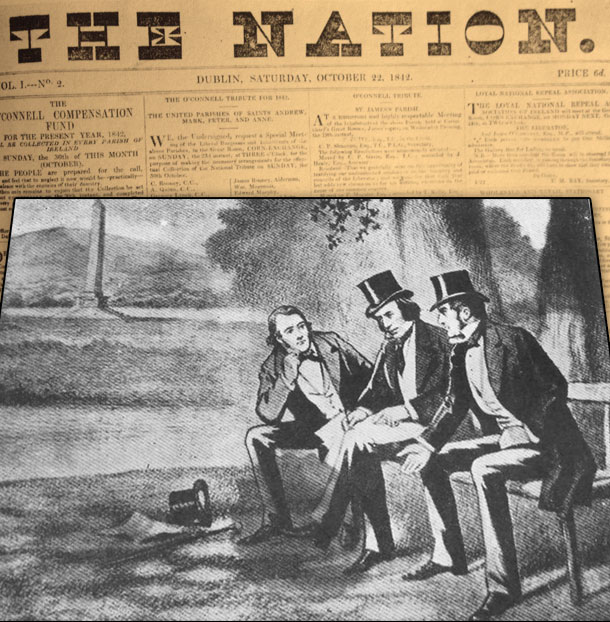
His first published poem was entitled 'The Munster War Song' and it appeared in 'The Nation' newspaper on the 7th January, 1843, under the pseudonym 'Shamrock' (at the time of its publication, he was actually in the process of moving from Carlow, to Dublin, to study medicine in St Vincents Hospital).
'The Nation' newspaper received a great response to Williams' poem, and 'Shamrock' became a regular contributor, with works such as 'Sisters of Charity' and 'The Haunted Man', which raised the profile and readership of the newspaper and of 'Shamrock' himself.
As well as the poems, 'The Nation' newspaper published a series of humorous articles from Richard Dalton Williams, entitled 'Misadventures of a Medical Student', and described the author, 'Shamrock' (in its July 1851 issue), in the following terms - "His intellect is robust and vigorous, his passion impetuous and noble, his perception of beauty most delicate and enthusiastic ; his sympathies take in the whole range of human affections, and his humour is irresistible. We think, indeed, that 'Shamrock' excels all his contemporaries in imagination and humour."
By now he was a member of the 'Young Ireland' Movement, and put his medical training to good use during 'The Great Hunger' of 1845-1849, by helping to ease the suffering of hundreds of cholera victims ; he was a hardened opponent of British misrule in Ireland and had joined the 'Irish Confederation' group, which was founded in January 1847 by William Smith O'Brien and other 'Young Irelanders' who had disagreed with Daniel O'Connell's 'Repeal Association'.
He was quickly elected to leadership level in the 'Confederation' and was the driving force behind a short-lived newspaper called 'The Irish Tribune', which he published with the assistance of 'Young Ireland' leader, Kevin Izod O'Doherty ; the first issue was published in June 1848, but only five issues of the weekly 'paper made it on to the streets before it was suppressed by the British in early July of that year. But
the British used 'The Irish Tribune' newspaper as a reason to arrest both men, and they were charged under the 'Treason-Felony Act' with "intent to depose the queen and levying war."
A famous barrister of the time, Samuel Ferguson, defended both men in a trial which lasted five months and caused great embarrassment to the British.
Eventually, in November 1848, Williams and O'Doherty were acquitted ; Williams went back to studying medicine, and qualified as a doctor, in Edinburgh, in July 1849.
In June 1851, he emigrated to America and, whilst in New Orleans, met and married an Irish woman, Elizabeth Connolly ; the couple moved to a town called Thibodeaux in Louisiana, where he wrote his last poem - 'Song of the Irish-American Regiments' -
'We have changed the battle-field,
but the cause abandoned never -
here a sharper sword to wield,
and wage the endless war for ever.
Yes! the war we wage with thee -
that of light with power infernal -
as it hath been still shall be,
unforgiving and eternal.' (From here.)
On the 5th July, 1862 - 161 years ago on this date - just shy of his fortieth birthday, Richard Dalton Williams, 'Shamrock of the Nation', died in America of consumption in Thibodeaux, Louisiana.
A patriot, a poet and a publisher, Dr Richard Dalton Williams is one of the hundreds, if not thousands, of almost unknown and/or practically forgotten Irish men and women that played their part in the on-going struggle to remove the British presence from Ireland. They deserve to be remembered somewhere : 'Now thou art a sink of evil — a serpent's nest — a tiger's den — an Iron-crowned and armed devil, having power to torture men.'
'LAW AND SOCIETY :
IS IT TIME TO ASK QUESTIONS OF THE LEGAL PROFESSION...?
Yet, in other more fundamental ways, certain members of the legal profession have questions to answer, but will almost certainly never be forced to do so by our current social consensus.
Certainly, there have been legal actions which have been far from edifying sights ; the cessation of the mini CTC signalling system inquiry, in particular, was not impressive to watch. There, we were treated to the unique claim that the constitutional rights of a dead person should stop a public inquiry!
Most citizens would like to see these types of inquiries move ahead, and positive results achieved. Yet that hasn't been the case with many.
The Lindsay Tribunal, for instance, has been so unimpressive that the Irish haemophiliacs are on the point of declaring no confidence in whatever findings it may issue. Given that the tribunal is not investigating the circumstances of 95 per cent of the infections, it is not difficult to understand why they are taking such a negative position.
Meanwhile, the Flood Tribunal is set fair to last for a decade and cost £100m.
Most are agreed that prosecutions or sentences for corruption are unlikely. With the possible exception of Michael Lowry, this is also likely to be the case with the Moriarty Tribunal. Even then, however, Michael Lowry is likely to be prosecuted under the Revenue Acts rather than as a direct result of any tribunal report...
(MORE LATER.)
1921 : BRITISH ARMY PATROL SURRENDER TO TOM MAGUIRE AND HIS MEN.
On March 7th 1921, the IRA's South Mayo Flying Column (pictured), under the command of Tom Maguire - who died 30 years ago on this date (5th July 1993) - surrounded a British army patrol at Kilfall between Ballinrobe and Castlebar forcing it to surrender and give up their arms. The patrol were then released unharmed. Tom Maguire’s personal account of the engagement is given in the book 'Survivors' by Uinsean MacEoin...
'On May 3rd of 1921, Tom Maguire led an ambush party on an RIC patrol in Tournakeady, Co. Mayo during which four RIC men were killed. Following the engagement, Maguire’s flying column made their escape to the Partry Mountains which lie to the west of Lough Mask. They were pursued by a large force of British soldiers and policemen who used an aeroplane to monitor the progress of the column.
A number of skirmishes ensued during which Tom Maguire was wounded and his adjutant killed. There is some dispute about the number of British casualties but fokelore has it that they were substantial. The column managed to escape with no further casualties...
Tom Maguire was elected to the Dáil elections of 1921, 1922 and 1923. He took the anti-treaty side in the Civil War and was a member of the anti-treaty IRA executive which commanded the anti-treaty army.
He was captured by the National Army (sic) and though he was told he was to be executed, his life was spared. However, his younger brother Seán, aged 17, was executed in Tuam on 11th April 1923 along with six others. These men are known today as the 'Tuam Martyrs'..'
In June 1923 General Maguire escaped from Athlone Barracks and was never re-captured.
Along with other surviving faithful members of the Second Dáil - the last All-Ireland parliament - he delegated Executive Authority to the Army Council of the IRA in 1938. In December 1969, he recognised the Provisional Army Council as the legitimate successor to the 1938 body -
"The majority of the delegates at the December 1969 IRA Convention, having passed the resolution referred to above, proceeded to elect an Executive which in turn appointed a new Army Council, committed to implement the resolution. That Convention had neither the right nor the authority to pass such a resolution.
Accordingly, I, as the sole surviving member of the Executive of Dáil Éireann and the sole surviving signatory of the 1938 Proclamation, hereby declare that the resolution is illegal and that the alleged Executive and Army Council are illegal, and have no right to claim the allegiance of either soldiers or citizens of the Irish Republic.
The delegates who opposed the resolution, together with delegates from units which were not represented at the Convention, met subsequently in Convention and repudiated the resolution. They re-affirmed their allegiance to the Irish Republic and elected a Provisional Executive which, in turn, appointed a Provisional Army Council.
I hereby further declare that the Provisional Executive and the Provisional Army Council are the lawful Executive and Army Council respectively of the IRA* and that the governmental authority delegated in the Proclamation of 1938 now resides in the Provisional Army Council and its lawful successors. I fully endorse their call for support from Irish people everywhere towards the realisation of the full freedom of Ireland.."
Dated the 31st day of December, 1969.
Signed : THOMAS MAGUIRE, (Tomas Mac Uidhir) Comdt. General."
NOTE - *Following the 1986 division, Comdt. General Thomas Maguire nominated the Continuity IRA as the legitimate IRA.
Tom Maguire is one of the many Irish republican men and women that the Republican Movement was, is and always will be guided by : when the majority of (P)IRA and (P)Sinn Féin decided to abandon abstentionism in the 1969/70 split, Ruairí Ó Brádaigh and Dáithí Ó Conaill sought and secured Maguire's recognition of the Provisional IRA as the legitimate successor to the 1938 Army Council.
Of the seven 1938 signatories, Tom Maguire was the only one still alive.
Likewise, in the aftermath of the 1986 split in the Republican Movement, Tom Maguire signed a statement in 1986 which was issued posthumously, in 1996 : he conferred this legitimacy on the Army Council of the Continuity IRA, who provided a firing party at Maguire's funeral in 1993 - he was 101 years of age when he died on the 5th July 1993 - 30 years ago, on this date.
Comdt. General Tom Maguire (28th March 1892 – 5th July 1993) remains an inspiration for Irish republicans to this day.
'WAITING TO FALL...'
If this year sees the end of the 'Age of Tribunals', it won't be a moment too soon.
By John Drennan.
From 'Magill' magazine, January 2003.
The outcome of the Moriarty Tribunal will be no different.
Like the Flood Tribunal, the good tribunal is legally 'sterile' - this means that even if it finds that Michael Lowry, for example, engaged in corrupt acts, it can impose no sanction other than the withholding of legal fees, and inflicting the kind of public embarrassment which will increase Lowry's majority in Tipperary by a thousand votes.
Of course, Mr Lowry could, in such an instance, be tried for corruption. But the present state of the law means that none of the evidence accumulated by the tribunal could be used. A Garda investigation would have to start from scratch.
You might think that this is a bit of a waste of six years and €20m!
We must be the only nation (sic) in the western world to choose something which is legally sterile as our 'main weapon' in the was against corruption. How easily we are pleased. For the moment our tribunals are safe, but their future prosperity is dangerously reliant upon the foundations of sand that a skim-doctor called Frank Dunlop is providing...
(MORE LATER.)
Thanks for the visit, and for reading,
Sharon and the team.
LEGAL FINDINGS STYMIED FOR FEAR OF UPSETTING A DEAD MAN...!
Within months of the British having 'outlawed' the 32-County Dáil Éireann, local councils in Ireland had decided to ignore the British directive and were reporting, and supporting, our own political administration in our own country. This, obviously, led to tensions...
We're in 'Marching Season' in the Occupied Six Counties and, in 1955, a British trade union tabled a motion regarding "..the flaunting and parading of flags and emblems", stating quite clearly that to do so in areas where the 'Orange Order' and other loyalist paramilitary groupings were operating was "the devices and tactics of reactionary bigots.."
This man, who committed a mortal sin before he was even born (!), involved himself in the struggle for Irish freedom and died, still a revolutionary force to be reckoned with, in the 1860's, but is not remembered as much or as often as he deserves to be...
So dodgy have been the State-instigated 'Tribunals of Inquiry' (into political/criminal occurrences in this Free State) that the 'Powers-That-Be' took it on themselves to severely limit one such 'Tribunal' least it breech the constitutional rights of a dead man...!
This Irish rebel, who took the fight to the British in Ireland in the 1920's, was over 100 years old when he died and left a political legacy behind him that still reverberates to this day...
We'll have the above and, I'm told, one other piece, ready for ya on Wednesday, 5th July 2023 so, like yerselves, I'm gonna have to wait until then to find out how exactly you can 'commit a mortal sin' before you are even born...?!
See ya on the 5th - thanks for the visit!
Sharon and the team.




.jpg)