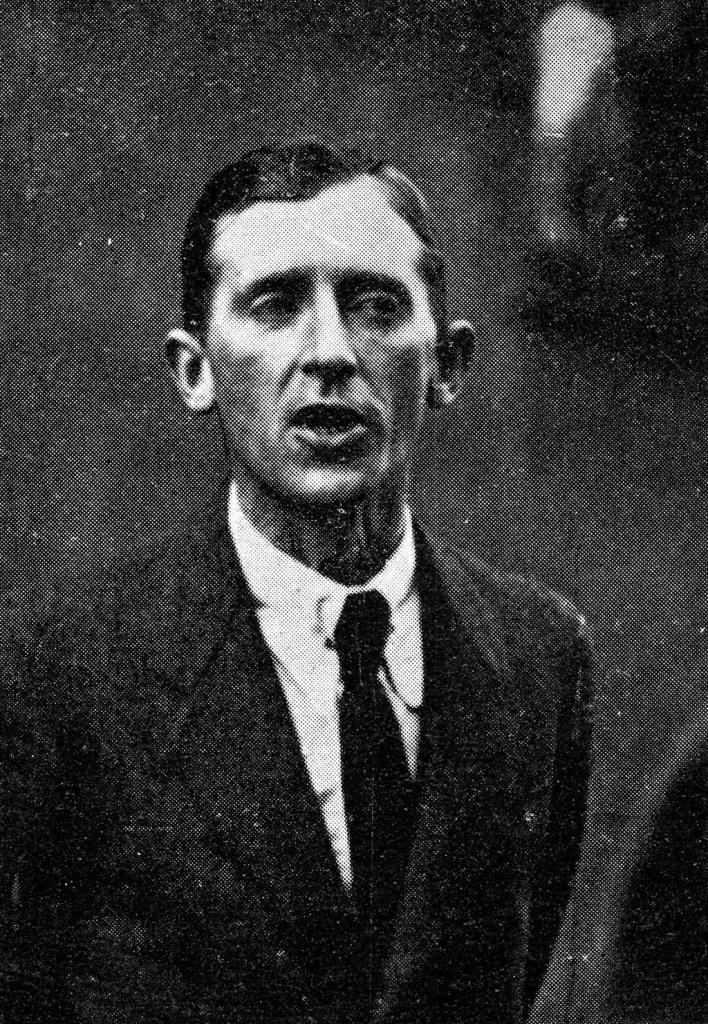
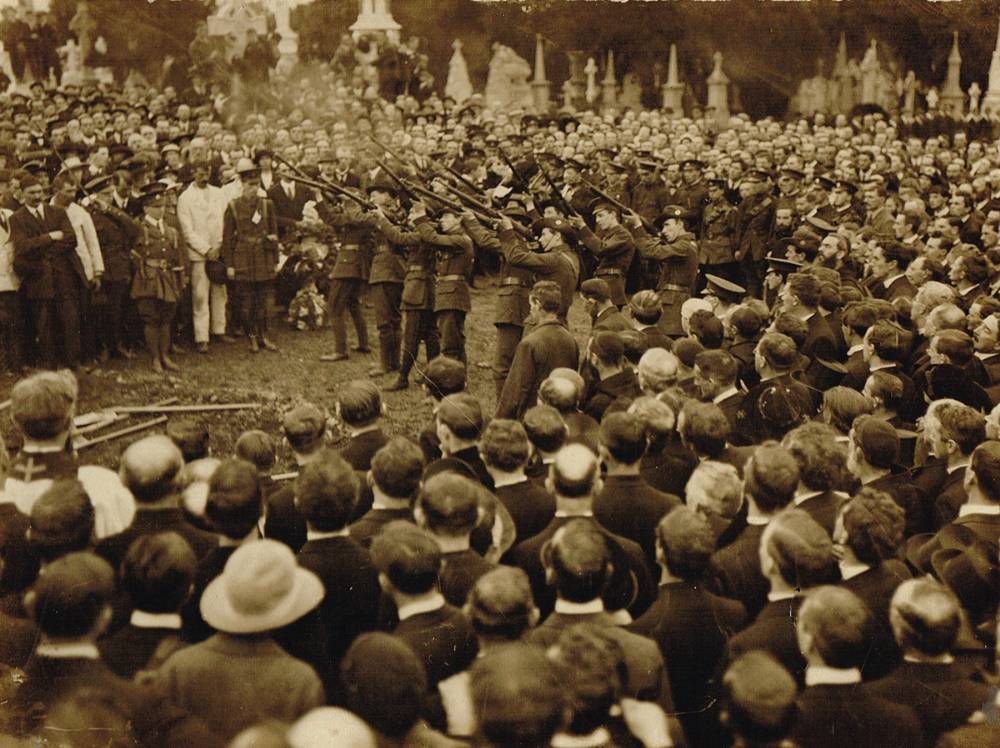
ON THIS DATE (12TH MAY) 105 YEARS AGO - NO PLACE AT THAT TABLE FOR THIS CHAIR.
If we had more time, we would give a brief history and/or mention of all those Irish men and women for whom this month carries special significance, but such is the level of destruction wrought on this country by the British over an on-going period of more than 850 years, and the huge number of Irish 'dissidents' that tried to right those wrongs, we are unable to do so but, nonetheless, we will try to do those brave people justice by posting a few words about just one of them - James Connolly, executed by the British on the 12th May 1916 - 105 years ago on this date.
All shared the same objective : to remove the British military and political presence from Ireland, not to be co-opted onto its 'board of management', as those in Leinster House and Stormont have been.
James Connolly was born on June 5th, 1868, at 107, the Cowgate, Edinburgh. His parents, John and Mary Connolly, had emigrated to Edinburgh from County Monaghan in the 1850s. His father worked as a manure carter, removing dung from the streets at night, and his mother was a domestic servant who suffered from chronic bronchitis and was to die young from that ailment.
Anti-Irish feeling at the time was so bad that Irish people were forced to live in the slums of the Cowgate and the Grassmarket which became known as 'Little Ireland'. Overcrowding, poverty, disease, drunkenness and unemployment were rife - the only jobs available was selling second-hand clothes and working as a porter or a carter.
James Connolly went to St Patricks School in the Cowgate, as did his two older brothers, Thomas and John. At ten years of age, James left school and got a job with Edinburgh's 'Evening News' newspaper, where he worked as a 'devil', cleaning inky rollers and fetching beer and food for the adult workers. His brother Thomas also worked with the same newspaper.
In 1882, aged 14, James Connolly joined the British Army in which he was to remain for nearly seven years, all of it in Ireland, where he witnessed first hand the terrible treatment of the Irish people at the hands of the British. The mistreatment of the Irish by the British and the landlords led to Connolly forming an intense hatred of the British Army.
While serving in Ireland, he met his future wife, a Protestant named Lillie Reynolds. They were engaged in 1888 and the following year Connolly discharged himself from the British Army and went back to Scotland. In 1890, he and Lillie Reynolds were wed in Perth and, in the Spring of that year, James and Lillie moved to Edinburgh and lived at 22 West Port, and joined his father and brother working as labourers and then as a manure carter with Edinburgh Corporation, on a strictly temporary and casual basis.
He became active in socialist and trade union circles and became secretary of the 'Scottish Socialist Federation', almost by mistake. At the time his brother John was secretary; however, after John spoke at a rally in favour of the eight-hour day he was fired from his job with the corporation, so while he looked for work, James took over as secretary. During this time, Connolly became involved with the Independent Labour Party which Kerr Hardie formed in 1893.
In late 1894, Connolly lost his job with the corporation. He opened a cobblers shop in February 1895 at number 73 Bucclevch Street, a business venture which was not successful. At the invitation of the Scottish socialist, John Leslie, he came to Dublin in May 1896 as paid organiser of the 'Dublin Socialist Society' for £1 a week. James and Lillie Connolly and their three daughters, Nora, Mona and Aideen set sail for Dublin in 1896, where he founded the Irish Socialist Republican Party in May of 1896.
In 1898, Connolly had to return to Scotland on a lecture and fund-raising tour. Before he left Ireland, he had founded 'The Workers' Republic' newspaper, the first Irish socialist paper, from his house at number 54 Pimlico, where he lived with his wife and three daughters. Six other families, a total of 30 people, also lived in number 54 Pimlico, at the same time!
In 1902, he went on a five month lecture tour of the USA and, on returning to Dublin, he found the ISRP existed in name only. He returned to Edinburgh where he worked for the Scottish District of the Social Democratic federation. He then chaired the inaugural meeting of the Socialist Labour Party in 1903 but, when his party failed to make any headway, Connolly became disillusioned and in September 1903, he emigrated to the USA and did not return until July 1910. In the US, he founded the Irish Socialist Federation in New York, and another newspaper, 'The Harp'.
In 1910, he returned to Ireland and in June of the following year he became Belfast organiser for James Larkin's Irish Transport and General Workers Union. In 1913 he co-founded the Labour Party and in 1914 he organised, with James Larkin, opposition to the Employers Federation in the Great Lock-Out of workers that August. Larkin travelled to the USA for a lecture tour in late 1914 and James Connolly became the key figure in the Irish Labour movement.
The previous year, 1913, had also seen Connolly co-found the Irish Citizen Army, at Liberty Hall, the headquarters of the ITGWU - this organisation, the ICA, was established to defend the rights of the working people. In October 1914, Connolly returned permanently to Dublin and revived the newspaper 'The Workers' Republic' that December following the suppression of his other newspaper, 'The Irish Worker'. In 'The Workers' Republic' newspaper, Connolly published articles on guerrilla warfare and continuously attacked the group known as The Irish Volunteers for their inactivity. This group refused to allow the Irish Citizen Army to have any in-put on its Provisional Committee and had no plans in motion for armed action.
The Irish Volunteers were by this time approximately 180,000 strong and were urged by their leadership to support England in the war against Germany. It should be noted that half of the Provisional Committee of the Irish Volunteers were John Redmond's people, who was the leader of the Irish Parliamentary Party. The Irish Volunteers split, with the majority siding with Redmond and becoming known as the National Volunteers - approximately 11,000 of the membership refused to join Redmond and his people.
However, in February 1915, 'The Workers' Republic' newspaper was suppressed by the Dublin Castle authorities. Even still, Connolly grew more militant. In January 1916, the Irish Republican Brotherhood had became alarmed by Connollys ICA manoeuvres in Dublin and at Connollys impatience at the apparent lack of preparations for a rising, and the IRB decided to take James Connolly into their confidence. During the following months, he took part in the preparation for a rising and was appointed Military Commander of the Republican Forces in Dublin, including his own Irish Citizen Army. He was in command of the Republican HQ at the GPO during Easter Week, and was severely wounded. He was arrested and court-martialed following the surrender.
On May 9th, 1916, James Connolly was propped up in bed before a court-martial and sentenced to die by firing squad - he was at that time being held in the military hospital in Dublin Castle. In a leading article in the Irish Independent on May 10th William Martin Murphy, who had led the employers in the Great Lock-out of workers in 1913, urged the British Government to execute Connolly.
At dawn on May 12th 1916 - 105 years ago on this date -James Connolly was taken by ambulance from Dublin Castle to Kilmainham Jail, carried on a stretcher into the prison yard, strapped into a chair in a corner of the yard and executed by firing-squad. Connolly's body, like that of the other 14 executed leaders, was taken to the British military cemetery adjoining Arbour Hill Prison and buried, without coffin, in a mass quicklime grave.
The fact that he was one of the seven signatories of the 1916 Proclamation bears evidence of his influence. He had told the Irish Citizen Army, on 16th April, 1916, that "..the odds are a thousand to one against us, but in the event of victory, hold onto your rifles, as those with whom we are fighting may stop before our goal is reached..."
He died, strapped to a chair, but that should not be seen to infer that he wanted that chair placed at a table where a compromise would be the outcome.
James Connolly, 5th June 1868 - 12th May 1916. Executed by the British at 47 years of age.
'WOLFE TONE COMMEMORATION.'
From 'The United Irishman' newspaper, June, 1955.
WOLFE TONE COMMEMORATION, BODENSTOWN, SUNDAY 19TH JUNE.
Parade will leave Sallins at 2.30pm. Oration by Eamonn Thomas, Dublin.
Thomas White, Los Angeles, will speak on behalf of Clan na Gael, America.
Special trains will leave Kingsbridge at 12.15pm, returning from Sallins at 6.30pm.
Commemoration Ceilidhe ; in the Mansion House. Ceol Colmcille, 8.0 to 11.30, Tickets 2/-.
BREAK THE CONNECTION WITH ENGLAND.
Published by the Republican Publications, Seán Treacy House, 94 Seán Treacy Street, Dublin, and printed by the Marian Printing Company Limited, 33 Rutland Place North, North Circular Road, Dublin.
(Please note - some details here in regards to the up-coming Bodenstown Commemoration for 2021.)
(END of 'Wolfe Tone Commemoration': NEXT - 'Aithbheochaint Na Gaedhilge', from the same source.)
ON THIS DATE (12TH MAY) 105 YEARS AGO : SEÁN MacDIARMADA EXECUTED BY THE BRITISH.
Seán MacDiarmada (pictured) was born in January 1883 in Corranmore (near Kiltyclogher), in County Leitrim, and studied at the local national school, before attempting to qualify as a teacher but he failed the exams.
He worked for a short time as a gardener in Edinburgh, in Scotland, later moving to Belfast where he lived between 1905 and 1906 and, while there, he joined the 'Ancient Order of Hibernians' (AOH) but his views of the national situation became ever more radicalised and by 1906 he had been sworn in as a member of the 'Irish Republican Brotherhood'.
He was one of the major strategists behind the planning of the 1916 Easter Rising, although most of his work in that regard was done 'off radar' and at great physical discomfort to himself - he was partially disabled by polio, but never let that interfere with his work to remove the British military and political presence from Ireland.
On the 12th of May, 1916 - 105 years ago on this date - Seán MacDiarmada [and James Connolly] were executed by a British Army firing squad in Kilmainham Jail in Dublin.
His last letter, written to his comrade John Daly, read as follows -
'Kilmainham Prison,
Dublin,
May 11th 1916.
My Dear Daly,
Just a wee note to bid you Goodbye. I expect in a few hours to join Tom and the other heroes in a better world. I have been sentenced to a soldiers death - to be shot tomorrow morning .
I have nothing to say about this only that I look on it as a part of the day's work. We die that the Irish nation may live. Our blood will rebaptise and reinvigorate the old land. Knowing this it is superfluous to say how happy I feel.
I know now what I have always felt, that the Irish nation can never die. Let present day place hunters condemn our action as they will, posterity will judge us aright from the effects of our action.
I know I will meet you soon, until then GoodBye. God guard and protect you and all in No. 15. You have had a done trial, but I know quite well that Mrs. Daly and all the girls feel proud in spite of a little temporary and natural grief, that her son and the girls, their brothers as well as Tom are included in the list of honours.
Kindly remember me especially to Mrs. Clarke and tell her I am the same Seán that she always knew.
God Bless you all,
As ever,
Sincerely Yours,
Seán MacDiarmada.'
"We bleed that the nation may live. I die that the nation may live. Damn your concessions England, we want our country..." ; Seán MacDiarmada, 27th January 1883 – 12th May 1916.
ON THIS DATE (12TH MAY) 102 YEARS AGO : SEÁN HOGAN AND THE STATION OF KNOCKLONG.
Seán Hogan (pictured) was practically still in his teenage years when he was appointed as one of those in command of the 'Third Tipperary Brigade' of the IRA, a leadership group which became known by the British as 'The Big Four' - Dan Breen, Seán Treacy, Seamus Robinson and Seán Hogan.
Seán was born in Tipperary in 1901 and, at just 18 years of age, he took part in the Soloheadbeg ambush on the 21st of January in 1919, in which two Crown force personnel (James McDonnell and Patrick O'Connell) were killed as they drew their weapons. The British went all out to capture or execute those responsible and, on the 12th of May 1919 - 102 years ago on this date - Seán was taken prisoner at a friends house, the Meagher's, at Annfield, in Tipperary, and taken to Thurles RIC barracks to be held overnight, and then transported to Cork.
The following morning he was taken by a four-man armed British military escort to Knocklong train station and the five men got on board a train ; Hogan, who was handcuffed, was put sitting between RIC Sergeant Wallace and Constable Enright, both of whom were armed with revolvers, and Constables Ring and Reilly, carrying shotguns, sat opposite the three men.
Seán Hogan, pictured, thought to be about 20 years young when this photograph was taken.
An IRA unit, led by Seán Treacy, Dan Breen, Seamus Robinson and Eamonn O'Brien, and including Ned Foley, Seán Lynch, John Joe O'Brien, Ned O'Brien and Jim Scanlon (all from the East Limerick Brigade IRA) located the compartment where Seán was being held against his will and Seán Treacy and Eamonn O'Brien drew their revolvers and walked through the train to the compartment ; on entering same, they loudly instructed all present to put their hands up and called for Seán to make his way to them.
RIC Constable Enright placed his revolver against Hogan's neck, using him as a shield, but was shot dead as he did so, as both Treacy and O'Brien had fired at him (Eamonn O'Brien was to say later that they would not have shot Enright had he not attempted to attack Hogan) and Seán, still handcuffed, took that opportunity to land a two-handed punch to the face of Constable Ring, who was sitting opposite him.
Seán Treacy and RIC Sergeant Wallace were trading punches, as were Eamonn O'Brien and Constable Reilly, when one of the IRA men managed to take Reilly's shotgun from him and smashed him over the head with it. He collapsed in a heap on the carriage floor. Constable Ring, meanwhile, found himself on the platform, having exited the carriage through a window, and withdrew from the area.
Seán Treacy and RIC man Wallace were still trying to get the better of each other, with Treacy telling Wallace to give it up as he was outnumbered and had lost his prisoner, but Wallace refused to do so. Both men were now grappling for Wallace's Webley revolver and Wallace managed to get enough control over it to fire a shot, which hit Seán Treacy in the neck - in that same instance, IRA man Eamonn O'Brien fired at Wallace, killing him instantly. Treacy survived, and was recorded later as saying "I thought I was a dead man. I had to hold my head up with both hands, but I knew I could walk."
Seán Hogan remained active in the struggle : he operated in Dublin, Kilkenny and Tipperary, was involved in the 'French Ambush' and was also heavily involved in raids on various RIC barracks and remained active until the Treaty of Surrender was being discussed, a 'compromise' which he was unable to support or condemn - he left the Republican Movement at that point and returned to Tipperary, to try and earn a living as a farmer. But he couldn't, and moved to Dublin where he got married and fathered a child, but the times were tough, economically, and he and his family could only afford to live in a slum tenement building in North Great George's Street.
He was suffering from depression at this stage and voiced disappointment that the Ireland he was living in was not that which he had fought for. He died, penniless, at 67 years of age, in 1968, and was buried in Tipperary town.
The news has spread through Ireland and spread from shore to shore
Of such a deed, no living man has ever heard before
From out a guarded carriage mid a panic stricken throng
Seán Hogan, he was rescued at the station of Knocklong
When a guard of four policemen had their prisoner minded well
As the fatal train sped o’er the rails, conveying him to his cell
The prisoner then could scarce foretell, of hearts both brave and strong
That were planning for his rescue at the station of Knocklong
The shades of eve were falling fast when the train at last drew in
It was halted for an hour or so by a few courageous men
They sprang into the carriage and it did not take them long
'Hands up or die' was the rebel cry at the station of Knocklong
King George’s pampered hirelings, they shrivelled up with fear
And thought of how they placed in cells, full many a Volunteer
Now face to face with armed men, to escape, how they did long
But two of them met with traitors deaths at the station of Knocklong
From Sologhead to Limerick, such deeds as these were never seen
And devil a tear was ever shed for Wallace of Roskeen
They did old England's dirty work and did that work too long
But the renegades were numbered up at the station of Knocklong
Now rise up Mother Erin and always be of cheer
You’ll never die while at your side there stand such Volunteers
From Dingle Bay to Garryowen, the cheers will echo long
Of the rescue of Seán Hogan at the station of Knocklong.
NO RIGHT OF APPEAL...
Why the media consensus on a broad range of issues is increasingly disturbing. By John Drennan.
From 'Magill' Annual, 2002.
The media consensus in favour of moral equivalence proved it could transcend boundaries, as Fintan O'Toole tutted about the American tendency "to divide the world between the forces of God and Satan", stating that "American fundamentalism" was as bad as that of Afghanistan. Every two-bit Irish hack who weighed in against America in those first few days after September 11th was writing, in his or her head, against the vast media consensus which supported America in everything it did.
The only problem was that the consensus didn't exist ; instead, in column after column of pseudo-outspoken caution, the reaction became the norm. Call it liberal posting, call it intellectual laziness, call it what you will - Irish journalists were frenziedly reading the collected works of Robert Fisk and Nick Cohen and weighing in behind the anti-American cause without remotely understanding the issues the way that either of these journalists do.
Mary Ellen Synon's response to this blather would have been interesting. However, as we have noted, Mary Ellen was taken care of a bit earlier in the year. The real triumph of programming belonged to 'Questions And Answers' as in two consecutive weeks not one pro-American sentiment was expressed by its audience. It was about the only place in the world where Mr Osama Bin Laden would have felt comfortable. Eventually, even RTE's 60's flower-power liberal anti-American collective realised there was a need for a bit more subtlety ; after all, even 'The Irish Times' was being neutral on the war. The station's 'Robinsonistas' promptly discovered a humanitarian crisis. They were only four years late...
(MORE LATER.)
ON THIS DATE (12TH MAY) 40 YEARS AGO : 'THE BOY FROM TAMLAGHTDUFF' DIES ON HUNGER-STRIKE.
"I have no prouder boast than to say I am Irish and have been privileged to fight for the Irish people and for Ireland. If I have a duty I will perform it to the full in the unshakable belief that we are a noble race and that chains and bonds have no part in us..." - these are the words of Hunger Strike Francis Hughes, written in a letter addressed to the people of South Derry and surrounding areas five days before he embarked on his hunger strike.
He was born into a republican family on the 28th of February 1956, the youngest son amongst ten children, in Tamlaghduff, County Derry. He left school at 16 years young and started working with a relative as a painter and decorator, a job he excelled at and could have made a good living from, but the political and military atmosphere of trying to live in an occupied area made his mind up for him : in his late teenage years, like so many other young adults before and since, he joined the IRA.
In March, 1978, Francis, 23 years of age, was badly wounded after a gunbattle with British forces ("Francis Hughes was very active in the area. I arrested him after an IRA gun battle in which a soldier was killed. Hughes had escaped but a large chunk of his thigh bone had been shot away. We were there in the dark of night, with torches, following a trail of bullets, blood and a beret he'd discarded when crawling away. He hid for hours in thorn bushes until he was in such pain that he shouted to a soldier. He was very dehydrated but as he was being carried away on a stretcher, he raised a clenched fist and yelled 'Up the Ra...!" -from here) and the British breathed a sigh of relief ; 'the most wanted man in the North' had been imprisoned and neutralised. They thought.
But, on Sunday, the 15th of March, in 1981, the British had to think again - Francis Hughes joined Bobby Sands on hunger-strike. Bobby died on the 5th of May and Francis died on the 12th of May - 40 years ago on this date - still fighting against the British military and political presence in Ireland.
'As I walked through the Glenshane Pass I heard a young girl mourn
"The boy form Tamlaghtduff" ,she cried, "is two years dead and gone"
How my heart is torn apart this young man to lose
Oh I'll never see the likes again of my young Francis Hughes.
For many years his exploits were a thorn in Englands side
The hills and glens became his home there he used to hide
Once when they surrounded him he quietly slipped away
Like a fox he went to ground and kept the dogs at bay.
Moving round the countryside he often made the news
But they could never lay their hands on my brave Francis Hughes
Finally they wounded him and captured him at last
From the countryside he loved they took him to Belfast.
Oh from Musgrave Park to the Crumlin Road and then to an H-Block cell
He went straight on the blanket then on hungerstrike as well
His will to win they could never break no matter what they tried
He fought them every day he lived and he fought them as he died.
As I walked through the Glenshane Pass I heard a young girl mourn
'The boy form Tamlaghtduff 'she cried 'is two years dead and gone'
How my heart is torn apart this young man to lose
Oh I'll never see the likes again of my young Francis Hughes.'
Francis Hughes, IRA Volunteer, 1956 - 1981.
'WITH THE IRA IN THE FIGHT FOR FREEDOM.'
From 'The United Irishman' newspaper, March, 1955.
These men achieved much because they were prepared to give much. They saw the relations between themselves and their country in terms of giving, not taking. They were prepared to give their minds, their energies and, if necessary, their lives, to the service of their country and the knowledge that they were serving their country was the only reward they either sought or desired.
If we are to take up the task where they left off we must relearn this lesson of service.
Join the Republican Movement!
(END of 'With The IRA In The Fight For Freedom' ; NEXT - 'Force : Moral Or Physical?', from the same source.)
Thanks for reading,
Sharon.
ON THIS DATE (5TH MAY) 40 YEARS AGO : BOBBY SANDS DIES ON HUNGER STRIKE IN LONG KESH PRISON.
The 1981 hunger strike was the culmination of a five-year protest during this on-going struggle by Irish republican prisoners ; a 'blanket protest' began in 1976 when the British government withdrew 'Special Category Status' for political prisoners and, in 1978, after a number of attacks on prisoners leaving their cells to 'slop out', the protest escalated into the 'dirty protest', where prisoners refused to leave their cells to wash and covered the walls of their cells with excrement.
In 1980, seven prisoners participated in the first hunger strike, which ended after 53 days then, on Sunday, 1st March 1981, (P)IRA POW Bobby Sands began his hunger strike.
He received widespread media attention for his protest and more so when, on the 9th April 1981, he was elected as an abstentionist member in a Leinster House (Free State 'parliament') election, after being nominated to contest the seat by Dáithí Ó Conaill, the then vice president of the then Sinn Féin organisation.
Bobby Sands was, as far as Irish republicans are concerned, a 'Teachta Dála' (TD) who was elected to take a seat in a 32-county Irish parliament, unlike the Free State representatives who sit in an institution in Kildare Street in Dublin today and claim to be 'TD's in an Irish parliament' and, indeed, Bobby's motives and those of Dáithí and the other then Sinn Féin Ard Chomhairle members who nominated him to contest the election were pure, unlike the motives of the self-serving time-keepers who sit in that Kildare Street premises today : the motives of the former involved a principled unwillingness to allow themselves and the struggle they were part of to be criminalised and to highlight to the world that they were fighting a political struggle against Westminster and its allies in this country.
Bobby Sands was sentenced to 14 years imprisonment for his alleged part in a fire-bombing campaign which, as part of an economic war against the British presence in Ireland, targeted business premises (in this instance, the Balmoral Furniture Company) with the intention of making it financially unviable for Britain to maintain its grip on that part of Ireland, a fact which present-day Provisional Sinn Féin and other Leinster House members seek to ignore or gloss over when referencing the so-called 'ineffectual/grubby deeds' of those who continue that struggle today.
On the 9th April, 1981, Bobby Sands was elected by 30,492 of those that voted in the Fermanagh/South Tyrone district, prompting, years later, this thesis from a republican leader : "Contrary to allegations made in the news media, there was not a straight line from the election of Bobby Sands in 1981 to the Stormont Agreement of 1998. Rather was the line from March, April and May 1981 to the same months in 1998 disfigured and distorted by an internal power-struggle for the leadership of Sinn Féin accompanied and followed by deceit and artifice as the ideals of Bobby Sands were steadily perverted and a section of the then powerful revolutionary Republican Movement turned into a constitutional party.." (from here). Bobby Sands, 9th March 1954 – 5th May 1981. RIP.
'CORK MUNICIPAL ELECTIONS...'
From 'The United Irishman' newspaper, June, 1955.
It will be emphasised that the restoration of our language and culture is an important part of our programme ('1169' comment - "our ancient history and culture..").
Voluntary workers and funds are urgently needed and any help, no mater how small, will be appreciated. Anybody willing to help can report to Election Headquarters, Thomas Ashe Memorial Hall, or ring Cork 24700 or Cork 23661.
(END of 'Cork Municipal Elections' ; NEXT - 'Wolfe Tone Commemoration', from the same source.)
ON THIS DATE (5TH MAY) 142 YEARS AGO : 'FATHER OF HOME RULE' DIES IN DUBLIN.
'ISAAC BUTT (1813-1879) POLITICIAN, BARRISTER AND PHILOSOPHER (pictured).
Isaac Butt was born in Glenfin, Donegal, on the 6th September 1813. His father, The Reverend Robert Butt, became Rector of St. Mary's Church of Ireland, Stranorlar in 1814 so Isaac spent his childhood years in Stranorlar. His mother's maiden name was Berkeley Cox and she claimed descendency from the O'Donnells. When Isaac was aged twelve he went as a boarder to the Royal School Raphoe and at the age of fifteen entered Trinity College Dublin.
He trained as a barrister and became a member of both the Irish Bar and the English Bar. He was a conservative lawyer but after the famine ('1169' comment - it was an attempted genocide) in the 1840s became increasingly liberal. In 1852 he became Tory MP at Westminster representing Youghal, Co. Cork and in 1869 he founded a 'Tenant League' to renew the demand for tenant rights. He was a noted orator who spoke fervently for justice, tolerance, compassion and freedom. He always defended the poor and the oppressed.
He started the Home Rule Movement in 1870 and in 1871 was elected MP for Limerick, running on a Home Rule ticket. He founded a political party called 'The Home Rule Party' in 1873. By the mid 1870s Butt's health was failing and he was losing control of his party to a section of its members who wished to adopt a much more aggressive approach than he was willing to accept. In 1879 he suffered a stroke from which he failed to recover and died on the 5th May (1879) - 142 years ago on this date - in Clonskeagh, Dublin.
He was replaced by William Shaw who was succeeded by Charles Stewart Parnell in 1880. Isaac Butt became known as "The Father of Home Rule in Ireland". At his express wish he is buried in a corner of Stranorlar Church of Ireland cemetery, beneath a tree where he used to sit and dream as a boy.' (from here.)
On the 18th November, 1873, a three-day conference was convened in Dublin to discuss the issue of 'home rule' for Ireland. The conference had been organised, in the main, by Isaac Butt's then 3-year-old 'Home Government Association', and was attended by various individuals and small localised groups who shared an interest in that subject.
Isaac Butt was a well-known Dublin barrister who was apparently viewed with some suspicion by 'his own type' - Protestants - as he was a pillar of the Tory society in Ireland before recognising the ills of that creed and converting, politically, to the 'other side of the house' - Irish nationalism, a 'half way house', if even that - then and now - between British imperialism and Irish republicanism ie Isaac Butt and those like him made it clear that they were simply agitating for an improved position for Ireland within the 'British empire', as opposed to Irish republicans who were demanding then, and now, a British military and political withdrawal from Ireland.
Over that three-day period the gathering agreed to establish a new organisation, to be known as 'The Home Rule League',and the minutes from the conference make for interesting reading as they highlight/expose the request for the political 'half way house', mentioned above - 'At twelve o'clock, on the motion of George Bryan, M.R, seconded by Hon. Charles Ffrench, M.P., the Chair was taken by William Shaw, M.R.
On the motion of the Rev. P. Lavelle, seconded by Laurence Waldron, D.L., the following gentlemen were appointed Honorary Secretaries : — John O.Blunden, Philip Callan M.P, W.J.O'Neill Daunt, ER King Harman and Alfred Webb. ER King Harman read the requisition convening the Conference, as follows : —
We, the undersigned feel bound to declare our conviction that it is necessary to the peace and prosperity of Ireland, and would be conducive to the strength and stability of the United Kingdom, that the right of domestic legislation on all Irish affairs should be restored to our country and that it is desirable that Irishmen should unite to obtain that restoration upon the following principles : To obtain for our countiy the right and privilege of managing our own affairs, by a Parliament assembled in Ireland, composed of her Majesty the Sovereign, and the Lords and Commons of Ireland.
To secure for that Parliament, under a Federal arrangement, the right of legislating for, and regulating all matters relating to the internal affairs of Ireland, and control over Irish resources and revenues, subject to the obligation of contributing our just proportion of the Imperial expenditure. To leave to an Imperial Parliament the power of dealing with all questions affecting the Imperial Crown and Government, legislation regarding the Colonies and other dependencies of the Crown, the relations of the United Empire with Foreign States, and all matters appertaining to the defence and the stability of the Empire at large...' (from here.)
The militant 'Irish Republican Brotherhood' (IRB) was watching those developments with interest and it was decided that Patrick Egan and three other members of the IRB Supreme Council - John O'Connor Power, Joseph Biggar and John Barry - would join the 'Home Rule League' with the intention of 'steering' that group in the direction of the IRB. Other members of the IRB were encouraged to join the 'League' as well, and a time-scale was set in which to completely infiltrate the 'League' - three years.
However, that decision to infiltrate Isaac Butt's organisation was to backfire on the Irish Republican Brotherhood : the 'three-year' period of infiltration ended in 1876 and in August 1877 the IRB Supreme Council held a meeting at which a resolution condemning the over-involvement in politics (ie political motions etc rather than military action) of IRB members was discussed ; after heated arguments, the resolution was agreed and passed by the IRB Council, but not everyone accepted that decision and Patrick Egan, John O'Connor Power, Joseph Biggar and John Barry refused to accept the decision and all four men resigned from the IRB.
Charles Stewart Parnell was elected as leader of the 'Home Rule League' in 1880 and it became a more organised body - two years later, Parnell renamed it the 'Irish Parliamentary Party' and the rest, as they say, is history.
Parnell's predecessor, bar one, Isaac Butt, died in Dublin on this date, 5th May, 142 years ago.
NO RIGHT OF APPEAL...
Why the media consensus on a broad range of issues is increasingly disturbing. By John Drennan.
From 'Magill' Annual, 2002.
The reaction of the people of Ireland against the media consensus was heartening, no matter what your views might be on the merits or otherwise of European integration.
It showed that we do not, after all, live in a society where the views of a nation are sculpted by self-appointed political arbiters. We just live in a society where the self-appointed arbiters believe the myth, and everyone else generally takes little notice. The 'No To Nice' campaign taught us all a few lessons in listening to the people on the ground. Quite simply, they were on message with the only person who really counts - 'Joe Public'.
'Nice' was followed by the continued outworking of the ILDA/ASTI (trade union)
war. Oddly enough, no sooner had the ATGWU accepted ILDA into its capacious folds than its General Secretary and some of his staff were suspended by their mother union for such horrors as the cooking of fish in a canteen and the possession by one of them of a mug which showed a half-naked woman when something hot was poured into it. This wasn't a harassment case - this was high farce.
But the finest hour of the craven journalistic cabal was yet to come ; as bodies still burned in the tinder of the World Trade Centre, the RTE/Irish Times/Last Word-collective was on the job immediately as we were warned that we should be wary of the US embrace... (MORE LATER.)
ON THIS DATE (5TH MAY) 105 YEARS AGO : JOHN MACBRIDE EXECUTED BY THE BRITISH.
John MacBride (pictured, sometimes written as 'John McBride', Seán Mac Giolla Bhríde) was born on the 7th May, 1868, in Westport, County Mayo. He was a leading figure in the 'Irish Republican Brotherhood' in that county but, at 28 years of age, he left Ireland for South Africa, where he organised an Irish Transvaal Brigade to fight with the Boers.
After the war, he moved to Paris and married Maude Gonne, but they went their separate ways in 1906, and he returned to Ireland, where he resumed his contact with the IRB. He wasn't involved with the planning of the 1916 Easter Rising, but played his part as Adjutant to Thomas MacDonagh in Jacob's Factory. The British put him to death on the 5th May, 1916.
Sixteen Irish republicans, including the seven signatories of the 1916 Proclamation, were executed by the British, after the Rising, while hundreds were imprisoned and interned in England and Wales. Within two days of the ending of the Rising, 'court martials' were convened by the British at Arbour Hill and Richmond Barracks - one of the first to face 'court-martial' was Padraig Pearse, the President of the newly-proclaimed Irish Republic (32-Counties, NOT a 26-County State) and commander-in-chief of the Republican Army.
On May 2nd, 1916, he was sentenced to death and despite a plea that his life be forfeit and that those of his comrades be spared, his request was rejected. During the following ten days, 15 republicans were 'court-martialled', sentenced to death and executed. On the morning of May 3rd, 1916, Pearse and Thomas J Clarke, the veteran Fenian and first signatory of the Proclamation, and Thomas MacDonagh, commander of the 2nd Battalion at Jacob's factory, were executed by firing squad in the yard of Kilmainham Jail.
The following day, four more executions took place - Joseph Plunkett (GPO Garrison), Edward Daly (commander of the Four Courts Garrison), Willie Pearse (GPO) and Michael O'Hanrahan (second-in-command at Jacobs factory). Major John MacBride, a veteran of the Boer War in South Africa, who fought at Jacobs factory, was the only execution carried out on May 5th, 1916 ; 105 years ago on this date.
'COMMENTS...'
From 'The United Irishman' newspaper, March, 1955.
Watch Your Imagination : "Fianna Fáil is going to capture the imagination of the people as it did in the earlier stages of the great national (sic) reconstruction drive", said Mr Erskine Childers, in Dublin, recently. It seems as if the truth is out at last that Fianna Fáil worked on the people's imagination for almost 20 years and, not content with that innings, the Party is planning another 'Operation Imagination'. Fool me once...
Westminster Elections :
A 'Newsweek' report states that Conservative Party strategists, who had been planning towards Autumn elections this year, now confide that unless the Far East situations clears up, elections will be put off until the Spring of 1956. Sinn Féin will contest all 12 seats in the Six Counties area and among the Sinn Féin nominations are a number of the republican prisoners at present under sentence in Belfast and English jails.
(END of 'Comments' ; NEXT - 'With The IRA In The Fight For Freedom', from the same source.)
Thanks for reading,
Sharon.
ON THIS DATE (28TH APRIL) 105 YEARS AGO : THE 'BATTLE OF ASHBOURNE'.
"You cannot put a rope around the neck of an idea...you cannot confine it in the strongest prison cell that your slaves could ever build.." - the words of Séan O'Casey, in relation to the murder of Thomas Ashe (pictured).
'Ashbourne in County Meath was the venue for one of the few military actions of the Rising to take place outside Dublin. It was also the most successful. Members of the 5th Battalion of the Dublin Volunteers had assembled near Swords on Easter Monday under the leadership of Thomas Ashe. In order to distract potential military reinforcements from Dublin City, over the next few days they proceeded to attack a number of RIC barracks in north County Dublin. They also attempted to disrupt the rails links into Dublin from the north and west of the country.
On Friday 28 April 1916 (105 years ago on this date) Ashe and his men set out for Batterstown, where they hoped to disrupt the Midlands Great Western rail line into Dublin. En route they passed through Ashbourne, where they attacked another RIC barracks. After 30 minutes the barracks surrendered, but the Volunteers were forced to continue fighting as a large detachment of RIC constables that had arrived in Ashbourne by car. The ensuing gun battle lasted over five hours, and was a rare and notable example of the use of guerilla tactics in the Easter Rising...' (from here.)
Thomas Ashe founded the Volunteers in Lusk and established a firm foundation of practical and theoretical military training. He provided charismatic leadership first as Adjutant and then as O/C (Officer Commanding) the 5th Battalion of the Dublin Brigade. He inspired fierce loyalty and encouraged personal initiative in his junior officers and was therefore able to confidently delegate command to Charlie Weston, Joseph Lawless, Edward Rooney and others during the Rising.
Most significantly, he took advantage of the arrival of Richard Mulcahy (pictured) at Finglas Glen on the Tuesday of the Rising and appointed him second in command. The two men knew one another through the IRB and Gaelic League and Ashe recognised Mulcahy’s tactical abilities. As a result Ashe allowed himself to be persuaded by Mulcahy not to withdraw following the unexpected arrival of the motorised force at the Rath crossroads. At Ashbourne on the 28th of April, 1916, Ashe also demonstrated great personal courage, first exposing himself to fire while calling on the RIC in the fortified barracks to surrender and then actively leading his Volunteers against the RIC during the Battle.
Four days previous to the 'Battle of Ashbourne' (on the 24th April, Easter Monday) Commandant Ashe had received orders from James Connolly to send forty members of his 5th Fingal Battalion to the General Post Office, in Dublin, to help fortify it, and he was instructed to raid nearby barracks, thereby, hopefully, locking down British forces and relieving pressure on those fighting in the city. He sent twenty men to the rebels headquarters at the GPO and kept the remainder of the fighters - about sixty in all - for the barracks attacks. It would prove to be a wise decision by the school teacher from Lusk.
Ashe and his men seized the Royal Irish Constabulary (RIC) barracks and the Post Office in Swords, then turned their sights on Ashbourne and planned to attack the RIC barracks there. That day, Ashe was joined by Richard Mulcahy, who had only recently been appointed to the rank of First Lieutenant. He was in the area following his own orders and happened to meet the Fingal Commandant by chance. Ashe immediately made Mulcahy his second-in-command.
Before launching their assault, they had made sure to cut telephone wires, and even sawed down telephone poles, to block off communications with the surrounding area. He then sent his older volunteers home, reducing his ranks to about 45 men. The attack at Ashbourne would prove to be tougher than they had expected ; usually, the barracks was manned by an RIC sergeant and four others, but it had been reinforced due to the fighting in the capital and, instead of five RIC for the IRA to contend with, there were now 10 British 'policemen', led by a District Inspector McCormack. They were well armed and well prepared.
The IRA disarmed two RIC men who were setting up a barricade outside the barracks and then called on the remaining enemy forces to surrender, but those inside the structure took aim and started shooting at the IRA men. A homemade hand grenade was lobbed at the barracks and, soon after, those inside flew the white flag but, just as the RIC men were about to emerge, the IRA were alerted to the imminent arrival of a large RIC convoy, under County Inspector Alexander Gray, on its way to put the down the rising. With the prospect of rescue from the convoy, the besieged RIC men rushed back inside and resumed the fight.
Seventeen cars carrying approximately 60 RIC men from Slane were, at that moment, speeding towards the scene. Ashe and his men were in a race against time, and had to rush towards the road to stop the convoy reaching the crossroad at Rath Cross, where the RIC could then spread out. It was at this point that second-in-command Richard Mulcahy came into his own. The narrow Dublin to Slane road, with its tall, close hedges – about seven-feet-high – on either side, provided perfect terrain for the rebels and Mulcahy had his men positioned on both sides of the road as the convoy approached at a few minutes past noon.
About 15 yards from the cross roads was the spot chosed to launch a devastating attack on the Crown Forces, and the RIC took heavy fire from all directions. The first to be hit was RIC County Inspector Gray, in the lead car. A newspaper report at the time stated that '..County Inspector Gray received a wound to the head and Sergeant Shanaher, of Navan, who was with him in the car, was shot through the heart. The Sergeant fell into a channel of water near the cross, and presented a gruesome spectacle when the battle ended. He was thrown into the channel in a sitting position and was found dead, still wearing his helmet..'
The rest of the convoy then jumped from their vehicles, seeking cover behind the wheels or beneath the cars themselves. Others leapt into a ditch and started firing on their attackers from there. The fighting was fierce ; a civilian car that blundered into the ambush was also fired on, resulting in the deaths of two of the occupants. For five hours lead flew in all directions, but the IRA were getting the upper hand. RIC District Inspector Harry Smyth managed to kill one Volunteer with his pistol only to be shot dead himself a moment later, his brains spattered across the ditch into which he fell.
With the loss of their leader, the remaining RIC men signaled their surrender. At the end of the carnage, eight policemen lay dead in ditches and along the road, and up to 18 were wounded. The IRA suffered two dead – John Crennigan and Thomas Rafferty – and five wounded, and the besieged RIC forces in Ashbourne barracks soon gave up the fight when they were informed that the rescue party had been defeated. Ashe and Mulcahy had the injured, including the RIC, ferried to the Meath Infirmary, in Navan.
Politically, Thomas Ashe was a member of the 'Irish Republican Brotherhood' (IRB) and he established IRB circles in Dublin and Kerry and eventually became President of the IRB Supreme Council in 1917. While he was actively and intellectually nationalist he was also inspired by contemporary socialism ; he rejected conservative Home Rule politicians and as part of that rejection he espoused the Labour policies of James Larkin. Writing in a letter to his brother, Gregory, he said -
"We are all here on Larkin's side. He'll beat hell out of the snobbish, mean, seoinín employers yet, and more power to him"
He supported the unionisation of north Dublin farm labourers and his activities brought him into conflict with landowners such as Thomas Kettle in 1912. During the infamous lockout in 1913 he was a frequent visitor to Liberty Hall and become a friend of James Connolly. Long prior to its publication in 1916, Thomas Ashe was a practitioner of Connolly’s dictum that "the cause of labour is the cause of Ireland, the cause of Ireland is the cause of labour".
In 1914 Ashe travelled to the United States where he raised a substantial sum of money for both the Gaelic League and the newly formed Irish Volunteers of which he was an early member.
Thomas Ashe died on the 25th September, 1917, after being force fed by his British jailers. He was the first Irish republican to die as a result of a hunger-strike and, between that year and 1981, twenty-one other Irish republicans died on hunger-strike.
The jury at the inquest into his death found "..that the deceased, Thomas Ashe, according to the medical evidence of Professor McWeeney, Sir Arthur Chance, and Sir Thomas Myles, died from heart failure and congestion of the lungs on the 25th September, 1917 and that his death was caused by the punishment of taking away from the cell bed, bedding and boots and allowing him to be on the cold floor for 50 hours, and then subjecting him to forcible feeding in his weak condition after hunger-striking for five or six days.."
Michael Collins organised the funeral (pictured) and transformed it into a national demonstration against British misrule in Ireland ; armed 'Irish Republican Brotherhood' Volunteers in full uniform flanked the coffin, followed by 9,000 other IRB Volunteers, and approximately 30,000 people lined the streets. A volley of shots was fired over Ashe's grave, following which Michael Collins stated - "Nothing more remains to be said. That volley which we have just heard is the only speech which it is proper to make over the grave of a dead Fenian."
The London-based 'Daily Express' newspaper perhaps summed it up best when it stated, re the funeral of Thomas Ashe, that what had happened had made '100,000 Sinn Féiners out of 100,000 constitutional nationalists.' The level of support shown gave a boost to Irish republicans, and this was noted by the 'establishment' in Westminster - 'The Daily Mail' newspaper claimed that, a month earlier, Sinn Féin, despite its electoral successes, had been a waning force. That newspaper said - '..it had no practical programme, for the programme of going further than anyone else cannot be so described. It was not making headway. But Sinn Féin today is pretty nearly another name for the vast bulk of youth in Ireland...'
And, thankfully, there are many like Thomas Ashe in that 'vast bulk of youth in Ireland' today.
'CORK MUNICIPAL ELECTIONS...'
From 'The United Irishman' newspaper, June, 1955.
An Election Committee has been formed and it is intended to contest the elections vigorously and ensure that the voice of Irish republicanism will be heard in local administration.
A special appeal is directed to former members of the Republican Movement to come forward and support the candidature of the Sinn Féin candidates. In the past year, there has been a revival of republican thought and to translate this into action and to cement our gains it is believed that very republican has a right and a duty to assist in the task of electing all our candidates.
It is intended to urge the people to study the Sinn Féin 'Social and Economic Programme' and their plan for national unity and independence. We will put forward our views on housing, rents, emigration, unemplyment and cost of living, and hope to convince the people that party politicians are too concerned with petty issues to face up to the real national problems... (MORE LATER.)
AN EASTER RISING TIMELINE : ON THIS DATE, 28TH APRIL, IN 1916...
'07.55hrs - Sackville Street being blown to pieces. The centre of Dublin is unrecognisable this morning. Rubble is strewn everywhere. Burnt-out cars, trams, dead horses, human bodies, all matter of carnage fills the capital’s streets. British 18-pounders are booming once again. The rebel HQ is completely surrounded.
09.05hrs - As soon as the sun rose this morning the machine guns and sniper rifles returned to work. Throughout the night, armoured cars have been scouting around Jacob’s factory’s positions. With the sound of heavy fighting and artillery, and word coming down from the factory’s towers of huge fires on the north side of the city, the men of Jacob’s garrison must fear that it will not be long before their own position is assaulted by the enemy.
10.12hrs - South Staffordshires are on the march. Huge numbers of troops from the regiment have crossed the Liffey at Butt Bridge, before marching on to Gardiner Street, and making their way towards Bolton Street. The college there is thronged with hungry and increasingly desperate refugees from the growing chaos...' (from here.)
After the British have completely left Ireland, politically and militarily, and the definite timeline from 1916 to that date is written, those reading it will then realise that the only part played in that scenario by the Stormont and Leinster House institutions was in delaying that achievement. Irish republicans realise that now, and have always done so.
NO RIGHT OF APPEAL...
Why the media consensus on a broad range of issues is increasingly disturbing.
By John Drennan.
From 'Magill' Annual, 2002.
Silence was also to the fore in terms of the next issue our media monolith turned its attention to and, of course, everyone supported the 'Nice Referendum' ('1169' comment - no, not "everyone" supported the 'vote yes' position). More European integration was just the sort of lad to put a bit of manners on the likes of Charlie McCreevy who, earlier that year, had been castigated for daring to suggest to Mr Romano Prodi that we would run our country (sic) the way we wanted to, thank you very much.
Besides, given that the opposition to 'Nice' consisted of a lot of pro-life types like Dana, perhaps it was best to not give those sorts too much publicity. The government took its eye off the ball and believed the media consensus and, by the time they realised how relevant this was to the real views of ordinary people, it was time for panic stations and the kind of bombastic propaganda that was not just useless, but insulting to the vast majority of intelligent voters.
Bertie Ahern breathlessly claimed that the 'No To Nice' side were getting thousands of pounds from right-wing US fundamentalists, foreign communists and the rest. The media helped him out by running far too big on a non-story ; the intelligent voters thought that a Fianna Fáil politician casting aspersions on funding sources was a bit rich and reeked of election week panic. The were right... (MORE LATER.)
ON THIS DATE (28TH APRIL) 100 YEARS AGO : CORK VOLUNTEERS EXECUTED BY THE BRITISH AND BEHIND-THE-SCENES DEALING IN CORK IN 1916.
Pictured - IRA Cork Volunteers, 1921.
'...on April 28 (1921), Volunteer Maurice Moore (aged 26) of Cobh, Co Cork and Lieutenant Patrick Sullivan (aged 24), also of Cobh, were both shot, following their capture during the Fourth Battalion, Cork No. 1 Brigade flying column disaster at Clonmult. On the same day, Volunteers Thomas Mulcahy (aged 25) and Patrick Ronayne (aged 26), both of Burnfort, Mallow, Co Cork, died by firing squad. Members of the 5th Battalion, Cork No. 2 Brigade, they were captured at the miscarried Mourne Abbey Ambush...' (from here.)
Honourable Irish men without a doubt, and we have no doubt that they, at least, were not, at that time, caught between an enemy and a leadership at local level who were not as honourable, as was the case in 1916 :
'..Captain Dickie, General Officer Commanding (of the British military) , invited the leaders of the Irish Volunteers in Cork on 28th April (1916) to meet him at the house of the Bishop of Cork, and that they refused ; that on the following morning he visited the Volunteer Hall himself, and held a conference with the Volunteer leaders which also proved abortive ; and that a further conference was held on 30th April at the Lord Mayor's house, at which the Bishop, the Lord Mayor, the General Officer Commanding, and the two leaders of the Volunteers were present, at which it was agreed that the Volunteers should hand over their rifles either to the Bishop or to the Lord Mayor, and that the (British) military were not even to know the number of rifles handed in, the rifles to be returned to the Volunteers as soon as the Dublin disturbances were over ; whether he is aware that, in conformity with that agreement, the rifles were on 1st May handed over to the Lord Mayor's custody, and passports were delivered to the Volunteer leaders to go through the county of Cork to advise the County Corps to abide by the agreement, with the result that no disturbance took place throughout the county ; but that, notwithstanding that agreement, the (British) military authorities on the following day arrested all the leaders, men and women, of the Cork City Volunteers, and lodged them in Cork gaol and, under threat of arresting the Lord Mayor, compelled him to surrender the rifles entrusted to him..
..if the Irish Volunteers handed in their arms to the Bishop (Daniel Coholan) and the Lord Mayor (Thomas Butterfield) before midnight on April 30th and assisted the (British) authorities to maintain order, the (British) General Officer Commanding was prepared to ensure no prosecution for offences other than acts of overt rebellion or traitorous correspondence with the enemy (by which is meant the Irish Volunteers)....at their own request, leaders of the Cork City Volunteers were permitted, on the 29th April, to visit country districts to endeavour to prevent disturbances by country branches of their organisation...' (from 'HANSARD, May 1916, 'DISTURBANCES IN IRELAND'.)
Shameful behind-the-scenes machinations, a criminal act, in our opinion that, during Easter Week in 1916, in Cork, an agreement was reached between representatives of the British occupation forces and the Cork leadership (as opposed to the rank-and-file Volunteers) of the Irish Volunteers "that the Volunteers should hand over their rifles", that the local Irish Volunteers should, in effect, become a British Army militia and "assist the (British) authorities (sic) to maintain order" and that Cork Volunteers be "permitted (!) to visit country districts to endeavour to prevent disturbances by country branches of their organisation..".
Absolutely disgusting and despicable behaviour by the Irish Volunteer leadership in Cork, in 1916. Actions of that sort, whether during Easter Week in 1916 or at any other period in our history - to be even willing to discuss such issues with the British - are unforgivable, but no shame attaches to the 'rank-and-file', the hundreds of brave Irish men and women from Cork who truly and honestly took the battle to the British and, thankfully, continue to do so to this day.
Interesting reading material on the above can be found here, here, here and here.
'Put not your trust in Princes' remains good advice ; even 'in-house', you have to watch what people do rather than what they say. We have always done that at this blog and doing so has served us well, to the point that we are proud of the people that we work alongside with in our joint efforts to secure a proper peace in this country.
ON THIS DATE (28TH APRIL) 158 YEARS AGO : LETTER FROM THE BRIGADIER-GENERAL TO THE MAJOR.
'Does the world even have heroes like Ireland's Thomas Francis Meagher anymore? After fighting for Irish independence ("I know of no country that has won its independence by accident") ,then condemned to death, pardoned and exiled, Thomas Francis Meagher escaped to America,where he became a leader of the Irish community and commanded the Irish Brigade during the Civil War. General Meagher’s men fought valiantly at some of the most famous battles of the Civil War,including Antietam, Fredericksburg and Chancellorsville. After the war, Meagher served as Acting Governor of the Montana Territory. In 1867, Meagher disappeared on the Missouri River ; his body was never found...' (from the poster, pictured, sourced here.)
It was in relation to the 'Chancellorsville Campaign' that Brigadier-General Thomas Francis Meagher, on the 28th April 1863 - 158 years ago on this date - wrote the following letter to his commanding officer :
'Report of Brig. Gen. Thomas Francis Meagher, U. S. Army, commanding Second Brigade.
The Chancellorsville Campaign :
BANKS’ FORD, NEAR FALMOUTH, VA.
April 28, 1863––1.30 p.m.
Maj. JOHN HANCOCK,
Assistant Adjutant-General, Hancock’s Division.
MAJOR: I have the honour to inform the major-general commanding the division that, in accordance with instructions received from him, I proceeded to this ford on yesterday forenoon, to relieve Colonel Kelly and take command of the brigade.
On arriving at the ford (where I found the Sixty-third encamped), I learned that Colonel Kelly had, an hour previous, proceeded to the United States Ford, at which place, I was advised by the major general, two regiments of the brigade were to be stationed. Accordingly, I set out at once to the United States Ford, taking the corduroy road leading up from Banks’ Ford to the Warrenton pike, being ignorant of the River road, not having either a map or guide to direct me. I proceeded along the Warrenton pike until I reached Hartwood Church, when I took the road leading to the United States Ford, at which I arrived some time about 5 p.m., and found everything perfectly quiet, and the Sixty-ninth and One hundred and sixteenth posted there in the best order.
Colonel Kelly had left something more than an hour before, to return to Banks’ Ford. I concluded, therefore, on remaining at the United States Ford until this morning, it being too late for me to return to the lower one by the only route (that of the Warrenton pike) with which I was acquainted.
This morning, a little before 9 o’clock, the Twenty-eighth Massachusetts Volunteers came in, having remained over night at Hartwood Church. As I was on the point of leaving for Batiks’ Ford, orders arrived for the regiments of the brigade stationed at the United States Ford to proceed to the former one. These orders were immediately put into execution, General Carroll’s brigade, which reached the ground about the same time as the orders did, more than supplying their place.
The Sixty-ninth, One hundred and sixteenth, and Twenty-eighth are expected very soon. I have relieved Colonel Kelly from the command, and have received from him all the instructions communicated to him as guidance for the command.
I have the honour to be, very respectfully, yours,
THOMAS FRANCIS MEAGHER,
Brigadier-General, Commanding.'
"Abhor the sword - stigmatize the sword? No, for in the passes of the Tyrol it cut to pieces the banner of the Bavarian, and, through those cragged passes, struck a path to fame for the peasant insurrections of Innsbruck! Abhor the sword - stigmatize the sword? No, for at its blow a giant nation started from the waters of the Atlantic, and by its redeeming magic, and in the quiverings of its crimsoned light, the crippled colony sprang into the attitude of a proud Republic - prosperous, limitless, and invincible! Abhor the sword - stigmatize the sword? No, for it swept the Dutch marauders out of the fine old towns of Belgium - scourged them back to their own phlegmatic swamps - and knocked their flag and sceptre, their laws and bayonets, into the sluggish water of the Scheldt.." - Thomas Francis Meagher.
Thomas Francis Meagher was born in Waterford City (near the Commins/Granville Hotel) on August 3rd, 1823, into a financially-comfortable family ; his father was a wealthy merchant who, having made his money, entered politics, a route which the young Thomas was to follow. At 20 years young, he decided to challenge British misrule in Ireland and, at 23 years of age (in 1846), he became one of the leaders of the 'Young Ireland' Movement. He was only 25 years of age when he sat down with the Government of the Second French Republic to seek support for an uprising in Ireland. At 29 years of age, he wrote what is perhaps his best known work - 'Speeches on the Legislative Independence of Ireland', of which six editions were published.
He unveiled an Irish flag, which was based on the French Tricolour, in his native city, Waterford, on the 7th March 1848, outside the Wolfe Tone Confederate Club. The French Minister for Foreign Affairs, Alphonse de Lamartine, and a group of French women who supported the Irish cause, gave Meagher the new 'Flag of Ireland', a tricolour of green, white and orange - the difference between the 1848 flag and the present flag is that the orange was placed next to the staff and the red hand of Ulster adorned the white field on the original.
On the 15th April that same year, on Abbey Street, in Dublin, he presented the flag to Irish citizens on behalf of himself and the 'Young Ireland' movement, with the following words : "I trust that the old country will not refuse this symbol of a new life from one of her youngest children. I need not explain its meaning. The quick and passionate intellect of the generation now springing into arms will catch it at a glance. The white in the centre signifies a lasting truce between the 'orange' and the 'green' and I trust that beneath its folds, the hands of the Irish protestant and the Irish catholic may be clasped in generous and heroic brotherhood.."
The 'trial' of Thomas Francis Meagher and other Irish patriots.
He was 'arrested' by the British for his part in the 1848 Rising, accused of 'high treason' and sentenced to death ("to be hanged, drawn and disemboweled..") but, while he was awaiting execution in Richmond Jail, this was changed by 'Royal Command' to transportation for life. Before he was deported, he spoke in Slievenamon, Tipperary, to a crowd estimated at 50,000 strong, about the country and the flag he was leaving behind - "Daniel O'Connell preached a cause that we are bound to see out. He used to say 'I may not see what I have laboured for, I am an old man, my arm is withered, no epitaph of victory may mark my grave, but I see a young generation with redder blood in their veins, and they will do the work.' Therefore it is that I ambition to decorate these hills with the flag of my country.."
In July 1849, at only 26 years of age, he was transported from Dun Laoghaire on the S.S.Swift to Tasmania, where he was considered, and rightly so, to be a political prisoner (a 'Ticket of Leave' inmate) which meant he could build his own 'cell' on a designated piece of land that he could farm provided he donated an agreed number of hours each week for State use. In early 1852, Thomas Francis Meagher escaped and made his way to New Haven, in Connecticut, America, and travelled from there to a hero's welcome in New York.
This fine orator, newspaper writer, lawyer, revolutionary, Irish POW, soldier in the American civil war and acting Governor of Montana died, in mysterious circumstances - he drowned after 'falling off' a Missouri River steamboat - on the 1st of July 1867 at 44 years of age.
Once, when asked about his 'crimes', he replied - "Judged by the law of England, I know this 'crime' entails upon me the penalty of death ; but the history of Ireland explains that 'crime' and justifies it."
This brave man dedicated twenty-four of his forty-four years on this earth to challenging British misrule in Ireland and, while it can be said without doubt that Thomas Francis Meagher did his best, a 'crime' does remain to be resolved.
'COMMENTS...'
From 'The United Irishman' newspaper, March, 1955.
Something Drastic ;
The unemployment figures for Ireland soared to 110,361 by mid-February, as economic chaos under the joint direction of Stormont and Leinster House showed its bitter fruit with so many workless.
The figure would be several times larger but for the steady drain of emigration, officially estimated in the region of 35,000 for each year. Even Unionist circles admit defeat and fear the impact on the political scene "...unless something drastic is done, the Six Counties will become a distressed area.." - so said Mr Norman Porter ('Independent Unionist'), in a warning to Stormont last month.
"Something drastic"? Let's replace the bungling of Stormont and Leinster House by introducing Sinn Féin's policy.
ON THIS DATE (28TH APRIL) 105 YEARS AGO : DEATH OF 'THE O RAHILLY'.
"Written after I was shot -
Darling Nancy
I was shot leading a rush up Moore Street
took refuge in a doorway.
While I was there I heard the men pointing out where I was + I made a bolt for the lane I am in now.
I got more one bullet I think
Tons + tons of love dearie to you + to the boys + to Nell + Anna.
It was a good fight anyhow.
Please deliver this to Nannie O'Rahilly, 40 Herbert Park, Dublin.
Good bye darling.."
Joseph O'Rahilly ('The O'Rahilly', pictured, and the author of the above letter) was born in Ballylongford, in County Kerry, on the 22nd April, 1875. He had a busy, well-travelled and interesting life and took part in the 1916 Easter Rising in Ireland, during which he was killed in the fighting ;
'The O’Rahilly has been killed. He had agreed to lead a diversionary charge, along with 12 other men, against a British barricade at the junction of Henry Street and Moore Street. He is shot, and drags himself to the back of Kelly’s shop, 25 Moore Street. He writes a last letter to his wife before dying of his wounds...' (from here.)
"Friday April 28th 1916. The General Post Office in Dublin, occupied on the Monday as the headquarters of republican insurrection, was burning fiercely. The insurgents inside had decided they had to make their escape across Henry Street to the network of small houses and shops on Moore Street.
A small party of twenty armed men dashed across the open street to establish a toehold there and to clear out a British barricade. At their head was a distinguished looking gentleman in green uniform, complete with Victorian moustache and sword.
The charging party was hit by volleys of British bullets from the barricades on both sides. Four Volunteers were killed outright. Their leader, the moustached gentleman, fell wounded in the face. He managed to drag himself out of the line of fire to Sackville Lane, where he lay, bleeding, grievously injured. His name was Michael O'Rahilly..." (from here.)
More information re 'The O'Rahilly' himself -
'His interest in Irish history led him slowly and inexorably towards nationalism. The first indication of nationalism is in a letters controversy in 1899 in the European edition of the New York Herald, following celebrations of Queen Victoria's 80th birthday. Rahilly criticised the celebrations, pointing out the miseries her reign had inflicted on Ireland. Some of his criticism was censored by the paper as too offensive..' - can be read here, and his family history can be read here, including a local [Clondalkin] connection -
'Aodogán and Marion (O'Rahilly) lived Moreen, Clondalkin, Co.Dublin (junction of Belgard Rd and Naas Rd, opposite Newlands golf course, townland of Mooreenaruggan). They spelt house "Moreen", but it is now spelt "Mooreen". The house was built 1936. Aodogán listed as living there by [Thom's, 1938].
The house website says: "In 1932, in America" [Aodogán and Marion] "purchased plans for use in building their new home, Mooreen House. The design was already famous and had been awarded the title House of the Year, and a full-scale replica was constructed in Macy's New York Department Store..."'. But read it quickly, in case it, too, vanishes -
'Dublin City Council is investigating the circumstances surrounding the demolition of the former home of a 1916 Rising leader in Ballsbridge this morning (Tuesday, 29th September 2020). The property at 40 Herbert Park, which once belonged to The O’Rahilly, was bulldozed by a company developing the site at around 6.30am this morning. The site and two adjoining addresses at 36 and 38 Herbert Park are set to be developed into 105 apartments and the extension of an aparthotel by Derryroe Limited, a company owned by the Kennedy and McSharry families...' (from here.)
Another State-inspired atrocity against our history, in the vein of, and for the same motive (€€€) as Hume Street, Wood Quay and Archers Garage. A corrupt State desecrating a part of its own history which it is ashamed of. Shame on the political system and those that operate same for paying lip-service to our historic past while counting the contents of their brown envelopes at the same time.
'SING of The O'Rahilly,
Do not deny his right;
Sing a "The" before his name;
Allow that he, despite
All those learned historians,
Established it for good;
He wrote out that word himself,
He christened himself with blood.
How goes the weather?
Sing of The O'Rahilly
That had such little sense
He told Pearse and Connolly
He'd gone to great expense
Keeping all the Kerry men
Out of that crazy fight;
That he might be there himself
Had travelled half the night.
How goes the weather? (By William Butler Yeats.)
'The O'Rahilly's' grandson, Ronan, 79 years of age, died on Monday, 20th April, 2020. The poor man was diagnosed with vascular dementia in 2013 and had been resident in a nursing home in Carlingford in County Louth for the last years of his life. "How goes the weather", Ronan?
Ar dheis Dé go raibh a anam.
(MORE LATER.)
Thanks for reading,
Sharon.
TO BE POSTED HERE ON WEDNESDAY 28TH APRIL 2021 : POLITICAL AND MILITARY MANOEUVRINGS BETWEEN THE 'IRISH VOLUNTEER' LEADERSHIP AND THE BRITISH ARMY DURING EASTER WEEK 1916.
In answer to some queries we have had in relation to this issue, we are talking about the 'Irish Volunteer' organisation, not John Redmond's '(Irish) National Volunteers' which, by 1917, were 'practically dead/non-existent', as the British described them ; that organisation in fact imploded that same year, although it was to all intent and purposes badly limping along from the summer of 1914, when the 'First World War' started : its leaders, John Redmond and William O'Brien, had called on their followers to enlist in the British military forces, a call which disgusted the republicans within that organisation.
Indeed, the 'Inspector-General of the National Volunteers' spoke openly about how the British military were not inclined to suppress them and voiced his disappointment that the British 'authorities' would not 'permit' the 'National Volunteers' to drill, train and practice. Who asks their enemy if it's ok that they 'skill-up', unless, of course, you know it's not your enemy that your making that request to?
The 'deal' done in one county between the leadership of the 'Irish Volunteers' and the British political and military leadership, in Easter Week, 1916, is the issue we'll be covering here, and we expect that our readers will be as sickened by the very notion that any 'deal' of that type should even be sought, never mind accepted, by the 'IV' local leadership.
And, to cap it all, the arrangement made and agreed to was reneged on by the British!
Thanks for reading ; we'll be explaining all on Wednesday, 28th April 2021. Hope you can check back with us then.
Sharon.