ON THIS DATE (13TH SEPTEMBER) 87 YEARS AGO : TWENTY-FOUR YEAR OLD IRISH REPUBLICAN KILLS HIMSELF OVER MENTAL TORTURE BY FREE STATERS.
'In fond and loving memory of Seán Glynn, Captain Mid-Limerick Brigade IRA, 69 Pennywell Road, Limerick, who died in Arbour Hill Detention Barracks, Dublin, Sunday 13th Sep 1936, aged 24 years. Jesus Mercy Mary help..'
- inscription on the grave (pictured) of Seán Glynn, who was born into a strong republican family in 1911 and, on leaving school, began work as a labourer.
In 1930 he joined the IRA and was known to be a committed Volunteer. He rose through the ranks and soon became O/C of 'B' Company of the Mid-Limerick Brigade, a position previously held by his father, John Glynn, during the early 1920's.
In 1936, the Free State government had banned the Wolfe Tone Commemoration at Bodenstown and ordered contingents of its State police and troops to block all approaches to Bodenstown.
In Limerick, approximately 30 republicans, including Seán Glynn, commandeered a Limerick County Council lorry and headed for Bodenstown.
They were apprehended at Dunkerrin, County Offaly and subsequently sentenced to prison terms ranging from 6 to 18 months (Seán was sentenced to nine months imprisonment). The prisoners were committed to Arbour Hill Military Prison, where the Free State Army ran an exceptionally harsh regime, including a policy of strict silence (the screws actually wore rubber-soled shoes, to ensure that they could 'appear as if from nowhere' in an attempt to frighten the prisoners), which was brutally enforced.
The Fianna Fail administration had warned that Arbour Hill "was no longer (sic) going to be a holiday camp or hotel for republican prisoners".
Conditions in the prison were grim - Free State military guards kept the republican prisoners in solitary confinement and they were punished for trying to speak or otherwise communicate with each other ; the prison was said to be like a tomb, and the system was intended to drive men insane and in some cases succeeded.
Several men never recovered from their months of solitude even if they did manage to preserve their sanity. These were the conditions that drove Seán Glynn, serving nine months for IRA membership - who had been in perfect mental health prior to his arrest - first insane and then, on Sunday, September 13th 1936 - 87 years ago, on this date - to take his own life (another IRA prisoner, Christy Aherne, had attempted to kill himself a few months earlier, for the same reason).
A subsequent inquest and commission of inquiry into his death found that he had been driven insane by the 'silent-system' in Arbour Hill.
After his death, somewhat more humane (but by no means pleasant) conditions prevailed for the remaining prisoners.
Two days after his death, Seán Glynn was buried in the Republican Plot in Mount St Laurence's Cemetery in Limerick.
At 24 years of age, he was driven to take his own life on September 13th, 1936 - 87 years ago on this date - by a Fianna Fail administration : driven to suicide by concocted prison conditions, Arbour Hill Barracks, Dublin.
Rest In Peace.
'KEOGHBOYS OF THE 1950's...'
From 'The United Irishman' newspaper, April 1955.
Sinn Féin must indeed be this man's 'bane of bliss and source of woe', because he sacrificed his claim to even the slightest shred of common sense in an effort to discredit it -
"Of around 1,300,000 votes cast, only 2090 first preferences were in favour of the only party who advocated physical force. We, of the Hibernian Order, who have always condemned physical force, find it extremely gratifying that of a total of 1,300,000 votes cast at the last General Election, only 2090 disagree with us."
He did not state that out of the 147 seats Sinn Féin had only contested two constituencies in the Twenty-Six Counties with no machinery, no money and no propaganda from the press. The last brave statement is just amusing -
"The protestants and the catholics of Northern Ireland (sic) can, therefore, believe together that in a united Ireland the task of subduing a few hundred at the most who would refuse to accept the law of the land would indeed be a light one."
It was all ended by the singing of 'A Nation Once Again'.
God help us.
An Goban Saor.
(MORE LATER.)
FREEDOM OF THE PRESS...?
On the 13th September 1919 - 104 years ago on this date - 'The Dundalk Examiner' newspaper was closed down by British forces, who were operating under orders from their military superiors in Dublin Castle, and other so-called "subversive" newspaper were also visited by British military wrecking crews.
The newspapers targeted had, for the most part, published advertisements for the 'Dáil Loan' request from that 32-County entity and, in doing so, had marked themselves out as 'enemies of the (British) State'.
In the following weeks about 35 newspaper offices throughout the 32 Counties were attacked by the British, who physically prevented the printing of any material by taking the equipment and other machinery apart and removing the various components with them on leaving the premises.
The newspaper owners were later contacted by Dublin Castle operatives and told that they could have their equipment back and resume publication only if they gave signed personal guarantees that they "would not publish seditious literature" in future.
But at least seven newspapers were either never given the 'choice' or, if offered, refused it, and ceased publication.
Dáil Éireann (not the current institution on Kildare Street in Dublin) decided to increase its own advertising abilities to relace the lost outlets and produced three million leaflets/brochures explaining the benefits of the scheme and distributed same throughout the country, posted out more than 50,000 letters to what were described as "high-net-worth" individuals and (correctly, as it transpired) expanded the Dáil's 'Loan Department'.
The 'Dáil Loan' operation stayed active until mid-July 1920 and, when the final tally was done, it had raised over £370,000 (equivalent to between about five and seven million Euros today) and was oversubscribed by about 50%.
Westminster and its minions in Dublin Castle had cut off their nose to spite their face!
IRELAND ON THE COUCH...
A Psychiatrist Writes.
'Magill' commissioned Professor Patricia Casey to compile an assessment of Irish society at what may emerge as the end of a period of unprecedented growth and change.
This is her report.
From 'Magill Magazine' Annual, 2002.
Ireland has always been famous for its strong sense of community, in which everybody knew everybody else* ; a society in which our roads were like umbilical cords attaching us to our families who nurtured us through their influence even from a distance : a society in which social opprobrium was one of the principle determinants of behaviour.
It was also a society that produced 'the valley of the squinting windows' as a metaphor for our intrusiveness and suffocation.
This has changed significantly and there are few, if any, social sanctions remaining - only murder, rape and financial wrong-doings are the focus of any public disapproval.
Evidence from other countries points to the controlling influence of social disapproval in stemming antisocial behaviour. Against this background, it is hardly surprising that crime is increasing, that teenagers are running amok and that their loutish behaviour, seen especially after exams, is regarded as nothing more than spirited high jinks...
( * '1169' comment : not anymore, unfortunately : State borders are, to put it very mildly, porous, and have been left so, purposely, for years. There now exists many new 'communities', consisting of tens of thousands of economic migrants, mostly young males, who are here to take whatever free resources they can, regardless of how they acquire them. Indeed, the political administrations in other countries have recently advised their citizens not to holiday in this State, as it's too dangerous to do so. And it's just as dangerous for State citizens here, too.)
(MORE LATER.)
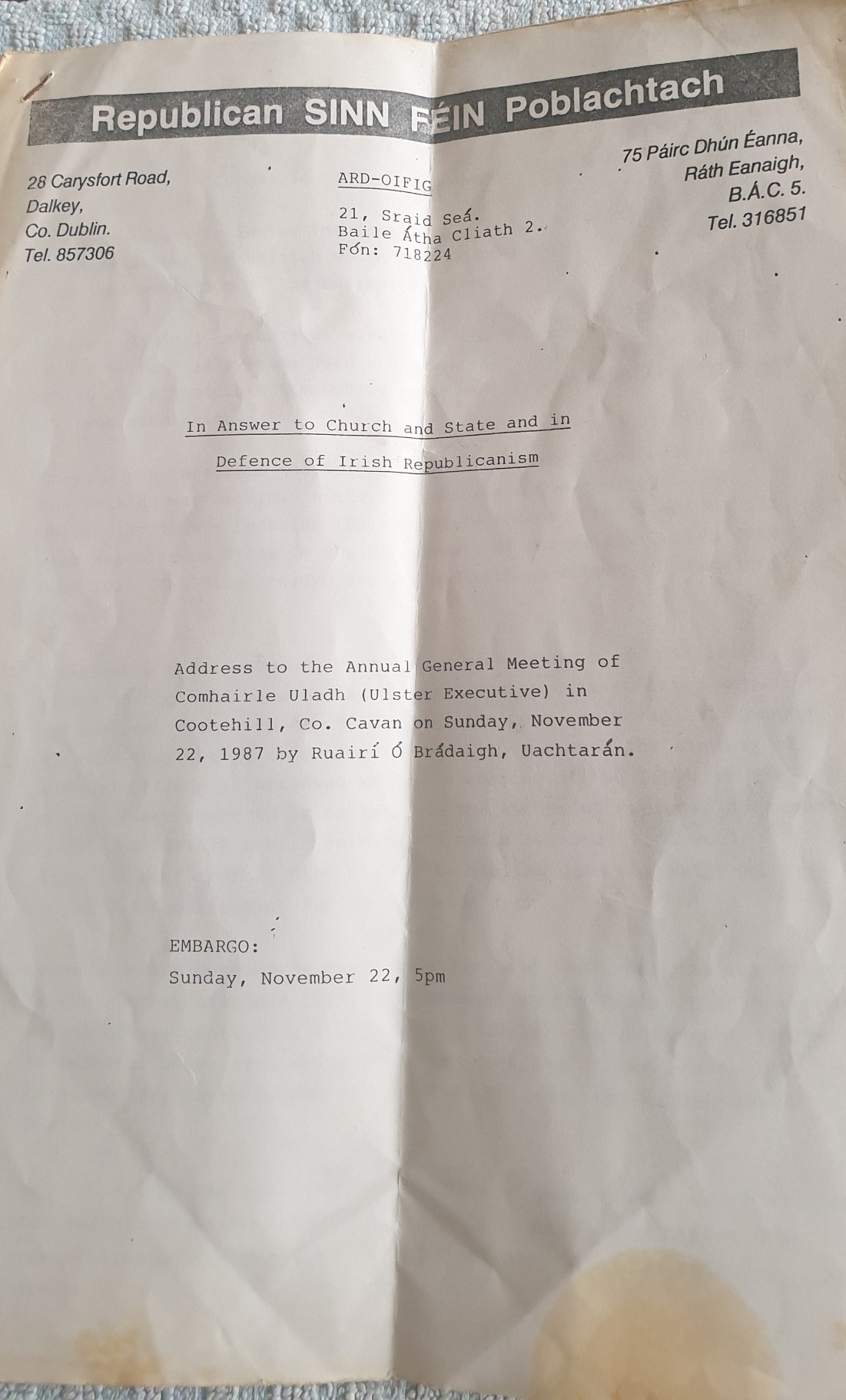
'IN ANSWER TO CHURCH AND STATE AND IN DEFENCE OF IRISH REPUBLICANISM...'
Address to the Annual General Meeting of Comhairle Uladh (Ulster Executive) in Cootehill, County Cavan, on Sunday, November 22nd, 1987, by Ruairí Ó Brádaigh, Uachtarán, Sinn Féin Poblachtach.
Comhaírle Uladh AGM, November 22nd, 1987.
The British Government, for its part, refused to declare illegal the loyalist organisation which claimed responsibility and soon afterwards capitulated to the loyalist demands in scrapping Sunningdale.
The British royal visitors to the bereaved and injured in Enniskillen ignored the family of Tommy MacAuley, killed in a loyalist sectarian assassination in Belfast. In point of fact between seven and eight hundred catholics have died in the Six Counties in the same manner in recent years.
The lessons of the reaction to the Enniskillen bombing is that there are two standards being operated with regard to the loss of human life in the present armed conflict in Ireland. On the one hand, such deaths are minimised and quickly forgotten and, on the other, such occasions are used politically to root British rule even deeper in Ireland and to collaborate with it in the most humiliating fashion...
(MORE LATER.)
AND, FINALLY...
...on the 13th September 1922, the IRA carried out three attacks on Free State troops in Dublin, at St Stephen's Green, Mountjoy Square and on O'Connell Bridge.
The 'Irregulars' were armed with rifles, handguns and grenades and, after the operations, one IRA man lay dead and another was injured, as were three Free State soldiers and three civilians. Also, a 'retired' RIC man, James O'Rourke, was killed during the battles.
On that same date, on Little George Street in Belfast, a young (Protestant) boy who worked as a messenger, John Walker, was shot dead by a lone gunman.
Thanks for the visit, and for reading,
Sharon and the team.
..AND IRISH LAWS'.
Ireland, 1930's - this young Irish republican was driven to extremes by the constant evil inflicted on him by the Free State 'authorities' who held him captive...
This enemy of Irish republicanism, who actually considered himself to be a fellow worker for the objectives of the Movement, was not able to convey republican sentiments either verbally or in writing, and was exposed as the deluded fraud he was...
From the 1900's in Ireland - an example of how NOT to try and silence your enemy and, in the process of NOT doing so, actually enriching them, financially as well as in the publicity stakes...!
An '1169' comment in relation to an article from 2002 in which our old ways were praised - mentioning how much they're missed and why it is that they are disappearing to the point of being extinct. 'Woke' readers beware.
From 1987 - British 'royal' visitors in Ireland and who it was that they decided not to 'visit' while in this country...
From the 1920's - this particular day is not especially marked, commemorated or remembered in our history, but it was a bloody day in Dublin...
...and we'll be with ya on Wednesday 13th September 2023, with details on all of the above. But probably no more than that. 'Cause we figure that that's enough for ya to be gettin' on with...!
Thanks for the visit, and for reading ; see yis on the 13th!
Sharon and the team.
ON THIS DATE (6TH SEPTEMBER) 83 YEARS AGO : REPUBLICANS EXECUTED BY DE VALERA.
Tom Harte and Paddy McGrath (pictured), two Irish republicans executed on the 6th September 1940 - 83 years ago on this date - by a Free State firing squad, commanded (politically) by a man that once (allegedly) supported their objectives - Eamonn de Valera.
'On 16 August 1940 the Special Branch raided 98a Rathgar Road in Dublin. The shop had been watched for some time and was thought to be an IRA training centre. In an effort to be first to catch the IRA, Sergeant Denny O’Brien decided to go in before his competitors in the Special Branch could get the credit and reward money from the slush fund, which was distributed periodically among zealous and particularly efficient officers.
Inside the building Patrick McGrath, Tommy Harte and Tom Hunt were determined not to give up without a fight. Bursting out of the door firing revolvers and a Tommy gun, they cut down three Special Branch men, killing Sergeant Patrick McKeown and Detective Richard Hyland and wounding Detective Pat Brady.
The three IRA volunteers raced down the street away from the stunned detectives who then opened fire and hit Harte. When McGrath went back to help him, both were captured. Hunt managed to elude police until 22 August when he was arrested in a house on Gloucester Street.
The Military Court sentenced McGrath, Hunt and Harte to death. Despite appeals, and McGrath’s Easter Week record, only Hunt’s sentence was commuted. McGrath and Harte were executed by firing squad in Mountjoy on 6 September 1940...' (from here).
And this (from here) - 'On 16th August 1940, Special Branch officers, led by Denny O’Brien, stormed 98a Rathgar Road, guns blazing, hoping to get reward money from a slush fund used to encourage similar raids against known IRA bases. In the ensuing gun battle, two branch men were killed, Sergeant McKeown and Detective Hyland, and a third wounded.
An IRA staff officer, Thomas Harte from Lurgan, was wounded and captured along with a senior IRA officer Paddy McGrath who had broken free but returned to assist Harte...according to Donnacha Ó Beacháin (in 'Destiny of the Soldiers'), there were no autopsies held on McKeown or Hyland.
An internal inquiry into the shooting was reportedly suppressed by Gerry Boland, the Minister for Justice...nevertheless, McGrath and Harte were tried by the Military Tribunal, which could only impose a death penalty and had just had its right of appeal removed...without an autopsy or forensic evidence, there was no attempt to establish who had fired shots (and the suppressed internal inquiry was claimed to have identified that McKeown and Hyland were killed by 'friendly’ fire')...'
Tom Harte was born in Lurgan, County Armagh, on the 14th of May, 1916 (the day before the trial of Roger Casement was to begin in London - he was charged with 'high treason' for his part in the Easter Rising), and had three brothers and two sisters. He received his primary education in St Peters School in Lurgan and, on leaving there, became an apprentice painter to Charlie McIntyre.
He joined the IRA and went to England as part of the 'Expeditionary Force' to take part in the bombing campaign - he was in London in 1939 with Arthur Conway when he was pulled in for questioning by the British police. He told them his name was Tom Green, from Baileborough in Cavan, but was still deported to Dublin.
Once back in Ireland, he worked as an organiser for the GHQ Staff of the IRA, and was wounded when the Staters raided a shop at 98a Rathgar Road in Dublin on the 15th of August, 1940. He was executed, at 24 years of age, in Mountjoy Jail in Dublin by a Fianna Fail-organised firing squad on September 6th, 1940 - 83 years ago on this date. In his last letter, which was addressed to his mother, he wrote -
"I am writing my last letter to you, because I thought more of you than any other person on earth..you know I was always strongly republican, was always thinking out ways and means of furthering republican ideals..if I fought for my country, it was for the poor downtrodden people of Ireland..I knew I never showed my feelings much at any time, but you were always loved just the same..I am going to finish now, asking you to remember me as a son you can be proud of. Say farewell to all for me. Goodbye and God bless you all, your loving son, Tom."
In 1948, the remains of Tom Harte were re-interred in the Republican Plot at St. Colemans Cemetery in Lurgan, County Armagh, following an oration by Ruaidhrí Ó Drisceoil of Cork, who finished his speech with the following poem -
'Prepare once more, march forth again
to fight and play your part
in Ireland's fight for Ireland's right
like Captain Thomas Harte.'
Paddy McGrath was born into an old Dublin republican family and took part in the 1916 Rising, as did two of his brothers. He was sent to Frongoch Internment Camp after the Rising and served his time there with, among others, Michael Collins, Gerry Boland (who signed the execution order on Paddy in 1940) and Dinny O'Brien (who, years later, as a member of the Free State 'Broy Harriers', was to lead the raid on Rathgar Road in Dublin, in August 1940, in which Paddy McGrath was arrested).
Following the Treaty of Surrender in 1922, Paddy took the republican side, as he did in the Civil War ; indeed, he carried a bullet in his chest from a British soldier, when he was shot at the GPO in 1916 - it was too close to his heart to be removed.
He undertook a hunger-strike in Mountjoy Prison with Dick MacCarthy, Jer Daly and Jack Lynch to obtain political status and they were released, after 42 days, unconditionally.
Paddy was brought to a shop in Rathgar Road in Dublin on August 15th 1940, by the then IRA Chief of Staff, Stephen Hayes, for a meeting with Tom Harte and Tom Hunt ; the meeting was raided by Free State forces, led by ex-IRA man Dinny O'Brien. Paddy McGrath escaped but, instead of making a run for it which he could have, he went back to comfort his friend, Tom Harte, who had been shot.
The two of them were captured together and were later put to death together by a Free State firing squad. Tom McGrath was known to be an uncompromising Irish republican who rejected 'positions of power' which were offered to him by de Valera and would not have appreciated the fact that his sister, Josephine, wrote a 'mercy letter' to de Valera in August 1940, in which she stated - "..it is unbelievable that I should have to appeal for my brother's life to you, who was once his comrade-in-arms.."
A well-known Irish republican of the time (and still remembered by the Movement to this day), Brian O'Higgins (pictured), wrote in the 1950 edition of 'The Wolfe Tone Annual' -
"On September 18th 1948, the bodies of Patrick McGrath, Thomas Harte, George Plant, Richard Goss, Maurice O'Neill and Charles Kerins were disinterred in prison yards and given to their comrades and relatives for re-burial among their own. These men were condemned to death and put to death as criminals, as outlaws, as enemies of Ireland.
Today, that judgement and verdict is reversed, even by those who were and are their opponents, and they are acknowledged to be what we have always claimed them to have been - true comrades of Tone, of Emmet, of Mitchel, of the Fenians, and of all the heroic dead of our own day and generation.
There was no bitterness in their hearts towards any man or group of men, no meanness in their minds, no pettiness or brutality in their actions. They were, and are, worthy to rank with the greatest and noblest of our dead, and the younger men we salute and pray for and do homage to today are worthy to be their comrades.
The only shame to be thought of in connection with those republicans is that Irishmen slew them and slandered them, as Irishmen had slain and slandered the men of 1922, for the 'crime' of being faithful soldiers of the Republic of Ireland.
Let us remember that shame only as an incentive to action and conduct that will make recurrence of it impossible ever again.
Wolfe Tone built his plan for true independence on the resistance tradition of all the centuries from the beginning of the conquest to his own day, and these men who were his faithful followers, knew no plan but his would ever end English domination in Ireland.
Those who would make all Ireland free must follow in his and their footsteps or fail. Men talk foolishly today, as they and others have talked for many futile years, of 'declaring' the Republic of Ireland. There is no need to declare it. Wolfe Tone and Robert Emmet founded it and made it known to the world.
Daniel O'Connell reviled and repudiated it, but John Mitchel and Fintan Lalor stood beneath its banner and gave it their allegiance. The Fenians made it articulate and preserved it through two generations until the men and women of 1916 proclaimed it in arms. The whole people of Ireland accepted it a few years later, giving it the most unanimous vote that has ever been cast in this country, and it was established and declared on January 21st, 1919.
It has never been dis-established since, but it has been suppressed by falsehood and by force, and it is suppressed at this moment. Against that force and falsehood, against that unjust and unlawful suppression, the men we honour today - Patrick McGrath, Thomas Harte, George Plant, Richard Goss, Maurice O'Neill and Charles Kerins - did battle unto death. Their blood cries out for only one vengeance - the restoration of the suppressed Republic of Ireland."
Those two brave Irish republican soldiers were executed by their former comrades on this date, 6th September, 83 years ago (incidentally, Paddy McGrath was de Valera's best man at his wedding...).
"A PROMINENT, UNCOMPROMISING, AND ARTICULATE SPOKESPERSON..."
Ruairí Ó Brádaigh Autumn School :
The Abbey Hotel, Roscommon, Saturday 9th September 2023, 10am to 5.30pm.
All welcome!
'In a very real sense, Ruairí Ó Brádaigh can be said to be the last, or one of the last Irish Republicans.
Studies of the Provisional movement to date have invariably focused more on the Northerners and the role of people like Gerry Adams and Martin McGuinness. But an understanding of them is not possible without appreciating where they came from and from what tradition they have broken.
Ruairí Ó Brádaigh is that tradition and that is why this account of his life and politics is so important.
At his death in 2013, Ruairí Ó Brádaigh remained a divisive and influential figure in Irish politics and the Irish Republican movement. He was the first person to serve as chief of staff of the Irish Republican Army, as president of the political party Sinn Féin, and to have been elected, as an abstentionist, to the Dublin parliament.
He was a prominent, uncompromising, and articulate spokesperson of those Irish Republicans who questioned the peace process in Northern Ireland (sic). His concern was rooted in his analysis of Irish history and his belief that the peace process (sic) would not achieve peace.
He believed that it would support the continued partition of Ireland and result in continued, inevitable, conflict...'
(From here.)
The Abbey Hotel, Roscommon, Saturday 9th September 2023, 10am to 5.30pm.
'KEOGHBOYS OF THE 1950's...'
From 'The United Irishman' newspaper, April 1955.
The stupidity of this latter with its series of platitudes is so obvious that it needs no comment.
It is his pharisaical introduction of the religious issue and his brazen use of the Catholic Church as an irritant to set up friction between fellow Irishmen (sic) that is so devilish.
Referring to remarks by Mr Hanna, he (Mr Patrick Sarsfield Donegan 'TD') continued -
"We in 'the South' abhor this attempt to make a political issue out of the innocent dead, and think that proper sympathy might well have been his line. The statement made by An Taoiseach and endorsed by all the political parties in An Dail (sic - he was referencing Leinster House) is a perfect example of a Catholic and an Irishmen under the circumstances."
We of all Ireland abhor your attempt, Mr Donegan, to turn the scourge of imperialism into a religious issue between Irishmen...!
(MORE LATER.)
ON THIS DATE (6TH SEPTEMBER) 210 YEARS AGO : BIRTH OF A 'HOME RULER'.
ISAAC BUTT (1813-1879) POLITICIAN, BARRISTER AND PHILOSOPHER (pictured).
'Isaac Butt was born in Glenfin, Donegal, on the 6th September 1813 (210 years ago on this date). His father, the Reverend Robert Butt, became Rector of St. Mary's Church of Ireland, Stranorlar in 1814 so Isaac spent his childhood years in Stranorlar.
His mother's maiden name was Berkeley Cox and she claimed descendency from the O'Donnells. When Isaac was aged twelve he went as a boarder to the Royal School Raphoe and at the age of fifteen entered Trinity College Dublin.
He trained as a barrister and became a member of both the Irish Bar and the English Bar. He was a conservative lawyer but after the famine in the 1840's became increasingly liberal. In 1852 he became Tory MP at Westminster representing Youghal, Co. Cork and in 1869 he founded the Tenant League to renew the demand for tenant rights. He was a noted orator who spoke fervently for justice, tolerance, compassion and freedom. He always defended the poor and the oppressed.
He started the Home Rule Movement in 1870 and in 1871 was elected MP for Limerick, running on a Home Rule ticket. He founded a political party called The Home Rule Party in 1873.
By the mid 1870s Butt's health was failing and he was losing control of his party to a section of its members who wished to adopt a much more aggressive approach than he was willing to accept. In 1879 he suffered a stroke from which he failed to recover and died on the 5th May in Clonskeagh, Dublin.
He was replaced by William Shaw who was succeeded by Charles Stewart Parnell in 1880. Isaac Butt became known as "The Father of Home Rule in Ireland". At his express wish he is buried in a corner of Stranorlar Church of Ireland cemetery, beneath a tree where he used to sit and dream as a boy.' (from here.)
On the 18th November, 1873, a three-day conference was convened in Dublin to discuss the issue of 'home rule' for Ireland. The conference had been organised, in the main, by Isaac Butt's then 3-year-old 'Home Government Association', and was attended by various individuals and small localised groups who shared an interest in that subject.
Isaac Butt was a well-known Dublin barrister who was apparently viewed with some suspicion by 'his own type' - Protestants - as he was a pillar of the Tory society in Ireland before recognising the ills of that creed and converting, politically, to the 'other side of the house' - Irish nationalism, a 'half way house', if even that - then and now - between British imperialism and Irish republicanism ie Isaac Butt and those like him made it clear that they were simply agitating for an improved position for Ireland within the 'British empire', as opposed to Irish republicans who were demanding then, and now, a British military and political withdrawal from Ireland.
Over that three-day period the gathering agreed to establish a new organisation, to be known as the 'Home Rule League',and the minutes from the conference make for interesting reading as they highlight/expose the request for the political 'half way house', mentioned above -
'At twelve o'clock, on the motion of George Bryan, M.R, seconded by Hon. Charles Ffrench, M.P., the Chair was taken by William Shaw, M.R. On the motion of the Rev. P. Lavelle, seconded by Laurence Waldron, D.L., the following gentlemen were appointed Honorary Secretaries : — John O.Blunden, Philip Callan M.P, W.J.O'Neill Daunt, ER King Harman and Alfred Webb. ER King Harman read the requisition convening the Conference, as follows : —
We, the undersigned feel bound to declare our conviction that it is necessary to the peace and prosperity of Ireland, and would be conducive to the strength and stability of the United Kingdom, that the right of domestic legislation on all Irish affairs should be restored to our country and that it is desirable that Irishmen should unite to obtain that restoration upon the following principles : To obtain for our country the right and privilege of managing our own affairs, by a Parliament assembled in Ireland, composed of her Majesty the Sovereign, and the Lords and Commons of Ireland.
To secure for that Parliament, under a Federal arrangement, the right of legislating for, and regulating all matters relating to the internal affairs of Ireland, and control over Irish resources and revenues, subject to the obligation of contributing our just proportion of the Imperial expenditure. To leave to an Imperial Parliament the power of dealing with all questions affecting the Imperial Crown and Government, legislation regarding the Colonies and other dependencies of the Crown, the relations of the United Empire with Foreign States, and all matters appertaining to the defence and the stability of the Empire at large....' (from here.)
The militant 'Irish Republican Brotherhood' (IRB) was watching those developments with interest and it was decided that Patrick Egan and three other members of the IRB Supreme Council - John O'Connor Power, Joseph Biggar and John Barry - would join the 'Home Rule League' with the intention of 'steering' that group in the direction of the IRB.
Other members of the IRB were encouraged to join the 'League' as well, and a time-scale was set in which to completely infiltrate that grouping - three years.
However, that decision to infiltrate Isaac Butt's organisation was to backfire on the Irish Republican Brotherhood : the 'three-year' period of infiltration ended in 1876 and in August 1877 the IRB Supreme Council held a meeting at which a resolution condemning the over-involvement in politics (ie political motions etc rather than military action) of IRB members was discussed ; after heated arguments, the resolution was agreed and passed by the IRB Council, but not everyone accepted that decision and Patrick Egan, John O'Connor Power, Joseph Biggar and John Barry refused to accept the decision and all four men resigned from the IRB.
Isaac Butt died in 1879 and, within twelve months, Charles Stewart Parnell was elected as leader of the 'Home Rule League' and it became a more organised body - two years later, Parnell renamed it the 'Irish Parliamentary Party' and the rest, as they say, is history...
IRELAND ON THE COUCH...
A Psychiatrist Writes.
'Magill' commissioned Professor Patricia Casey to compile an assessment of Irish society at what may emerge as the end of a period of unprecedented growth and change.
This is her report.
From 'Magill Magazine' Annual, 2002.
Either due to time constraints or because of the browbeating that parenthood has received from the effete, chattering classes, parents have been unable to resist.
Those of truly liberal persuasion would argue that the State, except in rare circumstances, has no role in acting as a 'social engineer', and that its principal function should be to assist and facilitate parents rather than intruding as paternalistic moralists as at present.
While the ever-present generational chasm between parents and children widens, it is arguable that it is being reinforced by this State-sponsored intervention in our young people's formation.
In all probability, future generations will grow up with models of parenthood that are largely passive rather than involved, unable to share a common 'language' with their teenagers and largely unskilled in the standard parental attributes, in the sure knowledge that the State is there to intervene...
(MORE LATER.)
'IN ANSWER TO CHURCH AND STATE AND IN DEFENCE OF IRISH REPUBLICANISM...'
Address to the Annual General Meeting of Comhairle Uladh (Ulster Executive) in Cootehill, County Cavan, on Sunday, November 22nd, 1987, by Ruairí Ó Brádaigh, Uachtarán, Sinn Féin Poblachtach.
Comhaírle Uladh AGM, November 22nd, 1987.
In May, 1974, loyalists bombs killed 33 people in Dublin and Monaghan in a single evening in furtherance of the loyalist political strike then taking place against the 'Sunningdale Agreement' and in particular the proposed 'Council Of Ireland'.
Catholics and protestants died in Monaghan while in Dublin at rush-hour on a Friday evening - 5pm - office girls, some of them from country areas, and poorer people from the area east of O'Connell Street were among those killed.
A child of two years of age lay dead in Talbot Street.
The funeral Mass for many of them in Dublin's Pro-Cathedral was crowded. Otherwise the response was muted. On neither of these occasions were books of condolences opened in various cities and towns ; the air-waves were not available day after day for the execration of those responsible and all that they stood for ; no "appeal funds" were set up to gather money and advertise in the daily newspapers.
No protestant churchmen asked his catholic fellow-Irishmen and women for public forgiveness and there was not even a whimper from the Dublin government to demand the extradition to the South of those responsible...
(MORE LATER.)
Thanks for the visit, and for reading,
Sharon and the team.
In the 1940's, in Ireland, this Irish republican Volunteer was the 'Best Man' at the wedding of one of his comrades, and all went well on the day.
But, 'after Truce and Treaty and the parting of the ways', that groom signed the order for his 'Best Man' to be executed...
In the 1950's, this Leinster House representative attempted to 'play the religious card' in relation to the on-going British military and political presence in six of our counties...
In the late 19th Century, this well-got Donegal Gentleman recognised the ills wrought on Irish society by the British presence, but hoped that he could 'tweak' those ills to be of less consequence...
In Ireland, in 2002 as with now (2023), the gap is widening between children and their parents and - again, then as now - State-sponsored intervention is working an agenda in the not-so-distant background...
From 1987 - different State reactions to military strikes, depending on which finger is on the trigger...
...and our fingers will be on the trigger (well...on the keyboard, anyway!) on Wednesday, 6th September 2023 ; hope you can check back in with us then!
Thanks for the visit, and for reading,
Sharon and the team.
ON THIS DATE (30TH AUGUST) 182 YEARS AGO : A NEW NATIONALIST VOICE IS 'PRESSED' INTO ACTION.
The front page of the first copy of 'The Cork Examiner' newspaper (pictured), which was produced on Monday, 30th August 1841 - 182 years ago on this date.
'The paper was founded by John Francis Maguire under the title 'The Cork Examiner' in 1841 in support of the Catholic emancipation and tenant rights work of Daniel O'Connell...the first issue of the newspaper appeared on 30 August 1841. Maguire was a barrister and an MP who supported an independent parliament for Ireland. From its inception, 'The Cork Examiner' was an advocate of constitutional nationalism.
The newspaper was originally an evening paper which appeared three times weekly...the newspaper's printing presses printed the First National Loan for the Sinn Féin Finance Minister, Michael Collins, in 1919, leading to the British authorities briefly shutting down the paper.
Ironically, the I.R.A. damaged the newspaper's printing presses in 1920, which were again destroyed by the anti-Treaty I.R.A. in 1922...' (from here.)
The newspaper had also found itself in difficulty in 1919 when it was closed down by Westminster for two days, in reprisal for it having published a Sinn Féin advertisement asking for donations towards a £250,000 fund that the republican organisation was trying to raise to further its objectives.
It had similar trials and tribulations the following year, 1920, when Westminster failed to get the results it wanted in the 15th January 1920 Elections in Ireland, so Westminster went to 'Plan B' - they called in British Army General 'Sir' Nevil Macready and appointed him as the
'Commander-in-Chief' of the their forces in Ireland.
General 'Sir' Nevil 'Make Ready' Macready, one of many British bully-boys inflicted on the Irish.
Macready was known to be in favour of martial law and the imposition of a complete military dictatorship on the island and, in December 1920, he told his political masters in Westminster that his "military governors" in Ireland had been given 'permission' "to inflict punishments" on the local population following any IRA operation in that local area - "Punishments will only be carried out on the authority of the Infantry Brigadier who, before taking action, will satisfy himself that the people concerned were, owing to their proximity to the outrage or their known political tendencies, implicated in the outrage...the punishment will be carried out as a Military Operation and the reason why it is being done will be publicly proclaimed." ('1169' comment - this was, in effect, carte blanche to the British military to do as they liked in Ireland.) However, as a 'pr stunt', in the belief that he could portray himself as something other than the vicious bastard he was, Macready implemented a policy by which those to be 'punished' were given one hours notice to remove any valuable foodstuffs, hay or corn, but not furniture, from their homes, which
were then reduced to rubble by the use of explosives.
But, generous to a fault as Westminster was (and is...!) to us Irish, a slightly different variation of this punishment was applied to those who lived in terraced houses - the furniture was to be removed from the dwelling and burned in the street!
On the 3rd January 1921, in Middleton, Cork, the British reduced seven houses to rubble "in official reprisal" for an IRA ambush carried out in the area, on 29th December 1920, in which three RIC/Tan members were killed. 'The Cork Examiner' newspaper carried a report of that particular IRA operation -
'Attack on Police at Midleton.
Followed by Ambush.
Two constables dead.
Closing on to ten o'clock at night when the police patrol standing at a corner of the main street were attacked by a large number of men who fired on them from three directions. The firing was of rapid but short duration. The ten policemen were considerably outnumbered, and taken as they were, completely by surprise, they had little time to put up a defence. One of them, Mullen, was shot by one of the first few shots discharged. He was killed instantly. A telephone call was made to Cork, and some lorries of police and ambulances set out and had nearly got to Midleton by 11.30pm.
The procession of lorries and ambulances, it is stated, had their way further impeded about two miles from the town, by obstacles, such as heavy branches of trees, lying on the roadway. They were just within two miles of the town, at a point where boreens cut off the main road, when fire was opened on the last lorry.
A sharp encounter ensued. In all, three policemen died as a result of the shooting.'
It was also on that same date (ie 3rd January 1921) that 'The Cork Examiner' newspaper printed a statement from the British, in which they outlined their position and intentions regarding that IRA attack - that statement declared that the "authorities" were going to destroy some nearby houses "as the inhabitants were bound to have known of the ambush and attack, and they neglected to give any information either to the military or police authorities."
Seven houses were chosen and the families in them were given one hour to remove any money or valuables, but not furniture. The houses were then destroyed as, indeed, was Macready's reputation in this country (and that of his kind in Westminster) so much so that he had failed so miserably in encouraging locals to support* him, his troops and their ideals that he had no reason not to try and bully and intimidate the locals into supporting him and his fellow thugs.
True to form for all imperialists.
(*Macready asked influential trade union leader Tom Foran to assist him to "get a grip" in Ireland, to which Foran stated - "William O'Brien, kidnapped by your predecessor and deported, is the person best qualified to give the most authentic information respecting the Labour movement in Ireland...it is useless attempting to 'get a grip on the conditions in this country' until you let go your grip on the citizens of this country.." - Macready obviously ignored that good advice and attempted to do the opposite.)
Anyway - in 1996, in a move to increase readership, its title was changed from 'The Cork Examiner' to 'The Examiner' and, in 2000, it became 'The Irish Examiner' but is now, unfortunately, an echo chamber for Leinster House propaganda.
'KEOGHBOYS OF THE 1950's...'
From 'The United Irishman' newspaper, April 1955.
Mr George Coburn TD, the next speaker, stated that the importance of demonstrations such as the one in Ballycastle was that they were not provocative.
Mr PS Donegan TD did, however, to put it in vulgar parlance, "take the cake", and proceeded to point out without, of course, stating the specific incidents, how the direct attacks on the British military in this country resulted in a strengthened and more incited border patrol by the 'Special Constabulary' in the Six Counties, and in the recent shootings by that body.
"During the last six months the consequences of an incorrect approach to the eventual unity of a Christian Ireland have been amply displayed. Armed men have made incursions into this State within a State, and within a nation, in the mistaken belief that force can only be met by force and coercion by similar coercion.
Sadly, the obvious truth that like begets like was only too clearly displayed in recent incidents at the Border when one perfectly innocent young man lost his life and others, injured and uninjured, have stood the gravest danger of losing theirs..."
(MORE LATER.)
ON THIS DATE (30TH AUGUST) 101 YEARS AGO : IRA ATTACK STATERS IN BANTRY, COUNTY CORK.
On the 30th August 1922 - 101 years ago on this date - IRA Volunteers from the Cork No. 5 Brigade arrived in the town of Bantry, in County Cork, to take the Post Office building back from the Free State Army, who were in occupation of it.
The rebels succeeded in capturing several buildings located near their objective but, as they were consolidating their gains, four of their number were killed - Brigadier General Gibbs Ross, Captain Patrick Cooney, Quartermaster Donal McCarthy and Lieutenant Michael Crowley, and one Free State soldier, a Captain John Hourihane - who had previously been an IRA Volunteer in the Cork No. 5 Brigade - was also killed in the battle.
The loss of four of their Officers led to the IRA retreating.
BRIGADIER COMMANDANT GIBBS ROSS, GLANDART, BANTRY.
CAPTAIN PATRICK COONEY, BRIDGE ST, SKIBBEREEN.
LIEUTENANT DONAL MCCARTHY, CARRIGBAWN, DRINAGH.
LIEUTENANT MICHAEL CROWLEY, REENOGREENA, GLANDORE.
'LIFE’S GREATEST SACRIFICE : FOR LIBERTY, FREEDOM, AND HAPPINESS.'
On the 30th August, 1920, Westminster imposed a curfew (10.30pm to 5am) for the Belfast area that was to last, with variations in the times, until 1924!
On the 30th August, 1921, Eamon de Valera replied to a letter he had received from Llyod George on the 26th August, in which Mr de Valera "stressed" how important it was 'that Ireland's declaration of independence and Britain's refusal to accept it' was. The same man was later to accept a so-called 'Free State' within Ireland and accept Britain's refusal to withdraw, politically and militarily, from all of Ireland.
In 'disturbances' in Belfast on the 30th August 1921 (mostly in the New Lodge Road, North Queen Street and York Street areas), nine people were killed : Stephen Cash, William Kennedy, William Smith, Annie Watson (5 years young), Henry Robert Bowers, Samuel Ferguson, John Coogan, Thomas McMullan and Charles Harvey.
On the 30th August 1922, the Free State administration in Leinster House issued an 'order' that any of its members involved in the anti-Treaty campaign should be arrested and also declared that any of its members currently in prison (ie anti-Treaty politicians) would not be released for the purpose of attending meetings of the institution (as they could rekindle old political passions in some Free Staters, no doubt).
On the 30th August 1922, a British Intelligence Officer, Lieutenant Richard James Story, was found dead in Dublin -
'King’s Shropshire Light Infantry.
Lieutenant Story, a native of Wrington Somerset, was found at 11.35pm on Wednesday the 30th of August 1922 near Island Bridge Dublin, he had been shot in the head.
Initially it was suspected, and some witnesses testified, that Storey had shot himself but Storey’s revolver was produced in evidence and testimony given that the gun had not been fired for several weeks. A verdict of death due to laceration of the brain caused by a bullet fired by some person unknown was returned...' (more here.)
The 'story' is that that man, the army, agency, and political grouping that he represented shouldn't have been in Ireland, and they still shouldn't be here.
IRELAND ON THE COUCH...
A Psychiatrist Writes.
'Magill' commissioned Professor Patricia Casey to compile an assessment of Irish society at what may emerge as the end of a period of unprecedented growth and change.
This is her report.
From 'Magill Magazine' Annual, 2002.
We assert our right to get a drink when or where we want it, and our individual needs take precedence over minor inconveniences that may be imposed when more restrictive laws are considered.
Meanwhile, we proclaim a desire to tackle the alcohol problem by our constant reference to underage drinking, when all the evidence is that the problem is not confined to the under-18's but exists among the over-18's also. This double-think is a recurring attribute of much of modern Ireland.
Ireland, enveloped by rapid social change - particularly in areas of personal morality - has shifted from the absolute certainties and authoritarianism of the past to moral relativism, at least in the area of parenting.
The 1950's have been blamed for many of Ireland's ills, and there has been a rush to jettison any disciplinarian residue from that period. So the child-centredness of Dr Spock, the parenting guru, has been adopted with gusto.
The result for parents is not so much that they do not wish their children to be well-behaved and responsible as that they are uncertain of how they should instill values lest they be dubbed backwoods people.
This ambivalence leads to a reticence in addressing a range of behaviours and values that include alcohol and drugs, relationships, the influences of pop music, abortion etc but, by their reluctance, parents have disempowered themselves and created a vacuum.
Stepping into the breach has been the State, whether by design or default, with the addition of more and more courses of a personal development nature to the already overcrowded school curriculum. To religion has been added 'Civic, Political and Social Studies', 'Relationship and Sexuality Education' and a pilot scheme for boys called 'Exploring Masculinities'... (MORE LATER.)
'IN ANSWER TO CHURCH AND STATE AND IN DEFENCE OF IRISH REPUBLICANISM...'
Address to the Annual General Meeting of Comhairle Uladh (Ulster Executive) in Cootehill, County Cavan, on Sunday, November 22nd, 1987, by Ruairí Ó Brádaigh, Uachtarán, Sinn Féin Poblachtach.
Comhaírle Uladh AGM, November 22nd, 1987.
The obvious inference of all this is that the British Occupation Forces in Ireland are morally right while the 'natives' who resist them are morally wrong.
But the 'natives' in this case are Irish people exercising the prerogative - some would say the duty - of resisting foreign aggression in their own land, a right common to all peoples on the face of the earth. However, the Catholic Church never said officially that the 1916 Rising was justified - quite the contrary, in fact - or that the partition of Ireland and the continuation of British imperialist rule here in new forms was unjust.
Similarly, the orchestrated reaction to what happened in Enniskillen is in sharp contrast to the low-key attitude or total ignoring of other occasions of great loss of life in Ireland since 1969.
One of the first major tragedies was in December 1971 when McGurk's Bar in North Queen Street in Belfast was demolished by a loyalist bomb and 15 nationalist people - the youngest aged 8 years and the eldest aged 80 - were killed. It was ignored...(MORE LATER.)
Thanks for the visit, and for reading,
Sharon and the team.
SEARCHING ITS OWN MEMBERSHIP, BUT NOT ITS CONSCIENCE...
In the 1900's, this newspaper was closed down (temporarily) by Westminster because it was thought by the British to be too inclined towards the IRA's objectives - today, however, it is practically kept afloat by British proxies in Kildare Street in Dublin...
Ireland, 1922 - the State administration in Leinster House searched its own membership (but not its conscience) and ordered that certain political colleagues (!) should be 'arrested' by State forces and others should be barred from attending its meetings...
Ireland, 2002 - Was that when the worm started turning re 'Civic, Political and Social Studies', 'Relationship and Sexuality Education' and a pilot scheme for boys called 'Exploring Masculinities' were introduced to young people...?
Ireland, 1922 - This British military operative was found dead in Dublin after leaving a party, somewhat the worse for wear : he was armed, but his gun hadn't been fired...
We'll be covering the above pieces, and a few more, on this blog on Wednesday, 30th August 2023 ; all related to Irish history and Irish politics, from all 32 Counties - give us a shout on the 30th, and we'll show ya wha' we got!
Thanks for the visit, and for reading,
Sharon and the team.
ON THIS DATE (23RD AUGUST) 225 YEARS AGO : A FRENCH BATTLECRY ON IRISH SOIL.
"UNION, LIBERTY, THE IRISH REPUBLIC!"
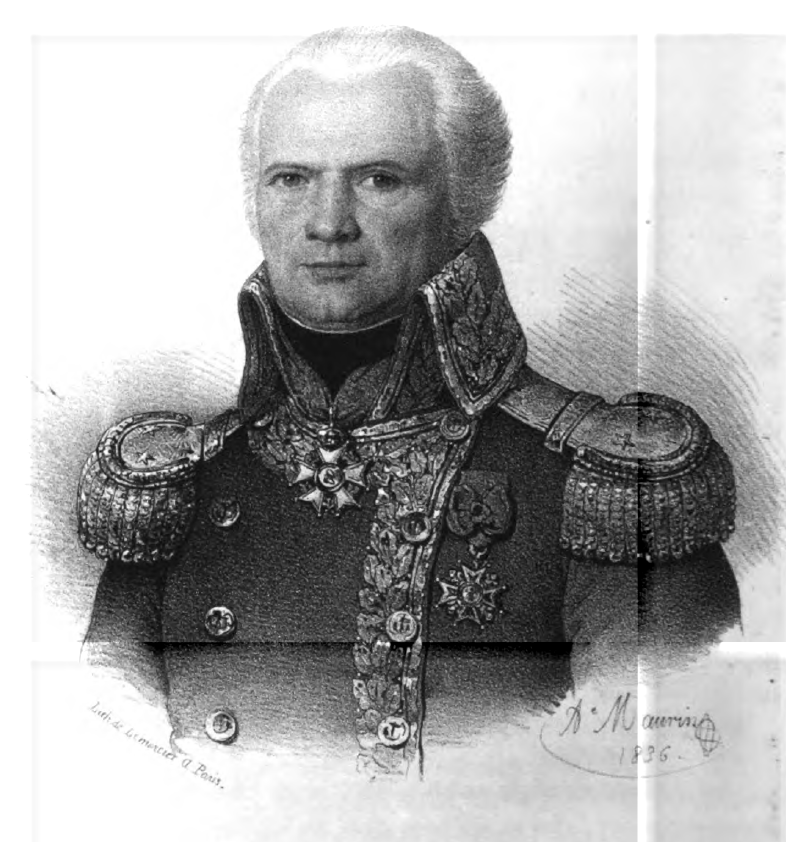
- the words and ideals proclaimed in Ballina, County Mayo, on the 23rd August 1798 - 225 years ago on this date - by French General Jean Joseph Amable Humbert, who had landed with 1,090 seasoned French troops (including 80 officers) at Cill Chuimin (Kilcummin) on the 22nd August.
Three expeditions to aid the 'United Irishmen' were authorised by the French Directory in July of 1798 ('In 1791, the newly installed French government offered military assistance to any group who wanted to overthrow their own King. This was very worrying for the surrounding monarchies of England, Spain, Germany and Austria..' - from here) and command of the first and smallest of these was given to General Jean Joseph Amable Humbert (pictured).
His small fleet of three frigates, under the command of Chef de Division André Daniel Savary, landed at Cill Chuimin (on August 22nd, 1798).
They marched by night across the mountains in torrents of rain (a distance of about 18 miles which, it has been estimated, would take maybe six hours to do on foot) and then a surprise attack at dawn ; and a masterly assault by General Jean Sarrazin (who later disgraced himself) on the British 'defenders' left flank gave warning of what was to come : brave Mayo men faced pounding artillery with nothing but pikes hammered out by skilled blacksmiths who had worked night and day for five days.
'Erin's sons be not faint-hearted
Welcome! Sing then Ca ira
From Killala they are marching
To the tune of Viva La!
They come, they come, see myriads come
Of Frenchmen to relieve us ;
Seize, seize the pike, beat, beat the drum
They come, my friends, to save us.'
To confuse the enemy further, General Humbert suddenly changed tactics - he launched his full reserve, and changed from closed formation to open file. Rising up in his saddle, and brandishing his sword, he gave the order, in Irish - "Eirinn go Brach!"
The drums sounded the 'pas de charge' and a blue line, now within a few paces of the British troops, regrouped back into closed lines and moved swiftly forward , their bayonets gleaming in the morning sun, a fierce and threatening determination in their countenances.
The famed army of the French Revolution was here in the fields of Mayo : veterans of many victorious campaigns on the continent, men who had endured much and who believed passionately in their cause. They had measured their enemy and marked them down as 'the defenders and upholders of tyranny and injustice'. The Sasanaigh and their Irish militias and Yeomen hesitated, and then turned their backs and fled in terror.
In Humbert's footsteps we commemorate today
in 1798 they came our way.
Arriving in three ships, the British flags flew
to conceal a plan that no British man knew.
At Kilcummin they landed, Irish pikemen joined the might,
and together they marched with Killala in sight.
The town was captured, Bishop Stock’s palace was made
the Franco-Irish headquarters where new plans were laid.
On August 23rd Ballina was the next plan,
between Moyne and Rosserk abbeys' the British, they ran.
The British we'll beat them, Érin go Bragh,
as they made their way to Béal an Átha.
They reached Ballina August 24th that morning,
but before the British departed they left a warning.
They captured Patrick Walsh and hung him from a crane,
the British departed, a United Irishman slain.
In Ballina the French marched through Barr na Dearg and Bóthar na Sop
with straw torches and a mattress, their way was lit up.
The people excited, a sight to behold,
as the flames of the night lit up buttons of gold.
From Ballina they left to Castlebar they go,
and marched through the mountains, a route the British didn't know.
Humbert captured Castlebar and the British they flee
in panic leaving behind cannon and artillery.
But at Ballinamuck Humbert faced a tough fight,
General Lake and troops behind him and Lord Cornwallis on his right.
The British overtook them, the battle no more,
many Irish were butchered, the French returned to their shore.
In memory of 1798, Ballina streets renamed,
Walsh, Tone, Teeling and Humbert who came to bring victory to Ireland, make her shores free,
to make her the ruler of her own country.
(Ann Marie Murphy, from here.)
'KEOGHBOYS OF THE 1950's...'
From 'The United Irishman' newspaper, April 1955.
Mr Michael O'Neill MP expressed his intention of exposing the "armed banditti" at Westminster ; it should be very beneficial to Ireland to let the Parliament at Westminster into the secret of what is going on in Ireland!
The Ballycastle business was even more hateful and would make any Irishman half worthy of the name blush with shame in front of the world. The account in 'The Derry Journal' newspaper states at the outset -
"Only a small number of extra of extra police (sic) were drafted into the town...", though there were 30 bands and a lengthy procession. They started by playing 'Faith of Our Fathers' and then mention was made of the death of Arthur Leonard by the chairman, Mr Hugh O'Donnell, who then stated that there was a limit to the patience of the Irish people and he thought that that patience was at breaking point.
It was up to Catholics to stand shoulder-to-shoulder and sink their differences as never before, he said - "right was might and would prevail". And that is the keynote of these sickening sycophants with their ferocious Catholicity and lack of Christianity ; they endeavour to keep the Catholic and Protestant people in Ireland at each other's throats... (MORE LATER.)
42ND ANNUAL HUNGER STRIKE COMMEMORATION FOR PEACE WITH JUSTICE : SATURDAY 26TH AUGUST 2023, 2.30PM, EAST END, BUNDORAN.
Organised by the 1981 H-Block Martyrs Committee of Bundoran/Ballyshannon, County Donegal.
On Saturday 26th August 2023, the Bundoran/Ballyshannon H-Block Committee will be holding a rally in Bundoran, Donegal, to commemorate the 42nd Anniversary of the 1981 Hunger Strike and in memory of the 22 Irish republicans that have died on hunger strike between 1917 and 1981 ; those participating have been asked to form-up at 2.30pm at the East End.
All genuine Irish republicans are welcome to attend!
Unseen Sorrow. (By Bobby Sands.)Her tears fall in the darkness as the rain falls in the night,
silvery tears like silvery rain, hidden out of sight,
the stars fall from her eyes like floating petals from the sky,
is there no one in all this world who hears this woman cry?
A simple little floating dreamy thought has stired this woman's heart,
the golden sleepy dream of yesterdays before they were apart,
what comfort can there be found for a petal so fair and slim
alone in a forest dark of sorrow she weeps again for him?
Warm silver rolling tears blemish a once complexion fair,
that once shown in the fairest radiance midst a cloak of golden hair,
and the children whimper and cry for a father's care
and love they've never known.
Who sees their little tears of innocent years,
as the winds of time are blown?
What sorrow will you know tonight,
when all the worlds asleep,
when through the darkness comes the wind
that cuts the heart so deep.
For there is no one there to dry your tears,
or your children's tears who cling around your frock,
when there has been another bloody slaughter,
in the dungeons of H Block.
Saturday, 26th August 2023, 2.30pm, East End, Bundoran, County Donegal.
IRELAND ON THE COUCH...
A Psychiatrist Writes.
'Magill' commissioned Professor Patricia Casey to compile an assessment of Irish society at what may emerge as the end of a period of unprecedented growth and change.
This is her report.
From 'Magill Magazine' Annual, 2002.
Further proof that our young people are drinking to excess comes from the fact that there has been a 300-fold increase in the number of teenagers being treated for alcohol-related disorders in our psychiatric hospitals over the past three years.
Garda figures for 1999 show that almost 4,500 young people came to their attention for drunkenness, an increase of 1,300 in two years.
Lederman in the 1960's identified a close association between the per-capita consumption of alcohol and dependence and, on that basis alone, the up-and-coming generation is likely to be afflicted by an epidemic of alcoholism unless a pattern of more responsible consumption emerges.
In spite of this, we seem unconcerned at proposals to liberalise our licensing laws, and opening hours have already been extended without a whimper in order to benefit the tourist industry... (MORE LATER.)
ON THIS DATE (23RD AUGUST) 65 YEARS AGO : IRISH TRICOLOUR + RUC = BEING SHOT DEAD.
Internment under the 'Offences Against the State Act' was enacted on the 4th July 1957 and, by October 1958, there were 141 detainees in the Curragh, with morale being described as 'very low'.
A total of 206 internees were detained by the State in that Camp, all of whom had been released by March 1959, as the State administration considered the IRA to be a spent force and the latter's political, military and paramilitary colleagues in the Occupied Six Counties were of the same frame of mind, to the extent that the pro-British 'police force' in that part of Ireland, the RUC, felt secure in declaring that they had a top-level informer in the IRA leadership, whom they codenamed 'Horsecoper', and had it on his/her information that the IRA had 455 members in Dublin and about 500 members in the rest of the Free State.
However, 'demoralised/a spent force' or not, both British-established administrations in Ireland - Leinster House and Stormont - were still attempting to 'put the boot in' on republican activity and continued to operate 'Most Wanted' lists, where those named on same would be seized on sight, or worse.
One man that that British 'police force' were particularly interested in was James Crossan, a native of Baunboy in Cavan, and a prominent Sinn Féin organiser (and IRA intelligence officer and active member of the Teeling Flying Column) in the border area.
On Saturday, 23rd August 1958 - 65 years ago on this date - James Crossan and one of his neighbours, Seán Reilly, were in a van on their way to Swanlinbar, in Cavan - only a stones throw from the British-imposed 'border' with Fermanagh - to collect a flag and finalise details for a demonstration to be held the next day (Sunday August 24th) in Ballyconnell.
Having done their business in Swanlinbar, the two men, and a local youth and Sinn Féin member, Ben McHugh, decided to go for a pint ; in the pub they met up with two friends from County Fermanagh.
Near the end of the night, the barman, Thomas McCarron, asked James Crossan's friend, Seán Reilly, if he would drop him and the two men from Fermanagh to the border, to collect a van belonging to one of the men, Glover Rooney, a cattle dealer from Kinglass, Macken, in County Fermanagh (the other man was Stanley Moffat, a sergeant in the B-Specials!), and Reilly agreed.
He parked his van about 100 yards from the border and about 300 yards from Mullan British customs post in Fermanagh ; James Crossan and the young McHugh got out with the three northerners and all five walked towards where the van was parked, near the border. With the few drinks on him and the time of the day it was - about 3am - Seán Reilly fell asleep in the van.
The sound of gunfire woke him and flares lit-up the sky around him; he got out of the van and saw two RUC men about 30 yards in front of him - they were running towards the British customs post. It later transpired that the five men (Crossan, McHugh, the barman and the two Fermanagh men), all unarmed, parted company on the Cavan side of the border at about 3.30am and, as Crossan and McHugh were walking back to the van, Crossan, 26 years of age, was shot dead by a group of RUC men who had positioned themselves on the southern side of the border.
Ben McHugh was arrested, and Crossan's body was taken to Enniskillen. The RUC claimed that they had come across an IRA reconnaissance mission of Mullan British customs post, which was a total fabrication ; at the inquest (held in Enniskillen) no witnesses were called and no attempt was made to investigate the circumstances of the shooting. The coroner simply justified Crossan's death as "justifiable homicide".
James Crossan was given a republican funeral and was buried in Kilnavert Cemetery, County Cavan, on the 26th August 1958.
When the fairy-like dew, the grass is adorning,
a volley rang out without any warning,
a young man fell dead in the cold grey of morning.
God bless you, God rest you, James Crossan from Bawn.
Forget not this young man, so gay and so cheery,
in working for Erin, he never grew weary,
But he'll toil never more round his own loved Clonleary.
God bless you, God rest you, James Crossan from Bawn.
There's no sleep for the Specials, they're tumblin' and tossin'
they are haunted with fear, every man every gossan,
for they'll pay for it yet, those who murdered James Crossan.
God bless you, God bless you, James Crossan of Bawn. (From here.)
'IN ANSWER TO CHURCH AND STATE AND IN DEFENCE OF IRISH REPUBLICANISM...'
Address to the Annual General Meeting of Comhairle Uladh (Ulster Executive) in Cootehill, County Cavan, on Sunday, November 22nd, 1987, by Ruairí Ó Brádaigh, Uachtarán, Sinn Féin Poblachtach.
Comhaírle Uladh AGM, November 22nd, 1987.
A Papal Rescript against the Fenians was sought by English diplomacy and obtained at the First Vatican Council in 1870, and the 'Plan of Campaign' in the Land War was condemned from Rome in 1886-7.
But it took until 1987 to witness the spectacle of the porch of a Catholic Church being turned into a British Crown Forces barracks through the distribution therein of leaflets calling on Irish people to become informers to the British against their fellow-countrymen and women.
A statement ordered to be read at all Masses in Ireland on Sunday, November 15th, condemned not all violence, including British and loyalist, but only "republican violence" ; the violence of the oppressor escaped censure or even mention while the physical resistance of the oppressed was alone declared to be evil.
A call was made for support for the "police forces" North and South, which includes the RUC and, by extension, the UDR and the British Army...
(MORE LATER.)
Thanks for the visit, and for reading,
Sharon and the team.